The Recipe Book (…and the very few recipes inside)

This week, I have chosen to continue discussion of my grandmother’s recipe book, although I feel that its function and usage, as well as chain of ownership, are not exactly groundbreaking. Obviously, it is a recipe book, with “Recipes” clearly stamped across the cover. Unfortunately, there is practically no information on the book whatsoever about its original manufacture other than the words “Made in Hong Kong” in type font on the inside of the back cover, so I cannot be certain about what company may have produced it or the year that it was made. I would not even know how to begin an attempt to discover the manufacturer or its manufacture date with so little data to go on, especially if it was a recipe book that was mass produced during the time period in which my grandmother bought it.

I asked my mother when my grandma may have bought the recipe book and she was unsure, but she estimated that it was probably bought in the 1970’s “judging by the recipes in there.” This implied, to me, that my grandmother only began to write her recipes down after my mother, the youngest of five girls, was born in 1967. Perhaps she had never had time before then to put her recipes on paper, but had been making these desserts and cookies for years; maybe she had never truly explored baking until most of her children were grown and had moved out. I am not sure, and these are questions I will pose to my aunts when I next get an opportunity. My grandmother passed away in 2005, meaning that she likely had this recipe book for approximately 30 to 35 years before my mom took ownership of it.

What is so interesting (and a bit funny) to me is that if my grandmother really had this book for so long, she wrote down very few recipes in that time. My mother and I, of course, treasure the book (my mother more so than me, as it belonged to her mother), but it only contains a grand total of twelve recipes, two of which were written in by my mom, probably after my grandmother had already died. Objectively, this may not seem like an item that would have intrinsic value based on what its function should be: a recipe book with only twelve recipes in it? Yet I cannot explain the deep connection that my mother and I both feel to it, and the sorrow we would both feel if it were to fall apart or become lost.

I cannot say that the book’s use has changed all that much over time, except that perhaps we utilize it now only to make some of the recipes inside rather than continuously adding more recipes, so I suppose it has taken on a bit of a decorative quality. I enjoy baking and cooking, but am by no means an expert. My mother has not added any more recipes in years, and I had never even considered writing in the book despite the fact that a majority of it is empty, the blank yellow pages practically begging to be filled in. I still feel quite odd about the idea of adding anything new, as if it would decrease the sentimental value of the object or as if it would be, in some way, sacrilegious. Maybe one day when I feel ready and as if I have something worthwhile to contribute, I will write in the recipe book, but for now I am content with taking it out of its place on a shelf in the dining room a few times a year, baking my grandma’s gingerbread cookies for Christmastime or making her apple crisp on a whim.

A Hoosier Hutch

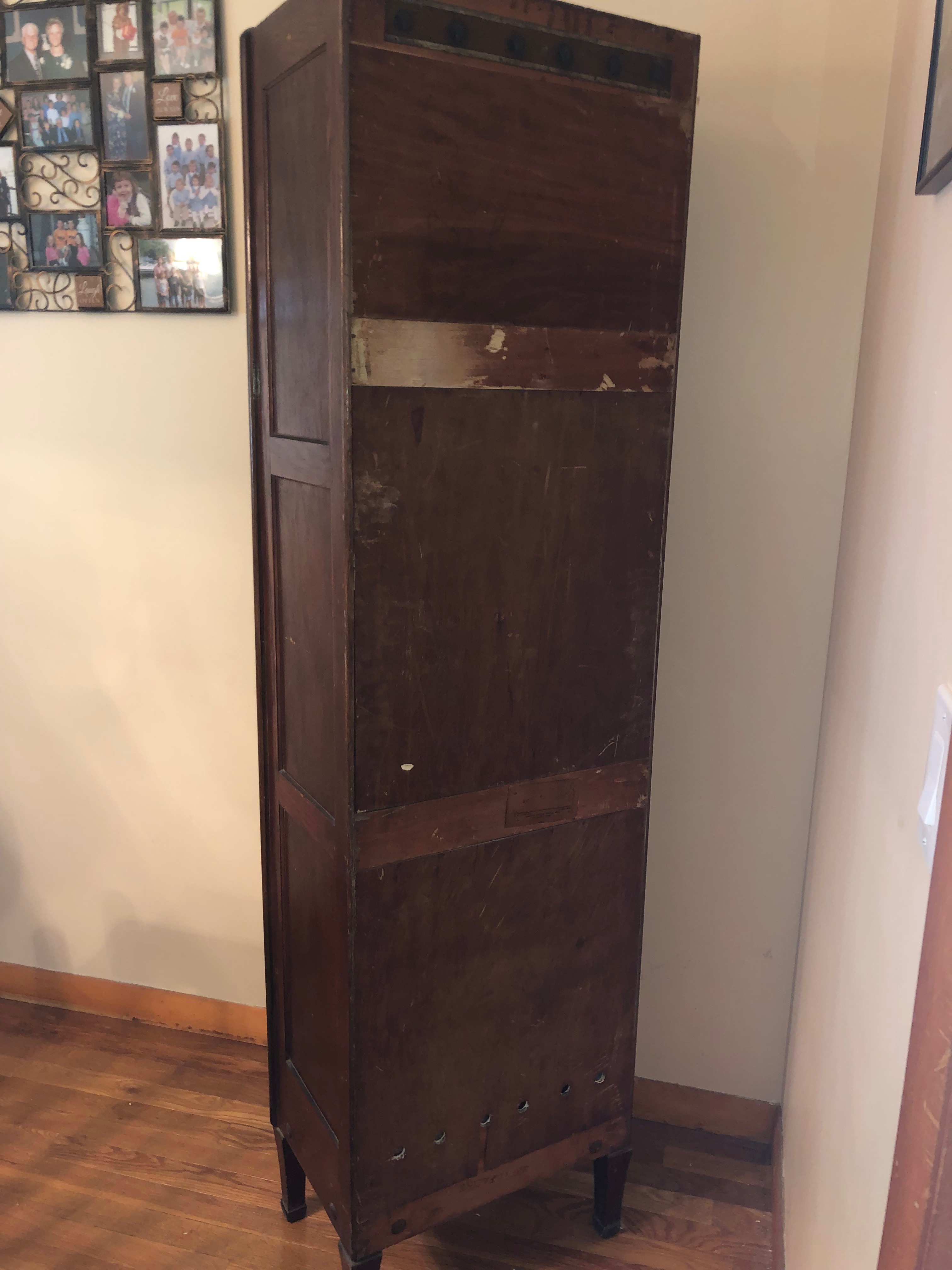
The item I have chosen to follow its chain of ownership within my family is a Hoosier stand-up hutch or cabinet, that I had no idea had been in may family for so long. This hutch belonged to my great-great-grandparents, who gave it to my grandfather, who we inherited it from when we moved into his house after he passed. I was able to go home this past weekend, and this is how I stumbled upon the idea of writing about this hutch. I was talking about family items with my parents, and we all happened to look at the hutch and say something different about it. I immediately knew that the story behind our dining room hutch would hold a lot of value, and that it would be a great item to trace back in history for four generations.

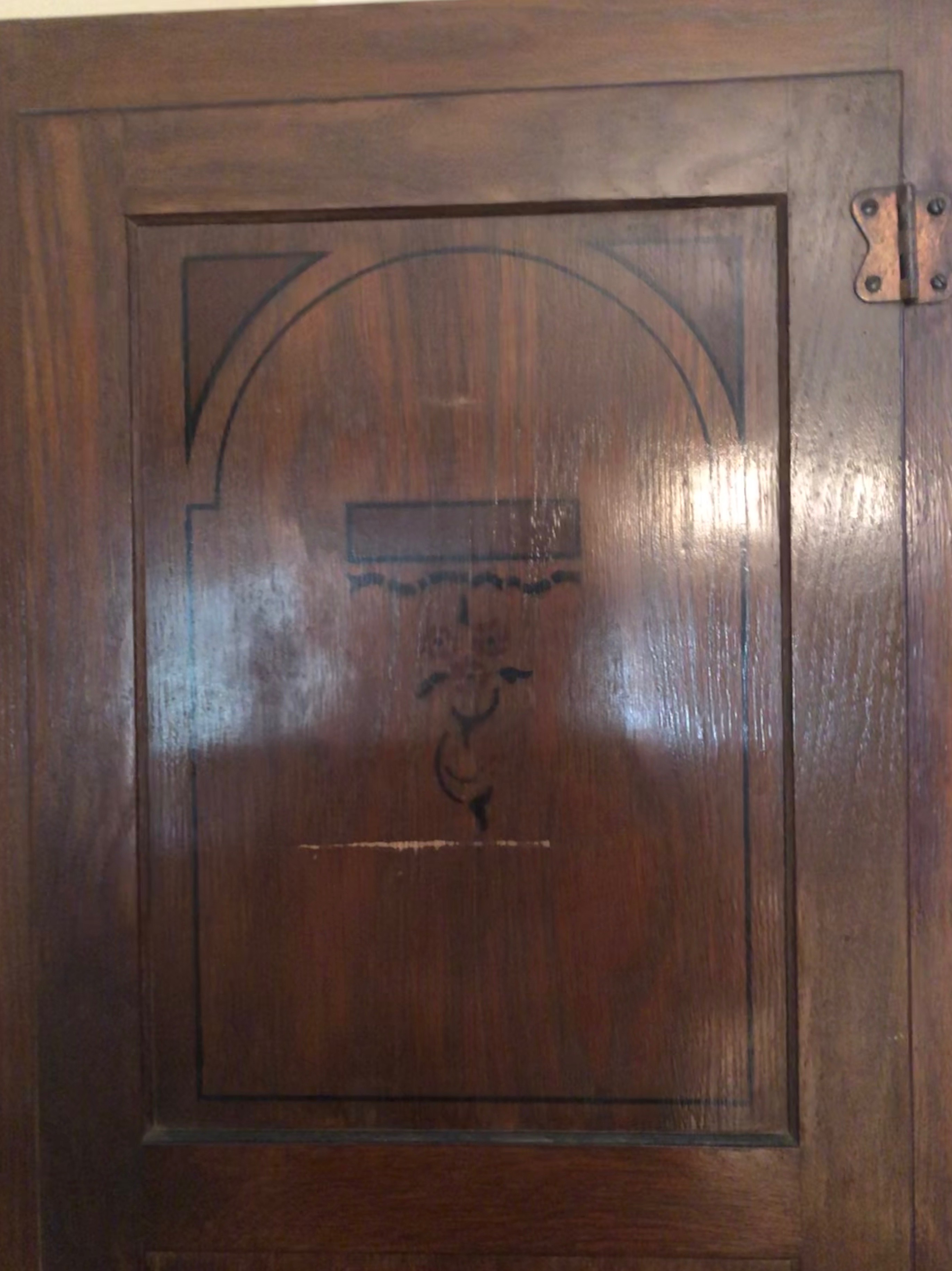
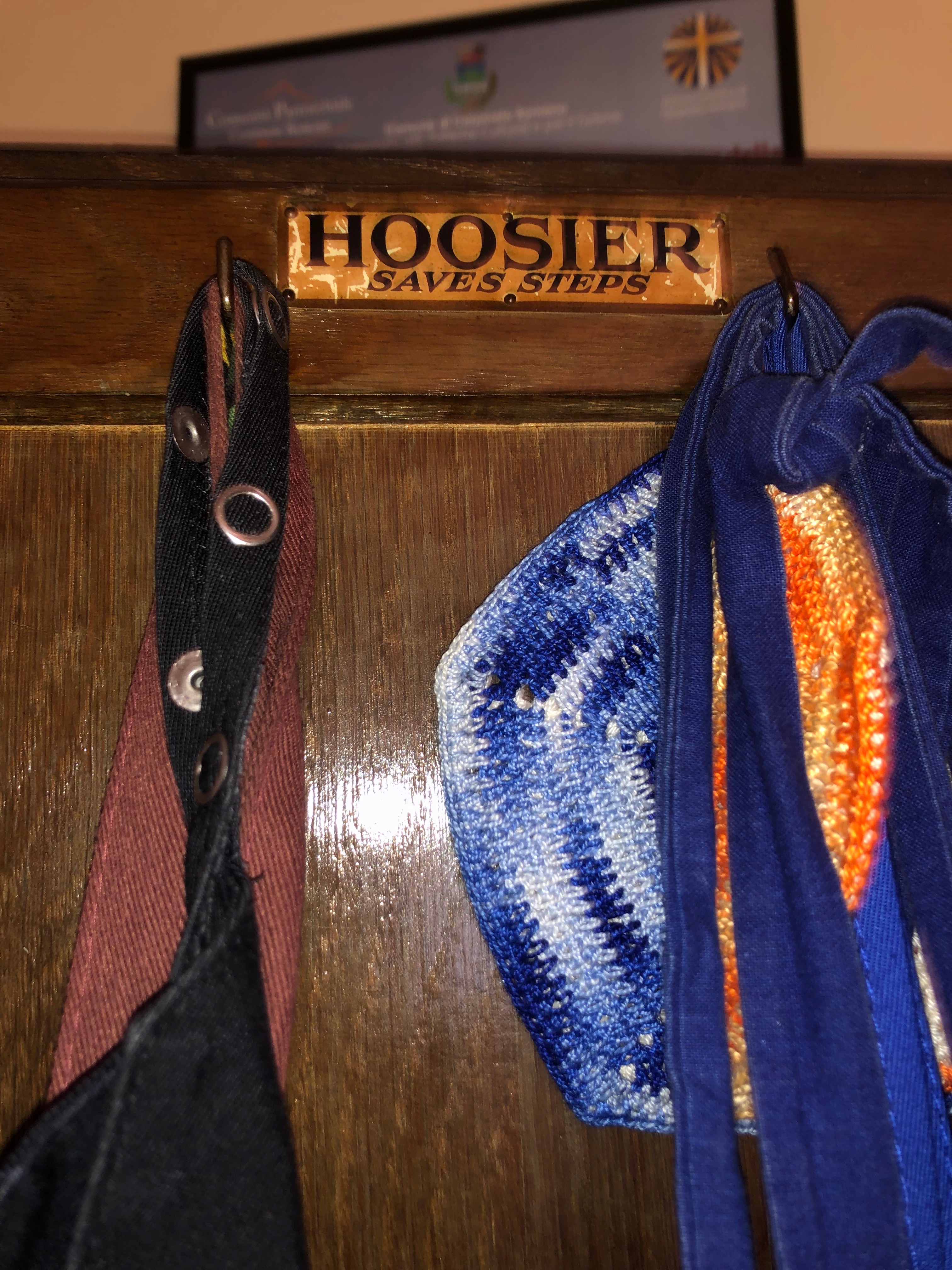
This Hoosier kitchen cabinet was manufactured by the company in New Castle, Indianna. When researching more about this brand and company, I found that our model is a bit different from the standard model that was popular during the time. The standard Hoosier model was a stand-up kitchen cabinet with a work station attached to it, so that one could store items, and prep meals all in one functional place. Our cabinet, is simply just that; a cabinet. It has five cream colored shelves, and storage options on the inside of the door. It has a darkly stained exterior, with some intricate details on the front of the hutch. It has small holes in the back, so that air can move in and out, and items don’t become stale. Hoosier cabinets quickly became staple items in many households, so I was a bit surprised that I could not find more information about other cabinet models like the one I have. There could be many explanations for this, for example maybe my great-great-grandparents purchased this style before the brand became popular, it could have been given as a gift to them, that for them this style was the most logical, or maybe sometime over the years they altered the cabinet.

Some of the details, including a floral pattern

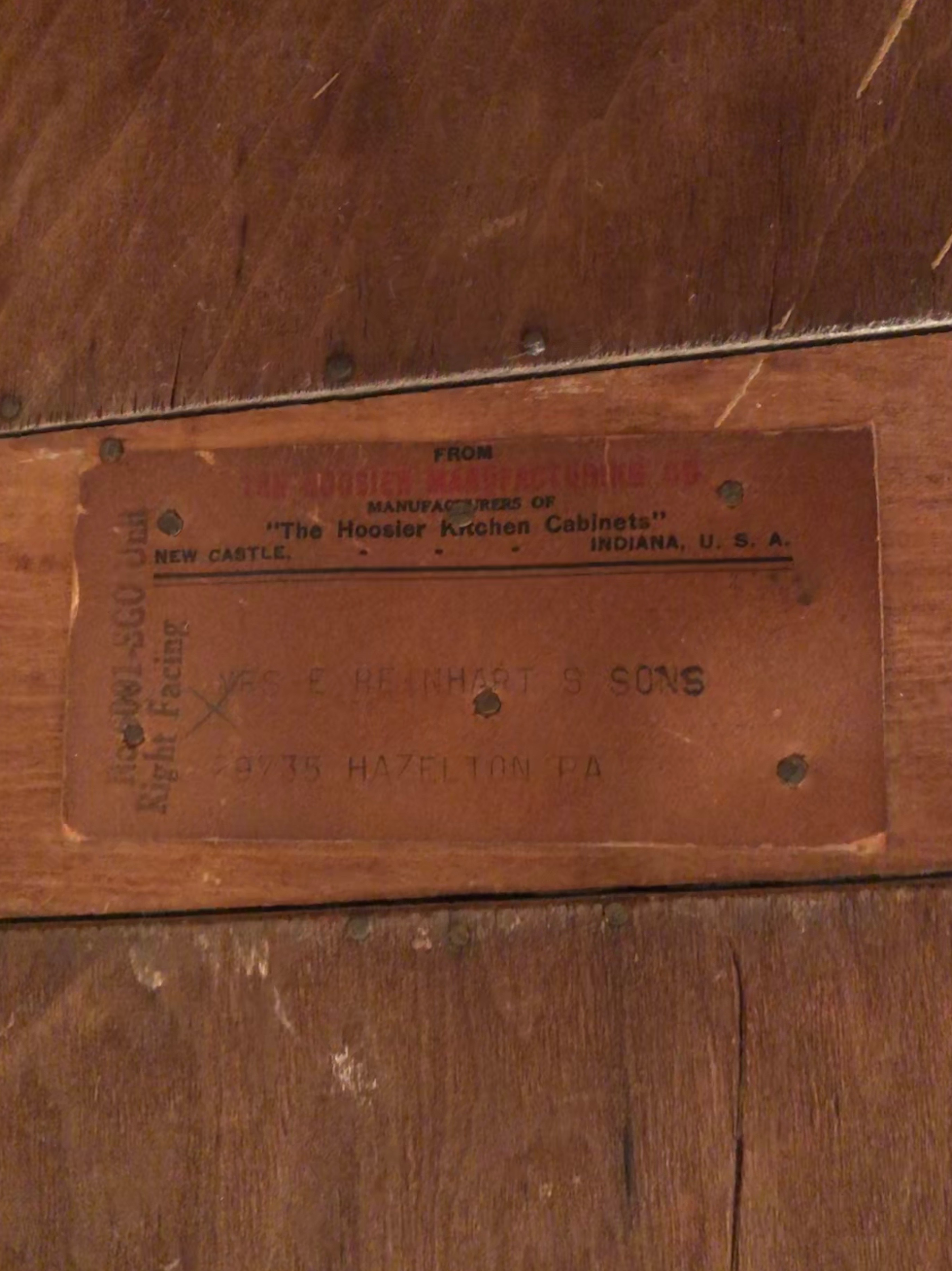
Any of these explanations could be true, but I do know for sure that the use of this cabinet has changed a lot over its time. While I have no way of knowing exactly what my great-great-grandparents used this hutch for, I do think that their use of it was representative of the time. On the label on the back, is my great-great-grandma’s address, where the hutch was shipped to after its manufacture. I am thinking that she used it as it was designed, for kitchen storage of items like baking supplies and spices.

My Great-great-grandmother’s address on the back

Somewhere in this cabinet’s lifetime, it was moved from its home in Hazleton, Pennsylvania, to Endicott, New York. Which is where it has stayed for the past two generations. This was passed down from my great-great-grandparents and given to my Poppa, and the time in between I am unsure who’s possession it remained in, or if it ever changed place or function. When this was given to my Poppa, he kept it in the basement of the house, and used it to store his tools. This is where some of the purposes of this cabinet change, as it has left the kitchen, and now been altered. To organize some of his tools, my Poppa drilled holes in the sides of the cabinet from which to hang things.

The hole in the center at the top, was drilled by my Poppa to hang his tools from

After the passing of my Poppa, my family and I moved into his house, to keep it in the family. Therefore, my house is full of family items and can even be considered one in and of itself. Since this is my mother’s childhood home, we have kept a lot of things the same, only changing those things that no longer serve us, like paint colors and carpets. Since my mother has had it, she has kept it in our dining room, and used it as a baking and spice cabinet. When discussing the hutch, she mentioned how she remembered cleaning the cabinet of my Poppa’s tools and how she and my father brought it upstairs. Growing up, I had no idea this hutch had been in my family for so long, and that it held so much significance. I’m glad I was able to discover a new family object, and trace its lineage over time, and now I hope that one day this cabinet can be found in my own dining room, where my future family will see it.


These Gloves Were Made for Boxing

I have always been interested in fitness and finding new ways to stay in shape. One of the more recent workout trends I have picked up in boxing. This has been by far my favorite one to be a part of. Although more difficult to pursue now that I am away at college, I still will shadow box or spar at any time I can. I have always been interested in watching movies and fights on boxing. From Muhammad Ali to Joe Frazier and George Foreman fighting till what looked like death in the ring. I was glued to the screen watching these gruesome yet legendary contests of endurance, persistence and character.

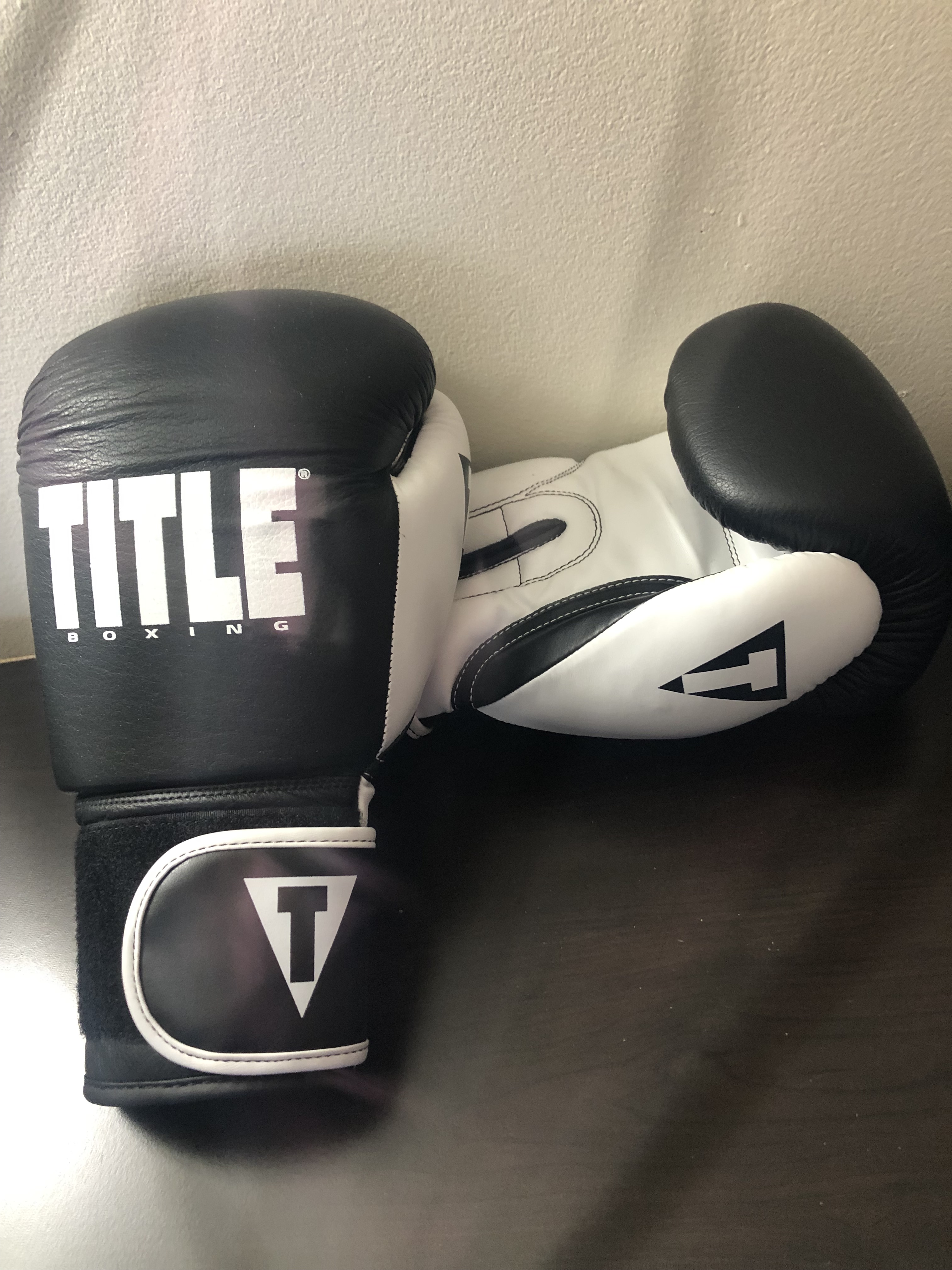
My first pair of gloves

These gloves have definitely seen their wear and tear, taking part in hundreds of workouts. They have helped me become stronger both physically and mentally. They serve as a protection for my hands while also adding some weight to supplement a workout. I have used them to help others become passionate about this sport while also feeling the benefits. This stress relieving, confidence boosting activity is something I could not do without my gloves.

My gloves have sat on my dresser since I have picked up this hobby. Their may purpose may be to fight however, I keep them out as a reminder. The ones I have out are my first pair and definitely not my last. I remember the first day I used these gloves and how powerful I felt after the workout. I remember breaking in the leather slowly till these gloves became made for my hands. Most gloves are made the same size and weight when used for workout purposes. So, when I broke them in to fit my hands it felt more personalized. They may all look similar but, it was important to me to have my own pair.  The ones made for sparring and fighting vary slightly.

I have always used Title boxing wraps and gloves since that is the gym I started at. However, I never knew the history behind this until now. The brand and gym locations itself were developed only in 2008 in Colorado and has spread to all over the world since. I don’t believe the brand has as much as a meaning as the history behind boxing and the purpose of using gloves.

Boxing gloves have always served the same purpose since they were created. These gloves main purpose are for hand protection for fighting. They have been dated back all the way to 650BC. However since the mid 1800s, the style has not changed much. Although my more modern ones contain velcro unlike the classic models you lace up. You still get the same satisfaction and leathery smell with every wear. The models have varied and developed based on practicality and rules and regulations of fighting. The purpose of protection and as a weapon has remained the same.

Earliest representation of boxing gloves

My 12 oz classic black and white Title boxing gloves are a great addition to my dresser. They serve as a reminder of my strength and reminder to keep fighting. What I have always noticed about the fighters I have looked up to in and out of the ring is that they always get back up and keep fighting. We all have fights in our own lives and we must keep punching through.

My Crystal Pendant (So New Paltz!)

I chose to discuss a new object for this week’s discussion. My Amethyst crystal necklace has become a staple of my wardrobe over the past year and a half.

I purchased it two summers ago at “Hippies, Witches, and Gypsies”, a self-described “eclectic” shop in Troy, New York.

Image result for hippies witches and gypsies
A very New Paltz-esque store

I am the first owner of this Ameythst pendant, but the chain it hangs on belonged to my mom; it was once used to hang her favorite cross. When I wear the pendant I am thus able to carry a bit of my mom with me wherever I go.

my pendant&my mom’s chain


Since the gemstone on my necklace was not always a piece of jewelry,  I did a bit of research on how Amethyst crystals are formed. Most of the Amethyst found today was formed between 130-150 million years ago from ancient lava fields. As the lava cools, several pockets are formed which trap gasses and water inside. Crystals are formed over time within these pockets. If Iron or Manganese is present during the crystal formation, the clear quartz crystals will turn purple–thus creating Amethyst crystals. To transform the stone into a piece of jewelry, the stone is generally cleaned with soap and water, ground and shaped with a Dremel tool, sanded, polished, and then wrapped with wire.

The stone has been expertly shaped

I’m not religious, but I am a very spiritual person–so certain “metaphysical” objects, like crystals, are deeply important to me. I have a small collection of crystals that I keep by my bedside–all with different meanings and purposes–but the Amethyst is the only one I wear on my body. The crystal is generally associated with physical and mental healing, protection, and stimulation and soothing of the emotions.  Amethyst has served several purposes throughout history. It was worn by travelers as protection from treachery and surprise attacks, kept soldiers from harm and granted them victory over their enemies, lent assistance to hunters, and was considered a powerful psychic stone of protection against evil forces. It was also believed to protect its wearer from disease and contagion. In the spiritual world, Amethyst provided a connection to a greater being. To the Hebrews, it served as the ninth stone in the breastplate of the High Priest, as well as the twelfth foundation stone for the New Jerusalem. To the Egyptians, it was listed in the Book of the Dead to be carved into heart-shaped amulets for burial. In Eastern cultures, it was used in temple offerings for worship, and to align planetary and astrological influences. It was popular in rosaries and prayer beads, credited with creating a calm, meditative atmosphere.

It may be a classic case of confirmation bias, but when I wear my amethyst pendant I really do feel calmer, more focused, and generally more in tune with myself and the world around me. It’s become a prized object of mine, and one that I feel deeply connected with. I once left my coin purse, which was carrying the pendant, on a Trailways bus and assumed I would never see it again. Three months later, I received a call out of the blue from the bus station in town saying they had found the purse. I like to think the pendant found its way back to me. Since that day, I’ve taken special care of the necklace and hope–regardless of the validity of crystal lure–that it’s doing the same for me.

https://www.crystalvaults.com/crystal-encyclopedia/amethyst

Necklace? Ring? Same Thing.

The object I have chosen to discuss for this blog post is one that is very near to my heart, quite literally.  It is a necklace that I have worn every day for over a year now. I have taken it off less than five times since the day I first put it on, one of those times being a few minutes ago while taking photos of it for this post.  When I first began wearing this necklace, I had no clue that it held and historical family value. I found it in one of my old jewelry boxes while looking for a new necklace to wear.

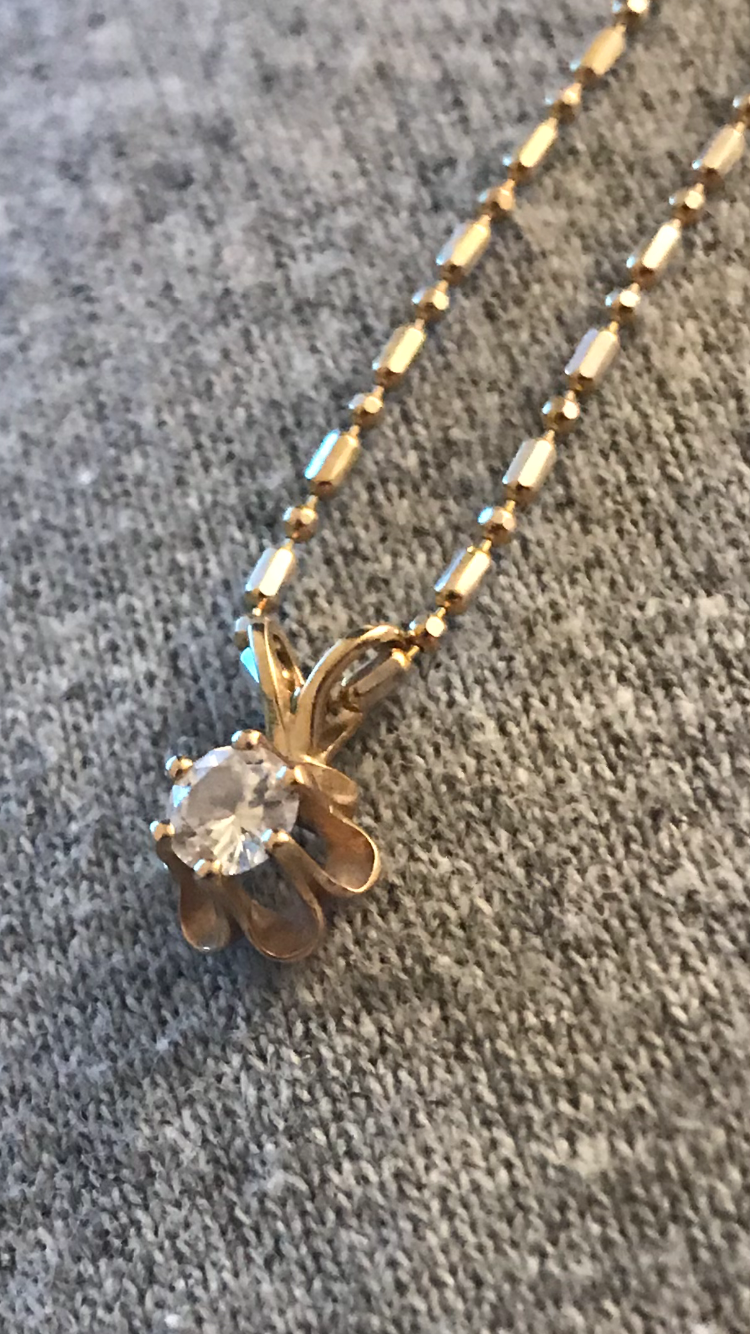
The necklace I currently wear every day.

When I was younger, I had a bad habit of hoarding necklaces that I would never wear.  About three years ago, I decided that I would only wear one necklace and that I would not take it off or replace it until it either broke or began to tarnish, or a year had passed.  I would keep the necklace on at all times, even while exercising, swimming, or showering. I knew that if I were to remove it, even briefly, the likelihood of putting it back on would be slim to none.  I had successfully worn two necklaces to the breaking point before wearing the one pictured, a gold colored necklace with a unique chain made up of shapes similar to cylinders and spheres, though more angular and connected by pieces of chain so thin they sometimes appear to be floating.  The charm is gold colored and resembles a flower, with the center being a small stone that I assumed was cubic zirconia. This necklace originally served the function of being worn until it breaks to prevent myself from purchasing any more necklaces.

My necklace continued to serve this purpose until a day in July this past summer.  I was wearing it, as I had for nearly seven months at that point, when my grandmother said “I love that you always wear that necklace”.  She said it in a way that made me curious, what was so special about this necklace? I’ve had it for years and it had just been sitting in a box.  I inquired further and my grandmother revealed that she had given the necklace to me when I was very young and that not only were the gold and gem real, but that the gem was originally a part of her engagement ring.  She at some point several years ago had had the ring reset and a gem was removed. She had it made into a necklace for me, her oldest granddaughter.

I do not know where exactly she had the necklace created.  I would guess that it was at a gold jeweler in New York City, as I remember going there with her and my mom as a child.  I was not there when the necklace was made, but I remember my grandmother telling me that it was her favorite jeweler and that she went there for most of her jewelry needs.  The clasp of the chain has some markings, but I think they are to show that the necklace contains a certain amount of gold. They do not seem to indicate any one specific jeweler.

I had no idea that this necklace that I continue to wear around my neck everyday has so much family significance.  In that moment, the necklace took on a new function. It now serves as a reminder of the love between my Grandma and Grandpa that has survived for over 50 years.  On my Grandma’s eighteenth birthday, she moved out of her childhood home. My Grandparents got married a few days later. I know consider this necklace symbolic of my grandparents love and it often serves as a comfort to me.  I have a habit of playing with it when I am nervous, by holding it, I am reminded of its origins and I smile.

This necklace has changed my routine of purchasing a necklace once a year as well.  It is very well made and I intend to wear it for a very long time. I have mentioned in class that my family does not have heirlooms, however, I hope to one day pass this necklace down to my own children.

Wooden Camera

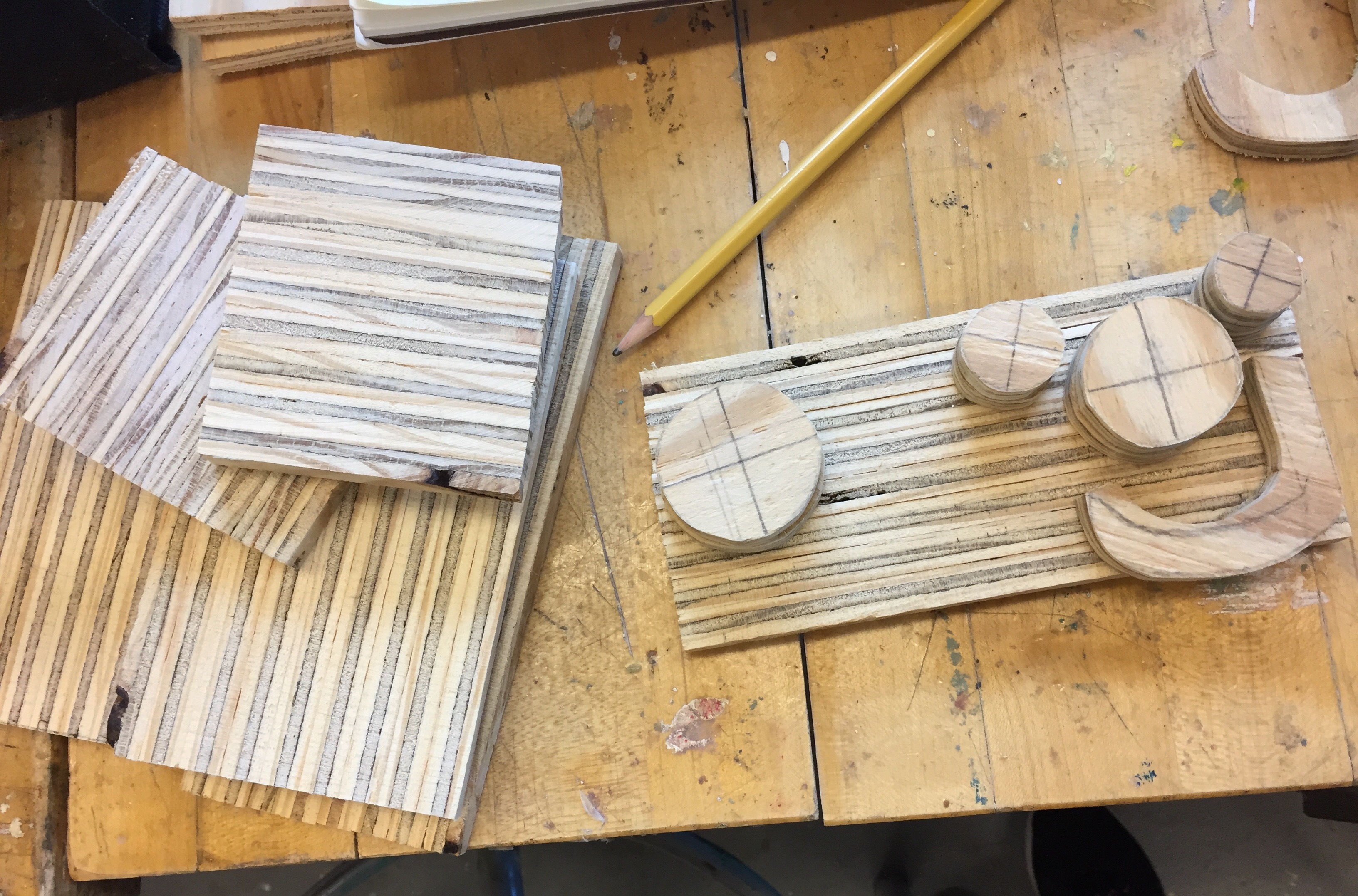
Pieces to the bigger picture

In my freshman year, my sculpture professor asked the class to make a box using plywood. We had to construct a container that could hold any object we wanted but there was a catch. There had to be a relationship between the vessel and its contents. We were provided with plywood, wood glue, nails, screws and clamps. I ended up making a wooden camera with a handmade camera roll with my freshman year memories. I wanted to make a camera because I have always loved the idea of capturing memories in a tin box for the future. My wooden camera had the New Paltz school logo on the outside so it could be a merchandise bought at the bookstore and the inside had pictures from my first year here. The relationship was the memories and friendships that college helped to create. I started making the wooden camera in early November of 2016 and was able to finish it within a week.

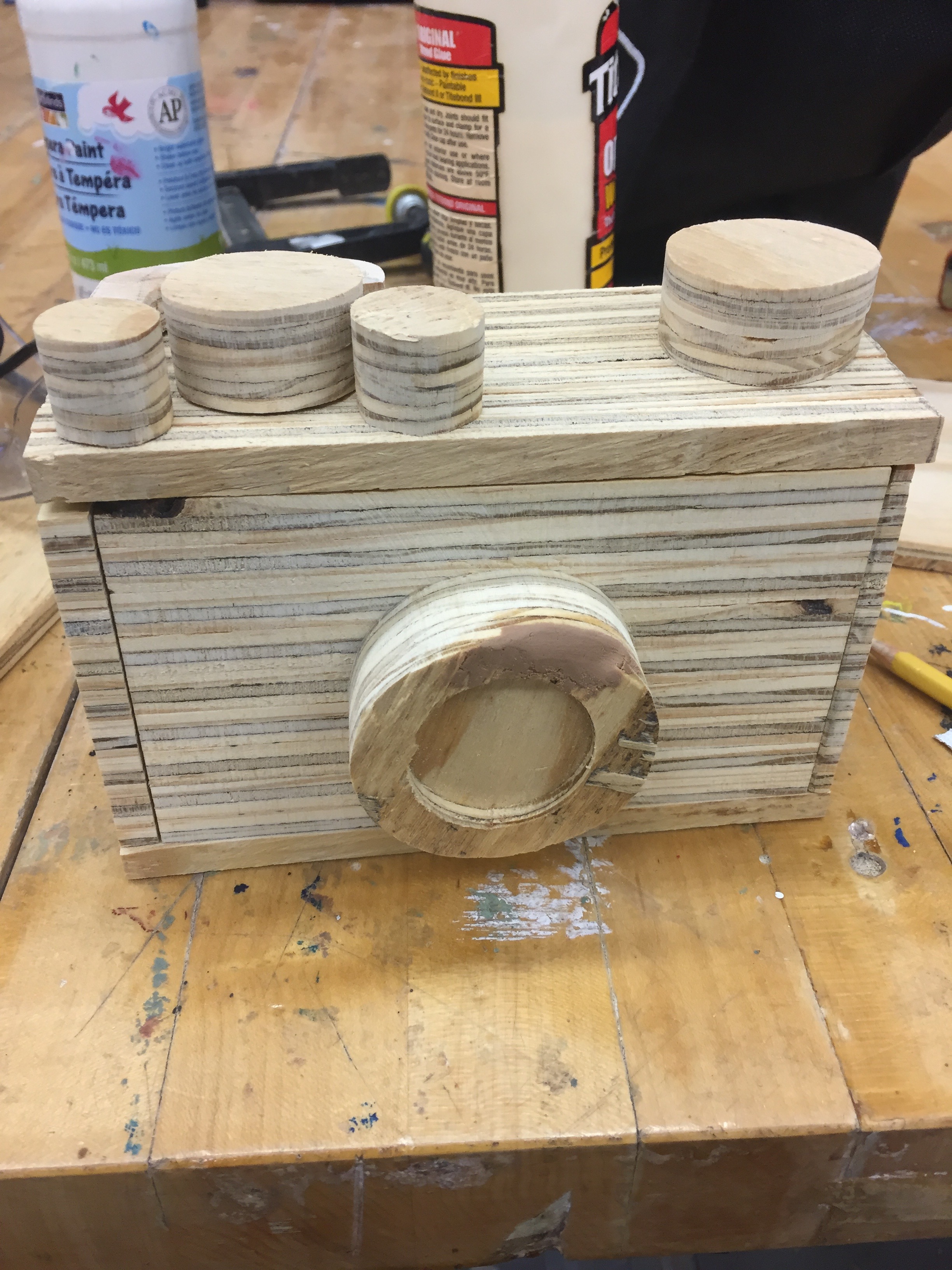
Finishing touches

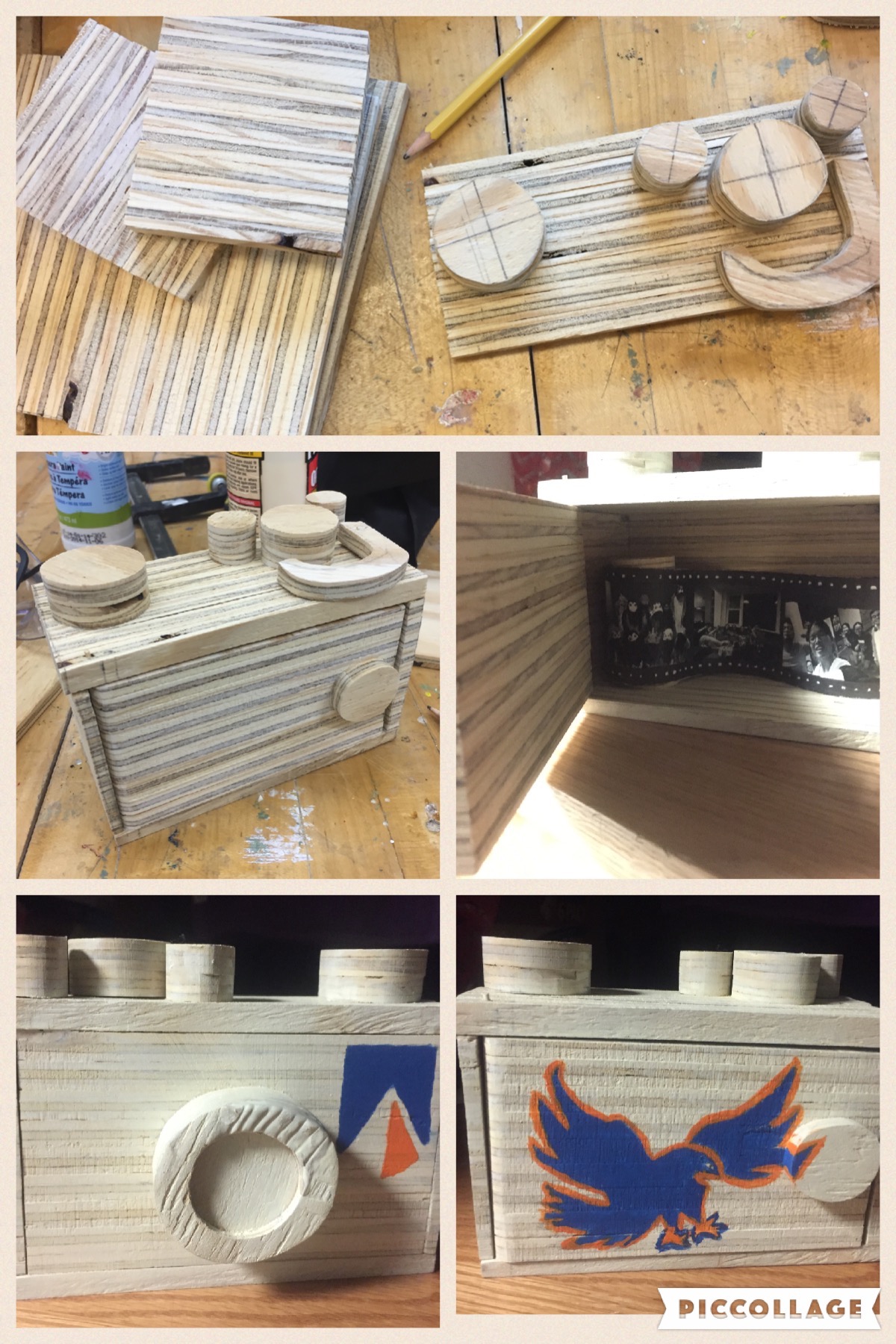
I started by cutting out individual plywood to be measured into nine layers and attached by wood glue. Then I measured out the sides and the pieces that will eventually go on top of the camera. I wanted to recreate a camera from the older generations because I have always liked dark room photo development. After assembling the proper pieces and gluing them down, I painted the hawk on the back and the New Paltz logo on the front right hand corner. Sanding down each of the sides and crevasses took a lot of time. I wanted the camera door to have an ability to open and close so viewers could see the handmade camera roll on the inside. With the help of my professor, I was able to drill a hole into the thin wood and insert a toothpick that would help the door swing open and close. Then, I printed out some photos in black and white and colored it to make it look like a camera roll.

Final product 🙂

Originally I had planned to keep it in my room as decoration because I had put so much work into it and I couldn’t just throw it out. However, I ended up giving it to my old photography teacher who inspired me to love black room photo development. I went home during winter break and I gave it to him as a gift. He inspired me to go to New Paltz to pursue education and art, but when I got here, I learned that I couldn’t do both without spending an extra year. I haven’t had a chance to visit my art teacher since freshman year but I hope it continues to inspire others to pursue their dreams too.

In Depth Analysis of the 1907 Silver United States Barber Dime

Expanding on my discussion of the 1907 Silver United States Barber dime, I decided to research how the value people place on currency shifts over time. In my last blog post, I discussed the role of the Barber Dime in early twentieth century American society: purchasing consumer friendly goods which helped make life more comfortable. While a dime produced in 2019 may not hold as much value as a fifty-dollar bill, a dime to destitute families one hundred years ago meant placing another meal on the table, buying coal to heat a tenement apartment, and sending letters to relatives. One person I know who still places immense value on a dime is my one-hundred-year-old great aunt. Growing up in a tenement building in New York City without a father and six other siblings, my great aunt was instilled with the virtue of appreciating any value of currency. Whether she earned a couple of pennies delivering bread for a local bakery or a few quarters hand sewing clothing, she knew any amount of money helped my great grandmother in supporting their family. Even though this type of appreciation for smaller currency may not be as common in younger generations, I would argue that this appreciation still exists, but it has shifted to larger standards of currency – twenties, fifties, and one hundred-dollar bills.

Over the course of one hundred years, the Barber Dime’s function in society has shifted, transitioning from daily currency to a rare collectible. While I realize the Barber Dime I found was being used to purchase a snack from a vending machine, most of these coins are not used for daily expenditures. According to the Littleton Coin Company’s website, a Barber Dime, if kept in good condition, can be sold at auction for $16 (1907-S Barber Dime 1). Even though this may not be a significant amount when compared to other rare coins, it shows how the dime has only gained value in the antique coin market, indicating that the Barber Dime’s role has shifted towards a collectible item.  

As discussed in my previous blog post, the Barber Dime was originally manufactured in 1907 in the San Francisco Mint, where 3.1 million copies were produced (1907-S Barber Dime 1). The designer Charles E. Barber, the sixth Chief Engraver in the United States Mint and the individual who the dime is named after, drafted and approved the design for the coin (1907-S Barber Dime). Past this information, I unfortunately do not know anything else about the Barber Dime. I do not know if the currency was abandoned after the establishment of the Federal Reserve, or whether the relationship between circulation and time of the coin has shown a linear or exponential decrease of usage in daily expenditures. I also do not know the previous chain of ownership, so unless I pursued forensic analysis, I will have little information regarding the coin’s prior ownership.

As an individual who enjoys United States history, I thoroughly enjoyed this assignment. I was able to invest time into researching an item I had kept in a drawer for nearly two years. Up until this point, I had never put much thought into the history of the dime, the role it performed in the early twentieth century, or the role it serves now as a collectible item. In the future, I fully intend to allocate more time towards researching the purpose and role currency served in American society during the Progressive Era.

Works Cited

 “1907-S Barber Silver Dime.” Littleton Coin Company, Littleton Coin Company, https://www.littletoncoin.com/shop/ProductDisplay?storeId=10001&catalogId=29555&r eferralCode=WRB&productId=18058&gclid=EAIaIQobChMI_6eGvfSd4AIVgo-            zCh0ifwR2EAQYAiABEgLZI_D_BwE. Accessed 3 February 2019.

A Seabee’s Medals

Most of what I know about my grandfather and his medals comes from asking my mother and my uncle, who, being a retired Colonel, is a great source for all things related to the military. My basic understanding is that my grandfather enlisted in the Navy at the start of the war, and worked building airstrips and docks used for the Island-Hopping campaign.

The Medals Again

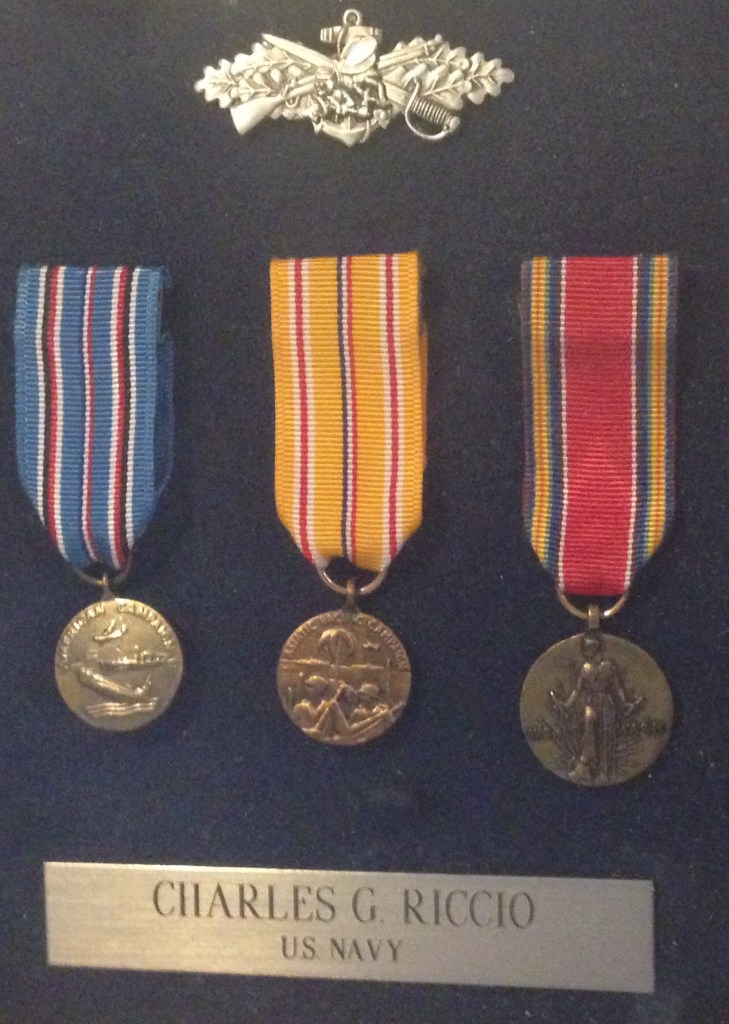
The badge at the top of the case is the seal of an enlisted Seabee Combat Warfare Specialist, a member of the Navy’s Construction Battalion, or C.B. for short (Warfare Pins/Badges). The bee with the machine gun and the wrench is their symbol, both a play on words and representation of their role in combat. These are worn on uniforms as a symbol of status and qualification, and don’t specify a particular rank, though an officer would wear a gold one. The badge signifies broad knowledge of naval history, weaponry and construction, as well physical fitness. These were minted by the Navy in 1992, which struck me as odd since my grandfather died that year. I asked my mother about it, and according to her, my uncle put in the paperwork and the badge was awarded posthumously, meaning, oddly enough, that my grandfather never owned or wore it.

As for the medals, I know the two on the right, but had to do some digging on the leftmost medal. That one is the American Campaign medal, awarded by FDR in 1942 to those who served in the US before entry to the war, and later to personnel who served during the war on the US theartre, namely our islands in Alaska and Hawaii (Herman). Its ribbon is red white and blue, the colors of the United States. Because the ribbon was issued before the medal, my grandfather may have actually had this on his uniform, though I doubt he wore it often, or any shirt for that matter.

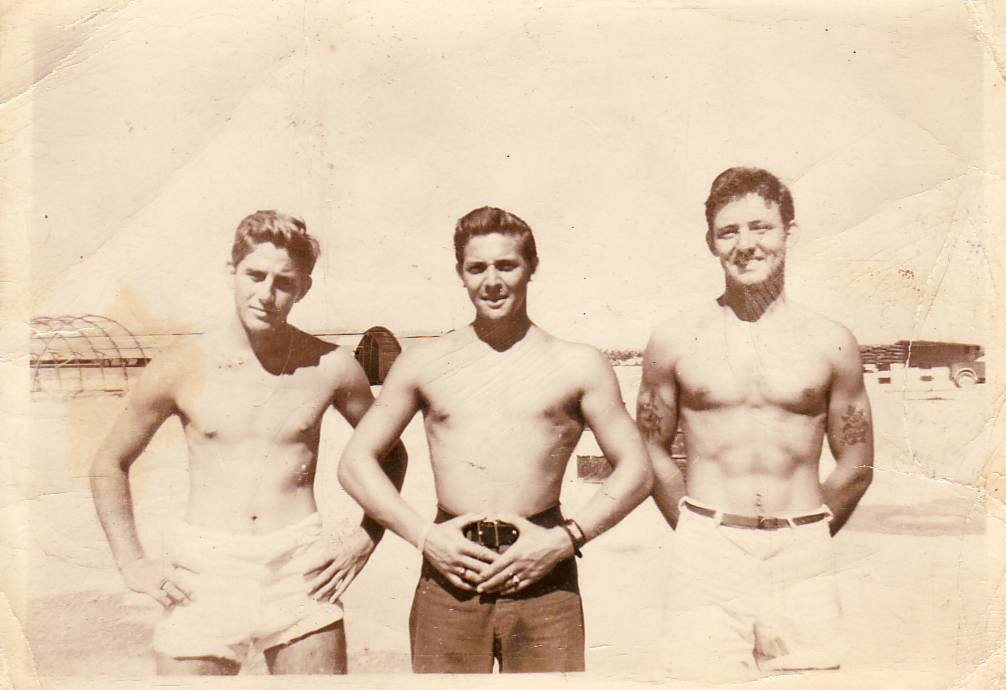
My Grandfather (Left) in the South Pacific Wearing Traditional Seabee Uniform

The center medal is the Asiatic-Pacific Campaign Medal, given after the war to every soldier serving on the Pacific front, and the rightmost medal is the World War II victory medal, commemorating every US soldier who served in the conflict. The Asiatic-Pacific Campaign Medal shows soldiers in the tropics, just like my grandfather’s picture above. The yellow, gold, and red ribbon mirrors the colors of the Japanese forces. On the victory medal, I was actually mistaken in my interpretation. The image is Lady Liberty holding a broken sword, and standing on the helmet of Mars, God of War (Medals of America). The central red stripe represents the conflict, and the rainbows flanking it are interpreted as the triumph of peace.

These medals are made mostly out of copper, then plated with the yellowish alloy that the Smithsonian calls “Gold-Colored Plating” (Air and Space Museum, World War II Victory Medal). After the medal is pressed into form and plated, the ring at the top is soldered on to attach the silk ribbon. The manufacture of these medals is contracted out to various mints, so it’s hard to know exactly where these were made, though judging by their wear (especially the victory medal, which has lost its gold color), my best guess is my Grandfather put in for them a few years after their issue in 1946. To get one, a valid service record that qualifies for the medal must be submitted, a precaution taken against stolen valor.

These medals are what my grandfather would have worn on his uniform after the war, at memorial day services, military balls and the like. Since then, they’ve transitioned from their initial function of mementos for him to recall and display his service with into something for my family to remember him by. I suppose its a characteristic of war medals that they are printed to acknowledge personal achievement and military history, and end up becoming family heirlooms.

The Stamp in Detail

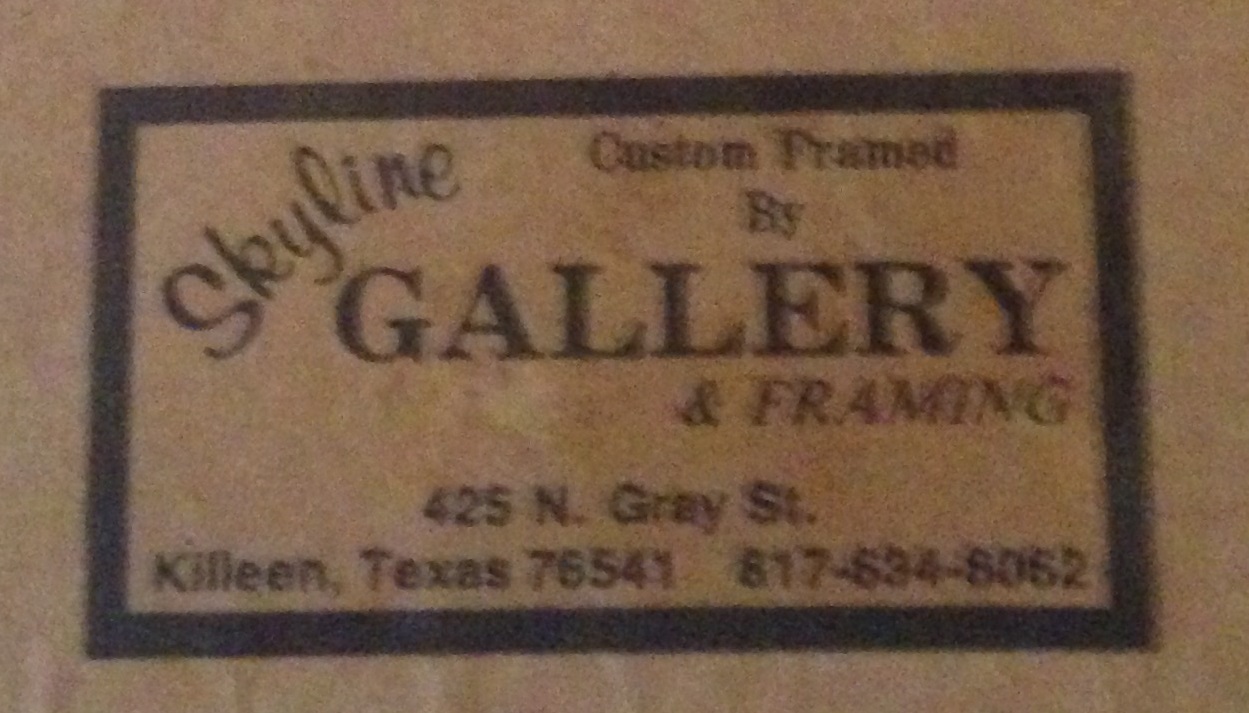
As far as the case, I know from the stamp on the back that it was put together from four frame corners at Skyline Gallery and Framing in Killeen Texas. My uncle lived in Texas very briefly from around 2004 to 2007, so this means that the display that sits on my mother’s dresser was put together in that time, moving the medals from stand alone pieces to a collection in memory of my grandfather.

Works Cited

US Navy. “Warfare Pins/Badges .” All Hands, 2007. https://www.navy.mil/ah_online/archpdf/ah200701.pdf

“American Campaign Medal.” Stein, Herman E. – TracesOfWar.com, STIWOT, http://www.tracesofwar.com/awards/268/American-Campaign-Medal.htm.

“World War II Victory Medal | Medals of America | Military Blog.” Medals of America, Medals of America, 22 Aug. 2018, http://www.medalsofamerica.com/blog/world-war-ii-victory-medal/.

“Medal, World War II Victory Medal.” National Air and Space Museum, 13 Mar. 2018, https://airandspace.si.edu/collection-objects/medal-world-war-ii-victory-medal-2

Course Blog #3: Origins of my Sohmer Upright Piano

Everyone has a creative side. Despite the fact that I’m a finance major who’s constantly working with quantitative data from both small firms and the economy, I still manage to allocate some my spare time to hobbies I’m passionate about. If you have read my previous post, you would know that music and piano performance continues to be a major interest of mine. As a result, I desire to dig deeper into my personal piano to discover its history and the function it continues to serve.

The instrument I currently own is a Sohmer Upright Piano conveniently located on the first floor of my home, always ready to be played. However, though, it is important to note that this was always the case. Prior to the fall of 2015, and while I started to develop a passion for piano performance, my parents and I decided it would be appropriate to obtain a real piano to practice on. After a long summer of searching and inspecting a myriad of different instruments, eventually we came across a piano that both looked nice and had a quality sound.

Before continuing with my object’s history, I feel that it is imperative to this post that I acknowledge the schism of functionality that has arisen recently over the use of pianos in domestic households. In my opinion, people who own these very complex and elegant instruments fall into either one of two categories: the piano is used as an instrument or it is merely used as a piece of furniture. In the past few years, I have met many individuals who own a piano but are unable to actually utilize it; as a result, it usually just turns into a piece of elaborate furniture.

This claim was reiterated further when I stumbled upon my prospective piano while visiting a small home in Westport, Connecticut. The family had told me that no one was able to play this instrument resulting in it being turned into a piece of glorified furniture that has begun to take up too much space within their home. When inspecting this piano, I noticed it was a Sohmer and was in excellent condition, both structurally and phonetically. Eventually my parents and I decided that this instrument would be an appropriate choice and later decided to purchase it from the family.

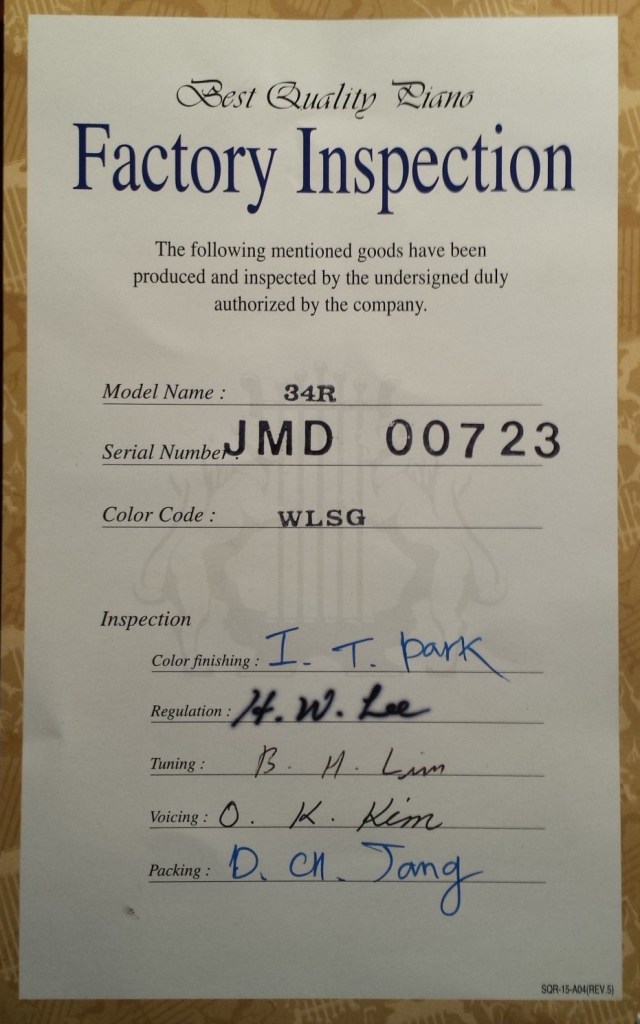
A factory inspection slip from the manufacturers.

Unfortunately, the only information I was able to obtain requiring the origins of this piano from the family was that they bought it at an auction a few years ago. Around this same time, I decided to conduct some further research into this newly obtained object. For starters, I found that this instrument was assembled by Sohmer & Co., a piano manufacturing company founded in New York City in 1872. In spite of this, further research divulged that Sohmer & Co. was eventually bought out by Samick Music Corporation, a large piano manufacturer based in Korea. Since Samick bought out Sohmer & Co. in the late 20th century, and since I found some Korean characters on the back of my piano, I can infer that my piano was made in the past 20-30 years.

In an attempt to discover more about the origins of my piano, I attempted to call Samick and ask the company if they knew any more information about my instrument’s history. To my dismay, the phone operator was not able to find my piano’s serial number when the company’s database and told me that it was most likely made in Korea. Since Samick recently shut down the production of Sohmer pianos recently, the company left no record of Sohmer pianos within their internal database. At this point, I felt as if I hit a brick wall in terms research; neither the company nor I had any leads to the origins of my instrument.

Although there is a lot of uncertainty regarding the origins of my Upright Sohmer Piano, I feel as if this research experience has helped me to gain a greater appreciate for my instrument. Having the ability to obtain an object that previously had very little purpose, other than being a piece of furniture, was very empowering; I felt that I was able to give this object purpose again. Consequently, this piano has become one of my favorite objects and as I continue to look to forward to playing it once again, I will be able to appreciate and acknowledge its significance to both myself and to the environment around me.

More on Josie’s Ring

This may be very straightforward, as far as I have been able to find my grandmother only ever wore this ring on her finger, she did not wear it on a necklace or use it for any other purpose. I believe the ring was designed to be worn, perhaps due to its value and flashy set stones it was meant to be worn on more special occasions rather than for everyday wear. This is how I assume my grandmother wore it. Perhaps, my grandmother may have worn this costly ring as a symbol of status. I tend to think this may not have been the case because she was not a flashy person and embraced her humble lifestyle, but I cannot be sure, it could have been a possibility. I generally remember her wearing rather simple gold jewelry from day to day, her wedding rings and a necklace. I do not believe this ring belonged to anybody before my grandmother, but as for the chain of ownership, it now belongs to me.

After scouring the LeVian website I can say with certainty this ring is no longer being manufactured. I have only been able to find one identical ring which was pre-owned and listed on ebay. I have not been able to find any details about its original manufacturing other than it being by the brand LeVian and its general specs which I mentioned in my previous post.

I can make a general assumption that my grandmother wore this ring at least once in a way that was clumsy, due to the chip in one of the sapphire stones. Or at the very least, she was being careless and hit it against something else that caused the minor break.

My best chance at learning anything new about the way my grandmother wore this ring was by making a phone call to my grandfather. But he is 89 and is generally not concerned with such small details. There are certain pieces of her jewelry he comments on from time to time, the ones she wore a lot and the ones he specifically bought her for anniversaries, such as a long chained silver heart necklace engraved for their 25th wedding anniversary. I do not think this piece stuck out in his mind, as it didn’t stick out in mine either. However, from the condition the ring was in, I can say with certainty that if my grandmother did not wear it often she still wore it enough. Ultimately, when I had my grandfather on the phone inquiring about my grandmother’s habits of wearing this specific ring he did not have much to offer the conversation.

This ring I believe has had waves of use. I believe there was a time my grandmother wore it, but I believe as she grew older and later into her life she stored it away and it became an object that was hidden away where it remained untouched until years after she passed away. My grandmother wore a lot of costume jewelry pieces, ones that were not of much worth. But she kept especially safe care of the items of hers which were more valuable than the rest. These pieces of jewelry were kept in their own box, stored in a different place than the rest, which only my grandfather knew the whereabouts of. Now, this ring in its second life cycle is being worn again, but not everyday. I wear this ring on special occasions, ones that are family oriented; weddings, engagement parties, special celebratory family dinners– occasions that to me have a special meaning to have a piece of my grandmother there to celebrate with us. Furthermore, I continue to only wear it alone on one hand, it just feels more special that way. But like I believe my grandmother did, when I am not wearing this ring I store it away safely in my jewelry box. It does not become an item that is on display but one that is hidden and tucked safely away. Perhaps at my wedding this will be my “something blue.”

I can never be too certain what purpose this ring fulfilled in my grandmother’s life. Was it a ring that had a significance to her? Did it make her feel as though she had status? Did she simply just like it? I will never know for sure. Despite my painstaking effort to find out more, I am afraid the details of this ring and the role it played in my grandmother’s life have passed along with her.