This week, I have decided to examine something that I love: shoes. Last October, I finally purchased a pair of Timberland boots I had been eyeing for a few weeks. I actually ordered two pairs of the same shoe – one in a size 7 and one in a size 6.5, as I was not sure which would fit – and then eventually returned the size 6.5 boots by mailing it back (Timberland has free return shipping!). I’m a bit ashamed to say I spent $145.97 on these boots (per pair, but I was refunded for the pair I returned).

The pair I bought are the Women’s Courmayeur Valley Chelsea Boots, size 7 in beige. One boot weighs a little less than a pound, surprisingly light for its thick rubber sole. They have stretchy side panels and wool and cotton lining. They are suede on the outside and contain Ortholite insoles, which supposedly are made to be sustainable out of recycled rubbers.
Timberland has a page dedicated to its Material Policy Statements, including areas such as Animal Welfare, Leather Processing, and a proclamation that they do not source their cotton from Uzbekistan due to the forced-labor system there that produces it. It is clear that the company wants its customers to be fully aware of the products that go into their shoes, and they seem proud of the fact that a majority of their shoes are made with sustainable, recyclable materials through ethically sound processes.
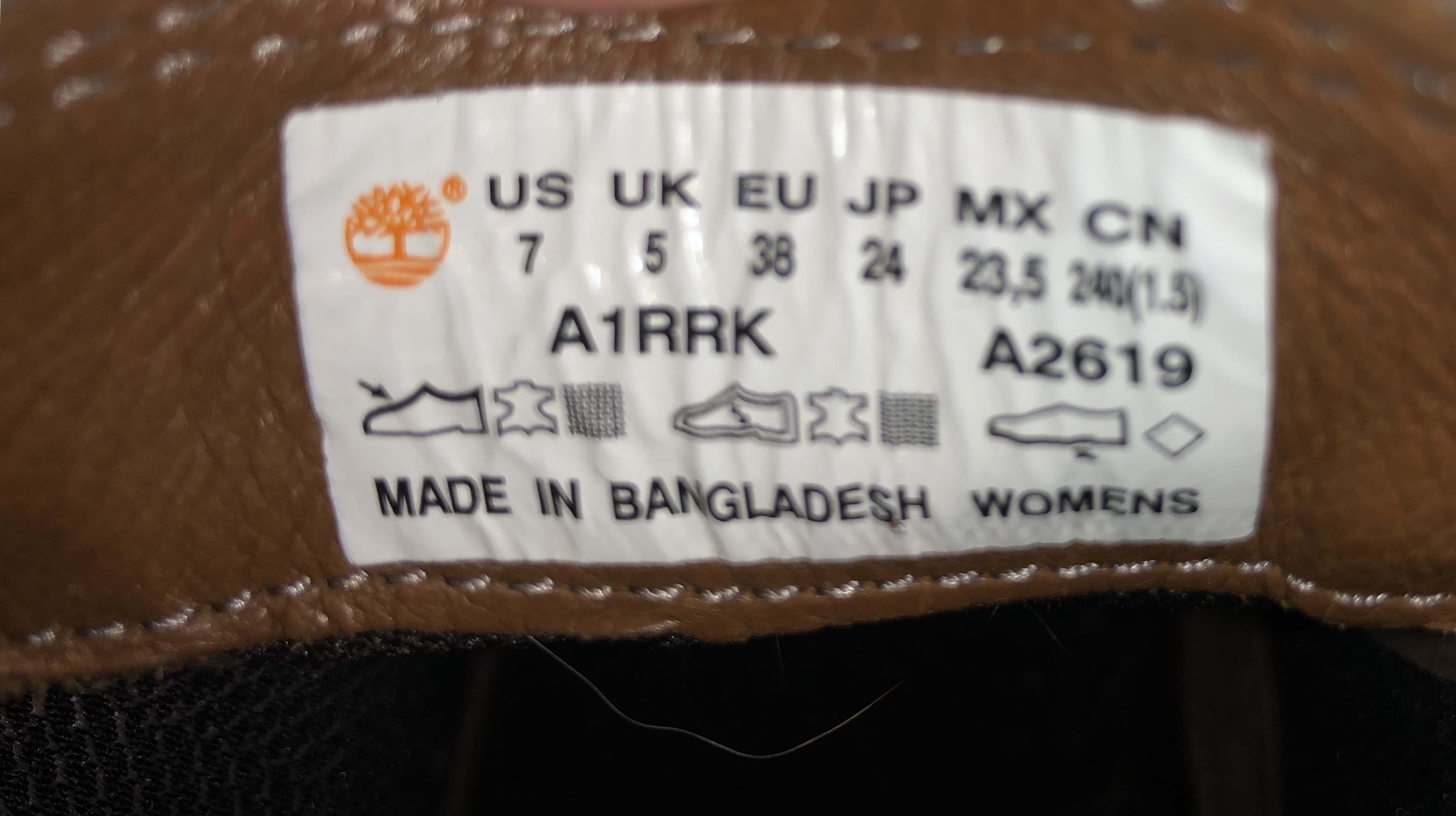
The inner label says that these boots were made in Bangladesh, and a quick Google search revealed that factory conditions in Bangladesh are not all that great. According to the Human Rights Watch website, little has been done to improve the conditions for garment workers in recent years despite a factory collapse in 2013 that killed 1,100 workers. Timberland, however, would have you believe a different story about the conditions of their workers: their website has a page listing their accomplishments with HERProject, an organization that seeks to improve the circumstances of low-income women working for global supply chains. While it is nice to see that Timberland may have had a hand in increasing health awareness for their female factory workers in Bangladesh, for some reason I always feel suspicious at how large companies advertise their charity work, especially when accompanied by photos like the one below of a smiling worker.

After examining the production of the boots, I then considered their journey. They were imported to one of three Timberland distribution centers in Canada, Kentucky, or Holland, the final center having received Europe’s BREEAM (Building Research Establishment Environmental Assessment Method) Certificate, a testament to its efficiency and eco-friendly nature. This facility gets 100% of its energy from wind power, which I thought was very cool. My boots, in particular, were shipped from the Kentucky center by way of UPS, finally arriving at my house just three days after I had ordered them. A friend of mine recently told me she is trying to do less online shopping because of its impact on the environment, what with the pollutive effects of fossil fuels released as goods travel to their destination, their home with the consumer who paid for them. This is not a topic I know much about, but I wonder if driving myself to the shoe store to buy a pair of boots would have been more or less energy efficient than ordering them, or if it perhaps is detrimental to the environment, either way. The fact that I shipped the pair did not fit back also likely had an environmental impact that I did not even contemplate.
According to the Timberland site, they “found out” that 67% of consumers take into consideration whether or not fashion is eco-conscious or not. Honestly, this is not something I considered at all; I bought my boots because I liked the way they looked and I wanted a new pair for the fall. However, after exploring this object’s production and how it finally got to me, I feel more aware of the massive, complex web of production and transport created by consumerism. It is hard to conceive of the human labor – and the human cost – that goes into the production of things that I take for granted. There are so many aspects that I did not even delve into, such as the packaging of Timberland products (supposedly recyclable) and the production of the individual components that went into my shoes (quite frankly, I do not think I wanted to know more about the tanning and leather process – I am not proud of my lack of environmental consciousness, but ignorance is bliss). After this project, though, I do think I will be more attentive to the grand scope of consumerism, especially when I inevitably buy another pair of shoes.
Sources:
https://www.timberland.com/responsibility/stories/improving-womens-health-in-bangladesh.html
https://www.timberland.com/responsibility/product/materials-policy-statements.html
https://www.hrw.org/news/2015/04/22/bangladesh-2-years-after-rana-plaza-workers-denied-rights
 The Materials of History, Thought, and Art
Katie, I truly appreciate your skepticism regarding the Timberland boot-making process. I feel as though no company would be willing to admit if they were lacking in the environmentally friendly aspect. I also have never thought of shoes in terms of environmental impact, especially not regarding shipping method or fuel necessary. I too must admit that I am not the most environmentally conscious when it comes to shopping for clothing and shoes, as I never truly realized how much goes into creating, packaging, and distributing these items. From now I on I feel as though I will be much more aware of what I’m purchasing and where it comes from.