I never thought I was much of a collector, but this blog post has me reconsidering this notion. I have a medium sized collection of earrings, most of which I’ve purchased from places I’ve traveled to. I have a pair from San Diego, Montreal, Burlington, and of course, New Paltz, to name a few. When I wear any pair of these earrings I’m reminded of salty California air, or the sound of music blaring from a Canadian park. They are all beautiful on their own, but they also represent a place and time in the past in which I was exploring somewhere new. Because of this, these pieces of jewelry mean a lot more to me than an average accessory.
The most recent addition to my collection is a bracelet and earring set from Santo Domingo, the capital city of the Dominican Republic. These pieces of jewelry are particularly special because they contain Larimar, a beautiful gemstone that can only be found on this specific Caribbean island.

My trip to the DR wasn’t a typical resort vacation. One of my sisters lives in Cabarete, a beach town on the northern coast of the island. Her boyfriend’s family lives in Santo Domingo, so my parents and I traveled there to meet his family and spend some time in the city they’ve lived in their entire lives. We stayed in Zona Colonial, a historic neighborhood that is actually the oldest permanent European settlement in the Americas. This trip was not only a chance to visit my sister, but it also served as a week-long history lesson. Her boyfriend, Cesar, knew so much about the history of his country, more than the tour guides at every museum we went to. Being immersed in Dominican culture was intimidating yet exciting, and I was forced to communicate in Spanish which definitely pushed me out of my comfort zone.
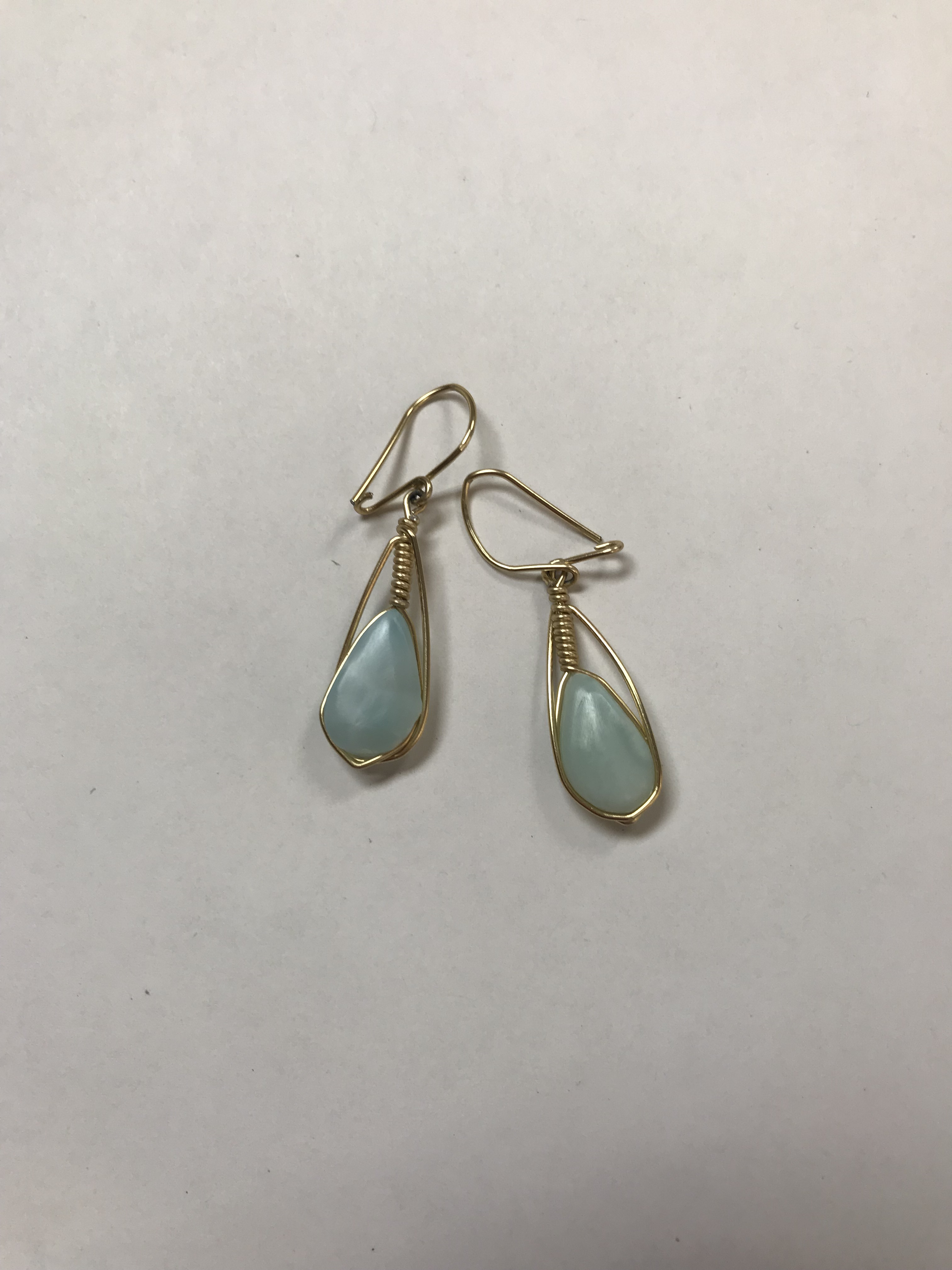
The Larimar in both the earrings and bracelet are wrapped in thin silver and gold wire, making both pieces of jewelry extremely lightweight. It is unclear whether these were done by machine or by hand, but my guess is by machine due to the extremely tight and almost symmetrical wire wrapping. The Larimar itself is a light sky-blue color with some faint white streaks under the surface. They have been tumbled, leaving the stones with a glossy finish.
Since Larimar is only found naturally in the Dominican Republic, it is strategically marketed toward tourists. This initially turned me off from the stone because I didn’t want to purchase the one thing that every tourist in the Dominican Republic purchases. Yet, I did. One day, my family and I were perusing through an indoor market full of souvenirs, and everywhere we turned people were trying to sell us their products. T-shirts, mugs, guirras (a Dominican percussion instrument), you name it. I had some cash, but wasn’t intending to buy anything. Then I got the corner of the marketplace and there sat an older woman behind a case of beautiful gemstone jewelry containing Larimar and Amber. My bracelet and earrings were sitting together in a small white box, and I looked at the woman and pointed to it. I asked her how much it was (in Spanish), and she replied with 300 pesos, which converts to about 6 U.S. dollars. In the U.S., jewelry containing Larimar can cost anywhere from $50-$700. I gave the woman 300 pesos, she placed the small white box in a plastic bag and I carefully secured it in my purse.
There is a lot of labor that goes into the production of gemstone jewelry, and Larimar in particular. There is only one place in the entire country where the stone can be found, and that’s at the Filipinas Mine in Los Checheses. Miners must dig and search for the stone, and then it has to be cleaned, tumbled, and then set into jewelry. Are the people who work on these pieces of jewelry paid enough? Are they treated fairly? Is there any way for me to know? These questions don’t usually cross my mind when I buy or wear jewelry, but I’m now realizing they probably should.
 The Materials of History, Thought, and Art
I really appreciated your post. I relate to the way your objects hold meaning to you, that they can bring you back to your trips—I have pieces of jewelry that do similar things for me. I think it’s really fascinating and special that you were able to purchase these pieces of jewelry and this gemstone that can only be found and cultivated on that island. But I also think you raise some really important points and questions at the end of your post about what it takes to mine these stones and the conditions of the miners. I firmly believe in trying to be an informed consumer as much as we can, and even if we can’t always find out the answers to our questions, I think it’s good that it’s something that we’re even pondering.
Your post was so interesting! I really appreciated your nod to the physical (often exploitive) labor that goes into mining these stones. Treatment of laborers is important to keep this in mind, though admittedly its something I hardly think about when purchasing new objects.
I found your post really interesting and I could feel how you value your trip and the information-as well as jewelry-gained from it. Your questions are also very important and something I considered in my post as well, though it is interesting to think about how these conditions compare and contrast in the making of a very commercial, assembly line type product versus your unique hand crafted jewelry.
I always love reading your posts! I love that you are noticing objects in your life that before this blog you otherwise did not pay much mind to. I love in this post how you cover the ethical concerns you have for the sourcing of the Larimar that is a part of your jewelry. I find myself wondering the same things when I wear some of the pieces I have, but I think you bring up a good point, is there really any way for us to know for sure? It is an interesting thought to ponder and after reading this I definitely believe I will think more about this, pertaining to my jewelry and other belongings in general.