Larimar

I never thought I was much of a collector, but this blog post has me reconsidering this notion. I have a medium sized collection of earrings, most of which I’ve purchased from places I’ve traveled to. I have a pair from San Diego, Montreal, Burlington, and of course, New Paltz, to name a few. When I wear any pair of these earrings I’m reminded of salty California air, or the sound of music blaring from a Canadian park. They are all beautiful on their own, but they also represent a place and time in the past in which I was exploring somewhere new. Because of this, these pieces of jewelry mean a lot more to me than an average accessory.

The most recent addition to my collection is a bracelet and earring set from Santo Domingo, the capital city of the Dominican Republic. These pieces of jewelry are particularly special because they contain Larimar, a beautiful gemstone that can only be found on this specific Caribbean island.

My Larimar bracelet.

My trip to the DR wasn’t a typical resort vacation. One of my sisters lives in Cabarete, a beach town on the northern coast of the island. Her boyfriend’s family lives in Santo Domingo, so my parents and I traveled there to meet his family and spend some time in the city they’ve lived in their entire lives. We stayed in Zona Colonial, a historic neighborhood that is actually the oldest permanent European settlement in the Americas. This trip was not only a chance to visit my sister, but it also served as a week-long history lesson. Her boyfriend, Cesar, knew so much about the history of his country, more than the tour guides at every museum we went to. Being immersed in Dominican culture was intimidating yet exciting, and I was forced to communicate in Spanish which definitely pushed me out of my comfort zone.
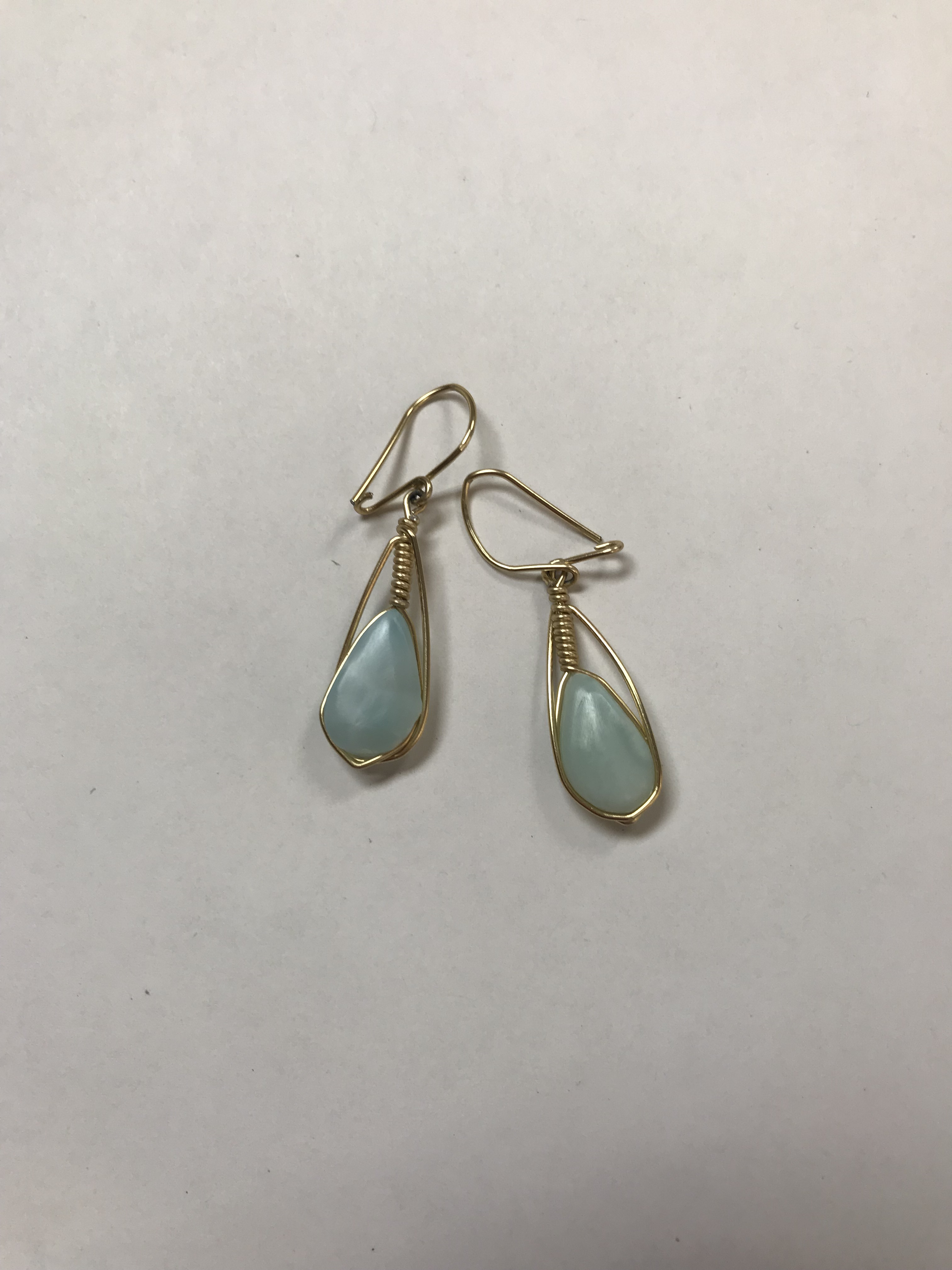
My Larimar earrings.

The Larimar in both the earrings and bracelet are wrapped in thin silver and gold wire, making both pieces of jewelry extremely lightweight. It is unclear whether these were done by machine or by hand, but my guess is by machine due to the extremely tight and almost symmetrical wire wrapping. The Larimar itself is a light sky-blue color with some faint white streaks under the surface. They have been tumbled, leaving the stones with a glossy finish.

Since Larimar is only found naturally in the Dominican Republic, it is strategically marketed toward tourists. This initially turned me off from the stone because I didn’t want to purchase the one thing that every tourist in the Dominican Republic purchases. Yet, I did. One day, my family and I were perusing through an indoor market full of souvenirs, and everywhere we turned people were trying to sell us their products. T-shirts, mugs, guirras (a Dominican percussion instrument), you name it. I had some cash, but wasn’t intending to buy anything. Then I got the corner of the marketplace and there sat an older woman behind a case of beautiful gemstone jewelry containing Larimar and Amber. My bracelet and earrings were sitting together in a small white box, and I looked at the woman and pointed to it. I asked her how much it was (in Spanish), and she replied with 300 pesos, which converts to about 6 U.S. dollars. In the U.S., jewelry containing Larimar can cost anywhere from $50-$700. I gave the woman 300 pesos, she placed the small white box in a plastic bag and I carefully secured it in my purse.

There is a lot of labor that goes into the production of gemstone jewelry, and Larimar in particular. There is only one place in the entire country where the stone can be found, and that’s at the Filipinas Mine in Los Checheses. Miners must dig and search for the stone, and then it has to be cleaned, tumbled, and then set into jewelry. Are the people who work on these pieces of jewelry paid enough? Are they treated fairly? Is there any way for me to know? These questions don’t usually cross my mind when I buy or wear jewelry, but I’m now realizing they probably should.

A Stuffed Husky

For this week’s post, I am choosing an object that is relatively new to my object collection–well, I don’t know if I can really include it in my own, since it was a gift for someone else. Nonetheless, it is the most recent item I have purchased and, though it does not have a long meaningful history, I hope that its future will.

Since I was a kid, I have had an infatuation with stuffed animals. It stemmed from my desire to own every single pet possible, but due to limited space in my home, I was only able to own a hamster of my own. To compensate, I bought a stuffed animal nearly every time I went into a store.

Now, being that I am much older, you may think I’d grown out of this habit. It’s true, I no longer pick one up every time I’m shopping, due to the fact that I am my own financially stable individual and now have to buy them for myself. However, for some momentous occasions, my mom still buys me one, for the sake of contributing to my collection and for keeping me young. When I moved into college, my mom bought me a stuffed elephant, an object that I keep close to me and still have here at school with me today. It brings me comfort and always provides me with a tiny reminder of my mom while I’m away and missing her.

The object I am focusing on, however, is not my stuffed elephant. Rather, it is a stuffed husky, from the same brand, that I bought my boyfriend for Valentine’s Day this year. Buying it for him, I had the same mentality that my mom did when she bought my elephant: that it would serve as a tiny reminder of me while we are away from each other. Plus, huskies are his favorite dogs, so that’s a bonus.

The stuffed husky

The company both stuffed animals come from is called Aurora. They are a popular brand on Amazon that people buy stuffed animals from. They were established in 1981 in California. A lot of their products are sold out of places such as zoos and high-end toy stores to appeal to “animal lover” crowds. Their toys are created, for the most part, to closely resemble life-like versions of the animals. The toys are made of safe, authentic materials, making them safe for young kids to play with. They are also made with extremely soft materials, again creating a resemblance to the real life version of these animals, just on a much smaller scale.

When I purchased the object, the process it had to go through was likely quite simple, being that it is a mass produced object. The particular stuffed husky that I bought probably came from a warehouse. For this reason, I do not feel as connected to the production/transportation of the object, seeing that I am the first person to have owned it, prior to my boyfriend. It does not have a rich history like my Claddagh ring did, where I can trace it’s origin back into my family line. However, I am hoping that the future of this stuffed husky will be rich. I want him to hold onto it for awhile, as a reminder of me, and see if it eventually ends up in the hands of someone else, who will be the first to be able to tell the story of its journey.

My Good Luck Charm

The item I decided to write my blog post on for this week is a necklace my grandma purchased for me as a souvenir from her trip to Ireland. As I have mentioned in previous posts, although I feel a stronger connection to my Ecuadorian side, I am also Irish on my moms side of the family. I don’t see this side of my family as often as the other because they are located in different states around the country, compared to my dad’s side which all live relatively close in Queens. However, especially around St. Patrick’s Day, I am still proud of this background and culture and am excited to learn more, hopefully while completing this post. Aside from the history of the object itself, I also thought it would be interesting to discuss some of my family’s history as well. My grandma is very into genealogy. A few years ago she began a very intricate search into my family’s origins. She especially thought it would be interesting to find more about my grandpa’s family history, especially since he was adopted. Through her research she has learned more about our irish roots, as well as english. She found many connections we have to various celebrities, and even found a connection to a woman who was on trial in Salem during the witch trials that I just so happen to be related to.

However, just like my grandma has discovered and researched our family history and origins, I too looked into the history of my necklace she gave me a couple of years ago. To begin, it is a tiny pendant on a gold chain. The front is covered in this gold plating with the outline of a shamrock revealing a stone, that makes up most of the rest of the necklace. The back of the necklace really reveals this stone, and the front shows a glimpse of it in the open spaces of the shamrock outline. Around the circle golden pendant are sort of ridges on the outside in a decorative fashion that adds a little extra flare to the necklace itself. When I first received this necklace from Ireland I never took it off. I wore it all throughout high school and to every performance I ever participated in as sort of my “good luck charm.” Today, I don’t wear it as often and have found new objects to give me these same feelings; however, I still have it in my jewelry box and pull it out on special occasions.

The necklace is from a region called Connemara in the county Galway. The word Connemara derives from the Gaelic meaning, “Inlets for the Sea.” Found in this area is Connemara Marble, it is a rare form of marble that is typically greenish in color. It dates back over 600 million years and due to its limited supply is considered one of the rarest forms of marble in the world. This rare marble is formed when limestone is heated under pressure. It is primarily green in color, but there are often shades of grey and brown seen throughout.

The stone in the necklace my grandma purchased for me is from a quarry in Clifden, Galway. It was opened by the Joyce family in 1822 and named it the Streamstown Marble quarry. The Joyce name has become pretty synonymous with Connemara Marble and they have been a supplier of this marble to many world-famous buildings. This includes Galway Cathedral in the city of Galway, in which the floor is made up of this beautiful marble. This floor is one of the largest examples of the marble in the world. I found this to be such an interesting assignment. I knew the necklace came from Ireland and I thought just that fact was special to my family and I. However, researching and finding out more about the background of the stone that is the centerpiece of this necklace, especially with how rare it turns out to be, really made me appreciate my long time “good luck charm,” that much more.

Unfortunately I am not home right now, so I am unable to attach an image of my necklace, but I will very soon. For now, enjoy this picture of my brother and I reppin’ our heritage in our golden days.


Provenance, noun: the beginning of something’s existence;something’s origin: How my favorite purse got from point A to point Me.


Only on rare occasions, does someone know the entire journey something has taken to end up in their possession. In most cases, a woman who gives birth knows where the baby came from. A gardener would know that they grew the zucchini they are eating for dinner, but may not know where the original seed originated from. When it comes to shopping, an item usually has tag. It might say “made in China” or “assembled in Honduras of U.S. components”. Finding something that is truly Made in America is a rarity. I am the proud owner of just such a product.

As a mom, I am not fussy about getting a gift for any particular holiday. My kids and husband know that if they have made the effort to pick out the perfect card, say “thank you” when warranted, and clean out the drainboard occasionally, makes for a happy mama. So imagine my surprise when my four kids pitched in on a Mother’s Day gift, purchasing a handbag I had been eyeing. Although it wasn’t a designer bag, it was still out of my price range. My purse called The Hobby, is from a company called R. Riveter. Named after Mrs. Oveta Culp Hobby of Texas, she was the country’s first secretary of the Department of Health. Education, and Welfare and the second woman to hold a U.S. cabinet position. I have carried it almost daily since 2017.

My Hobby bag.

Now what makes this bag special? First, it is black and brown, the two colors I wear most often. Second, it is the perfect size (9”x 11”x 4.5”)crossbody bag. I can wear it over my shoulder, across my body so my hands stay free, or I can carry it as a clutch. Third, it is made of leather and a rugged canvas with brass fittings. It has held up beautifully, its wear adds to its lovely patina. Finally, I am able to know everything about my bag, including the women who made it, because of the amazing company from whence it hails.

R. Riveter is the brainchild of Cameron Cruse and Lisa Bradley. Being the wives of military spouses can be a rewarding yet difficult one. Many military families move a lot, in addition to coping with deployments, lack of personal family close by, and difficulty securing long term employment. The pair started with the intent of creating their own careers. It needed to be flexible and mobile for their transient lives. They decided to charge $4000 total to their credit cards, buying a commercial grade sewing machine, some canvas, and leather. They designed, created, and produced handbags, then sold them. The bags were popular and soon Lisa and Cameron needed to bring on more people to help. This is where R. Riveter became a company that was truly something special.

Their mission? “R.Riveter doesn’t hire military spouses to make handbags. We make handbags to hire military spouses, and create a greater sense of mission” (R. Riveter website). After a successful Kickstarter campaign in 2014, the 2015 opening of their first brick and mortar store in North Carolina and a presentation on the television show called Shark Tank in 2016, the business continued to grow, as did the demand for the product.

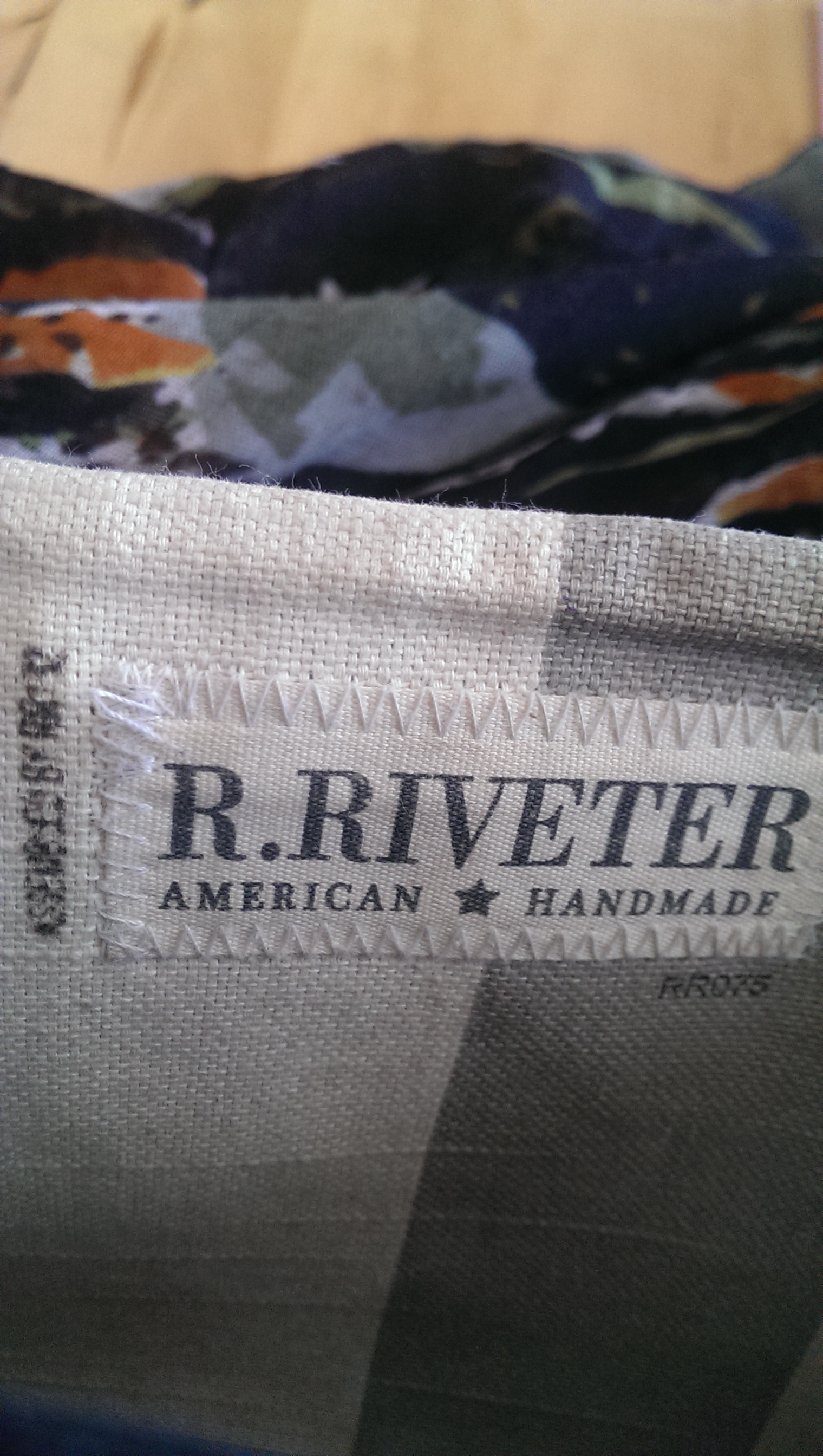
Each R. Riveter bag comes with a dog tag and a leather fob. The dog tag tells the year of manufacture. The leather fob tells us that RR053 (remote riveter), Danie, from Fort Campbell, KY, prepared the leather hides for the strap and flap of the bag. Inside the bag printed on the lining are two more stamps. RR075, liner riveter, Victoria, from San Antonio, TX, sewed the canvas lining. Lastly, RR132, Christa, from Fort Bragg, NC, is the sewing machine operator and assembler who completed the bag’s construction. Although I am awaiting a reply from the company, from what I can ascertain from the website is that all of the components in the purse are also American made.  My bag was purchased directly from the website and shipped to my home. I am not sure what the shipping company was.

***I heard back from the company’s customer service person Stacy. As far as she know, R. Riveter does everything possible to source the materials for each bag from U.S. makers. The leather comes from a company called Weaver Leather which is located in Mt. Hope, Ohio.It’s been in operation since 1973. A limited edition bag that was available recently. was made from cone denim, which ended up selling out. The American company, which ran for over 100 years, was the last one to make this material in the U.S. Sadly, it closed its door recently. If she is able to pass along more information, she will.


In addition to my love for this item, I am also thoroughly impressed by the company and what it stands for. The website has a wealth of information about how R. Riveter came to be, how their mission is able to empower women and support military families, and much more. One of my sons is third generation Army. When I carry my Hobby purse, I hope I am supporting a fellow comrade of his, along with their military family. In the future, I would love nothing more to own another R. Riveter bag and continue to help those in need.

Technology in Academia

For this weeks blog post, I am going to provide a detailed history of how my Vaio Z Canvas – my primary laptop at SUNY New Paltz – came into my possession and how it has helped my academic career.

            In September of 2015, I was beginning my junior year of high school. One of the courses I was enrolled in was Introduction to Engineering Design (IED), a course focused on Computer Aided Design (CAD) modeling and 3D printing. Prior to the beginning of IED, I had no experience with CAD modeling; while I found the material interesting, I struggled to keep up with the assignments. The software used in the course, Autodesk Inventor, was only available on the computers in the engineering classroom, so if I did not finish my assignment in class or during office hours, I was not able to continue my work outside of the classroom. I tried downloading Autodesk Inventor onto my father’s laptop, but his laptop did not have the appropriate computer hardware to support the program. After a few assignments passed, I decided to make an investment in my education: purchase an affordable, compact laptop, where I could run sophisticated software such as Autodesk Inventor and complete assignments in a timely manner.

After two months of extensive research, I concluded that the Vaio Z Canvas was the laptop I was going to purchase. I choose this unique laptop for a few specific reasons: the performance of the central processing unit (CPU) in executing demanding tasks was remarkable; the graphics card in the computer was, at the time, the best Intel could offer for a non-discrete graphics processing unit (GPU); the utility of having so many accessible ports; and the ability to travel with the laptop without the concern of losing a significant amount of storage space. At the time of the purchase, there were few options on the market for a fast, reliable, and compact 12 inch laptop, so there was little competition in persuading me to purchase another laptop.

As an electrical engineering student, a 3D CAD modeler, and an amateur photographer, I needed a computer that could support any form of sophisticated software – Adobe Lightroom, Adobe Photoshop, MATLAB, Dassault SolidWorks, Autodesk Inventor, and Rhino 6 – to execute demanding tasks (reference Figure 1). Sporting an Intel i7 quad-core Haswell (fourth) generation processor, 8 gigabytes of DDR4 Random Access Memory (RAM), Intel Iris Pro Graphics 5200, and a 256 gigabyte SATA solid state drive (SSD), the internal hardware in the Vaio Z Canvas provided exactly what I needed. For a person who does not know a lot about computer hardware, this information may seem confusing or irrelevant. To put these specifications into perspective, the Vaio Z Canvas can compete head to head with Apple’s 2015 15-inch MacBook Pro, an elegant piece of technology that can easily execute demanding tasks, so for $1200, a $1000 less than the 15-inch MacBook Pro, I immediately jumped on the deal for the Vaio Z Canvas.

Figure 1 – My Vaio Z Canvas running Autodesk Inventor.

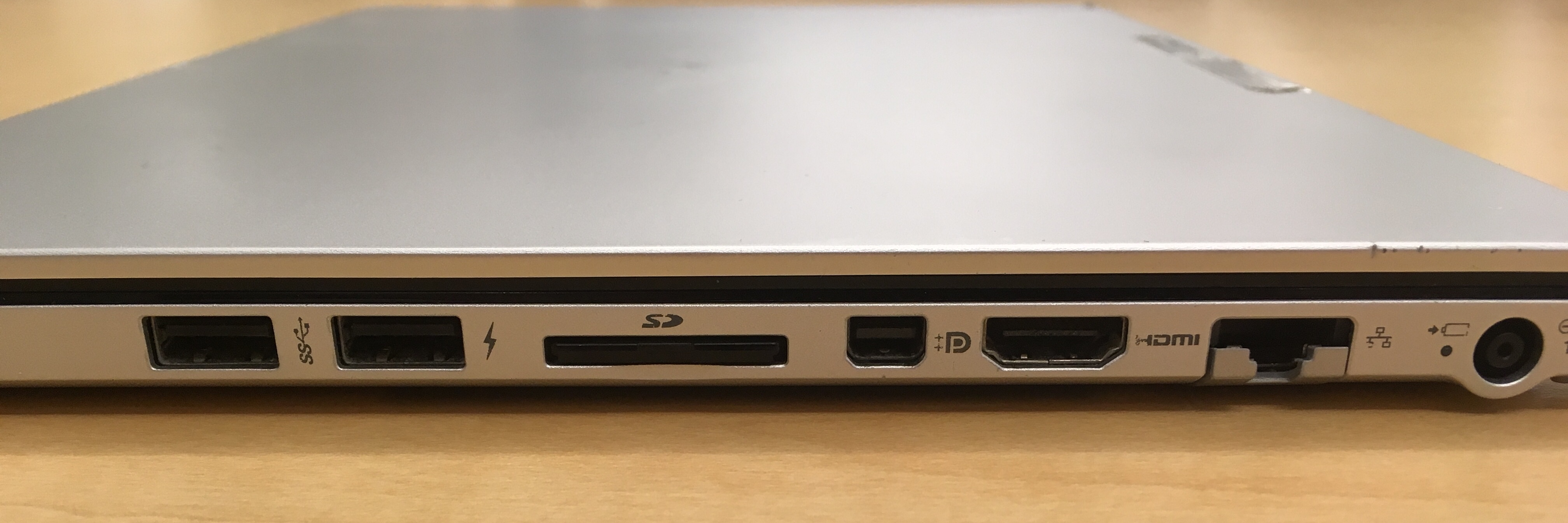
In addition to the hardware persuading me to purchase the Vaio Z Canvas, the ports of the computer were another unique feature. In stark contrast to Apple’s decision to switch to strictly USB C ports on their MacBook Pro line, the Vaio Z Canvas takes a traditional approach when it comes to ports. The Vaio Z Canvas includes two USB 3.0 ports, one full SD card slot, one displayport, one HDMI port, one gigabit ethernet port, and one 19.5 Volt charging port (reference Figure 2). With this wide array of a port selection, I never have to think about buying an adapter, saving me money and space in my backpack. While the Vaio Z Canvas may be slightly thicker and heavier than the 2015 15-inch MacBook Pro, I still value the versatility in having so many ports. Without these ports, I would not be able to project my laptop to two different computer monitors while studying for classes (HDMI and displayport), revise photographs while travelling (SD card slot), quickly transfer CAD files to a 3D printer (SD card slot), or establish a fast, stable connection to the internet (gigabit ethernet). These ports in combination with the computer hardware of the Vaio Z Canvas enable a higher level of productivity.

Figure 2 – The wide array of ports included in the Vaio Z Canvas.

This past December marked three years since I purchased my Vaio Z Canvas. While there are frustrating issues such as the poor battery life or the small, unresponsive trackpad, I fortunately have no regrets in purchasing this laptop. The Vaio Z Canvas has also helped me in an indirect way: introducing me to digital note taking on Microsoft OneNote. All throughout junior high school, I used five-star subject notebooks, and while I never had an issue with the notebooks, I found that Microsoft OneNote offered a myriad of features – changing different pen colors while using the same pen, offering different font thicknesses while writing, and the opportunity to record a lecture – which a five-star subject notebook simply could not match. This laptop has helped me tremendously throughout high school and college, and I intend to keep using it until the day it stops working.

A jar filled with inspiration

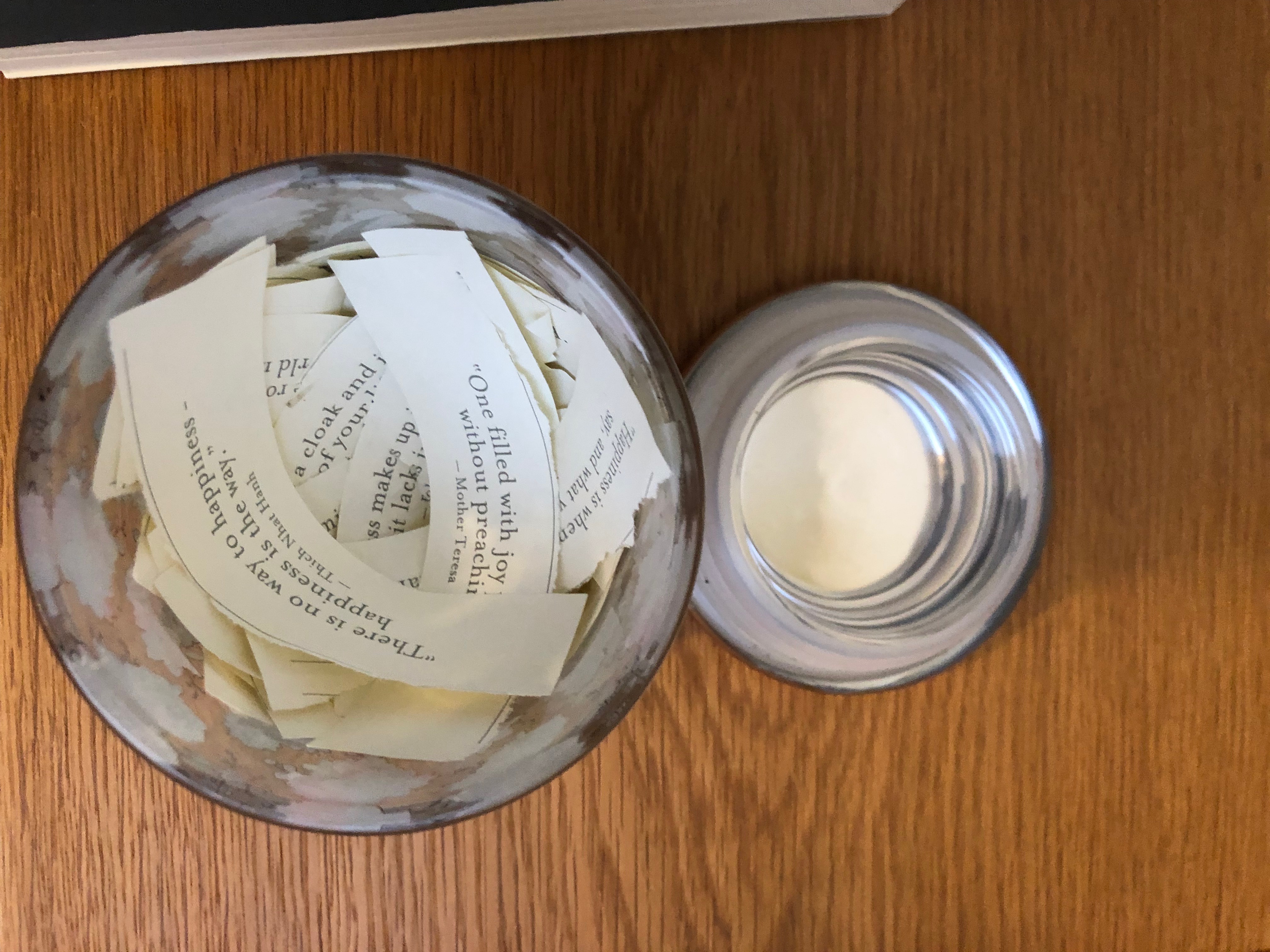
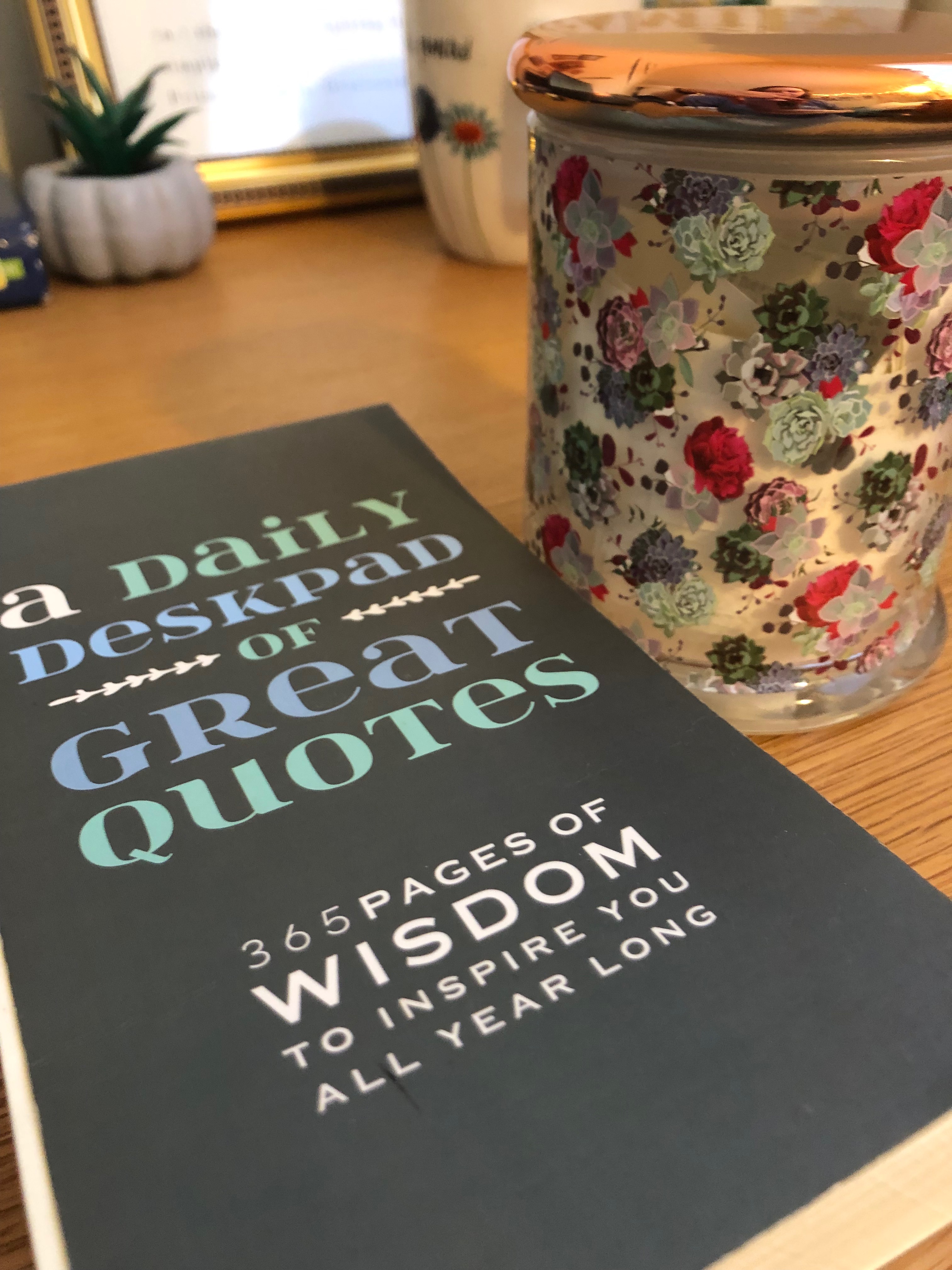
This week I am choosing to describe two objects that together are significant to me. One is a glass jar, that was actually designed as a candle holder. I got this as a gift for christmas two years ago, and keep it on my desk here at school. At first, I knew I could not use this as it was designed, as candles are not allowed in the dorms, but I have kept the same use for it even after moving out. I use this jar to store the bottom of my to-do lists or grocery lists every few days. These lists, are the second item, and were a gift that I received after graduating high school. This notepad of lists has inspirational quotes on the bottom, and after each of my lists are complete or crossed off, I cut or rip off the quote at the bottom and store them in this jar.

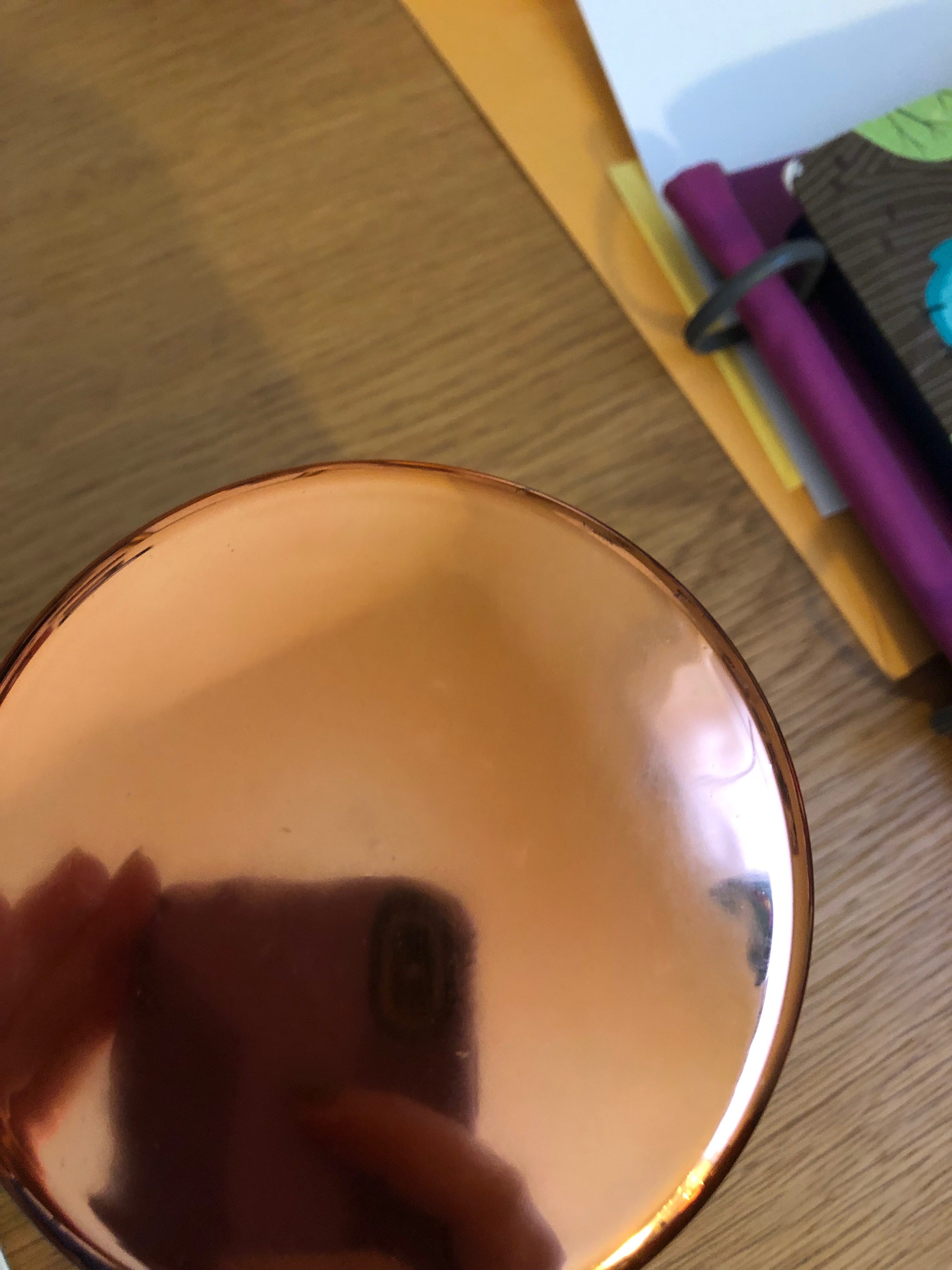
The jar has succulents all over it, as a reminder of how I love these plants and the desert. The top is a rose gold color, and very shiny, as you can see your reflection in it. The jar was made in China, and purchased at the store Francesa’s.

The notepad, is also made in China, but originally purchased at TJ Maxx. It has a colored cover, and the pages are a cream colored with grey lines and text at the bottom. One thing I love about connecting these items, is that they match very nicely. The greys and blues in the succulents match the cover of the notepad, and the pinks and green succulents stand out more along with rosy top.

While these items are from two different manufacturing companies, and sold at two different stores, they originally both came from China. This was not surprising to me, as most things we purchase come from another country, most of them China. The jar was produced from TMD Holdings company, based primarily in Pittsburgh, PA and in China. This company was large, and manufactured a variety of products, and the website was very business oriented, with its tabs listing the processes of the company and their partners. While the notepad was produced from Eccolo, which is a company that produces stationary and other accessories primarily out of Italy, but has this World Traveler line to include a more global perspective. This website, was very aesthetically pleasing, and more focused on advertising the products than the business or manufacturing process.

What drew me to writing this post was how inseparable these items are to me. I use them together, in a way that is meaningful to me, but they also serve as a reminder of my cousins and the thought they put into purchasing these objects for me. What’s crazy to me is how they were purchased at different times but still work so well together that I almost forget I had one before the other. In the back of the notepad, I still keep the note my cousin wrote when giving me this gift. It is hard for me to separate these items now, because I use them together, and keep them close to each other on my desk. These objects are extremely important to me, because of their practical purpose, but also for how they make me happy, and think of my cousins when I use them.

My Boots (and all the work that went into them)

This week, I have decided to examine something that I love: shoes. Last October, I finally purchased a pair of Timberland boots I had been eyeing for a few weeks. I actually ordered two pairs of the same shoe – one in a size 7 and one in a size 6.5, as I was not sure which would fit – and then eventually returned the size 6.5 boots by mailing it back (Timberland has free return shipping!). I’m a bit ashamed to say I spent $145.97 on these boots (per pair, but I was refunded for the pair I returned).

The boots
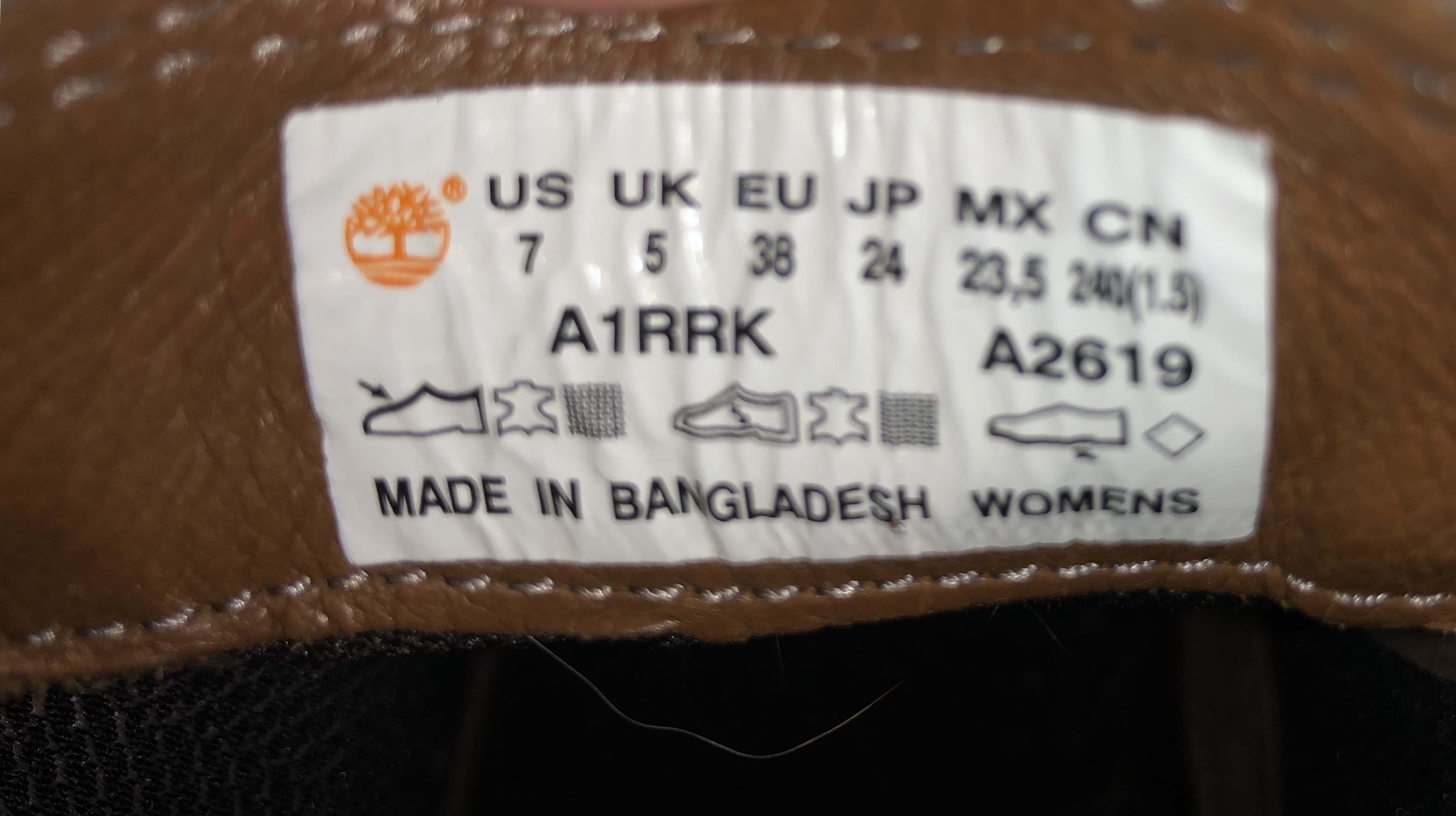
The inner label

The pair I bought are the Women’s Courmayeur Valley Chelsea Boots, size 7 in beige. One boot weighs a little less than a pound, surprisingly light for its thick rubber sole. They have stretchy side panels and wool and cotton lining. They are suede on the outside and contain Ortholite insoles, which supposedly are made to be sustainable out of recycled rubbers.

Timberland has a page dedicated to its Material Policy Statements, including areas such as Animal Welfare, Leather Processing, and a proclamation that they do not source their cotton from Uzbekistan due to the forced-labor system there that produces it. It is clear that the company wants its customers to be fully aware of the products that go into their shoes, and they seem proud of the fact that a majority of their shoes are made with sustainable, recyclable materials through ethically sound processes.

The inner label says that these boots were made in Bangladesh, and a quick Google search revealed that factory conditions in Bangladesh are not all that great. According to the Human Rights Watch website, little has been done to improve the conditions for garment workers in recent years despite a factory collapse in 2013 that killed 1,100 workers. Timberland, however, would have you believe a different story about the conditions of their workers: their website has a page listing their accomplishments with HERProject, an organization that seeks to improve the circumstances of low-income women working for global supply chains. While it is nice to see that Timberland may have had a hand in increasing health awareness for their female factory workers in Bangladesh, for some reason I always feel suspicious at how large companies advertise their charity work, especially when accompanied by photos like the one below of a smiling worker.

The (supposedly, & hopefully) happy Timberland factory worker

After examining the production of the boots, I then considered their journey. They were imported to one of three Timberland distribution centers in Canada, Kentucky, or Holland, the final center having received Europe’s BREEAM (Building Research Establishment Environmental Assessment Method) Certificate, a testament to its efficiency and eco-friendly nature. This facility gets 100% of its energy from wind power, which I thought was very cool. My boots, in particular, were shipped from the Kentucky center by way of UPS, finally arriving at my house just three days after I had ordered them. A friend of mine recently told me she is trying to do less online shopping because of its impact on the environment, what with the pollutive effects of fossil fuels released as goods travel to their destination, their home with the consumer who paid for them. This is not a topic I know much about, but I wonder if driving myself to the shoe store to buy a pair of boots would have been more or less energy efficient than ordering them, or if it perhaps is detrimental to the environment, either way. The fact that I shipped the pair did not fit back also likely had an environmental impact that I did not even contemplate.

According to the Timberland site, they “found out” that 67% of consumers take into consideration whether or not fashion is eco-conscious or not. Honestly, this is not something I considered at all; I bought my boots because I liked the way they looked and I wanted a new pair for the fall. However, after exploring this object’s production and how it finally got to me, I feel more aware of the massive, complex web of production and transport created by consumerism. It is hard to conceive of the human labor – and the human cost – that goes into the production of things that I take for granted. There are so many aspects that I did not even delve into, such as the packaging of Timberland products (supposedly recyclable) and the production of the individual components that went into my shoes (quite frankly, I do not think I wanted to know more about the tanning and leather process – I am not proud of my lack of environmental consciousness, but ignorance is bliss). After this project, though, I do think I will be more attentive to the grand scope of consumerism, especially when I inevitably buy another pair of shoes.

Sources:

https://www.timberland.com/shop/womens-ankle-boots/womens-courmayeur-valley-chelsea-boots-black-a1j66001#hero=0

https://www.timberland.com/responsibility/stories/improving-womens-health-in-bangladesh.html

https://www.timberland.com/responsibility/product/materials-policy-statements.html

https://www.timberland.com/responsibility/stories/improving-energy-efficiency-at-our-distribution-centers.html

https://www.hrw.org/news/2015/04/22/bangladesh-2-years-after-rana-plaza-workers-denied-rights

https://herproject.org/partners/companies

A Compass With No Directions

My metal compass

This week I would like to focus on an object that I have owned for a year and a half, but that I have only recently started using on a near daily basis.  This object is my compass. It is not the type of compass that depicts what direction one is facing, but the kind of compass used to make perfect circles.  I purchased this object for a class two fall semesters ago, yet we only needed to use it twice. However, this semester I am enrolled in a class by the name of Axiomatic Geometry, a class in which the compass is a vital tool.  

My compass opened to the fullest extent

My compass is metal, however they may be plastic as well.  One side of the compass has a thick, needle-like structure on the end.  The opposing side is created to hold a golf pencil (a small pencil, approximately four inches in length that does not have an eraser).  The two sides are joined by a mechanism that allows them to smoothly glide in and out, changing the distance between them. The distance set will determine the size of the circles created.  The compass has distance measurements in both inches and centimeters. The distance markings refer to the size of the circle’s diameter. The compass has no indication of what company created it, it merely says made in China and possesses no other identifying marks.

Despite the lack of identifying marks on the compass itself, I am able to track its origins from my Amazon order.  According to my order history, this is a Charles Leonard Ball Bearing Compass. This brand has been around for over seventy years in the office supply industry.  For this reason, on Amazon, the company writes a claim that they can guarantee quality and value. The compass is able to create circles with up to a twelve inch diameter.  It has increased in price by $0.33 since I purchased it in August of 2017. The price I paid was $4.31, the compass now costs $4.64.

The first known compasses did not have a pencil or a pen on one end, but a needle on each end.  It was invented by Galileo in the late 1500s in an attempt to create a universal mathematical tool for arithmetic and geometry.  This compass would make circles and arcs by leaving scratch marks on the surface. Compasses can also measure length and move a length, despite the fact that the unit of measurement for the length will not be provided by the tool.

I have now learned how this tool works in the geometrical context.  While it can technically only make circles and arcs, the circles and arcs can create so much more.   For example, using only a line segment and a compass, one can create a perfect equilateral triangle. Other examples of what can be created on a mathematically perfect level include angle bisectors, replications of a given angle, replications of a given quadrilateral, a perpendicular line, etc.  I was unaware as to how much could be done with this tool until I began taking a class that focuses on it. I find it fascinating how sometimes the simplest mechanisms can do so much.

Sources:

https://brunelleschi.imss.fi.it/esplora/compasso/dswmedia/storia/estoria1_st.html

http://www.historyofpencils.com/drawing-tools/drawing-compass/

https://www.amazon.com/Charles-Leonard-Bearing-Diameter-80360/dp/B00290LPDU/ref=sr_1_fkmrnull_1?keywords=Charles+Leonard+Ball+Bearing+Compass+with+Golf+Pencil%2C+Metal%2C+Up+to+12+Inch+Diameter%2C+Silver+%2880360%29&qid=1551683146&s=office-products&sr=1-1-fkmrnull

My Skis and their Parts

My most recent purchase was a pair of downhill skis, with the supposed intent of saving money on rentals. We’ll see how that goes.

This particular pair is a set of Fischer Pro Mountain Fire Skis, and bears the Fisher triangle logo at the top, as well as the phrase “Pro MT Fire” at the top and bottom, with a green stripe design printed onto a black plastic surface.

The skis stand 5’5” tall, and taper from a width of 4.5” thick at the top to 3” at the center, back to 4.5” at the bottom, giving them a sort of lanky hourglass shape when looked at head on. At this angle, the tips bend toward the viewer, then curves up slightly again at the center such that it is pressed into the snow by its user’s weight. This type of curve is called a rocker, and both prevents the ski from catching on small elevation changes, while limiting how much the skier’s boot presses into the snow, allowing a smoother glide.

The Center of the Skis, and the Bindings

Looking from the side of the skis, they are about half an inch thick , and the center separation due to the rocker is brought into closer view. The bindings that I installed myself are also visible, though they are really separate pieces fitted onto the skis rather than parts of the skis themselves. At the edge of the skis where the black plastic cover ends, a thin strip of steel can just be made out, bolted onto the ski to protect the less durable materials from wear. Taking this off would allow the removal of the outer plastic, and reveal the contents of each ski. I like my skis, so I’ll make do with images provided by ski manufacturers instead.

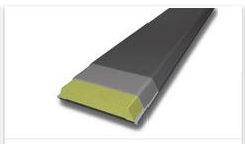
Internals of the Pro Mountain Fire Ski (Fischer)

From Fischer’s image above, the yellow center material is wood. This wood core is assembled from long strips of a hard wood like birch ash, or maple (Ski Construction). This gives the ski strength, while allowing it to flex along the long axis created by the wood. Around the wood, in grey, is a fine layer fiber glass, both waterproofing the ski and binding the wood tightly in place. From there, the black top and bottom layers are added to ski on. The image below shows these outer layers in more detail.

Extrusion of Ski Layers (Ski Construction)

From the above, the blue layer at the top is the plastic that covers the top of the ski, while the bottom layer is now more visible, along with the metal strips that line the bottom edges. This black material is polyethylene plastic of various concentration (Ski Construction). This adheres nicely to wax, which is what provides low enough friction to glide on the snow.

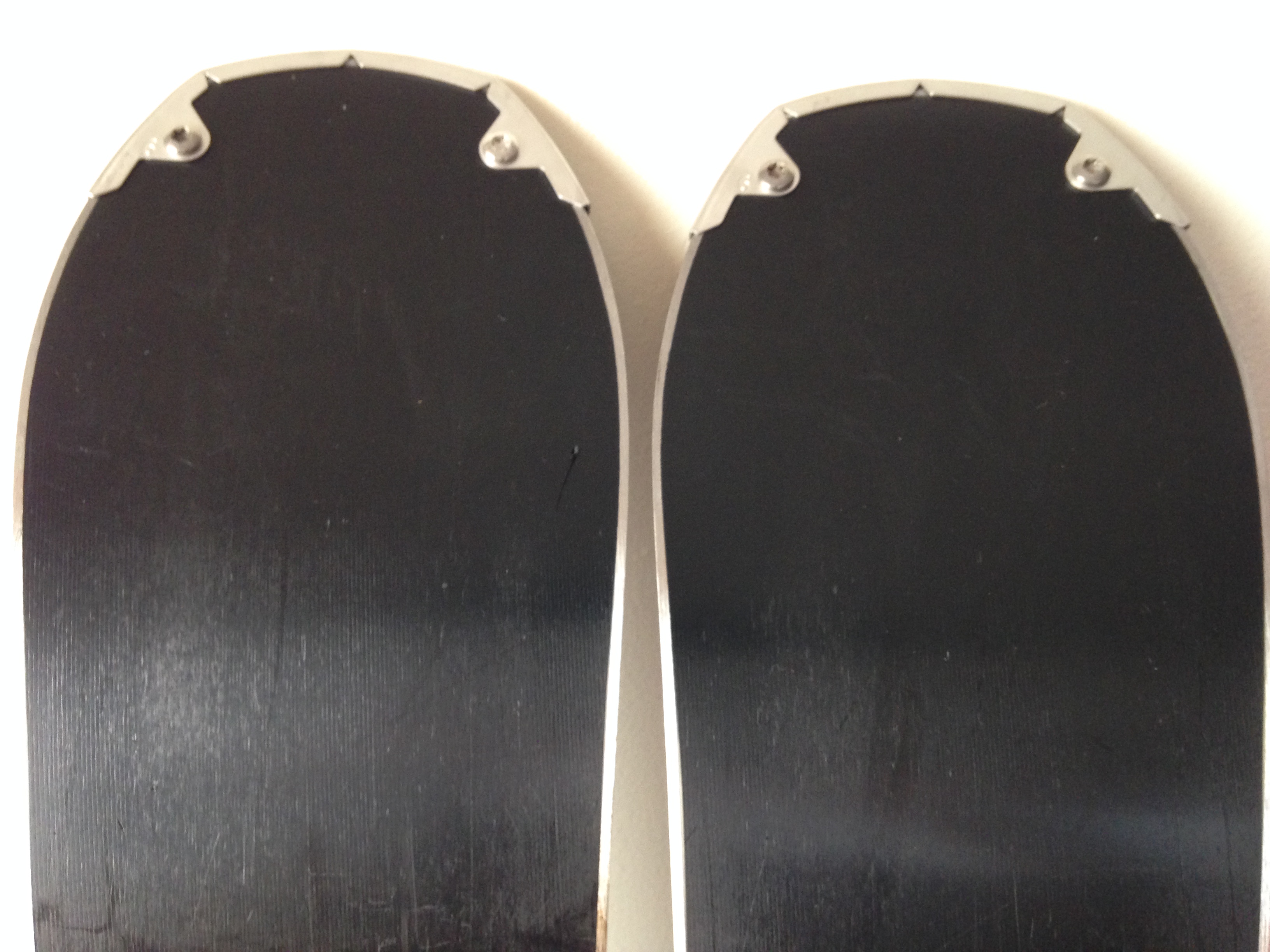
Slightly Damaged Ski Wax

The polyethylene layer completes the ski and is clearly visible in its almost pitch dark black, however, it has a sheen provided by the layers of wax on it. In this particular picture, some grooves are evident in the wax; wear that comes naturally with use over a long period, and in this case has appeared in short order from ill-fated off trail adventures.

Fischer is mainly recognized as a nordic ski company, and brand recognition from using them in the past probably contributed to my decision to buy my downhill skis from them as well. Fischer skis are made in their factory location in Innkreis, Austria (About Fischer), and this particular pair shipped overseas to an Amazon warehouse in Pennsylvania before arriving at my doorstep this December.

Quite a lot of materials go in to making a pair of skis, and thinking about where the wood, glass, wax, metal and plastic were made and then shipped to Austria for assembly really does give me a new perspective on both the amount of effort that went into making them, and how many different places the money I spent on them ended up. Perhaps next time I’ll think twice about chopping them up on the glade terrain.

Works Cited

Fischer. “Fischer Pro MTN Fire Skis w/RS 9 GW Bindings Mens .”   Amazon, Amazon, 2019, http://www.amazon.com/Fischer-Fire-Skis-Bindings- 160cm/dp/B07HH2DJJZ/ref=sr_1_138?s=outdoor-recreation&rps=1&ie=UTF8&qid=1544410428&sr=1-138&refinements=p_85:2470955011,p_36:20000-50000&th=1&psc=1.

“Ski Construction.” Ski Construction – Ski Equipment – Mechanics of Skiing, Mechanics of Sport, http://www.mechanicsofsport.com/skiing/equipment/skis/ski_construction.html.

Fischer Sports. (2019). About Fischer. [online] Available at: https://www.fischersports.com/us_en/explore/company/about-fischer [Accessed 4 Mar. 2019].

Looks can be Deceiving

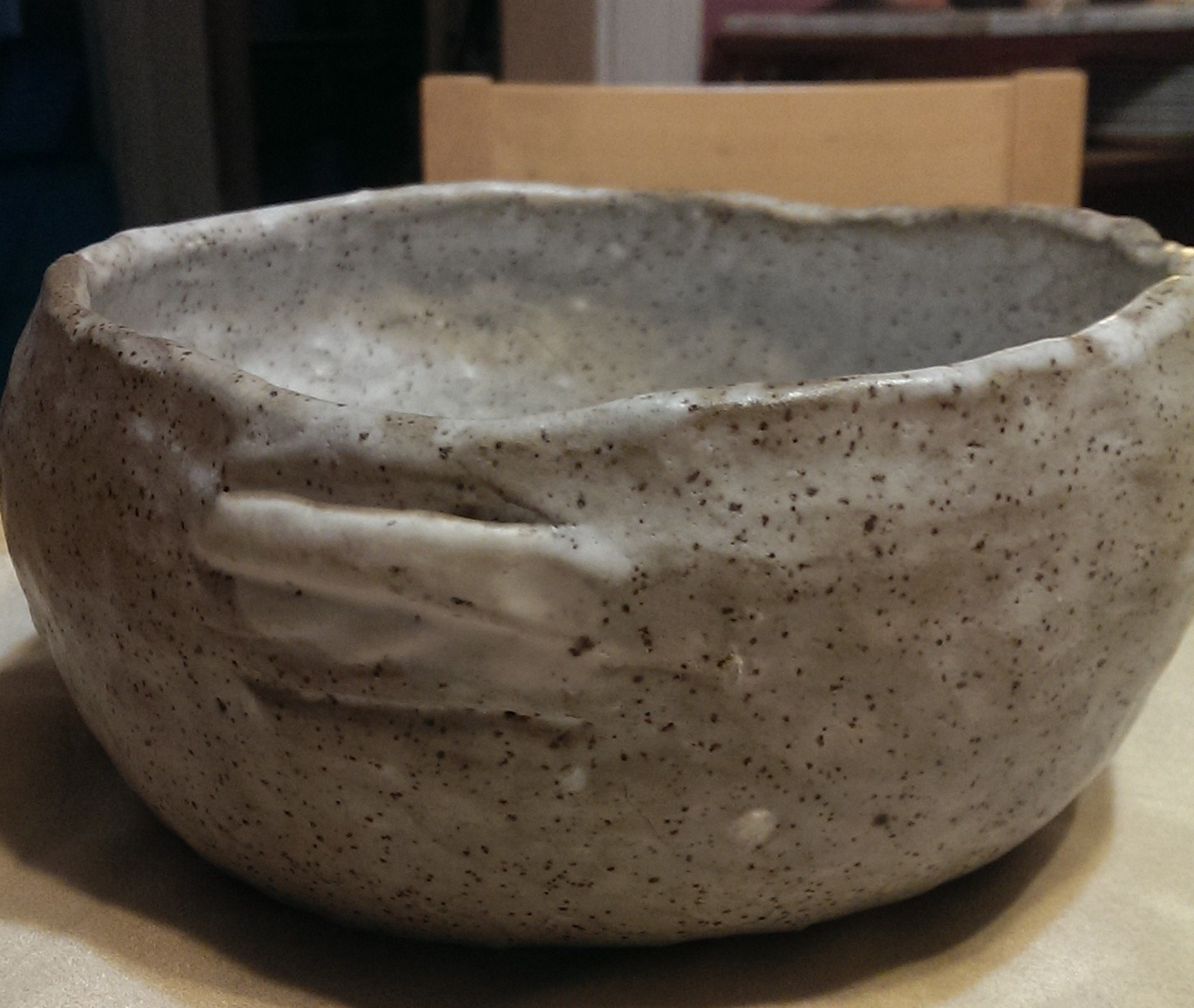
It’s a bowl. It sits on a shelf in my library, catching a son’s pants pocket contents. Weighing in at three pounds, it is approximately nine inches in diameter and three and half inches deep. The vessel started as a block of brownish red clay, shaped into a circle. Not created on a pottery wheel, it was formed by hand with coils of clay, rolled out and wrapped on and upward from the slab, added two to three rounds at a time, then covered in plastic wrap to stay moist. When the desired height was achieved, the ropes were smoothed by hand. With a day’s worth of drying time in between, the bowl took about a week to form. Once the desired shape was completed, the piece was thoroughly dried.

The completed vessel.

With this step completed, a glaze was chosen which was made of lime, talc, manganese, feldspar, zinc, and tin, the last ingredient making the glaze white. Everything was mixed together in a bucket. The bowl was dipped one half at a time. With the clay being so absorbent, one needed to move quickly in the application, wiping off the liquid so it didn’t coat the vessel’s base. The lead free glaze ensured the bowl would be food safe. The piece dried for one to two more weeks, kiln fired for 24 hours, cooled for another day, then removed from the oven. Although the surface was dull, the final result was similar to a glass coating.

The white band where the glaze dip overlapped.

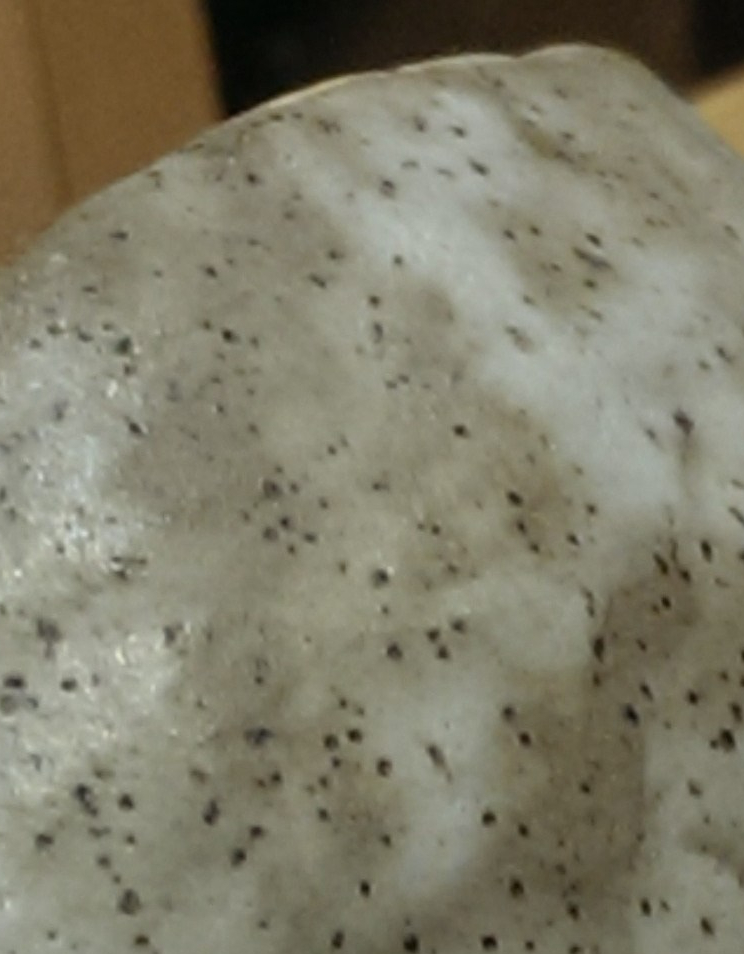
Upon closer inspection, the bowl definitely looks handmade. It is quaint and rustic. It’s finish is uneven: a little white, a little beige, with darker brown speckles. A small area by the rim has some of the coils peeking through a whiter, glazed area. Running one’s hand over the bowl, it feels cool and a little uneven. There are no chips or areas of wear. It is sturdy but would break if dropped.

A closeup of the glaze.

So you might be wondering, why write about this piece of pottery? What makes it so special? The thing is, it was made by my late mother, Ute. She left very few things behind when she died. This bowl is precious to me because it came from her hands. As she smoothed the clay roping, she left imprints of her fingers in the surface, especially around the base and the rim. This is similar to hand forming the edge of a pie crust. The added bonus is her signature in its base.

Mom’s signature.

I was able to gather this information about how this bowl came to be during a visit with my mother’s best friend Lynne, on what would have been my mom’s 77th birthday. Lynne is a professional potter. For the last four decades, she has created pieces in clay and porcelain almost daily. The quality of her work is truly extraordinary and art gallery worthy. She taught my mom all facets of this craft and happily shared her recollections. We laughed, cried, and remembered just how one-of-kind Ute was. This vessel holds more than odds and ends; it overflows with memories. I hope it ends up with one of my children, a gentle reminder of a grandmother they never got to meet, but who’s known to them through stories, photos, and a lovingly handmade earthenware bowl.