Philip Hasbrouck’s “Nice Cyphern Book”

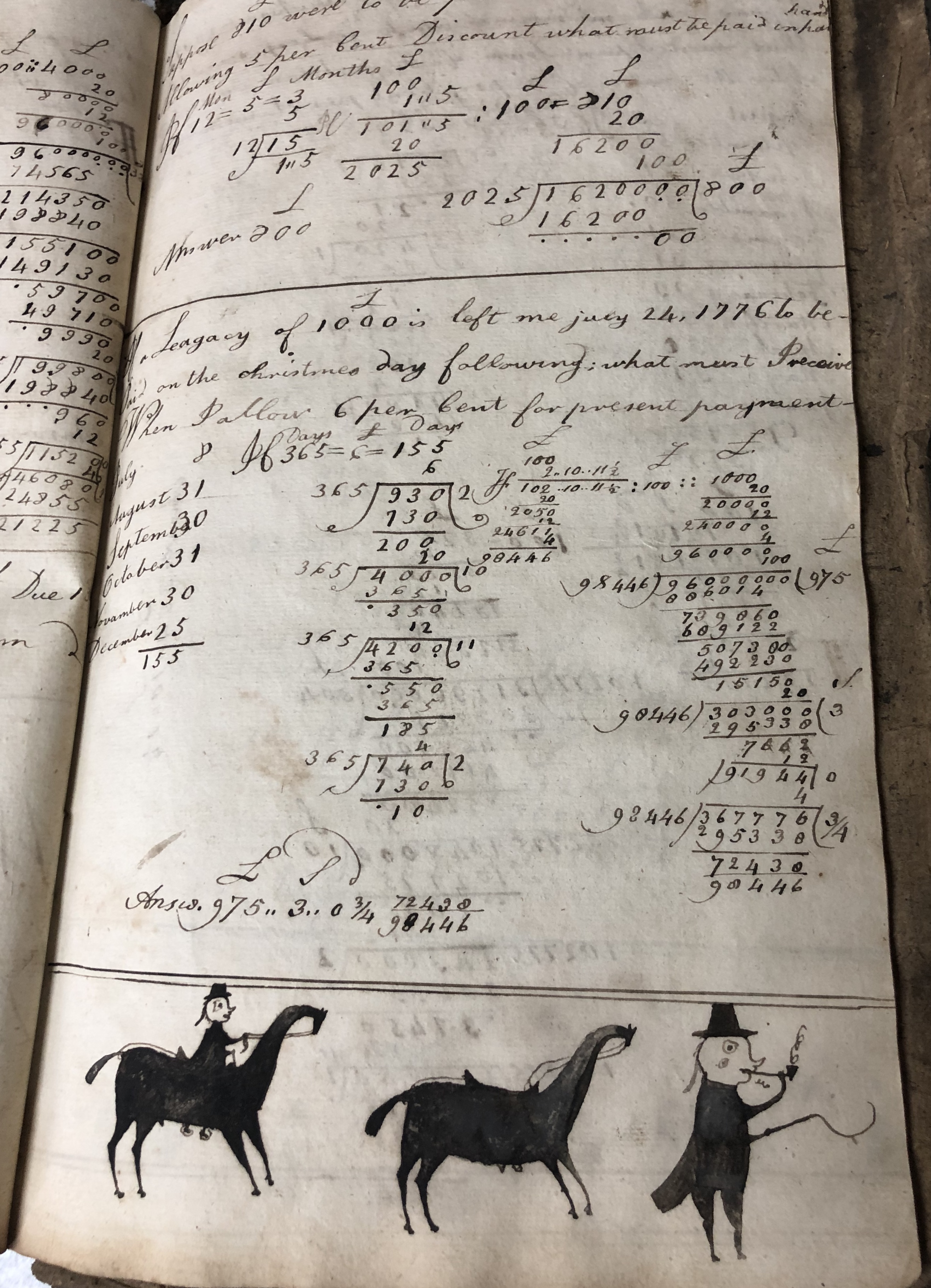
This ciphering book belonged to young Philip Hasbrouck in approximately 1796. Beneath the battered, unassuming, faded cover bearing the words “Philip Hasbrouck, His Nice Cyphern Book” are 132 beautifully preserved pages containing his journey through arithmetic, his learning of the business practices of the time period, and his fascinating doodles.

A common thread that can be traced across years and years of history is the education of children. In the time of the Huguenots, they focused on “the three R’s”: reading, writing, and ‘rithmetic, and their educational system was heavily influenced by religion and matters of daily life. On a surface level, this ciphering book only contains Philip’s mathematical exercises and problems; however, diving deeper into the content of this book reveals a great deal about what was considered valuable to teach to children in the New Paltz community in the late-18th century.

Physical Description: The ciphering book is unexpectedly big, and certainly larger than most academic notepads or workbooks used by students today. It is about 12 inches long, 7 inches wide, and less than .5 inches thick, although it is likely the book has been compacted by time and years in storage. The stained and rumpled cover is rough to the touch and feels like a thin cardboard material. The edges of the cover are crinkled and furled, even a bit torn in places, with brown string running through the edges and through the center of the book to serve as binding. The inner pages of the ciphering book are stiff and yellowed with age, and some are stuck together. Despite some watermarks, fading, and ink bleedthrough between pages, the interior of the book is much more well-preserved than the cover and is nearly all clear and legible with Philip’s lovely sweeping script. The bottom right corners of the pages are the most crumpled, suggesting the repeated turning of these pages by Philip, his teacher or tutor, and the many researchers long after, leaving the corners bent and well-used.

Provenance: After its ownership by Philip Hasbrouck, it is difficult to trace this book’s journey. Who felt the need to keep a child’s math problems? Where was it kept? How did it get passed on? It is impossible to be certain of all the answers. We only know that after Philip Hasbrouck’s completion of his ciphering book, it somehow fell into the hands of brother and sister Robert Stokes and Mary Jensen Stokes years and years later, who donated it to Historic Huguenot Street in 2016 after finding it in storage in their family home. The brother and sister have also donated a couple of other artifacts to HHS.
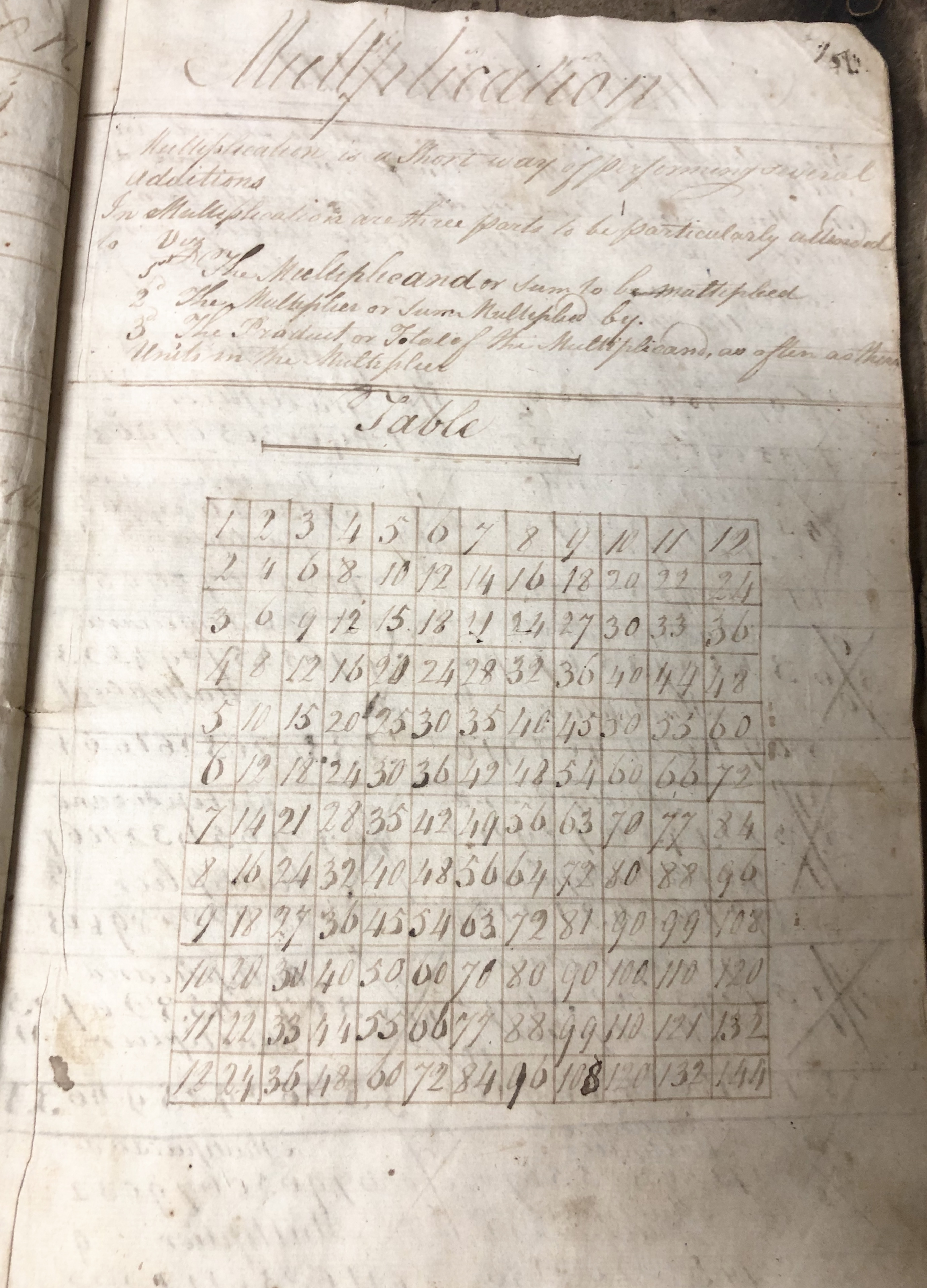
A page on Multiplication, with a table just like today’s multiplication charts

Narrative: Born in 1783 to Joseph Hasbrouck and Elizabeth Bevier, Philip was the great-great-grandson of Abraham Hasbrouck, one of the Patentees and original settlers of New Paltz. It is unclear when Philip first began writing in the book; there may be a date on the cover, but it is impossible to make out. However, one of the pages later on in the book is dated August 1st, 1796, when Philip would have been 13. It is possible that he owned his workbook for a couple of years as he progressed through his math studies. The ciphering book begins with the definitions and practice of the basics: addition, subtraction, multiplication, and division, all exactly the same as how these topics are taught now. There were also the same categories of math, with pages titled, “Of Dry Measure,” “Of Liquid Measure,” “Of Time,” and “Of Money” (though this unit of measure was concerning pounds and shillings), but there are some classifications that seem specific to the time period, such as, “Of Land Measure,” “Of Winchester Measure,” and interestingly, “Of Wine Measure.” Philip’s application examples are largely focused on land, business, and commerce, including problems about selling sheep, purchasing bushels of wheat, measuring the acreage of a ranch, or making sale deals with other merchants. As the book continues, Philip moves on to more complex lessons about types of interest, discounts, rebates, barter, and “brokage,” the definition of which includes a mention of selling goods to “Strangers or Natives.” This made me wonder if the New Paltz community in the late-18th century was still dealing in trade with the local Native Americans, or if they simply saw fit to include this in education. This ciphering book, along with records of the Hasbrouck family accounts, seem to demonstrate that “the economic goals of the settlers in New York’s mid-Hudson River valley and their descendants included meeting annual subsistence needs, increasing the comfort level of daily life, accumulating land, and passing on a legacy to heirs” (Hollister & Schultz 143). Philip’s concrete, realistic arithmetic exercises illustrate the importance of learning the ins and outs of engaging in business and being a merchant, perhaps especially so for a Hasbrouck, whose family store was still operating during Philip’s time.
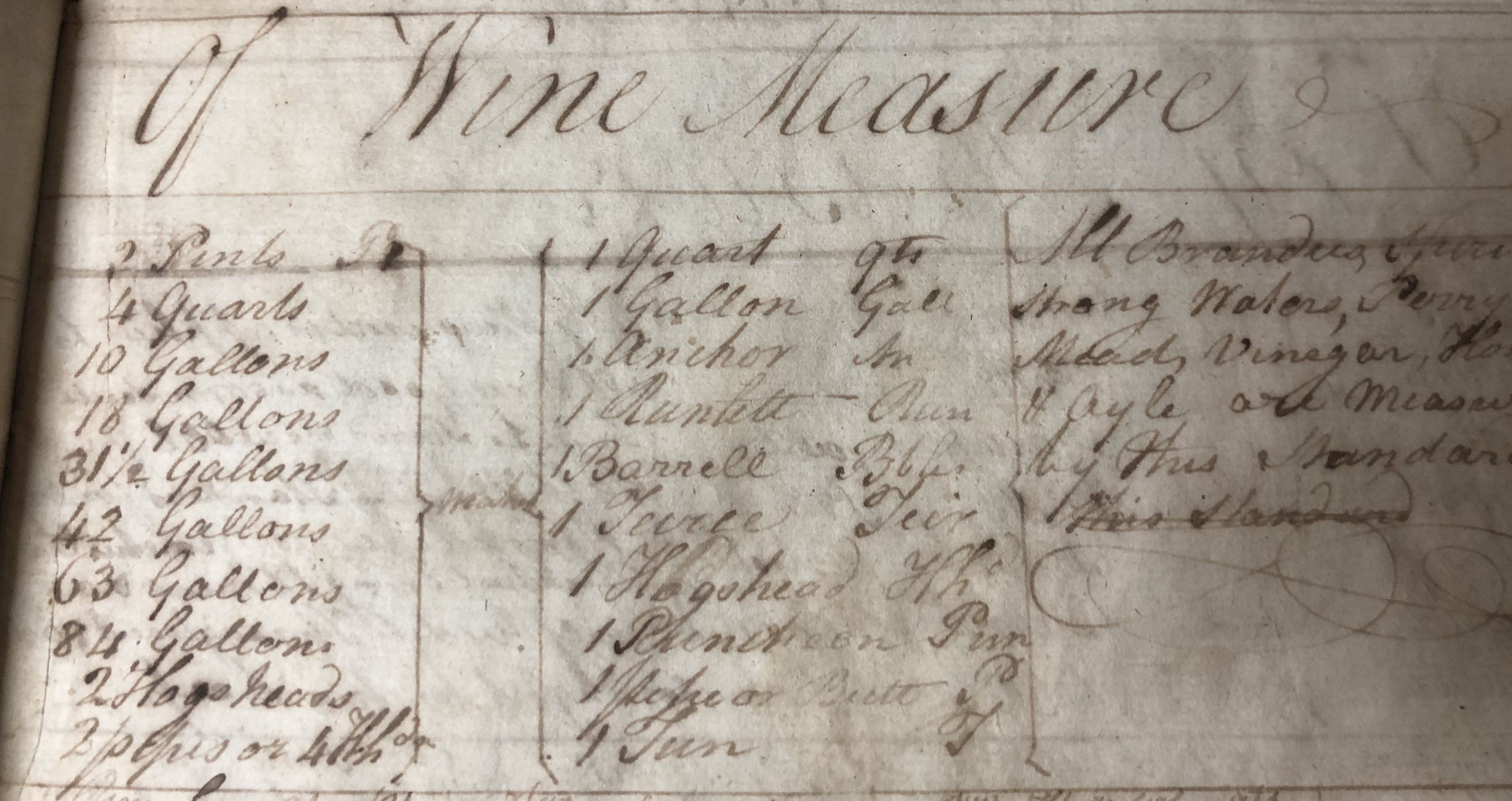
“Of Brokage” definition, dated 1796; it reads, “What is Brokage. It is an Allowance made to Persons called Brokers at a certain rate per Cent. For finding Customers and selling to them Thee Goods of other men, whether Strangers or Natives.”
A problem relating to merchants: “1. My father sends me word that he has bought goods to the value of [money amounts] upon my account. I demand what his commission comes to at 3 1/2 per cent”

Religion makes only one appearance in Philip’s ciphering book, but the reference is concise and incredibly apparent. Tucked in a neat little box in the middle of a page full of numbers is the following passage: “Philip Hasbrouck is my name and guilt is my station / this earth to be my dwelling place and Christ to be my salvation. When I am dead and gone and all my Bones are rotten / when you see remember me that I am not Forgotten – Philip Hasbrouck.” The rather random placement of this religious excerpt in the midst of Philip’s math problems was incredibly interesting to me and brought up a lot of questions: Did the schoolteacher tell him to write it? Did the whim merely strike Philip? The rhyme is both catchy but foreboding, especially for a child, but it may have been inspired by the study of bible verses. During this time period, many families required their children to “learn to ‘read the Bible and write a legible hand’ by the time they reached adolescence. Reading and writing not only reinforced the child’s religious life, but they suggested a mastery of the fundamental skills needed to pursue further self-directed study” (Volo & Volo 97). Philip’s beautiful cursive suggests a great deal of writing practice. (Funnily enough, however, some of his entries contain misspellings, unnecessary words, lack of punctuation, or missing letters; the aforementioned example, if you look closely, is missing the “T” in Christ, so it reads, “Chris to be my salvation.”)

Philip’s religious entry
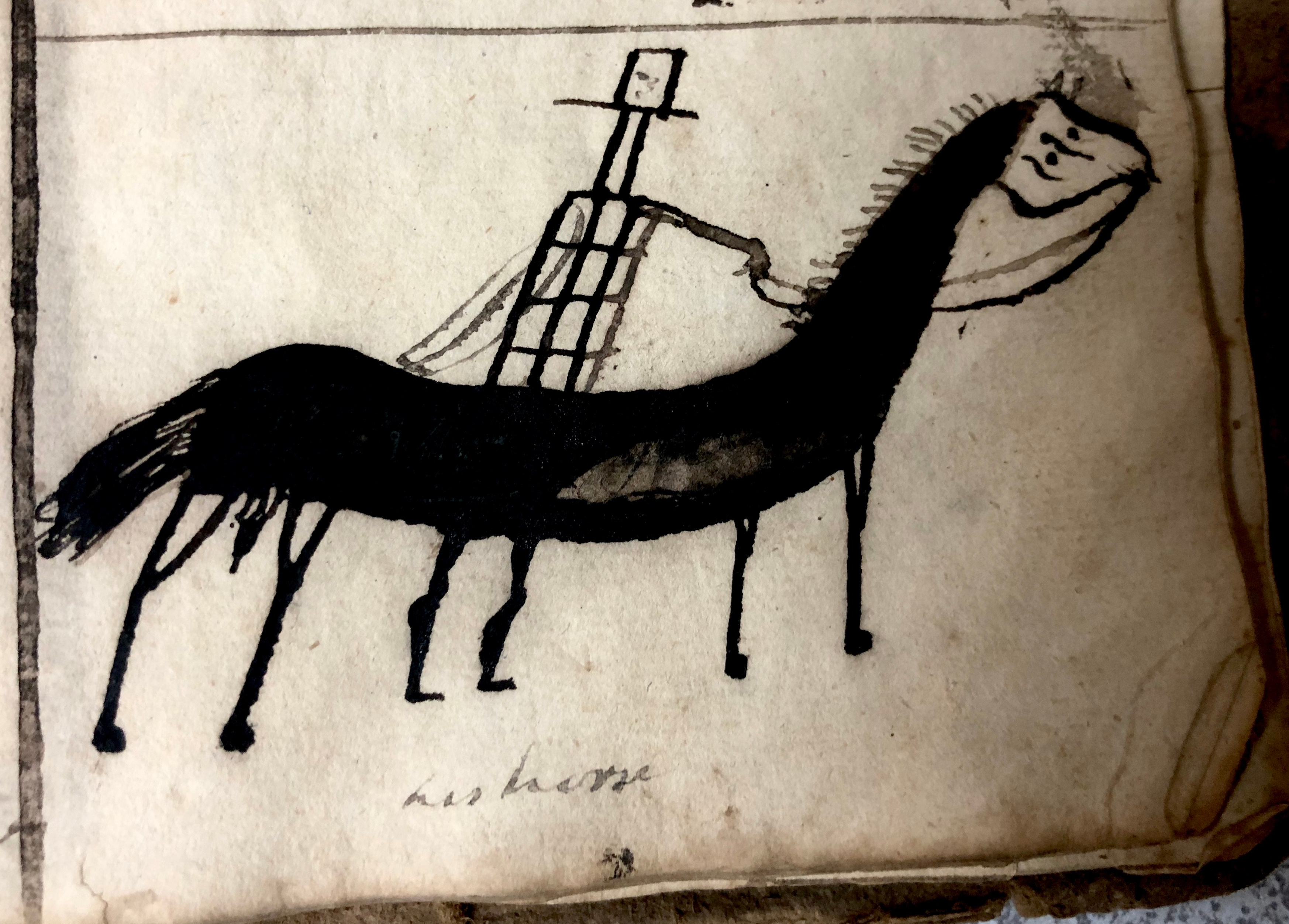
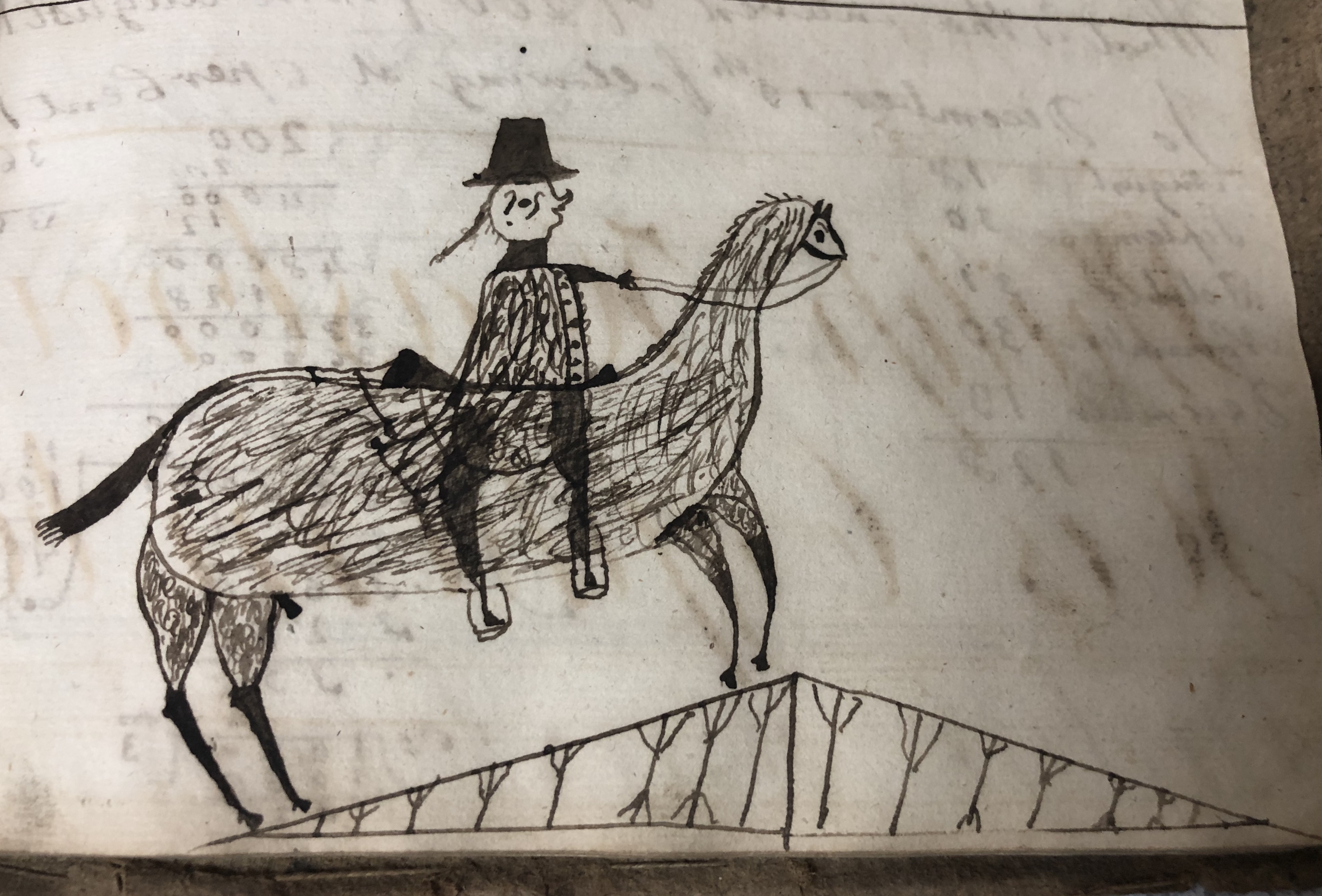
Helpfully labelled “his horse” by Philip

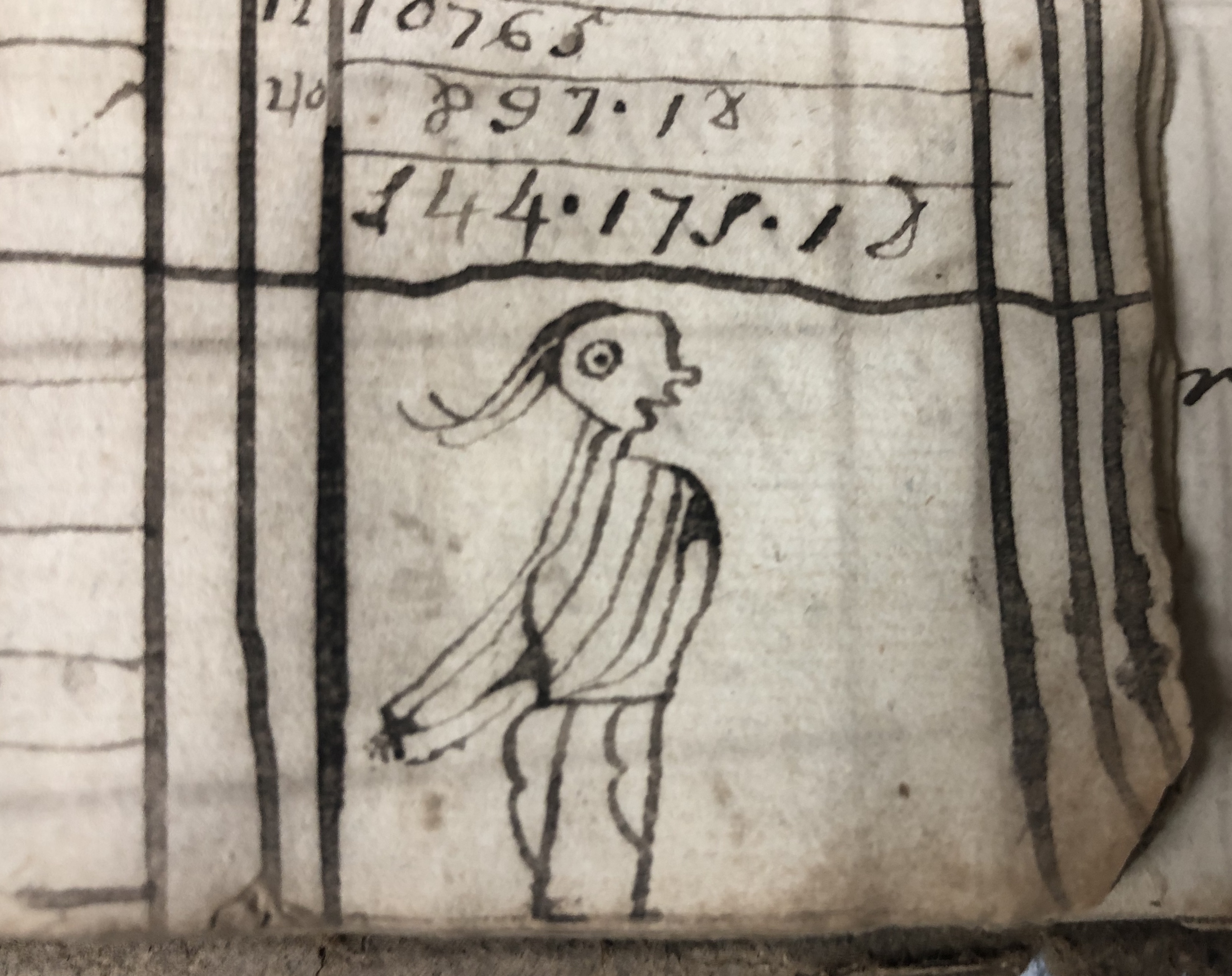
Although clearly a diligent student, the abundant doodles throughout the book are a testament to Philip’s occasionally wandering mind. For me, looking through this book was such a strange experience; its characteristics and content seemed so foreign to my conception of what education is like, and his doodles seemed to lend a bit more humanity and authenticity to the artifact. Seeing his small pictures that appeared more frequently the further I delved into the ciphering book, I was able to more fully reconcile with the fact that a child held this book in his hands, once, and wrote in it, did his math problems, likely became frustrated or tired at times, and turned to drawing in fits of boredom. It seemed that Philip’s favorite things to draw were horses and men, and they have various (sometimes silly) appearances. Some of the men smoke pipes or are holding whips in front of horses, and they are often well-dressed, with long hair and wearing tall hats. I wondered if his doodles spoke to his perception of the men around him, of their activities, and perhaps what it meant to “be a man” in his community in this time period.
A series of men; two smoke pipes and the middle appears to be playing a violin
It looks like Philip tried to scribble out his writing next to this drawing; “Philip Hasbrouck” written down one column, and down the other: “There he Stands Sir he is a gentleman”

Reading through this book was a thought-provoking and surprising learning experience, with the curiosity that was evoked by all that is contained within the ciphering book’s pages. I was struck by the types of problems Philip completed; they were certainly more applicable to his world and his daily life than the kinds of problems we do in math classes today. I also was fascinated by the religious rhetoric demonstrated and how it compares to the separation of education and religion in public schools now; to see the religious passage merged right in with his arithmetic exercises suggested just how deeply intertwined the two were for New Paltz citizens in the late-18th century. As it turns out, his education served him well; young Philip Hasbrouck grew up to be a farmer and merchant, and in 1832, he was part of a group of New Paltz residents who received the deed to a property upon which they would build a Dutch Reformed Church. Exploring Philip’s doodles made me feel as if I could relate to him, a child of the 1790’s. It was comforting, in an odd way, to realize that although the education was incredibly different from the way it is now, the minds of children remain the same, transcending time. His drawings, however, also raised some questions: What would the doodles of a child who was not as well-off as Philip look like? What would a young girl be drawing? After investigating what I thought, quite frankly, might be a mundane representation of old-time education, I was thrilled by the information and insight that can be gleaned from a young boy’s writing in his school book from over 200 years ago.

References:

“Guilford Dutch Reformed Church Records (1832-1930).” Historic Huguenot Street, Huguenot Historical Society, www.huguenotstreet.org/guilford-dutch-reformed-church-records.

Hasbrouck, Philip. Ciphering Book, 1796.

Hollister, Joan, and Sally M. Schultz. “Single-Entry Accounting in Early America: The Accounts of the Hasbrouck Family.” Accounting Historians Journal, vol. 31, no. 1, June 2004, pp. 141–174. EBSCOhost, doi:10.2308/0148-4184.31.1.141.

Salton, Meredith. “A Child’s Ciphering Book.” Object of the Week, Historic Huguenot Street, 15 Aug. 2016, hhscollections.wordpress.com/2016/08/15/a-childs-ciphering-book/.

Schenkman, A.J. “Philip Hasbrouck’s Account Ledgers.” The Gardiner Gazette, The Gardiner Gazette, gardinergazette.com/article/philip-hasbroucks-account-ledgers/.

Volo, James M., and Dorothy Denneen Volo. Family Life in 17th- and 18th-Century America. Greenwood Press, 2006.

The Not So Sunny Side of Historic Huguenot Street

Collars are objects that we often associate with animals, specifically dogs, in order to keep them constrained and close to their owner at all times. In modern times, it is rare that we associate collars with the containment of human beings, yet this inhumane act of cruelty is exactly what happened on Historic Huguenot Street throughout the 18th century.

E. Hardenbergh Slave Collar
The slave collar on display on Historic Huguenot Street. It first went on display publicly in 2016, after Joseph McGill, founder of the Slave Dwelling Project, came to town to spend a night in the slave quarters in the Abraham Hasbrouck House. Engraved in the collar is the name, E. Hardenbergh.

Physical Description

The object I chose to contribute to this collaborative history project is the slave collar that was shown in the Abraham Hasbrouck House. The slave collar that is part of the Huguenot street collection is made of steel and brass. There is a label on the front and a lock on the back that can be tightened based on the circumference of the wearer’s neck. The label is engraved with the slave owner’s name, “E. Hardenbergh,” in neat cursive. There is a peculiar decorative element to the label, with pointed arrow-like symbols engraved around the border. The label is attached to a thick chain link, to ensure security of the collar while in use.

Provenance

The name on the collar, “E. Hardenbergh,” refers to Elias Hardenbergh, son of Abraham Hardenbergh who was the Supervisor of the town of New Paltz from 1751-1761, and then again in 1770 (Le Fevre, 456-457). Elias Hardenbergh was also a relative of Colonel Johannes Hardenbergh, who was a citizen of Swartekill, NY, and owned seven slaves according to the 1790 United States Census. According to the John Jay School of Criminal Justice’s New York Slavery Records Index, Johannes Hardenbergh was the owner of two slaves named Elizabeth “Mau Mau Bet” and James Baumfree, who had a daughter named Isabella. Isabella Baumfree would later change her name to Sojourner Truth.

According to information provided by the Historic Huguenot Street archives, the slave collar was given as a gift from Andrea Coons Foster in January 2010. Preliminary research suggests that Coons Foster is a descendant of a family associated with Huguenot Street. Something that I found interesting was that despite the collar being donated to the historic site in 2010, it wasn’t displayed publicly until 2016. I’m curious as to why the Huguenot Historical Society waited so long to display the collar.

Narrative

Studying and analyzing history almost always guarantees a look into the darker sides of society. Throughout history, there have been many horrific occurrences that make us question how these things could have possibly happened–slavery being one of them. Slavery can be defined as the process of taking ownership over another human being and forcing them to do laborious tasks without their consent. When discussing slavery, minds tend to travel to Southern plantations, where large quantities of slaves were forced to work. While slavery did run rampant in the South, it existed in Northern states as well. Geography aside, the implementation of slavery has undoubtedly influenced racial discrimination and prejudice, both which are still impacting us today. These discussions are important because it directly impacts the black experience in the United States of America, something that I, as a white woman, will never fully understand. After slavery was abolished, black citizens had a hard time understanding their place in American society. W.E.B. DuBois described this phenomenon as a sort of “dual-consciousness,” in reference to the difficulties in identifying as both “African” and “American,” (Groth, xvi).

How does this tie into New Paltz and the Mid-Hudson Valley? At the end of the eighteenth century, New York had the highest population of slaves in the North. Three-fifths of these slaves worked in the Hudson Valley (Groth, xvii). The kind of work that was performed included farming, tending to orchards, trade work (blacksmithing, carpentry, tailoring), and domestic work for female slaves. No matter the labor, none of it was easy. Closer to home, Sojourner Truth was considered “more valuable than a man” because she could perform not only domestic labor but also agricultural labor that brought her to outdoor fields (Groth, 8).

Who wore this collar? How did they feel when they wore it, and then when it was taken off? A collar is not only a tool to physically constrain another being, but it can also be seen as a symbol of power and dominance, similar to handcuffs. However, using a collar on a human being is extremely dehumanizing, more so than handcuffs will ever be. According to the Smithsonian National Museum of American History, slave collars were used as a disciplinary method of identifying slaves who were considered risks of becoming runaways.

It is difficult and maybe a bit painful to consider the founders of New Paltz as slave owners. Yet, that was not all they were. While it is important to recognize this side of the story, the founders of New Paltz were also pioneers, entrepreneurs, and established a lasting community in the Mid-Hudson Valley. We get a firsthand account of a Huguenot Street descendant’s thoughts on this harsh truth in a Press Release from the Historical Huguenot Society. Mary Etta Schneider recalls the reason behind the French Huguenots’ arrival in New York– to escape torture, enslavement, and murder. Yet, she reflects on her ancestors doing these exact things to their slaves, something she admits to being ashamed of.

It’s important to tell the story of slavery in the North, because many people believe it didn’t happen or that it wasn’t as extreme as it was in the South. Especially with the recent activity involving the name changes of buildings on campus, I believe diving into the history of slavery in New Paltz can be enlightening, heartbreaking, and extremely informative.

References

Benton, Ned. “Sojourner Truth – Identifying Her Family and Owners.” New York Slavery Records Index, John Jay College of Criminal Justice, July 4AD, 2017, nyslavery.commons.gc.cuny.edu/2017/07/04/sojourner-truth-identifying-her_family-and-slave-owners/.

Groth, Michael E. Slavery and Freedom in the Mid-Hudson Valley. SUNY Press, 2017. EBSCOhost, search.ebscohost.com/login.aspx?direct=true&AuthType=ip,url,uid,cookie&db=nlebk&AN=1514879.

Le Fevre, Ralph. History of New Paltz, New York and Its Old Families (from 1678 to 1820): Including the Huegenot Pioneers Who Settled in New Paltz Previous to the Revolution. Fort Orange Press, 1903.

The Price of Freedom: Slave Collar, Smithsonian National Museum of American History, amhistory.si.edu/militaryhistory/collection/object.asp?ID=698.

United States, Congress, “Heads of Families at the First Census of the United States Taken in the Year 1790.” Heads of Families at the First Census of the United States Taken in the Year 1790, G.P.O., 1908.

Historic Huguenot Street Press Release
https://www.huguenotstreet.org/news-release-slave-dwelling-projects-mcgill-to-shine-a-light-on-northern-slavery-ownership

The Quilts of Huguenot Street

Quilts in History

The Civil War in America saw a major uprise in the production and ownership of quilts. After President Abraham Lincoln signed the Homestead Act in 1862, westward expansion began. The idea of the west proposed such an ideal way of living; it offered new land, new opportunities, and a new life. To many, it was like arriving in a New World all over again. However, westward migration was not something that happened immediately. Pioneers who sought to take the journey spent months, if not years, preparing. The need for clothing and blankets became a dire necessity and no one went anywhere anymore without a sewing kit. Those who were making the migration were told to bring 2-3 blankets or quilts. Quilts became a commonality, not only with the pioneers, but also with the people after they settled. They had proven to be incredibly versatile, serving as quilted blankets as well as cloths, rags, and other types of fabric needed for daily use.

As this was going on, quilts began to serve a greater purpose than merely providing warmth and convenience. Those who sewed these together began to embroider them as well. Scenes were sewn into the textiles of these quilts, telling stories such as the story of westward expansion. They also began to serve the purpose of symbolizing cultural, social, and political matters. One such matter was the presence of slavery in America at the time. A group of people known as the Quakers began to use their quilt-making skills to create a quilted pattern that served as a rebellion against the institution of slavery, as well as the presence and ideals of the Confederates.

History of the Underground Railroad

The Underground Railroad was a name given to a complex network of people within the United States who commonly aimed to lead slaves to freedom. It was developed around the time of the Civil War as an effort to undermine the Confederacy and bring an end to the inhumane practice. One of the main active groups that participated in this movement was the Quakers. The word “quaker” also, unironically, means friend and these were mostly people from the Christian church united in their shared mentality that every human had the ability within them to experience God.

The term “underground” in the title of this network’s name is indicative of its desire to remain relatively unknown. Many were persecuted for attempting to aid slaves on their way to freedom, as were slaves attempting to reach freedom. As a result, it was key that the organization remained unknown to those who may appose its operations. Instead, those who were part of this network developed numerous “secretive” techniques, only meant to be understood by those who were within the operation.

Freedom Quilts

Freedom quilts were thought to be a part of the underground railroad that worked in disguise to lead slaves to freedom. The quilts were usually adorned with some sort of arrow shaped pattern. This was a common pattern regardless, but when hung outside of one’s house they became directional symbols, pointing the way to freedom. Since quilts were such common objects to have hung outside of one’s home, this method was able to remain undetected, so much so that historians still do not have concrete evidence that this was the main purpose of these quilts. However, despite the lack of the facts, the idea is still an incredibly interesting one and sheds light on the truth of our history and the hardships that slaves dealt with, as well as the extreme methods they needed to pursue to obtain their freedom.

Huguenot Quilts

Huguenot Street has a rich collection of similar quilts, all of which tell a story about the history of the Huguenots and the town of New Paltz. Located in their “commemorative quilts” section of their website, Huguenot Street is in possession of a quilt which is titled the Tercentenary Quilt. This quilt is comprised of thirty-five textiles stitched onto a blue fabric background. This contrast works to make the textile images pop. The Tercentenary Quilt is an example of an album quilt. More specifically, this design is officially known as the Baltimore Album Quilt, a style that, as evident in the name, originated in Baltimore, Maryland during the 1840s and are well-known to tell stories within their designs.

The Tercentenary Quilt was created by thirty-five women as a celebration of the three hundred year anniversary of the New Paltz settlement. As evident in the image below, each block tells a little story about New Paltz’s history. They include the first church built in the town, the Huguenot cross, the Bevier-Elting house, the Walkill River, and many more. This specific quilt is rich in stories and histories, so much so that the object itself has become a historic item, for it serves as a reminder of where Huguenot Street comes from and the stories behind their origin.

This is the full image of the Tercentenary Quilt, part of the collection located at historic Huguenot Street. Hand embroidered, it consists of thirty-five squares, each depicting different aspects of New Paltz’s history. When looked at closely, you can see the individual stitch that was created by one of the sewers. As opposed to a quilt that may be made today, this quilt clearly shows that it was handmade due to minor errors such as slightly crooked textiles and uneven stitching. Nonetheless, this element gives the object a more authentic feel. It was created in 1978.

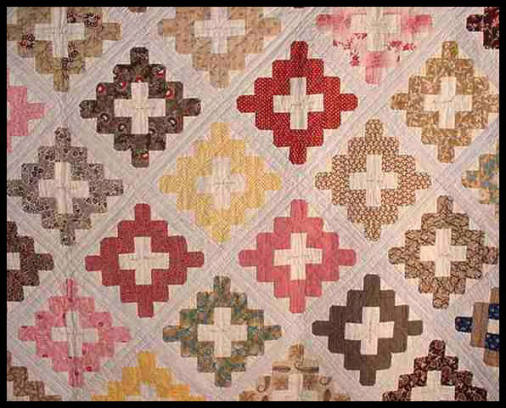
The Huguenot Quilt Collection also includes a section called “friendship quilts.” These are collective quilts that were passed down through family lines as a way to commemorate the family members that came before them. One such quilt is The Duboisville Friendship Quilt.

This is a full image of the Duboisville Quilt. Similar to the Tercentenary Quilt, this object is comprised of a repetitive pattern that was hand stitched together by multiple hands. The colors used are very natural and subdued, giving the quilt an earthly vibe. It was created in 1859.

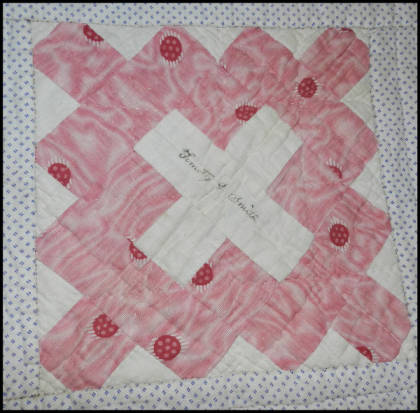
The appearance of this quilt varies greatly from the previous stated one, despite its simple repetitive pattern. This quilt includes brights colors such as reds and oranges, rather than predominantly using blue fabric. However, the significance of this object lies in the signatures that are present within the quilt. In the middle of each diamond-shaped design, as shown in the images, is a signature of who is presumed to be one family member.

As shown in this close-up image, you can see that there is a faint signature in the middle of this textile. The signature is said to belong to one of the family members, either commemorated in this quilt, or one of the ones who worked on its creation.

The significance of this object lies in it’s connection to the legacy of the DuBois family. The DuBois family history is rich within the history of New Paltz and Huguenot Street. Descendants of Chretien DuBois and his wife Francoise le Poivre, the DuBois family found their way to American, and eventually Kingston, after years of attempting to escape persecution in Europe. After finally settling in New Paltz along the Wallkill River, the DuBois family began to lay down a legacy that remains prevalent today. The preservation of these quilts and the names of the family members that are embedded within them serves as a reminder of just how deep the history of Huguenot Street lies.

Provenance

The legacy of the Tercentenary Quilt is easier to track than the Duboisville quilt, due to the fact that it was created during the seventies. Celebrating the three hundred year anniversary of the Huguenot settlement, as stated previously, thirty-five women were commissioned to create it. The woman who donated it to Huguenot Street remains anonymous, but it is thought that she is a family member of one of the women who created the quilt.

However, the legacy of Duboisville quilt leaves behind a traceable path. It was owned by a woman named Mary H. Dubois, evidently a descendant of the Dubois family. It is believed that the quilt was likely made as a gift to both Charles and Mary DuBois prior to their departure from Duboisville–a city in Michigan. Afterwards, the quilts fell into the hands of Reverend Edwin Herman DuBois, gifted to him from his aunt Elvie Dubois. Elvie was Mary DuBois’ daughter. She later then passed on the quilt to Evelyn M. Gueho. Evelyn M. Gueho is accredited with the donation of the Duboisville quilt to Historic Huguenot Street. On June 28, 1990, it became a permanent part of their quilt collection.

Narrative

Quilting is an art form that continues to serve an integral part of human history. The word quilt is derived from the French word “cuilte” with the same meaning. However, as a verb, the word quilt translates to “join together,” which serves as a double meaning to the togetherness, of not only the literal stitching in the fabric, but of the legacies and stories they tell.Upon arriving in the new world, European settlers brought the art of quilting with them. During the nineteenth century, quilting became more than just an art form in America; it became a social interaction. Women would often convene in places called quilting bees to swap textiles with one another and complete quilt work they may have been doing alone at home.

With this in mind, it is more understandable as to why thirty-five women were accredited with the creation of the Tercentenary Quilt. Seeing that Huguenot Street, and New Paltz in general, is an incredibly small area nowadays, it makes sense that the women who settled here would convene together to make quilts. It is likely that each little story was sewn on its own before the entire quilt was put together. Each woman was responsible for choosing a landmark, a person, or a family member to create their own square textile on.

The object of the quilt literally–and metaphorically–symbolizes the interwoven histories of these people. When we look at it, we are able to trace every single story that each of the female creators wanted to tell. That is the true beauty of an object, and especially a historic one: the ability to tell a story.

References

Quilts of Historic Huguenot Street, omeka.hrvh.org/exhibits/show/quilts-of-hhs/introduction.

“The Duboisville Friendship Quilt, Historic Huguenot Street.” Hudson River Valley Heritage, http://www.hrvh.org/cdm/ref/collection/hhs/id/2163.

Editors, History.com. “Underground Railroad.” History.com, A&E Television Networks, 29 Oct. 2009, http://www.history.com/topics/black-history/underground-railroad.

Editors, History.com. “Quakers.” History.com, A&E Television Networks, 19 May 2017, http://www.history.com/topics/immigration/history-of-quakerism.

“DuBois Family Association.” Historic Huguenot Street, http://www.huguenotstreet.org/dubois.

“HISTORY OF QUILTING.” Emporia State University, www.emporia.edu/cgps/tales/quilte~1.html.

“Quilt Discovery Experience.” National Parks Service, U.S. Department of the Interior, http://www.nps.gov/home/planyourvisit/quilt-discovery-experience.htm.

A Mirror Image of Magdalene Elting LeFevre

Creation: As humans we will never truly be able to see ourselves with our own eyes, we will only ever be able to see a reflection. Cavemen since the beginning of time used puddles, observing their reflection as something of magic. With evolution, mirrors were made of polished stones, eventually after the secular desire to see a reflection was understood, varying techniques to achieve this were implemented in different countries. Ultimately,  the final and most successful process involved coating glass with a metallic silver.  As society became more established and advanced, mirrors became an object richly sought after, used both for practical purposes and as demonstrated through ornate and intricate framing, as decorations. This Federal style mirror located on Historic Huguenot Street in New Paltz, New York can be found in the Deyo House Federal Bedroom.

148401.jpg

This Federal Style Mirror sits in the corner of the Federal Bedroom in the Deyo House on Historic Huguenot Street in New Paltz, New York. Its Federal Style featuring a gold eagle or pheasant wide spread across the top is reflective of America’s newfound stature in 18th century as a sovereign and strong United Nation. Though this piece is fairly small it is largely representational as a glimpse into this period in time.

Physical Description: This rectangular shaped mirror measures 35 inches in length and 16 inches in width. The frame is made of a rich colored wood, possibly mahogany, that surrounds the glass mirror piece, which is inlaid in the center of the wood. The very inner edge of the frame that is in direct contact with the glass itself is painted gold, though it difficult to distinguish due to years of wear. The wood has fretwork carvings on the top and bottom. The carvings resemble flames or torches on the top, which can be seen as symbolic of power. It is clear this wood was carved by hand due to the imperfections of the carvings. Upon close inspection, the carvings do not exactly mirror each other on either side and are not perfectly sanded, with a rough edge to them, reflecting further that this frame was created by hand. 

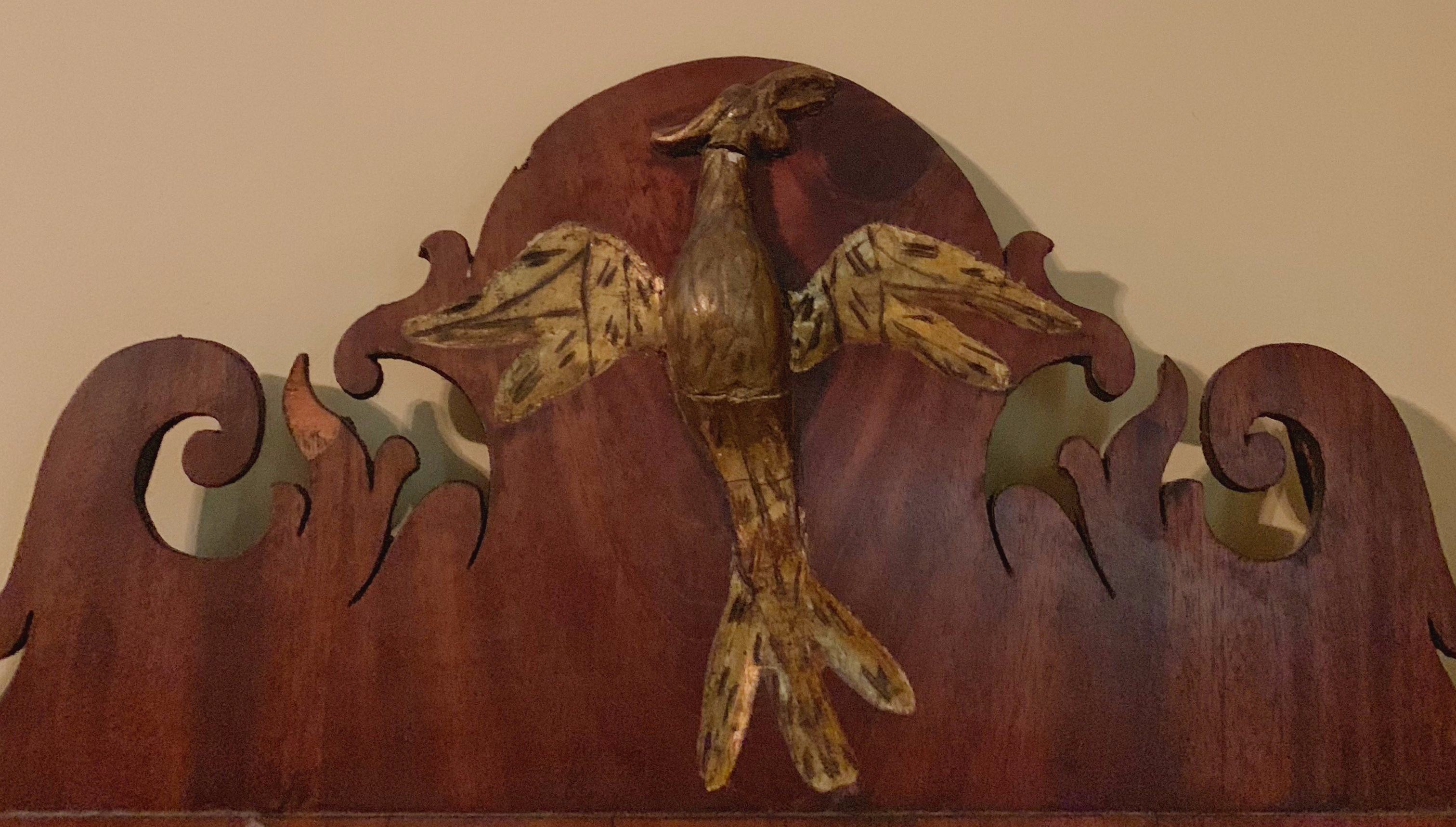
The top of the mirror features a three-dimensional gold eagle or pheasant with its wings spread broadly across the wood. The Federal era lasted roughly from 1780 through 1830 in the United States and furnishings created during this period were heavily influenced by Greece and Rome (Thurlow 2009). After the Revolutionary War and the Treaty of Paris, the United States was recognized as a sovereign nation. The eagle then became a symbol of unity — an expression for Americans to be recognized in their own way with their own values (Liebster 2012). Having a mirror in your home with this type of symbol further emphasized the sense of American Patriotism that existed within the home. 

7facf96b-fdeb-485f-83dc-c6e3221c5447.jpg

The Gold Eagle/Pheasant Spread Proud Upon the Mirror.

Provenance: This mirror has provenance with the Elting family who actually lived on Huguenot Street, so it has existed in New Paltz for quite some time. The donor of the mirror to Huguenot Street was Helena LeFevre. When she passed away in 1965, she left the mirror to Historic Huguenot Street (2013). She was a member of the Huguenot Historical Society; her donation of her things to the society paying great homage to her passion for historical preservation. Her receipt of donation entailed that the mirror belonged to Magdalene Elting LeFevre, daughter of Roelof Elting and Mary Louw, wife of Peter LeFevre with whom she had ten children.

Narrative: Magdalene Elting LeFevre was born on February 22, 1766 and died March 10, 1823. She lived in the Bevier-Elting house on Huguenot Street while she was growing up. Her father, Roelof was sentenced to prison and then exiled for refusing to accept Continental currency from a customer in addition to a land dispute. In Roelof’s absence, two of his daughters passed away. Without a father present, Magdalene had to suffer through losing two siblings.  A traumatic experience for any individual, as loss is something difficult to understand, especially at a young age. 

IMG_9258.jpg

The Bevier-Elting House. 2019.

Magdalene went on and married Peter LeFevre in 1789, where they lived on the Bontekoe farm in a stone house. According to Peter’s tax records, he ranked in the higher end of the middle-income tax bracket, though his stone house was fairly run down. It is difficult to say exactly when or how Magdalene came to own this mirror. However, it can be surmised that it was a wedding gift to Magdalene and Peter, or perhaps she came to own it through an acquisition of a similar nature. Though, there is no accessible information to be certain of this. This suggests the level of financial comfort which Magdalene and Peter lived with.

Further emphasizing Peter and Magdalene’s comfort was the fact that they owned three slaves. According to the 1798 census, Peter owned three slaves, whom were not subject to taxation. This means they were either children under twelve years of age, or that they were older than fifty. There are documents that define one of Peter’s purchases of Molly, in 1798. Were Peter and Magdalene living beyond their means? Had they purchased slaves that they could not afford, as suggested by the run down condition of their home? Peter and Magdalene’s owning of slaves while the mirror was in their home, paints a vivid picture of the time in history this mirror was a part of. A nuanced definition of American Patriotism can further be applied to the owning of the mirror. The eagle/pheasant represents American Patriotism, but it is clear that part of their American values at this time included owning other human beings. 

This mirror was likely displayed in a room where Magdalene and Peter’s guests would see it. This is because it was a reflection of their American values, ones they were prideful in. In this same room, one of the slaves they owned would likely have been responsible for maintaining the condition of the mirror.

“Molly, please see to it that the mirror is in pristine condition before this afternoon, we have guests coming.” Molly then would make her way to the room where the mirror was hung on the wall and have no choice but to stare at her own reflection as she wiped it down. It is not difficult to imagine the brutality felt by a human being who is owned, being forced to look at their own reflection while serving their owners. The reflection seen by Molly was one that forced her to embody the bitter reality that she was purchased by these people as property and existed to serve them. The reflection seen by Magdalene and Peter, or their guests was much different. Looking into the mirror they saw themselves and became enveloped by a sense of American pride and patriotism. Reflective of the attitudes of this period, where the owning of slaves was not given a second thought.

While there is not substantial information available about this mirror specifically, other than its chain of ownership, the stories of its owners and their trials and tribulations are highly reflective of the period in time this mirror was owned. This mirror stands in the Deyo Federal Bedroom as a reflection and encapsulation of life in 18th century New Paltz.


References

“Bill of Sale for Molly to Peter Lefevre : Historic Huguenot Street.” Hudson River Valley Heritage, hrvh.org/cdm/singleitem/collection/hhs/id/633/rec/6.

“Helena S. LeFevre.” Findagrave.com, Poughkeepsie Journal , 22 Oct. 2013, http://www.findagrave.com/memorial/119140830/helena-s_-lefevre.

Liebster, Amy. “Eagles After the American Revolution.” Metmuseum.org, June 2012, www.metmuseum.org/toah/hd/eagl/hd_eagl.htm.

“Peter and Josiah P. LeFevre Family Papers: ‘The Bontecoe LeFevres’ (1703-1937).” Historic Huguenot Street, http://www.huguenotstreet.org/peter-and-josiah-p-lefevre-family-papers-the-bontecoe-lefevres.

“Tax Roll, 1779 : Historic Huguenot Street.” Hudson River Valley Heritage, hrvh.org/cdm/compoundobject/collection/hhs/id/3027/rec/86.

Thurlow, Matthew. “American Federal-Era Period Rooms.” Metmuseum.org, Nov. 2009, http://www.metmuseum.org/toah/hd/fede/hd_fede.htm.

The Jean Hasbrouck House


Originally built in 1694 and later renovated around 1721, this massive stone house was an economic and social class distinction of its time. This house is distinctive because of its square form, central entrance, two room deep passage plan and flanking windows. Even with these unique features it still kept its dutch characteristics by keeping its interior exposed wood beams, jambless fireplaces and stone outer. Set currently upon one-acre of property, this 5 bedroom masterpiece also contains an attic and basement.

Creation

The Huguenots came to what we now know as New Paltz with nothing but hope and ambition to start their new lives. In 1677 they began developing New Paltz into what we know it as today (Home). The seven prominent families who are credited for developing New Paltz such as the Hasbrouck family purchased 40,000 acres from the Esopus Indians and began construction on their new life. At first they built simple wood houses but, due to the high status and wealth of these families, they quickly began construction on distinctive, more expensive Dutch style stone houses. Using more durable materials led to us being able to preserve their history and remind us that they created this town. Many of the structures and homes they created still stand today. “New Paltz is one of the most significant historic towns in New York State history and aspects of its early settlement history are of national significance” (Larson 1). Architecture and decorative arts are the two areas where Dutch culture can be seen surviving still today in the Hudson Valley.

Jean Hasbrouck intentionally created this double-wide Dutch house structure to show off his wealth in the new world. Although there is no permanent record of this due to not all historical houses being registered. It is believed that this is the only one of this kind still standing today in the United States. This house when created in 1694 set the tone for all other stone houses in this area. Although, none could compare to its size and magnificence. Later his son Jacob expanded this house. The house was used for more purposes than when it was created such as a store and also could house more family members. Today, it still stands on Huguenot street, reminding us of the significance of these brave families who came to develop the beloved town we call New Paltz today.

Physical Description

A Dutch style stone house was a tedious, time consuming process to construct. From building the basement foundation, adding the wood frames, plastering the interior, this process took months to begin to take shape. However, these houses were strong and sturdy, leaving the Hudson Valley containing some of the oldest architecture in the eastern United States. The typical seventeenth century stone house contained multiple entrances, a front façade and a steep gable roof. Although containing an attic and a basement, living was restricted to the main floor of usually no more than 3 rooms. However, Jacob expanded his home to five rooms. The houses were heated with jambless fireplaces. These fireplaces are a large hearth with no sides, venting into the chimney. (Larson 5). This is a distinctive feature of Dutch architecture. The Jean-Hasbrouck house is the only or one of the few with this structure still standing.

Dutch Stone House Significance

On top of being made of heavy materials and being a laborious process, stone houses were also costly and pretentious even those containing only one room. Stone became an emblem of wealth (Report 1.7). Stone houses were indicators of upper class status and the material gained value when this distinction of wealth and class became important in the community. Stone houses were only built wealthiest figures living in the area. The style of your house was said to show your social status. This material distinguished successful farmers and families from the everyday townspeople (Larson 4). The Jean Hasbrouck house stood above the traditional stone houses because of its size and amount of stone used to create its massive structure.

There are many similarities from the 17th century Dutch buildings discovered both in America and in Europe. Striving to make a presence in the New World community, the Dutch colonists built their iconic Dutch style houses here in America. The use of stone to build kept the Dutch homes distinct from the English and reminded the English that their Dutch culture was still prevalent even in the New World. These houses stood as a refusal to conform to English new world traditions. The Jean Hasbrouck House is one of the most impressive examples of Dutch Colonial stone architecture remaining in the United States.

Narrative

Jacob Hasbrouck renovated his father Jean’s house into a Dutch style house even more grand than the generic Dutch houses seen around the Hudson Valley. Generally plans for dutch houses were restricted to a three room maximum , one story house plans. Jacob’s house did not fall into these plans, it fell into the Large House category reserved for people generally of local importance. His five bedroom, one and a half floor home became an elite house in the neighborhood. This house stood at over twice the size than his neighbors. It is significant because the house was exceptionally large for its time and represented the Hasbrouck’s participation in the new world. While still keeping traditional Dutch culture, this design also showed his American presence. One feature that set this house apart from the other traditional houses was its roof structure and attic space. The roof frame was constructed with a complicated set of interlocking rafters, collars and braces neatly joined to create the structure and sizable attic space which was unusual for its time. Another reason the Jean-Hasbrouck house stood out amongst the other houses because of its symmetrical façades and center passage plan. It was one of the earliest accounts of this design of elite architecture in eastern America.

Provenance

Originally built in 1694 by Jean Hasbrouck as a small one-room living space, the building we see today was expanded around 1721 to serve as a store and a family house while also reminding the community of his status. While renovating Jacob still wished to keep some of the original characteristics of the 1694 design. You can still see the long oak beam in the southern part of the basement supporting the basement fireplace and a rafter on the west roof avoiding the chimney from the original 1694 house. Remainings of the original jambless fireplace and box bed can also be seen today.

The design we see today is that of his son Jacob Hasbrouck, Jean is said to have passed away before building plans were put in place. He expanded the house into its unusually large proportions. He was able to do this because his father passed all of his inheritance down to him making him unusually wealthy for his age (Larson 8). Jacob was an experienced farmer of only 34 years old. He increased the value of his father’s land through land allotments, his shop and various other ways of lending out his land. This large sum of money left to him led him to show this off through the design of this house.

Currently the sophisticated house that stands has seen no major construction since 1721. There has been work done to solely improve the conditions such as upgrading the windows and minor maintenance. In 1893 the vacant house was purchased by Historic Huguenot Street for $3,000 and the one acre of land it was set upon. 1952 interior work was done to keep it preserved. A light was added to display this historical house more. This home shows the Hasbrouck presence in society and Jacob’s large inheritance of wealth. Standing among the other buildings left, we can see its significance through its size and design even hundreds of years later.

Sources:

Crawford & Stearns. Historic Structure Report: The Jean Hasbrouck House. Architects and
Preservation Planners, 2004.

“Home.” Historic Huguenot Street, http://www.huguenotstreet.org/home.

Larson, Neil. “Building a Stone House in Ulster County, New York in 1751.” Vol. 2, 2014, pp. 1–16.

Larson, Niel. Furnishing Plan for the Jean [Jacob] Hasbrouck House. Neil Larson & Associates, 2004.


A Clock with Two Faces

The grandfather clock stands auspiciously in the entrance hall of the Deyo House, replacing a similar clock that historically would have been there. The case is adorned with columns and brass spires, coming together in a curved crown. Its early 19th century English style displays the Deyo’s American heritage and wealth. While it now tells the history of the Deyos, the clock also has its own unique story.

Description

                Made of Mahogany wood, the casing of the clock runs ten inches deep at all points, and it runs 21 inches wise at the top and bottom, narrowing slightly for the central section where its counterweights hang. The interior is covered in black fabric, and has a brass plate that reads, “In memory of Doctor Arthur Dubois Brundidge: Presented by his sisters Louise Brundidge and Pauline Brundidge.” Two round plates with hooks are also visible. Behind the glass cover the face of the clock is white with gold floral patterns adorning the corners and the rounded top. Under the wiry hands, the numerals are Arabic, and the center reads faintly in elegant script, Robert Russell, Ballymena. Columns on either side of the clock face culminate in rounded brass spires, and the very top of the clock curls in to a circular brass ornament that crowns the work at eight feet tall.

Provenance

              This clock is part of the recreation of the Deyo House, and not original to it. As is displayed on the plate that now rests inside it, the clock was donated in 1980 by Louise and Pauline Brundidge on behalf of their late brother, Arthur Brundidge. The siblings are children of Jeannette Deyo Dubois, born in Gardiner in 1880 and Arthur Daniel Brundidge, born in Newburgh in 1875 (DuBois Lineage). A note left with the donation claims, “Federal period case by NY maker – in Brundidge Quimby family since 1795 Marlboro, Plattekill, Newburgh and Walden,” but a 2015 note under it states “This information is probably related to another clock” (Historic Huguenot StreetAcc. #3474-80.1).

Narrative

                This clock, of course, is not the original from the Deyo House. However, its presence tells a story that dates back to Gilded Age American and Colonial Revival. Having good financial fortune and wanting to show it, Abraham and Gertrude Deyo Brodhead turned the Deyo family home into the modern era mansion that stands on the street today in 1894. Of course, for a home to truly cement its owners’ reputation as budding socialites, it needs to be filled with the very finest furniture. From gold-gilded radiators to a player piano, no expense was spared. In particular, early American heirlooms were in style as a part of the Colonial Revival movement.

               To some extent, Colonial Revival was founded a growing appreciation of American history and a desire to preserve it, but it almost certainly sprouted from the desire of older families  to separate themselves from the new wave of immigrants. (Haley) Given that, what better way to display the Brodhead’s Anglo-Saxon, Protestant heritage than with an 18th century English grandfather clock by Clark of London? Clarke was a world-renowned maker, known for using Turkish numerals on clocks, which were generally exported to the Ottoman Empire, and finely adorned with round, brass ornaments (British Museum). The first thing a guest sees when they enter the house, the Clark clock undoubtedly made the right impression on hundreds of guests over the years. Abraham would go on to lose the family fortune, and auctioned off most of the furniture in 1915, but interestingly the clock is not among the items listed. Gertrude and Abraham took the clock with them to their next residence on North Chestnut Street, and Gertrude wouldn’t auction it until 1926, when the “Grandfather’s clock brass dial by Clark of London” was sold by J.B. Sissons and Sons  (New Paltz Independent).

               The current clock is a good replacement for the clock that used to sit in the Deyo House. It’s Arabic numerals and brass ornaments are in the same style as Clark, but it has quite a story of its own, in addition to the one it tells as part of the museum display. Contrary to the donation note, Ballymena is a town in northern Ireland, so the clock was most certainly not made in New York. Robert Russell shows up on Ireland’s 1821 census as a 40 year old “Watch and Clock Maker” living in Navan,  a town, in the center of Ireland, quite a trek from Ballymena. He isn’t a very well known clock maker, but seems to have been doing well for himself, married with four children, an apprentice, and one house servant. This means the clock was almost certainly not in the Brundidge Quimby family in 1795, as it’s doubtful Russell had his own workshop at 14 years old.

Tracing the Brundidge family, I only managed to get as far back Louise’s grandfather, Henry Brundidge, born in Newburgh in 1840. But what is interesting about him is that he is listed in the 1900 census as a clock repairer, along with his sons Arthur and Albert (United States Federal Census). The three worked together in the business district at 124 Water Street in Newburgh, fixing jewelry, watches and bicycles (Newburgh City Directory). It’s hard to know exactly how the Robert Russel clock came into their possession, but it seems likely that the clock was acquired by their repair show at some point. While the clock doesn’t always stay with its case, it’s easy to imaging the Russel clock, with the swan neck crested case, ticking away amidst the bustle of Water Street; an attractive show piece that proved this repair shop meant business. Assuming it was on water street, the clock saw a unique piece of local history, as the district was later demolished, and 124 Water street now has nothing on it.

Most historical museums are missing some of original furniture, and fill in where necessary. In that sense the clock, which looks enough like a Clark of London piece, does an excellent job telling the story of the Deyo family. But, perhaps more importantly, this clock has a story different from the one it tells as its day job. Made in Northern Ireland, likely fixed in Newburgh and then passed down throughout the Hudson Valley, the clock traveled the Atlantic to witness the growth of the region, and in doing so, gathered a uniquely American history of its own.

References

DuBois Family Lineage, Historic Huguenot Street Records, p. 664

British Museum. “George Clarke (Biographical Details).” British Museum, http://www.britishmuseum.org/research/search_the_collection_database/term_details.aspx?bioId=89468.

Haley, Jacquetta. Furnishings Plan, Deyo House. 2001.

Historic Huguenot Street Donation Records. 3474-80.1- Clock, tall case.

National Archives of Ireland. 1821 Census. Web. 19 Apr. 2019 http://www.census.nationalarchives.ie/pages/1821/Meath/Navan/Navantown/383/

New Paltz Independent, “Auction of Antique and Modern Furniture, Oriental Rugs, Etc.”  4 November, 1926.

Newburgh City Directory, 1901

United States Federal Census, 1900