
My sister has a ring. It’s not too old, only coming into our family in 1946, but an heirloom nonetheless. It was given to her a few months after she turned twenty by our great-grandmother at a family reunion. The gift giving was a moment of joy for some, a moment of jealousy for others, and it was also the last time I saw my father’s mother’s mother alive.
My paternal grandmother has ten siblings, six of them sisters, all of whom have children and grandchildren of their own. So why, pray tell, out of all the options, all the daughters, grand-daughters and great-granddaughters, was the ring bestowed upon my sister? This silver band studded with a diamond suited perfectly to its size. It might have something to do with the fact that my grandmother is her oldest, my father my grandmother’s oldest and my sister my father’s. It could be that, a logical chain of primogeniture succession. It could be that, unlike many others, my sister had never shown any interest in possessing the ring, a ring central to the mythology of our paternal family. Perhaps. Or it could just be that out of all of my great-grandmother’s progeny, all of the many many grand-children and great-grandchildren, my sister was the only one named for her. The only other Lillian.
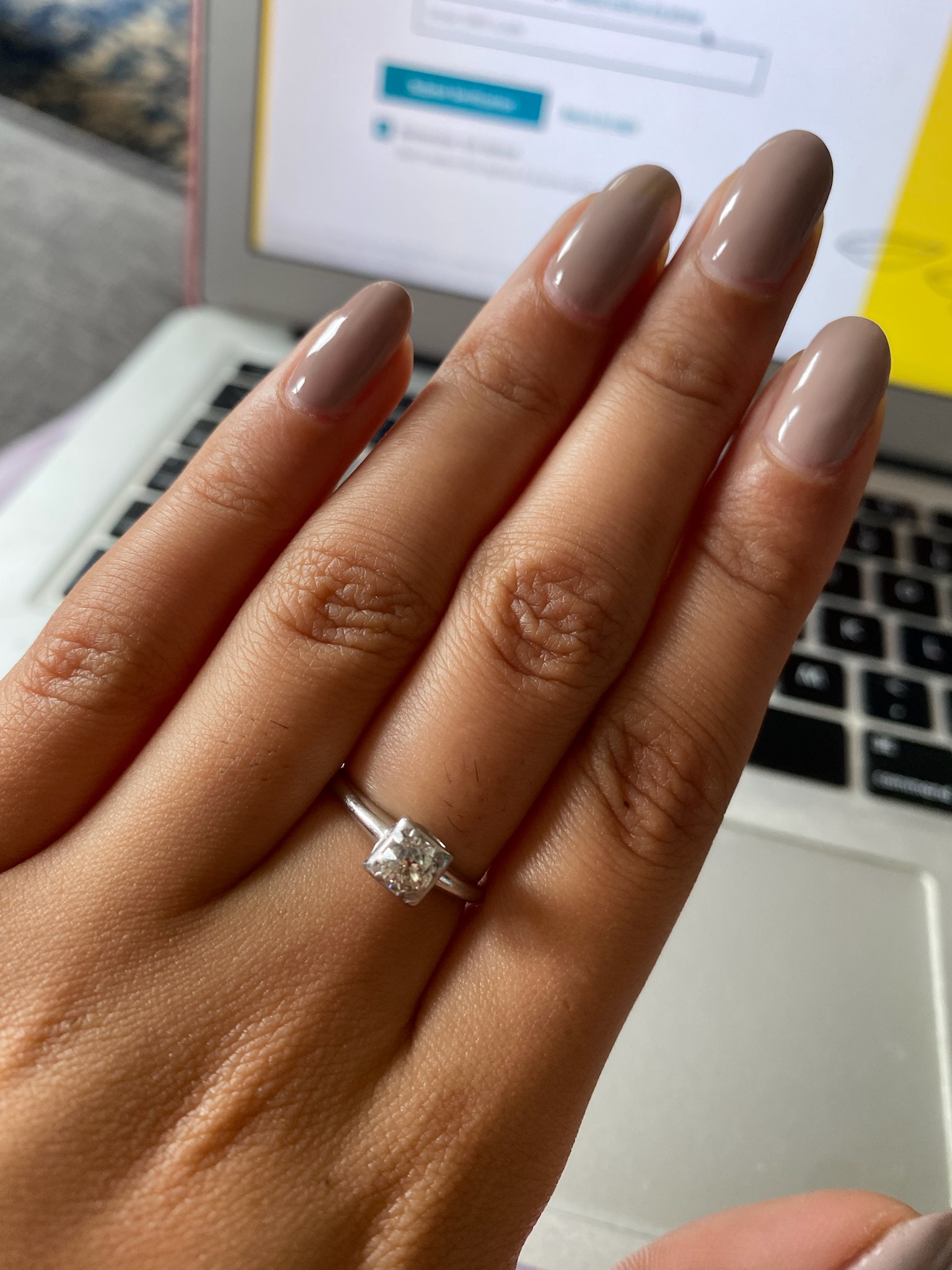
This state of affairs, that is the fact that only one person was named after a woman who had eleven children, is particularly egregious once you take into account that almost every firstborn son in the family has Eugene as either their first or middle name, including my father. Eugene being the name of her husband and my great-grandfather. It’s really quite sad to think how utterly surprised she was when my mother and father told her that their first child would be named after her. So, of course, my sister got the ring. From one Lillian to another. An unassailably sensible decision. But how did the elder Lillian come to have it in the first place?
We go back to the end of WWII and Operation Magic Carpet. It’s January 1946 and Gene Hamshar is getting off a ship in his hometown of NYC. He’s been away for years, seen hell, fought from the shores of Normandy, to the Hürtgen Forest, to the Baltic. He saw friend’s die in the Battle of Bulge, only surviving himself with the help of some Belgian women who dutifully changed their flags from German to British back to German several times a week. And after all that he was back and nothing had changed. Well nothing besides the fact that he now had a low-interest mortgage and an addiction to liquor.
Something that had certainly not changed throughout his time at war, was what the first thing he was going to do when he got back. Though he had promised to go straight home as soon as he got back to American. Instead, Gene elected, as his first action back in the U.S., to go to a pawnshop. I couldn’t tell you the name of the place or how long he stayed there or even how many different shops he visited. I can tell you that by the time he walked up the steps of the Hamshar home in Queens, he had a diamond ring burning a hole in his pocket. And standing before him was the beautiful woman he wanted to put it on.
The woman at hand was Lillian Herndon. Lillian was not a city girl. Nor did she ever expect to even see a city much bigger than Charlottesville. But here she was in New York staring down at the man she met all those years ago, before the war took him over to Europe. The two had met when he was in her home town of Scottsville, Fluvanna County, Virginia. One of those tiny Mid-Atlantic towns in a empty county with soil still badly damaged from generations of tobacco planting. The town, village really, was exceptionally quiet Lillian’s whole life. Until one day it was flooded with young men from FDR’s Civilian Conservation Corps (CCC). Eugene Hamshar was one of these young men.

After years apart and days spent waiting for him at his parent’s house, Lillian didn’t have it in her to wait a second longer. She rushed down the stairs, threw the door open and wrapped her arms around her Gene. And that’s when he asked her to marry him. Still in his uniform, he got down on one knee, beseeching her in that soft, polite voice of his, and without a second’s hesitation, she gleefully accepted. Having caught wind of what was happening outside, the Hamshar family joined the couple on the steps and officially and likely tearfully welcomed their only son back home. At some point, someone thought to commemorate the day with a photo. A photo now tucked safely away in their eldest daughter’s desk.
Eugene and Lillian were married on February 23, 1946 in Scottsville, VA. and the engagement ring was replaced by a golden wedding band. Safely retired to a mostly vacant jewelry box, the diamond studded loop of silver awaited an heir for the next seventy-two years. Only being brought out for annual resuscitations of the story that brought a truly prodigious family into being. A family that altogether now constitutes about a third of the Scottsville corner of Fluvanna County. Though, of course, that’s not exactly a whole lot of people.
 The Materials of History, Thought, and Art
This is a lovely story and of course a lovely ring. The ring’s simplicity hints at its own origins of being bought at a city pawn shop likely only hours before the actual proposal. I like your touch at attempting to understand Gene’s experience when you say that you couldn’t even say how long he must have spent looking or how many shops he entered. It also leaves that unanswerable part of the story where you wonder: did he see the ring right away or did he have to look through dozens? I think you bring up a wonderful connection between the concept of gift giving and naming someone after another person. The act of naming someone after a family member can be a gift in itself, as it was for your sister. Though it is rather shocking that out of all the children and grand-children, she is the only one to share the name.