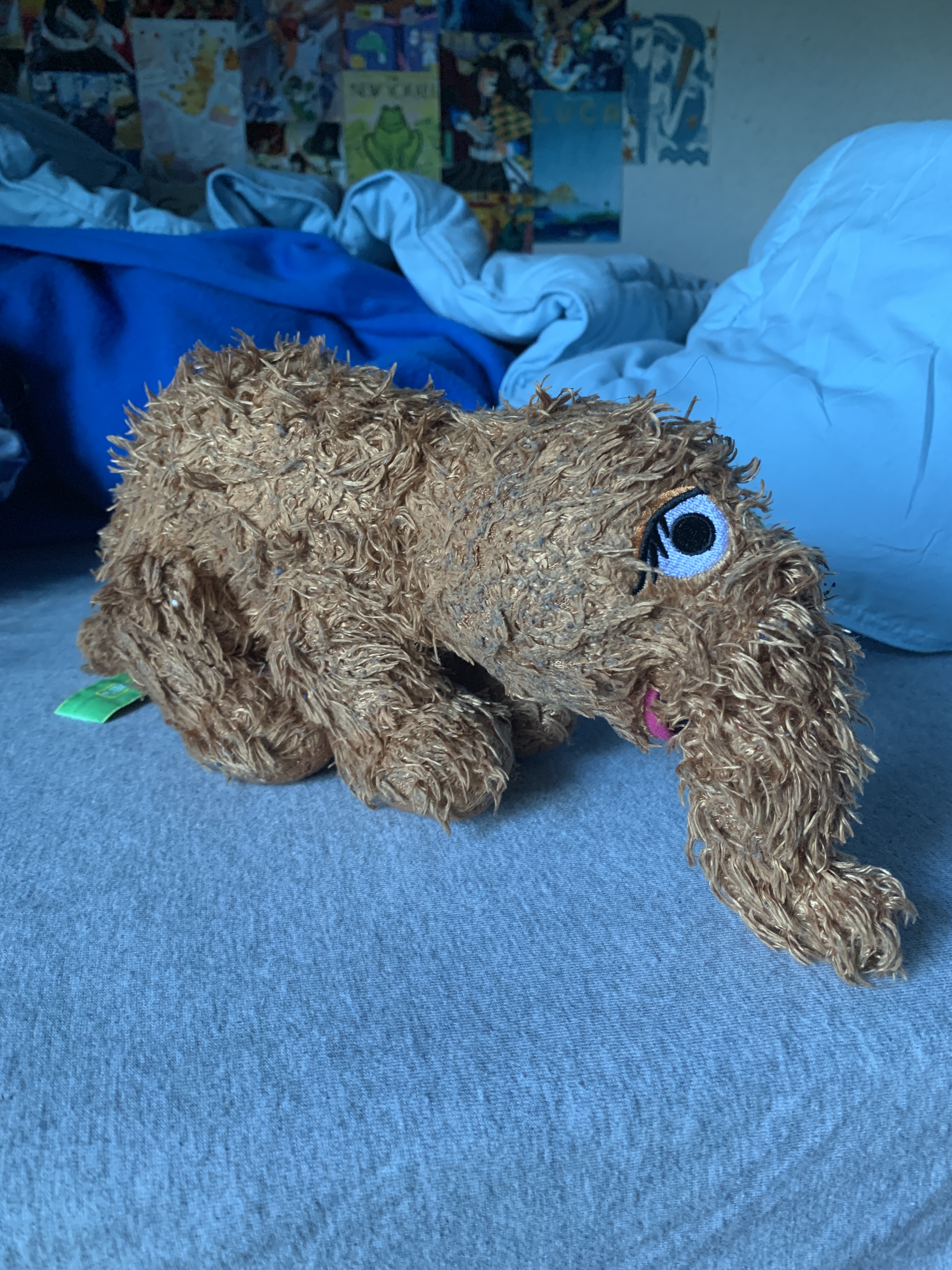
The item I chose for this assignment is a plush Snuffleupagus from Sesame Street that some friends gave to me the night before I had spinal surgery. I first found it in the hospital’s gift shop, on a rotating rack with other Sesame Street characters (I was 17 when I had the surgery, so I was staying in a children’s hospital). For reasons unknown, I felt immediately drawn to it. It was probably nostalgia, or the fact that Snuffleupagus seems like such an obscure character, even on a show like Sesame Street. It has become an important part of my nighttime routine, and I can’t seem to sleep if it’s not with me. According to its sewn-on tag, it is made of polyester fibers and stuffed with polyurethane foam.
This plush is distributed by GUND, a Canadian-owned toy company based in Edison, NJ. However, like most products, its tag says, “Made in China”. China is an important hub for the textile business. While I could not find sources about polyester production specifically as a part plush toy manufacturing, there are numerous sources about the textile industry in China.
Many Chinese garment factories are known for what we refer to as “fast fashion”, or cheaply made clothing typically made by exploited, low-paid factory workers. Polyester is a commonly used material in fast fashion items, so this seemed like the best place to start. Brands that partake in fast fashion usually claim their employees make “at least minimum wage”, while that may be true on paper, these minimum wage values only constitute to less than half of a livable wage. Garment workers in China face long hours, about 14 to 16 hours a day, all week long. Like the video we watched about Bangladesh, the conditions in Chinese garment factories are morbid. Workers often breathe in toxic substances, and there is little to no ventilation. The fast fashion industry is also notorious for the use of child labor, a staggering 11% of children in the world are forced to work monotonous, dangerous jobs like this.
When researching GUND, I visited their page on Amazon and read the small blurb written about the manufacture of their products. They simply state that their products are made in China, shipped to the United States, and kept in warehouses for distribution. When stated so regularly, you would not even consider the amount of labor and pain endured to make a product as inviting as a plush toy.
Sources:
https://www.amazon.com/ask/questions/Tx32FD1XDPP3IOA?ref_=ws_cp_5d1c147625091864a89d_m_4_s_5_qa
 The Materials of History, Thought, and Art
Firstly, that is so cute! Secondly, I appreciate that you focused on fast fashion and the textile industry in your blog post. Exploitation in fast fashion is a major problem, and it is very prevalent in the world today. You successfully showed a great example of separation from the means of production, since all our toys and textiles seem to come from far-off factories and are sold in a line with several other identical items. It is very telling that you were not able to find some sources. Another problem with fast fashion is waste, and how people will throw away barely used items and quickly buy more, but I can tell that your Snuffleupagus is very well-loved and has been kept for a while.
I love Snuffleupagus, I always found him to be one of the most charming of the Sesame Street characters. If you haven’t, I recommend looking into his first appearance and the lesson that episode was meant to teach viewers – it is both wholesome and important!!
As for how he was made… It is definitely true that most people do not think of what the employees of such manufacturing factories endure, especially when information about where such products are made is purposefully vague. It is very telling that you were able to find so little information about the production of something so widely used in creating anything that has fabric, whether it is clothes, upholstery, stuffed animals, etc. That this information is not readily available is troubling. With fast fashion, factories exploiting workers, and child labor, there needs to be more transparency worldwide about the methods used to create, well, anything!