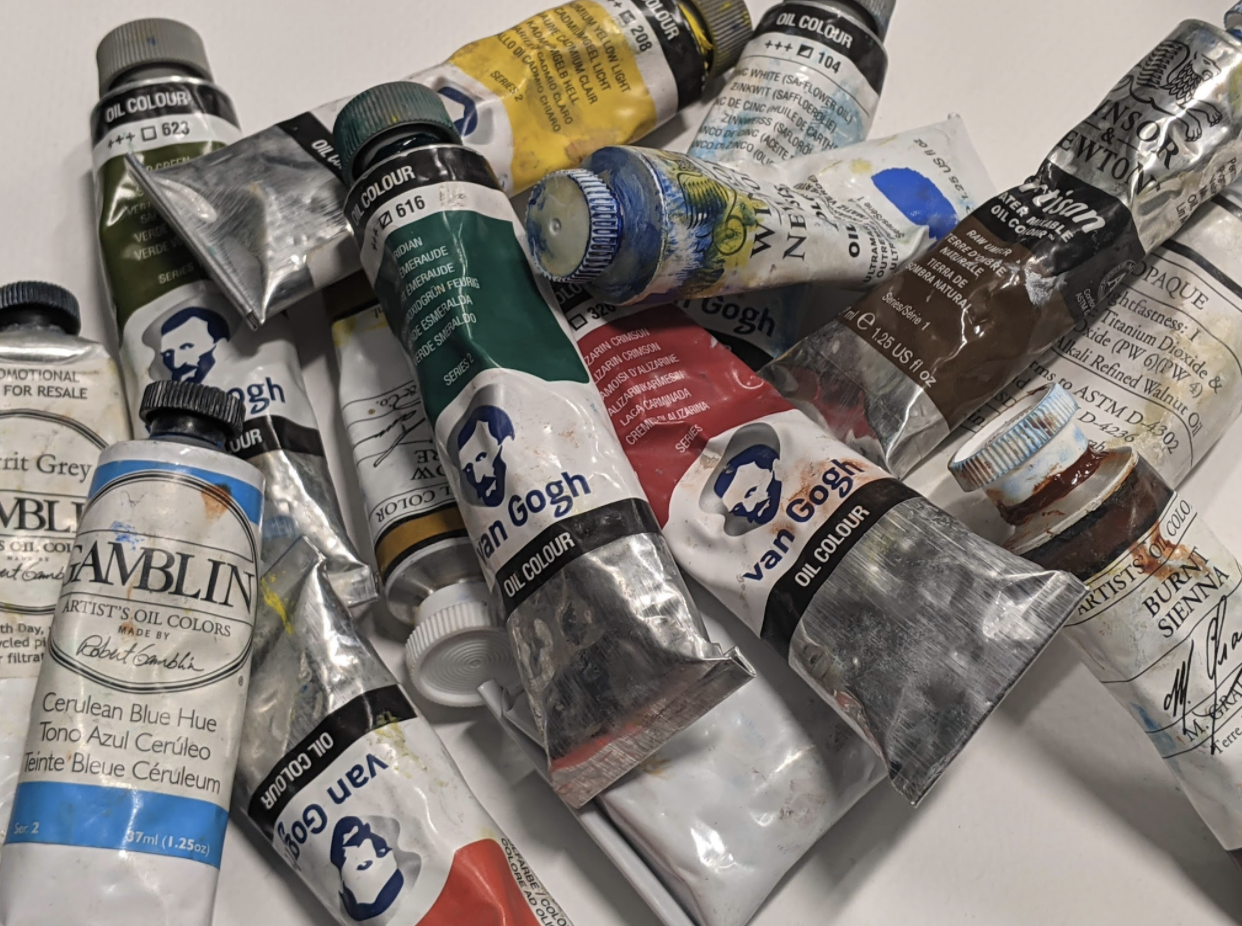
I chose to look into my set of oil paints. The paint itself consists of two major ingredients, pigment and oil. Of course, there is also packaging and mixing in the process of creating a tube of paint ready to be sold in a store. The oil in my paint comes from walnut, linseed, and safflower plants. These plants need to be farmed and processed into oil for the paint. These oils are combined with pigments to create colored paint. Pigment comes from many places like metals, minerals, and elements. Sometimes they also come from insects, such as carmine red, none of my paints do. Mineral pigments need to be mined, crushed into powder or otherwise processed, and shipped. The paints are mixed and packaged by different companies. In my case those include Gamblin, Van Gogh, or Winsor Newton. They are packaged in aluminium tubes with plastic caps. I have also heard of people mixing their own paints. But to do that they still need to get the pigments and oils, which are often impossible to produce on your own.
Pigments are one of the most complex and important parts of paint. We tend to see color as surface level, something that does not really affect the make-up of an object, but different colors can change so much about an object. They come from different places, and have different backgrounds, chemical processes, toxicities, and expenses depending on the color. Even price changes based on the pigment and oil type. While a t-shirt may not change price based on color, paint often does. It is easy to notice with a material that is so grounded in the need for color variation. At the beginning of the semester, I went to get supplies at the art store, but spent the whole time calculating which paints would burn the smallest hole in my pocket. Even among the same color, different brands can vary in hue, saturation, and viscosity.

Viridian green is my favorite color of all of my paints. It is a deep bluish green that lightens to mint. This pigment is made using powder from a rare mineral called eskolaite. This green is one of the less toxic green paints, which is why it is still used today. Other greens like Scheele’s green, which contains arsenic, were extremely toxic and are no longer in use. Viridian green was patented in 1859, and the eskolaite used to make it is mainly mined in northern Europe.

White is usually produced from metals, often heavy metals. I have two different kinds of white, titanium and zinc. Titanium white, as you might guess, comes from titanium, a heavy metal. While it is not as toxic as paints that come from lead or arsenic, it is still one of the less safe colors. My second tube of white is zinc white. Zinc is a less toxic alternative white, but it is less commonly used. It is a harder paint to make, because the zinc does not react as well with the oil, and it took a lot longer for people to perfect it in oil paints. It is also known for being a cooler shade of white that leans towards blue. Zinc is often mined in Canada, but processed in Eastern Asia.
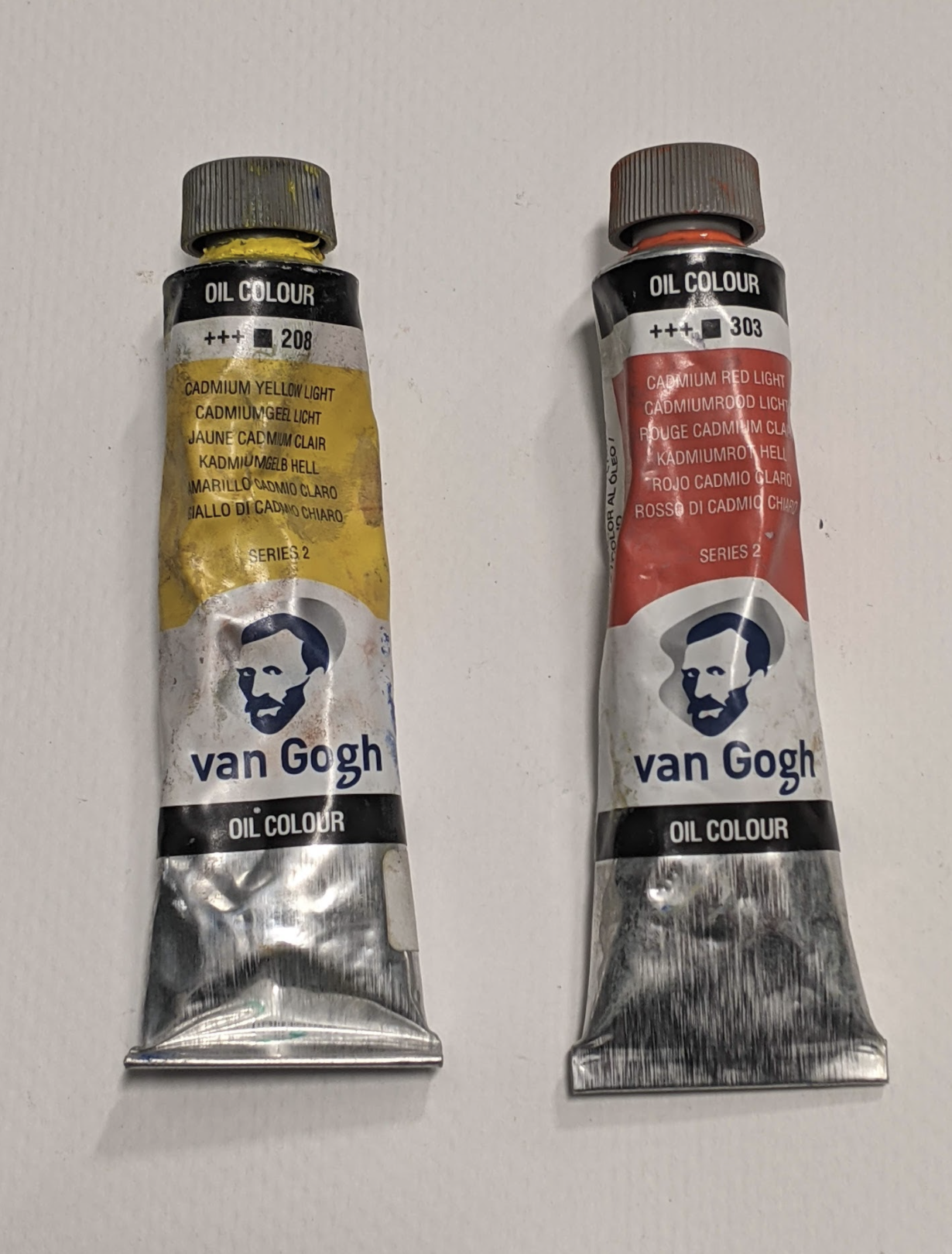
One pair of paints that interested me were cadmium red and yellow light. I was surprised how two different colors could come from the same source. Cadmium is an element, and is a byproduct of zinc ore processing. It is used in reds, oranges, and yellows, but is less commonly so due to its toxicity. Usually is produced in eastern Asia, where zinc is processed.

Ultramarine is a shade of blue made from crushed lapis lazuli. Blues in nature are very rare, and ultramarine was a very rare and expensive pigment throughout history. This has been one of the most important pigments since the renaissance, and has always seemed like a magical substance. Since it only came from very few places, the process behind making it was often a mystery. Its name means “beyond the sea” which does a great job of representing how otherworldly people considered this intense blue. When I paint with it. I always find myself cutting it with another color because of how overpowering it is. The lapis lazuli used to make it is commonly and historically mined in Afghanistan.
My paints are a collection of objects that I bought, kept, and used together. They are always grouped as the same thing and considered to be variations of the same object. But each one is very different. Because of their differing colors and brands, these paints all have different components, labor, and histories. Even though these things are often forgotten, they still matter and have an impact on our world.
For more information on paints and pigments you can look at:
 The Materials of History, Thought, and Art
Hi Sarah! This was a really interesting read, and I like how you discussed all of the colors in the set. Even though you use all of them the same way, they each tell a different story. Oil painting is so fascinating, and some of the substances that were used to make it in the past are almost unbelievable. It’s also cool to learn about oil paint colors that “don’t exist” anymore, and colors that are so rare they cost hundreds or thousands of dollars for a single tube. Great job!
I love that you chose these paints as your object! Being a fellow artist i learned about different materials and substances that are in these oil paints in one of my intro to painting classes a year or so back. I really liked the way you described the blue paint as coming from the lapis lazuli and it being so rare. The name of it also was very intriguing to me and like you said makes a lot of sense at how deep and sea like the blue oil paint is.
This was a pretty interesting object and history, I was particularly intrigued by your description of the minerals used in the production of the paints. The information on the lapis and the Viridian was a new concept to me.
Hi Sarah! It was fascinating to learn about the different paints and the materials used to create differing pigments. I was surprised to learn how many pigments are created using toxic or semi-toxic substances. I wonder if we will ever get to a point where such colors do not rely on these ingredients. My favorite part of this piece was learning about Ultramarine, which is made from crushed lapis lazuli. I have always thought lapis lazuli was a beautiful rock with such a vibrant color. It makes sense that you would have to dilute the Ultramarine a bit because of that!
Hi Sarah,
I loved learning about the origins of some of your paints. I use a lot of oil paints for canvas paintings and have never really bothered to look into the origins of how these paints were created. While I knew some of the paints were relatively toxic to work with I had never bothered to research why they were so bad. It was really interesting to learn about something I had really no knowledge of. Your explanations of pigments also makes a lot of sense in regards to paint prices. I always find it funny when I ask for oil paints for Christmas or my birthday and my family is shocked at how expensive the prices get!
Hi Sarah! This is such a cool post! It is so fascinating to me that each color has a unique story. I’m not an artist so I was very unfamiliar about the production of mediums such as oil paints. I thought they were produced with synthetic colors/dyes, but I suppose even synthetic dye has to come from somewhere. I had no idea that they were produced from minerals and other elements though. That’s really neat. It’s also interesting to me the way a color can have a value. Even if two colors are equally intense in pigment and are used for similar things, depending on where they come from they can have such different monetary values. And the fact that various colors can come from the same source! Very thorough and interesting analysis. 🙂
Hey Sarah! I really enjoyed reading your post. It’s so interesting to me how much information you could get from a material that’s composed of just two major ingredients. I Really enjoyed how you would discuss why a certain paint looks or acts in a different way, and then explain how that reasoning causes other qualities of the paint. Reading about how a material’s color, toxicity and value are all determined in part by a minor ingredient was really interesting to read about.