
Between my bookshelf at home, my shelf in my art studio, and the books I have in my dorm, I own about ninety books. I have decided to focus on tackling my bookshelf at home, which holds sixty-six books. I have decided to pick up and consider each one of my books, deciding which ones “spark joy” in me and which are really just clutter. To start this process, I have removed all of the books from my shelves, leaving only knick-knacks and paper clutter behind. I have now split my sixty-six books into twelve categories. These categories are not split evenly rather they are based on time period, purpose, or author. Splitting the books into groups made the process a little less overwhelming.
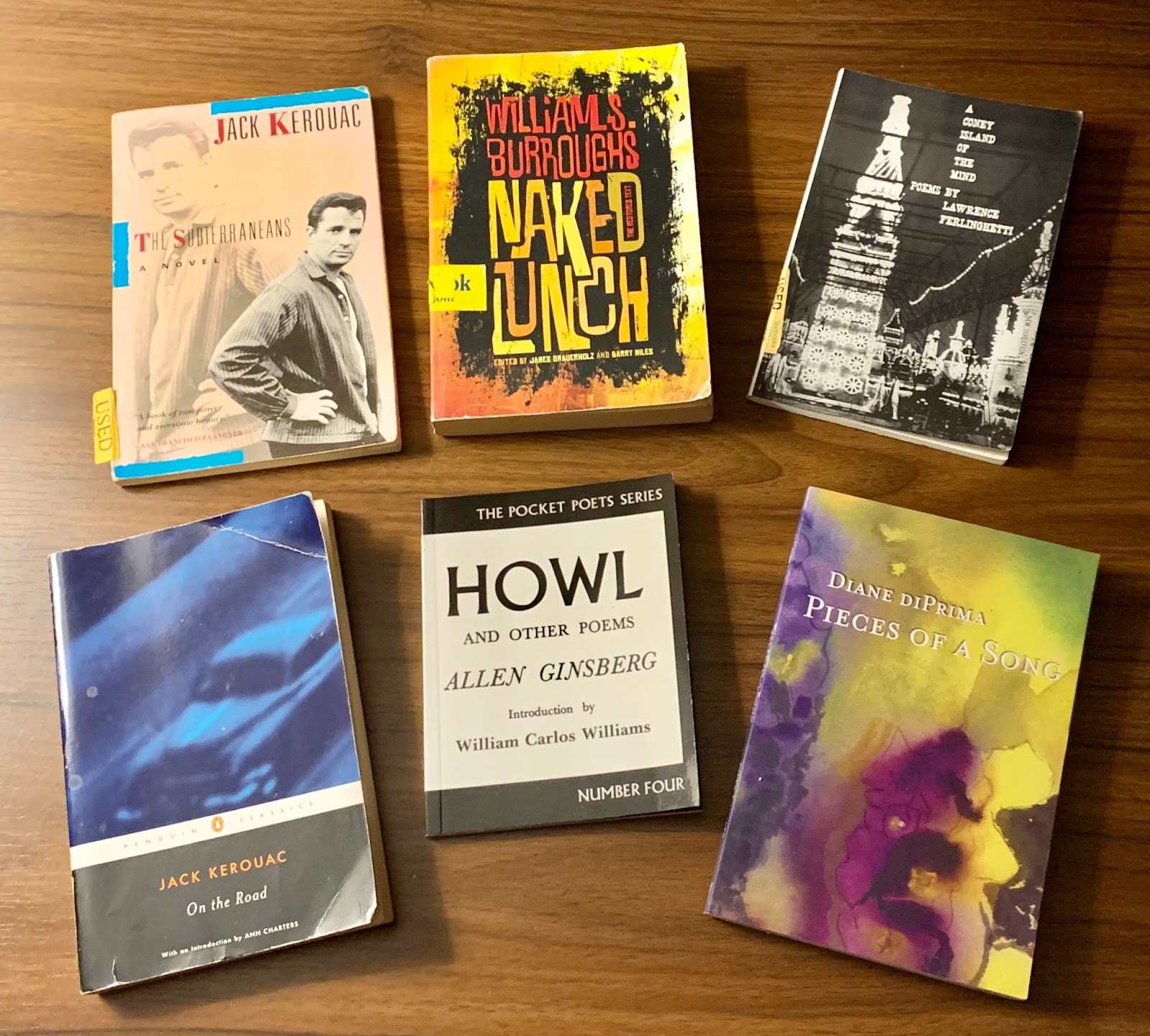
I found it funny that even when I was first planning this process, I had books in mind that I would be getting rid of. It makes me wonder why I didn’t get rid of these books that have been bothering me in the first place. The first books I knew I wanted to get rid of come from my collection of books written by authors of the Beat Generation. I got these books when I was taking an English class on the Beat Generation last semester. I wanted to get rid of both of my Jack Kerouac books, as the rampant sexism in these two novels brings me the opposite of a spark of joy. As for the other books, I felt very content to put Burroughs, Ferlinghetti, and di Prima in the “sell” pile as I don’t have any desire to reread any of these books. One book I didn’t feel comfortable getting rid of ws Allen Ginsberg’s Howl. The book doesn’t take up much space, being thin and small. I also can say that the handful of Ginsberg’s poems I read in this book did generate a positive response from me and I would like to one day read the rest. This leaves one book in the keep pile and five books in the toss pile.
Whether or not I would read the book again tended to be the trend on how I would determine what books stayed and went. This was quite difficult as I had to make my future actions and the time I would be able to alot to my books predictable. This was easy for books that I just didn’t enjoy, even with multiple readings, as I knew that they brought no joy or positivity into my life. It was also easy to determine what books stayed, as they were all the books that I have really loved.

One set of books that I knew I would keep are my collection of Vonnegut books. One is my first copy of Slaughterhouse-Five that I first bought and read when I was eleven years old. Another book is a graphic novel adaptation of Slaughterhouse-Five that I bought a few months ago. The set of books is a box set of all of Vonnegut’s stories, compacted into four books, bought for me by my mother. While the box set may make my old copy of Slaughterhouse-Five obsolete, I just can’t force myself to get rid of any of these books, as they are so important to me. I can say that every time I pick up one of my Vonnegut books, I feel a spark of pure joy, so they will remain on my shelves.


Sifting through my collection of classic literature left me rather conflicted, as I found myself wanting to get rid of books that I didn’t enjoy, but felt that I should because of their status as “a classic.” After giving in to my own emotions towards these texts, I found myself getting rid of The Tempest, Gulliver’s Travels, and Alice’s Adventures in Wonderland. I didn’t really enjoy reading any of these books so I likely won’t be reading them again. Using this same system I am keeping a lot of my Medieval, Greco-Roman, and modern classical literature that I do see myself reading again. This includes works from Sophocles, Boccaccio, Nietzsche, Sartre, Salinger, and others. I actually find it funny how many of these books I have read upwards of three or four times, specifically titles by Nietzsche.

I have a collection of books that I have bought, but not yet read. All of them were purchased during the break before the start of the semester. I am hoping that during my break before graduate school I can chip away at these particular books, so I will not be getting rid of them. Even though I have read The Odyssey three times now, I am still very excited to read Emily Wilson’s translation, in specific, because I have heard great things about it. I also can’t help but feel that getting rid of books you haven’t even given a chance is like throwing away an opportunity.

In totality I am getting rid of nineteen out of sixty-six books, leaving forty-seven behind. I am honestly shocked that I got myself to get rid of so many books. However, the process was oddly freeing. It is nice to see my bookshelf more closely representing my ideals now that I have removed books that I do not feel a connection to. It is also nice to see free space on the shelves, as before it felt like a battle to squeeze a new book onto a shelf. Though, I must say that actually donating or selling these books may be a harder task than putting them in a pile that says “donate.”

 The Materials of History, Thought, and Art
Hi Natalie, this was an interesting blog post for me to read as I also decided to do the experiment on some of my books. I love the way you categorized them! I can see how that would’ve made it easier. I did mine in a more disorganized manner and looking back on it I wonder if there’s more I could’ve parted with if I decided to break it down a bit more kind of like how you did.. I thought your assessment was really straightforward and realistic and I think Kondo would be proud. Ps. Candide is great, I think you’ll really like it.
Hi Natalie, I really enjoyed reading this post. I thought the way you separated the books into different categories was a great idea! With as many books as you have, it is no wonder that you were overwhelmed by this process. I agree with Sydney that your assessment of the books and whether they brought you joy was very straightforward. It was easy to understand why you chose to keep the books you did and why you chose to donate or sell others. One last thing – I find that objects that are “classic” or “vintage” can be hard to get rid of because we assign them so much value, even if we don’t like them very much, so I think it is great that you were able to discard of books that you wanted to keep due to them being classics!