Cleaning Up My Bookshelf

For this assignment I decided to try Kondo’s “joy test” sorting system on some of the books, and papers that were on my shelf, among others small items.

I was fairly neutral about the state of this shelf, but I figured it would be a good place to start. When I took a step back and looked at the things that were on the shelf, I realized that I probably would be ok without a lot of it being out in the open.

The first thing that I immediately decided would have to stay was the rocks and minerals. I cleared out the middle section specifically for them, so I figured I could just arrange them in a neater way and be done with it. If there is anything in this assortment of stuff that really “sparks joy” its my collection. This is just a small portion that I acquired recently but they really hold a special meaning to me. I don’t really spend much on myself, but expanding my collection is one of the few exceptions, as such it is really important to me to keep these close to me and in a place where I can see them and appreciate them.

Next, I moved on to the pencils and pens and other supplies, these I simply moved into a box where I kept other things of that nature. This was the simplest move as I knew where they belonged and had simply neglected to place them in their proper location. The bag of and posters were easily dealt with as well.

The books and papers were the most difficult in my opinion, I usually tend to keep documents and papers for longer than most people as I have a sense they will come in handy down the line. That being said, I was sure that many of these documents were unnecessary, and some of the books I had were either never going to be read or had been read already.

Like the method suggests, I just put all the books and papers on the floor and sorted them vaguely into categories. I separated books from loose papers first, and then sorted the papers into a few sections: Reference material, old assignments, and exams, and miscellaneous. I quickly discarded the miscellaneous pile as It was mostly just junk. I looked through the remaining papers carefully; some of the old labs I have are from freshman year, but I use them as reference when I am doing my job as a teaching assistant. As such, these are important for me to keep on hand, so I put them in a folder for safekeeping. The old assignments and exams were tougher as I keep them to study from. That being said I decided I did not need them at the moments, and they didn’t have to be displayed so openly, so I put them in a separate folder in my closet.
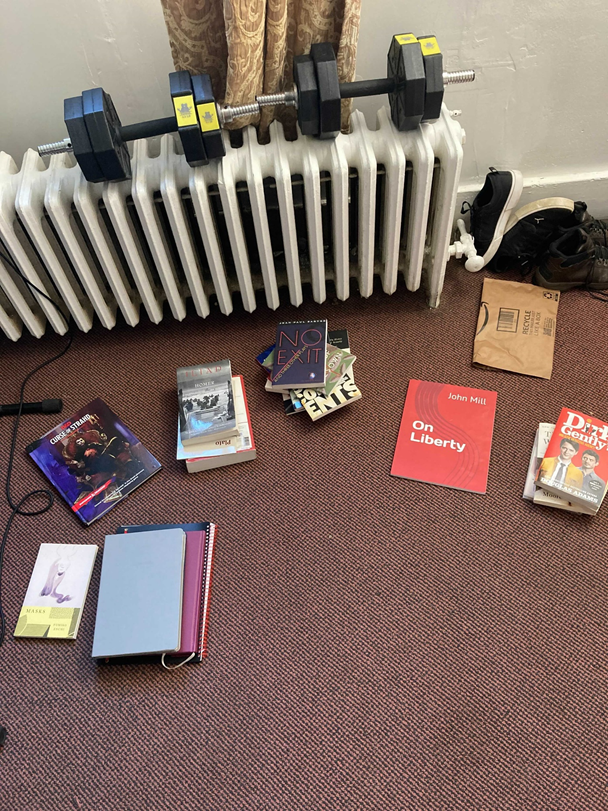
After I had sorted through the papers, I was left with just the books. This proved to a more difficult task, so I started by sorting the books into categories as well. I arranged them based on their uses: books that I need for schoolwork, books that I don’t need for schoolwork at the moment, novels I have read already, and novels I have yet to read as well as miscellaneous. I took the one miscellaneous book and I put it on my piano stand, because I use that one quite frequently. As for the others: I realized that I haven’t referenced any of the older texts since my midterm and I likely won’t need them until my final exams. The notebooks and journals are mostly unused as well, so I relegated them to the bottom shelf, along with the novels I have read already. On my top shelf I basically only have the books that I will need actively continuing the semester.
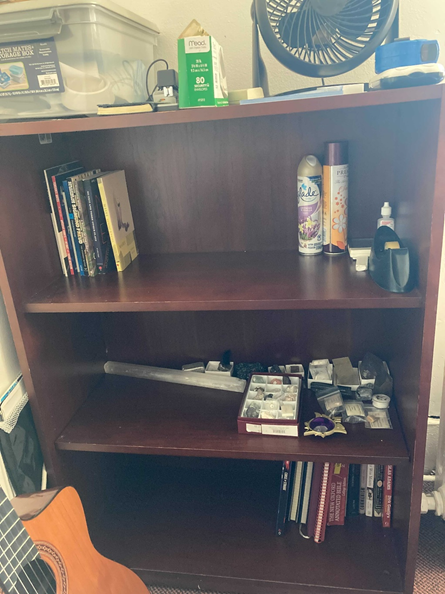
Overall, this exercise was interesting as I was looking more objectively at these items. Right off the bat I removed the objects that sparked the “most joy”, being the rocks and minerals, I had. The bag of posters was also something I wanted to keep. The issue was mostly with the books and realizing that I probably wouldn’t reread any of the books I had. In this way I was able to separate out most of my materials and even dispose of a lot of stuff I didn’t realize I had. Spreading everything out made the process simpler mentally although more tedious physically, but I can understand where Kondo is coming from in this regard.

An English Major’s Unsurprising Collection of Books

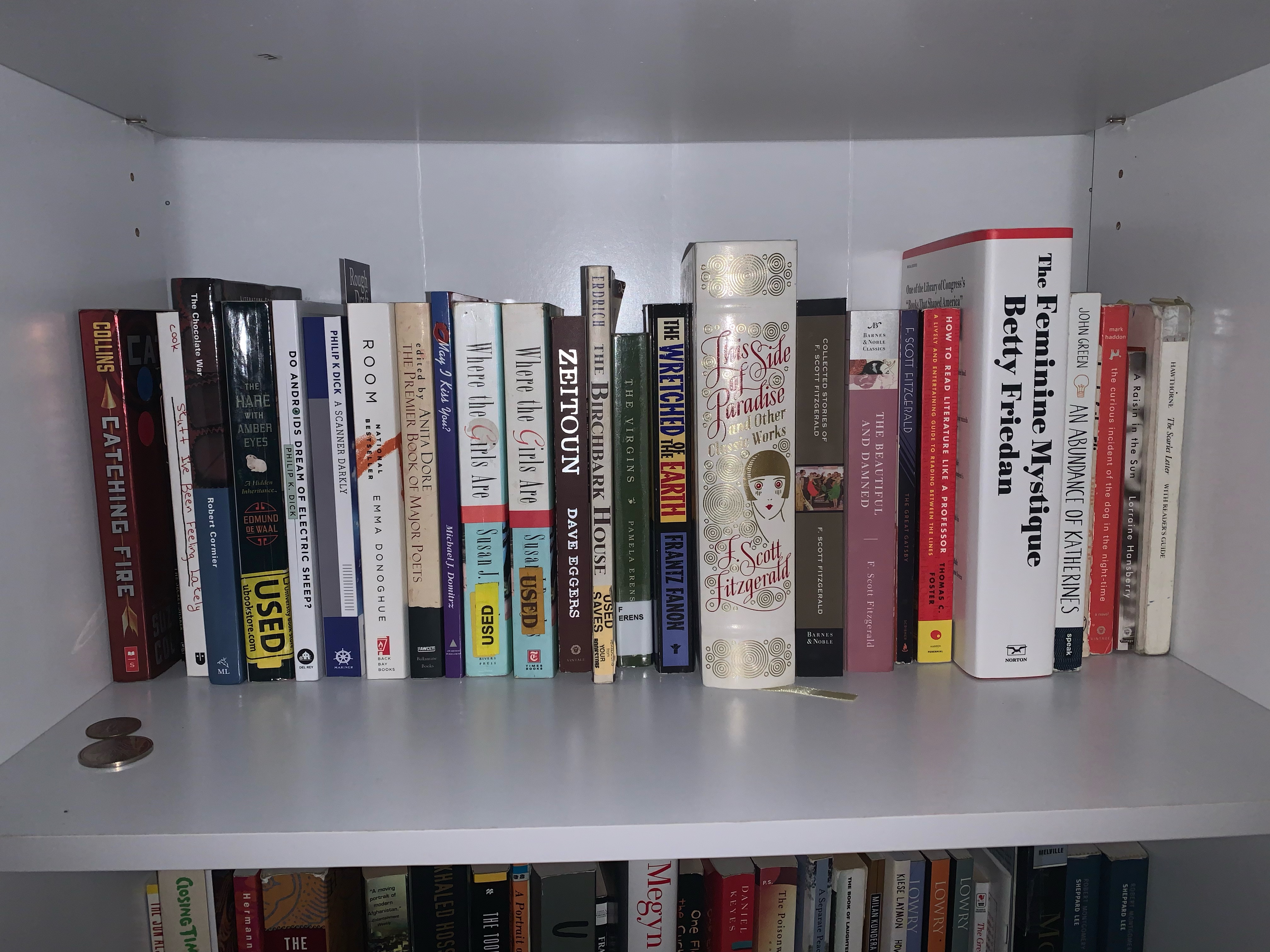
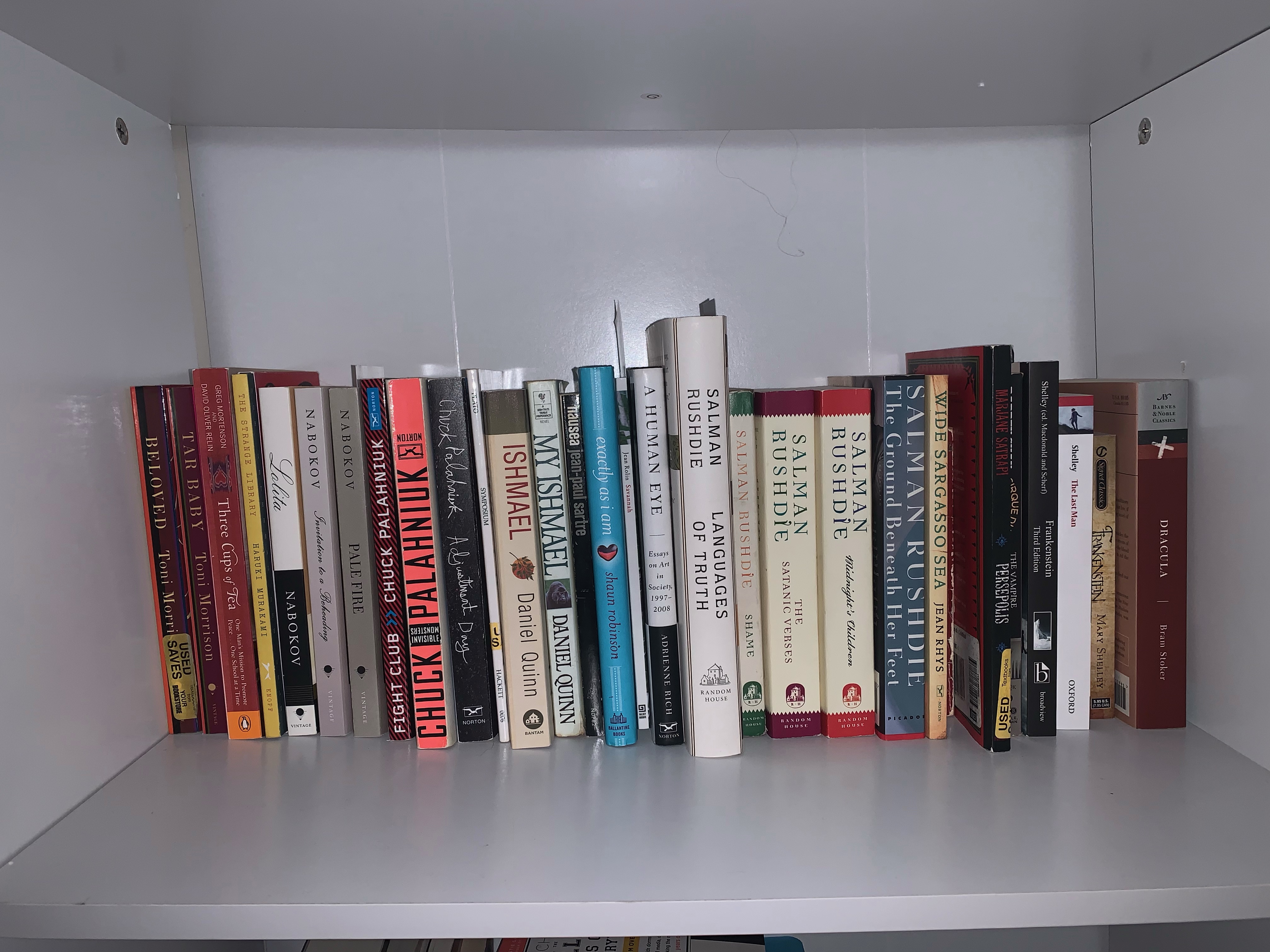
For this assignment, I choose my book collection. I began with approximately 131 books. The idea of getting rid of books, however, troubled me. I came in with a handful of books I know that I actively no longer want. I have a collection of books by Lois Lowry, which creates The Giver Quartet. I have never read past The Giver, and I have never planned to read past The Giver. However, this set was a gift, so I feel sort of guilty giving it away. I had this experience with several other books as well, such as Megyn Kelly’s book Settle for More.

A picture of my full bookshelf, which is slightly slanted because my floors are uneven.

It was a gift from my grandmother, but I have never been interested in autobiographies, especially about people I am completely unfamiliar with. I flipped around the book, read some of the language and felt it was not of interest to me. On the other hand, the book gave me some form of joy, almost like it could spark joy. So, I held onto it a little longer. I began researching the book, and discovered that the book “discusses the unwanted sexual advances she received from Roger Ailes while working at Fox News” (“Settle For More”). I had found this interesting, then began reading some of the reviews on Amazon, and found that she said quite a lot of things that I could not find myself agreeing with. I had mixed feelings about this book; it was a gift from my grandmother, but I didn’t have any desire to read the book. This book was the beginning of my “unsure” pile.

Settle for More by Megyn Kelly.

Recently, I found myself going to a couple bookstores in Kingston. I have a friend who started going to SUNY New Paltz, and she had never been to Kingston before, so I took her to Rough Draft: Bar and Books, and Half Moon Books. At Rough Draft, Gabby recommended to me How to Slowly Kill Yourself and Others in America by Kiese Laymon, so I bought the book. This, however, is a habit of mine. A lot of the books that I purchased that are in my bookshelf I haven’t gotten around to reading yet. These books include Closing Time by Joseph Heller, Siddhartha by Hermann Hesse, One Flew Over the Cuckoo’s Nest by Ken Kesey, and so many more. I suppose part of the “joy-sparking” pleasure in collecting books is the anticipation to read them. Something that sparks joy for me personally, is having someone share their favorite literature with me. Siddhartha was given to me by my girlfriend because she wanted me to have read her favorite book. Knowing that these books were given to me because people I love want me to experience something personal, that is both intangible and tangible, to them makes it more special. Therefore, all books that were gifts/recently purchased absolutely sparked joy in me.

How to Slowly Kill Yourself and Others in America by Kiese Laymon. Picked up at Rough Draft on October 13th, 2021.

Some books, such as the series including The Giver, were easily removed. A few other books I couldn’t remember where I got them. May I Kiss You? By Michael J. Domitrz, my double copy of Where the Girls Are by Susan J. Douglass, The Virgins by Pamela Erens and my double copy of Sheppard Lee, as well as two other books that I couldn’t recall buying/receiving made it into the “discard” pile. For this experiment, I also pretended like I could “discard” my copy of Franklin Evans or The Inebriate by Walt Whitman, which I read for class, because I disliked it so much. All together, I removed ten books. I was surprised I couldn’t get myself to remove more, and ended up putting Settle for More by Megyn Kelly, making it eleven.

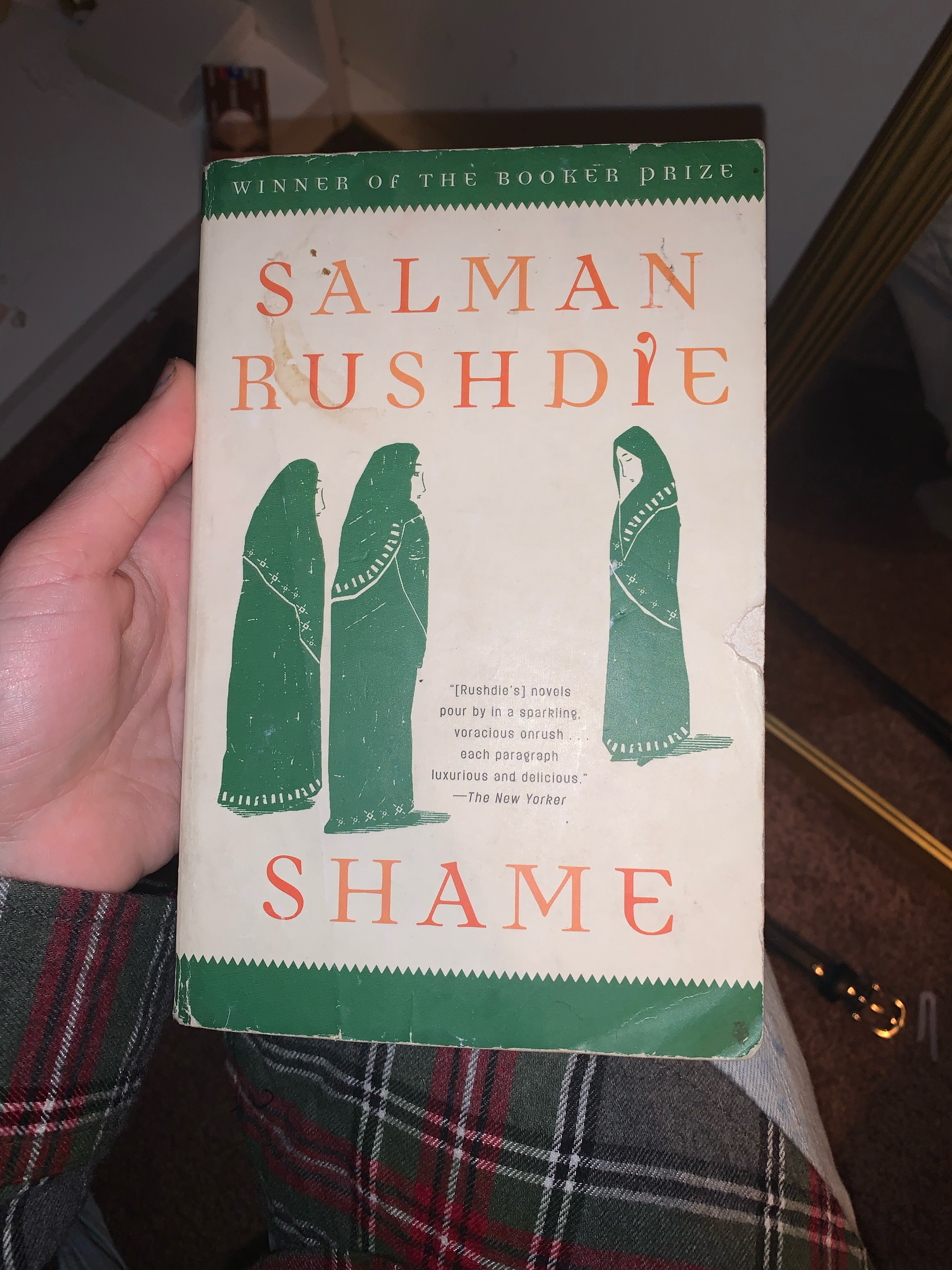
Shame by Salman Rushdie. Book was purchased and read for the Spring 2020 semester in Professor Woods’ Transnational Literature class.

All together, I left feeling pretty emotional. For a period of time, I flipped through Salman Rushdie’s Shame and re-read all of the little notes I left for myself. I read this book at the start of the Covid-19 lockdown, and felt that heart-racing and butterfly-filled stomach-aching (like the original meaning of “tokimeki”). The book was so difficult for me to read at first; I felt so unfamiliar with the language, and there was so much dissonance from myself and the author. Now, I have a tattoo for the book. In class, we’ve spent a lot of time talking about tattoos and how they memorialize objects, experiences and moments as a piece of art.

My tatto memorializing Rushdie’s novel Shame. The language is Urdu, شرم which means ‘sharam’ (shame). The english translation of shame (like tokimeki) is wholly untranslatable.

I also felt a little bit of pride when I was looking at my collection of novels by Angela Carter, which of course sparks joy in me. One of them isn’t featured in the picture since I am currently reading it, but I remembered the excitement I felt upon my attempt to collect all of her books. The book titled Honeybuzzard is a first-printing from 1966. The book is now called Shadow Dance, so it feels heart-warming to own the novel with its original name. 

My collection of novels/books/short stories by Angela Carter, including Honeybuzzard.

At the end of this experiment, I still had over a hundred books, which came to no surprise. This particular collection is the most valuable to me. I know that reading and literature holds a special place in my heart, so making room for more books (both on my bookshelf and in my heart) is always possible. Something I noticed was how the books that sparked the most joy were also the books that I had written in and highlighted. Maintaining the pureness and integrity feels unimportant: I want them to be specifically mine, with my own thoughts and notes inside of them. 

The first row of my book collection (An-Co).
The second row of my book collection (Co-Ha).
The third row of my book collection (He-Mo).
The fourth row of my book collection (Mo-St). I did not include a picture of the fourth row.

Mignone Hall of Minerals and Gems

The American Museum of Natural History houses many wonderful exhibits one in which is the Mignone Hall of Minerals and Gems. This massive exhibit accounts for around 5,000 specimens. The space it occupies is 11,000 square feet but that accounts for meteorites displayed in the hall which are not part of the mineral and gems collection, so the square footage of the rest is a bit lower.

The collection has evolved over the years with many additions and the occasional loss of specimens when burglars find their way in as was the case with the Star of India (a special piece in the collection). It was quickly found but other stolen that night have never been found. The collection first opened in 1869 at the American Museum of Natural History. Originally it was displayed at the Old Arsenal Building in Manhattan where there were around 7,000 specimens.

The Allison and Roberto Halls of Gems and Minerals is in the American Museum of Natural History in Manhattan on the 1st floor of the museum. Upon entering the dark room, you are greeted by a huge amethyst geode measuring at 12 feet tall. Once you get past this very large focal point, you are then surrounded with many glass cases filled with minerals categorized by different mineral groups, rock specimens that have mineral inclusions, and large mineral specimens, such as the 12 ft tall amethyst and stibnite. One glass case in specific shows different types of quartz, including grape agate from Indonesia, while another includes minerals formed from magma, including quartz, topaz, and beryl. Off what could be considered the “main gallery” is a room that contains precious stones along with examples of raw gems and their cut & finished counterparts.   

    The Mignone Halls of Gems and Minerals is designed to tell its visitors how mineral species formed, how they are classified and studied, and how they are used as personal objects, tools, and even technology. In total, the galleries show more than 5000 specimens from around 98 countries. The Hall closed in 2017 to undergo a redesign worth around $32 million and reopened to the public recently last June.

    According to a June 2020 to 2019 financial statement from the museum, most funding comes from government grants, revenue, as well as from donor donations.

Sources

“Title of Section.” Title of Website, Publisher or Sponsoring Organization, Date of publication or last modified date, URL. Accessed Date Month (abbreviated) Year.

“Allison and Roberto Mignone Halls of Gems and Minerals Will Open Fall 2020.” American Museum of Natural History, https://www.amnh.org/about/press-center/mignone-gems-minerals-fall-2020. Accessed 04 Oct. 2021.

“Allison and Roberto Mignone Halls of Gems and Minerals.” American Museum of Natural History, https://www.amnh.org/exhibitions/permanent/gems-minerals. Accessed 01 Oct. 2021.

“American Museum of Natural History.” Crunchbase, https://www.crunchbase.com/organization/american-museum-of-natural-history. Accessed 04 Oct. 2021.

Castillo, Augusto. “Mignone Halls of Gems and Minerals.” GIA, https://www.gia.edu/gems-gemology/summer-2021-gemnews-mignone-halls-of-gems-and-minerals. Accessed 01 Oct. 2021.

“Consolidated Financial Statements Together with Report of Independent Auditors: The American Museum of Natural History.” American Museum of Natural History, https://www.amnh.org/content/download/325415/5011081/file/Consolidated%20Financial%20Statements%20for%20Fiscal%20Years%20Ended%20June%2030,%202020%20and%202019.pdf. Accessed 04 Oct. 2021.

Dukes, Tanya. “Some Famous Gems Get a New Setting.” The New York Times, 23 Oct. 2021, https://www.nytimes.com/2021/05/23/fashion/jewelry-gems-american-museum-of-natural-history.html. Accessed 01 Oct. 2021.

“George Frederick Kunz.” Wikipedia, https://en.wikipedia.org/wiki/George_Frederick_Kunz. Accessed 01 Oct 2021.

Hennings, Juli and Harry Lynch. “The Star of India.” EarthDate, Bureau of Economic Geology, https://www.earthdate.org/node/125. Accessed 01 Oct 2021.

Jordan, Sarah. “Famous Gemstones: The Star of India Sapphire.” The Gemmological Association of Great Britain, https://gem-a.com/gem-hub/gem-knowledge/famous-gemstones-star-india-sapphire. Accessed 01 Oct 2021.

“The Famous New York Subway Garnet.” Diamondoodles, January 27,  https://www.diamondoodles.com/blog/the-famous-new-york-subway-garnet. Accessed 01 Oct 2021.

Dream of Italy, a Collection of Art at Le Musée du Louvre

While many may associate Italy with Christian or Catholic imagery, it is important to remember the vast, rich, and storied history of Italy before the rise of monotheistic religions. When visiting the “A Dream of Italy” exhibit and viewing Marquis Campana’s Collection, this is something important to keep in mind. While there are a few works of art that are influenced by Christianity, such as Sandro Botticelli’s, “La Vierge et l’Enfant” or the Virgin and Child, many of the pieces in this collection are influenced by Greek mythos. These works of art were mostly created during the 1st century BC, 2nd century BC, or 3rd century BC. While one would not need to be an expert on Greek mythology to appreciate the art within this collection, doing research on the different characters, Gods or Goddesses within this exhibit will allow you to have a richer experience. I found in my research into the Bust of Ariadne that learning about her fate – while at first tragic – allowed me to appreciate her beauty that much more. The mythology behind this art is just as important to understanding the art itself, as is in the case of the “Plaque Campana, thiase dionysiaque” which depicts the God Dionysus’ procession of advisors, worshippers, or “inebriated revelers” (“Thiasus”). Dionysus is the God who is said to have rescued Ariadne from the island of Naxos (“Ariadne”), and that these works of art were created within similar time periods exemplifies the motifs that were most common during that time. Something else to look out for is what these objects are made of. Many of the objects are made using clay or terracotta clay, materials more easily available between the 1st and 3rd centuries BC. Any color used is another thing to focus on. Paint and pigments are not something that were so easy to come by in the earliest centuries, especially any that are blue or have a blue hue to them. Be introspective – how did the artists get these colors? How were they created? Who provided the labor that allowed such pigments to be created? Most importantly, allow yourself to be transported to another time. Such art is less commonly created today – as art evolves over time, with themes and materials changing and evolving. How do these ancient works of art move you?

This collection is so significant because it genuinely feels like a collection. It was the collection created through various connections by one person. The research into the story of these objects shows how it started as many lost individual objects from ancient artists in Italy, until they were rediscovered. Before Campana these objects had no connection to one another. “He brought together this extraordinary collection by way of excavations, the antique and art market, the network of collectors between Rome, Naples and Florence, and his links with scientific institutions”(Dream of Italy). This collection of artwork only exists because of its curation. Campana did not create the objects, but he did create the collection. When it was eventually broken up and sold to numerous different buyers across Europe, the grouping that he established was not forgotten. He established his vision of Italian Art  through his ensemble of objects, and even though it did not last forever, the collection still managed to find its way back together. By becoming an exhibit in the Louvre, the ties between the object, and the importance of these ties is enforced. Campana’s idea of Italian art that he found, bought, and acquired one object at a time is now on display for anyone to see. The most important finding of this collection is how it proves the importance and endurance of collections, and how they can be just as important as the objects within them.

Bibliography

“A Dream of Italy.” What’s On | Past Exhibitions, Louvre, https://www.louvre.fr/en/what-s-on/exhibitions/a-dream-of-italy

“Ariadne.” Encyclopædia Britannica, Encyclopædia Britannica, Inc., https://www.britannica.com/topic/Ariadne-Greek-mythology

“Bacchanal, Adj. and n.” OED Online, Oxford University Press, Sept. 2021, www.oed.com/view/Entry/14285.

“Bacchanal English Definition and Meaning.” Lexico Dictionaries | English, Lexico Dictionaries, https://www.lexico.com/en/definition/bacchanal

“Bust of a Woman : Ariadne at The Louvre, Paris.” 3D Printable Bust of a Woman : Ariadne at The Louvre, Paris by Scan The World, MyMiniFactory, https://www.myminifactory.com/object/3d-print-bust-of-a-woman-ariadne-at-the-louvre-paris-12406.

“Dionysus.” Encyclopædia Britannica, Encyclopædia Britannica, Inc., https://www.britannica.com/topic/Dionysus

Garcia, Brittany. “Minotaur.” World History Encyclopedia, World History Encyclopedia, 1 Sept. 2013, https://www.worldhistory.org/Minotaur/

Harrsch, Mary. Achelous and the Origin of the Horn of Plenty, 17 Jan. 2021, https://ancientimes.blogspot.com/2021/01/achelous-and-origin-of-horn-of-plenty.html. 

“Statue.” Musée Du Louvre, Louvre, https://collections.louvre.fr/en/ark:/53355/cl010286384

“Thiasus.” Wikipedia, Wikimedia Foundation, 24 June 2021, https://en.wikipedia.org/wiki/Thiasus

3D Tours:

https://www.louvre.fr/en/online-tours

https://www.google.com/maps/@48.8600231,2.3370687,3a,75y,132.07h,65.46t/data=!3m7!1e1!3m5!1sAF1QipOVCwfqS0b3rHeesH-QBBaQQvf1fI_NLIyRCoay!2e10!3e11!7i5472!8i2736

The Story of Anne Frank, Commodification, and Profit

Anne Frank is perhaps the best-known victim of the rise of the Nazi regime in the years leading up and during World War II. The experiences Anne conveys in her diary gives the reader as well as society at large an important insight into the daily life under an oppressive regime and extreme discrimination. A window into anti-Semitism in the mid-twentieth century, Anne’s father Otto 
Frank took it upon himself to preserve both Anne’s diary as well as the ‘Secret Annex’ that the Franks, family friends the Van Pels, and a man by the name of Fritz Pfeffer hid from the Nazis for two years. Named after his youngest daughter, Otto founded the Anne Frank House in the years following the end of the war. 

The museum was built into the existing building that Anne and her family hid in, and houses a collection of contemporary objects that accompanied Jews in hiding. The museum was founded in 1957 by Otto and was later inherited by the state of Netherlands after his death in 1980. The house still serves as a museum to this day and sees over a million visitors a year. 

While the museum was originally created as a way of preserving the memories of the Frank family and those hiding for their survival, the museum and collection’s message has become warped over time due to the potential of profit. The original purpose of the museum has subsided to make the museum more profitable, and no other decision conveys this better than the refurbishment of the house itself in renovation during the coming of the new millennium. 

When Otto started the Anne Frank house, he chose not to refurbish the building, saying: “They took everything out during the war, and I want to keep it that way”.[1] Otto’s goal was ultimately to display to visitors of the museum the bareness and lack of the materiality as well as lives under the genocidal Nazi regime. However, in the 2000s, Amsterdam chose to refurbish the house despite Otto’s intentions. While the explicit reasoning for the refurbishment is unknown, it is highly likely that it is a decision by the museum to be more “immersive” and allows for the visitor to depict themselves in Anne’s situation. The decision to have the museum more like that depicted in Anne’s diary depicts the shifting purpose of the museum from one that shows the palpable fear of Jews in hiding from almost certain death to one that glamorizes the building into a replication that one can be profited off. 

There are other examples of this shift in intent, such as the sale of cardboard models of the Secret Annex as well as replicas of the diary Anne used herself. The Anne Frank House also allowed its duplication in “The Fault in Our Stars” to be used as a background for a kiss scene. These examples depict a key theme: the Anne Frank house and the collection it houses have been transformed from a story into an experience. The house no longer serves as a reminder of the grim story of the Frank family and destructive anti-Semitism. Rather, the house and collection have been reduced to a fantasy setting that aims to make the original story more fantastical and immersive, as if the diary were a fictional tale aimed at the relatability of its readers.

Every museum or collection creates a narrative, whether it be intentional or not. As a replication of history, the Anne Frank Museum and collection has partaken in the setting of a narrative. Rather than portray Anne as a multi-faceted teenage girl who grappled with her adolescence while living in hiding, the museum strips Anne of her agency and depicts her a character. The museum is more focused on making the collection “more immersive” for guest experience instead of relaying the story of the dangers of hatred and fascism. For as long as this persists, the house stands as nothing more than a tourist trap, and the story of Anne and other Jews cease to remember by the collective. Anne Frank has been monetized and commodified in the last couple of decades – no longer a human being who existed less than a century ago but instead a copyrighted character for profit. 


[1]Frank, Otto. “How It All Began.” Anne Frank Website. Anne Frank Museum , October 16, 2019. https://www.annefrank.org/en/about-us/how-it-all-began/. 


Works Cited 

“Anne Frank Collection.” Anne Frank Website. Anne Frank Museum , March 31, 2021. https://www.annefrank.org/en/museum/anne-frank-collection/. 

“Auschwitz Exhibition Blog – New Objects from Anne Frank House Added.” Auschwitz. Auschwitz , November 6, 2018. https://auschwitz.net/new-objects-from-anne-frank-house-on-display/. 

Chakravarti, Sonali. “More than Cheap Sentimentality: Victim Testimony at Nuremberg, the Eichmann Trial, and Truth Commissions1.” Constellations 15, no. 2 (2008): 223–35. https://doi.org/10.1111/j.1467-8675.2008.00486.x. 

Diaries, Radio. “Before Rosa Parks, a Teenager Defied Segregation on an Alabama Bus.” NPR. NPR, March 2, 2015. https://www.npr.org/sections/codeswitch/2015/02/27/389563788/before-rosa-parks-a-teenager-defied-segregation-on-an-alabama-bus. 

Frank, Otto. “How It All Began.” Anne Frank Website. Anne Frank Museum , October 16, 2019. https://www.annefrank.org/en/about-us/how-it-all-began/. 

Ozick, Cynthia. “Who Owns Anne Frank?” The New Yorker. The New Yorker , September 29, 1997. https://www.newyorker.com/magazine/1997/10/06/who-owns-anne-frank. 

Pitock, Todd. “Amsterdam’s Anne Frank Industry.” Haaretz.com. Haaretz, November 17, 2014. https://www.haaretz.com/opinion/.premium-amsterdams-anne-frank-industry-1.5330170. 

“Shop.” Anne Frank Gift Shop. Anne Frank Museum . Accessed October 4, 2021. https://webshop.annefrank.org/en/all-products/

Williams , Zoe. “Totalitarianism in the Age of Trump: Lessons from Hannah Arendt.” The Guardian. Guardian News and Media, February 1, 2017. https://www.theguardian.com/us-news/2017/feb/01/totalitarianism-in-age-donald-trump-lessons-from-hannah-arendt-protests. 

Media 

Tour of the Secret Annex: https://youtu.be/0SJgudCq540

Bookcase as a Secret Door: https://youtu.be/1JSEVBX3cfY

Roots of “The Dinner Party”: History in the Making by Angela Earvolino, Skylar Couch-Tellefsen and Ezra Baptist

The Making of Judy Chicago's Feminist Masterpiece, The Dinner Party - Artsy

The Dinner Party is a work of second-wave feminist art made up of a collection of thirty-nine unique place settings that each honor a historical or mythological woman. Judy Chicago spearheaded it’s creation and assemblage from 1971 to 1979 and the collection was displayed for the first time in San Francisco, 1979. This was an important first step for feminist art to become more mainstream.The primary pieces in the collection are the thirty-nine plates for each highlighted woman. The plates largely follow a ‘vulvar motif’ and are arrayed in a triangular pattern with each side of the triangle representing a different era of the history of Western women. The complexity and verticality of each plate represents the amount of liberation said woman experienced in her day. Beneath the table and the plate settings lies the Heritage Floor which contains the names of nine-hundred-ninety-nine additional women who were selected to in relation to the main thirty-nine. The addition of the is meant to convey “how many women had struggled into prominence or been able to make their ideas known— sometimes in the face of overwhelming obstacles—only (like the women on the table) to have their hard-earned achievements marginalized or erased,” (Chicago). The overall mission of the collection is to bring attention to the generally overlooked contributions of women by highlighting historical ‘heroines’ that are less known than their male counterparts and, in doing so, start to create a parallel narrative to our typically androcentric Western history.

Despite Judy Chicago’s post-feminist approach to artwork, we found that some aspects of her artwork could be interpreted differently. While the vulvar motif throughout her dinner plates depict variations on the concept of ‘woman’, the message is ultimately relying on bio-essentialist ideological perspective on women as a whole. On the other hand, it is true that the women that she incorporated at the Dinner Party were all cis women. Although you can hardly blame Chicago for not including any non-cis women in the collection, given that it was made in the late 70s, we think the collection can ultimately improve. We’d like to imagine that if this project were to be continued, that more dinner plates would be made, there would be a more inclusive sentiment that does not rely on body parts, and considers the trans women who have contributed to the feminist scene and to the world. It would be fantastic to have a Marsha P. Johnson dinner plate, and interesting to hypothesize it might look like, considering her role in LGBTQ+ politics. While Chicago’s intentions for the collection were empowering, significant improvements could be made to this collection to make it more inclusive. One of the glaring controversies surrounding this collection is that Sojourner Truth is the only black woman represented in the collection.We would encourage those who visit the collection to also check out the The Roots of The Dinner Party which contains Judy Chicago’s research documents, test plates and her notes on the evolution of the project as a piece of collaborative feminist art and historical revisionism. We would also implore those viewing or visiting the collection to consider these questions: how plates are arranged in your own live and residence. Are there plates in your home because they “feel” like your plate? How does Chicago challenge the traditional perspective of women by reclaiming the dinner table/placement as a form of adornment and recognition? What role do you think historical revisionism should play in our society going forward, do you think it’s important and/or can it go too far? What significance does a collection like this have in the 21st Century, regarding feminism and how our society views women?

Bibliography

“Luigi Valadier: Splendor in Eighteenth-Century Rome” By: Natalie Hawkins, Kim Blum, and Zoey Calison

Luigi Valadier (1726–1785)
Herm of Bacchus, 1773
Bronze, alabastro a rosa, bianco e nero antico, and africano verde
h. 68 7/8 in. (175 cm)
Galleria Borghese, Rome
Mauro Magliani

Luigi Valadier: Splendor in Eighteenth-Century Rome was an exhibition displayed at The Frick Collection in Manhattan from October 31, 2018 and January 20, 2019. This exhibition is one of three produced by the Frick Collection meant to highlight historically overlooked decorative artists. Scholar, researcher, and curator, Alvar González-Palacios in collaboration with art critic, Xavier F. Salomon curated the first museum exhibition devoted to the works of Luigi Valadier in the United States. This collection looks to introduce the wider public to the splendid objects to come from Luigi Valadier’s busy workshop in 18th century Rome. The collection includes a wide range of objects meant for both private and religious display, all of which are covered in meticulous designs, precious metals, and rare stones. Valadier himself is a rather tragic figure, as despite being consistently employed by some of the richest families in Europe, he found himself in a great deal of debt at the end of his life. Debt which is believed to have been a result of a large amount of unpaid commissions. This lead to Valadier’s suicide by drowning in 1785. It was at this time that his workshop would be passed on to his son Giuseppe, who would go on to compile a complete inventory manuscript of his father’s works, tools, and materials. This manuscript was crucial to the later exhibition of Valadier’s works. 

The collection was displayed in three sections. The lower level south gallery displays secular work. Across the vestibule, the lower level north gallery displays ecclesiastical work. Both of these lower level galleries show the work in low-lit rooms with dark blue walls. On the ground floor of the Frick, in an oval room Valadier’s table Centerpieces are displayed in the center of the room, placed in a style which is meant to reflect the Roman Forum. This room is opened up to the larger museum, making the room brighter than the other galleries in the collection. While the exhibit is no longer on display, The Frick Collection website offers high resolution photos of all of the objects in the collection, as well as a virtual tour which shows the objects as they were placed during the time of the exhibition. 

Lower Level South Gallery
Lower Level North Gallery
Ground Floor of Frick- Oval Room

Bibliography:

González-Palacios, Alvar. “Two Candelabra by Luigi Valadier from Palazzo Borghese.” Metropolitan Museum Journal, vol. 30, [University of Chicago Press, Metropolitan Museum of Art], 1995, pp. 97–102, https://doi.org/10.2307/1512953.“

“Herm of Bacchus.” Galleria Borghese, 13 July 2020, https://www.galleriaborghese.net/portfolio-items/herm-of-bacchus/.

Introduction.” Introduction | The Frick Collection, https://www.frick.org/exhibitions/valadier/introduction.

“Luigi Valadier, Splendor in Eighteenth Century Rome.” YouTube, uploaded by The Frick Collection, 7 November 2018,

“Past Exhibition.” The Frick Collection, https://www.frick.org/exhibitions/valadier.

Roworth, Wendy Wassying. “Rethinking Eighteenth-Century Rome.” The Art Bulletin, vol. 83, no. 1, [Taylor & Francis, Ltd., College Art Association], 2001, pp. 135–44, https://doi.org/10.2307/3177194.

Smith, Roberta. “Luxuries of Long Ago, Fit for a Royal Banquet.” New York Times, 28 Dec. 2018, p. C13(L). Gale Academic OneFile,  link.gale.com/apps/doc/A567506269/AONE?u=newpaltz&sid=bookmark- AONE&xid=a0ccea16. Accessed 2 Oct. 2021.

Distributing-the-Bears

Three of my Build-A-Bears: Eevee, Sven, Rex

            Build-A-Bear Workshop (BABW) is a store that most people – adults and children alike – are aware of. Whether you have built a bear for yourself or for a loved one, chances are you have probably seen, heard of, or purchased a product from this store. I happen to love Build-a-Bears and have since I was a child and attended my first BABW birthday party in when I was eight years old. Since then, I have assembled a small collection of bears, whether made myself or by someone else – these bears are what I have chosen to focus on for this assignment. I have always loved stuffed animals since I was a young girl, but there is something magical about creating your own!

            According to the Build-A-Bear website, there are seven steps involved in the process of building your own bear. The first is to pick a “special furry friend – from a silly superhero to a sporty mascot and a cheerleading bunny to a snuggly teddy bear” (“The Workshop Experience”). After that, one has the option of picking a sound effect to insert into the bear – based on experience, the sound is usually in one of the paws. The third step involves stuffing the bear: “customize your creation with sounds, scents, stuffing, and, of course, our iconic special heart that holds your love and wishes” (“The Workshop Experience”). This step is often the most enjoyable for children (and I am a bit of a sucker for it, too)! When stuffing the bear, you can choose whether you would like it to be on the firmer or softer side, which usually depends on how the bear will be used. The Bear Builder (the employee who helps you build your bear) will also instruct you to do a few things with the small heart you choose for your bear, such as rubbing it in between your palms so that your bear is always warm, giving it a hug or kiss so your bear knows it is loved, doing a little dance so your bear knows how to have fun, and a making a wish on the heart so that your dreams may come true. The fourth step involves simply hugging the bear to make sure it is “stuffed just right” and is neither too soft nor too firm (“The Workshop Experience”). The next three steps involve dressing the bear, naming the bear (which involves creating a birth certificate), and then taking it home. 

            After thinking about this involved process, I wondered how the bear “skins,” clothing, accessories, etc. get to their destinations, so I will be focusing on the distribution aspect of this company. According to their 2019 Annual Report, Build-A-Bear Workshop:

[Owns] a 350,000 square-foot distribution center near Columbus, Ohio which serves the majority of… stores in the United States and Canada. [They] also contract with a third-party warehouse in southern California to service [their] West Coast stores. (“Annual Report”)

Outside of North America, BABW “contract[s] with a third-party distribution center in Selby, England… In Asia, [they] contract with a third-party distribution center in Shanghai, China” (“Annual Report”).  A few things come to mind when I read about the locations for their distribution centers and the locations these centers service. First off, while I am sure the distribution centers that serve these locations are enormous, one must wonder about the working conditions there. To only have one distribution center per continent, the workers likely work long hours. Depending on where the centers are located, they could be working under grueling conditions, as labor laws in other countries can be more relaxed – and working conditions more dangerous. The next thing that comes to mind is pollution – what, if anything, is done to ensure that these centers are not contributing to the pollution within their respective countries? Considering that “shipments from… distribution centers are scheduled throughout the week… and [they] typically distribute merchandise and supplies… once every other week or once a week,” it does not seem that emissions is something BABW considers a priority (“Annual Report”). On the other hand, Build-A-Bear Workshop has policies and regulations in place to ensure that forced labor, child labor, or human trafficking does not occur at any step within their supply chain:

Our policy mandates termination of contracts and dismissal of any supplier found to use human trafficking, slavery or child labor in the production of products or components of products for Build-A-Bear Workshop. (“Supply Chain”)

This information is readily available on their website, something I found to be promising, as transparency about such issues is extremely important. 

            I would like to see Build-A-Bear Workshop address their emissions and how they can cut back as we face a global climate crisis. Moreover, I hope that they do more than terminate contracts with companies found in noncompliance of labor laws and report such facilities to their respective authorities.

Works Cited

“Annual Report.” Annual Report SEC Form 10-K Filing for Fiscal Year 2019, Build-A-Bear Workshop, Inc, https://ir.buildabear.com/static-files/a8db7a4d-e120-4909-9ddb-1f502d1984cd. 

“Supply Chain.” Build-A-Bear Workshop, Build-A-Bear Workshop, Inc, https://www.buildabear.com/brand-help-supply-chain.html. 

“The Workshop Experience.” Build-A-Bear Workshop, Build-A-Bear Workshop, Inc, https://www.buildabear.com/brand-about-story-experience.html. 

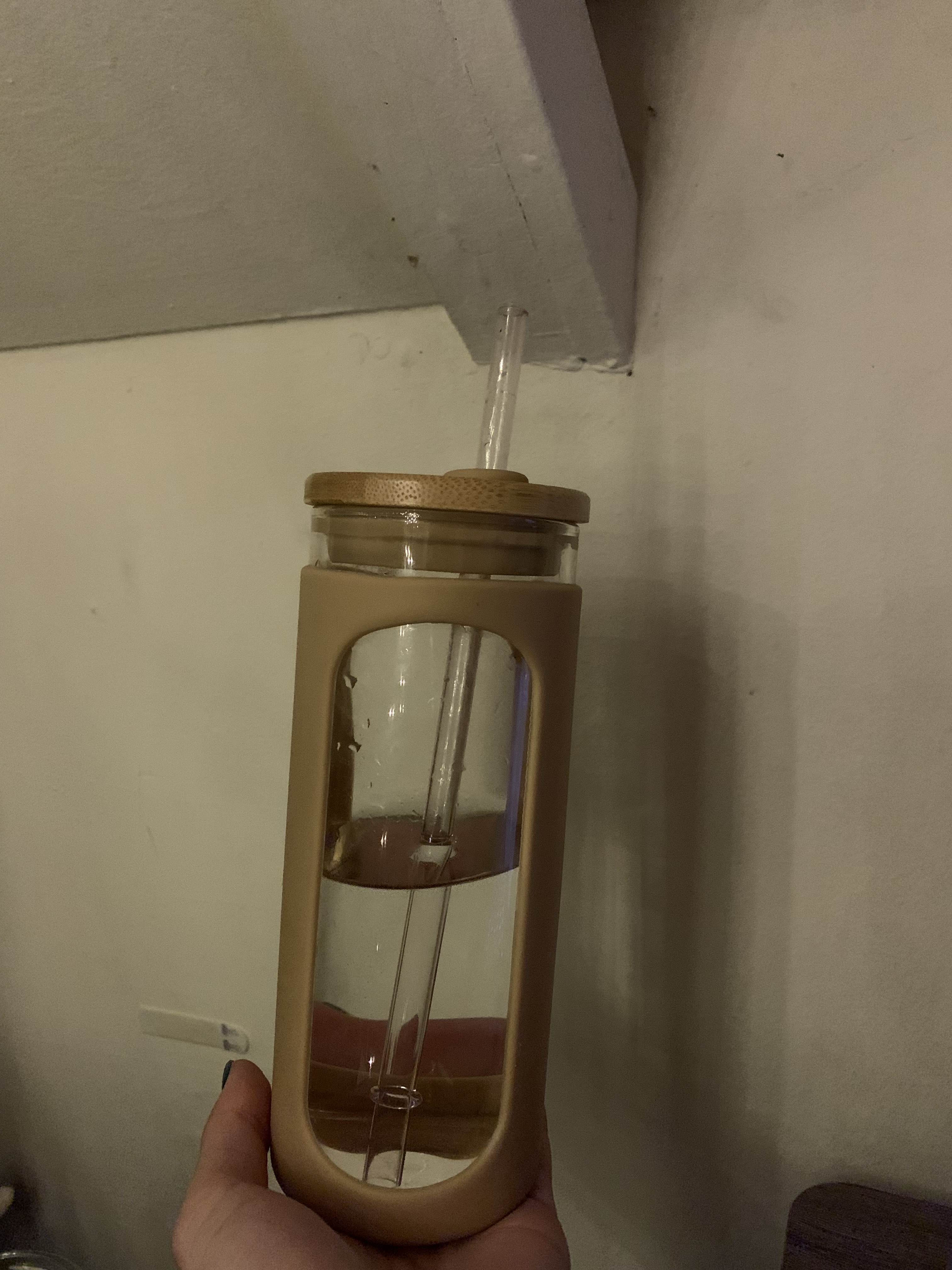
Kodrine 20oz Glass Water Tumble with Straw and Lid,Bamboo Lids Water Bottle, Iced Coffee Cup Reusable, Wide Mouth Smoothie Cups, Straw Silicone Protective Sleeve BPA FREE-Amber

Upon my recent resignation from Starbucks, I realized I would not be permitted to free coffee any longer. Unfortunate. And so, on Wednesday, September 29th, I ordered a reusable cup.

I went to Amazon, where I am embarassingly an avid shopper, and found this cup listed for $15.99. Amazon’s 1-Click Buy feature couldn’t have made it any easier to make the purchase. Because of Amazon’s naturally prosaic manner, I didn’t think too hard about making this purchase. I am an avid coffee-drinker, I love espresso, and I have my own espresso machine. I thought a reusable cup would be the perfect oppurtunity to keep making coffee at home.

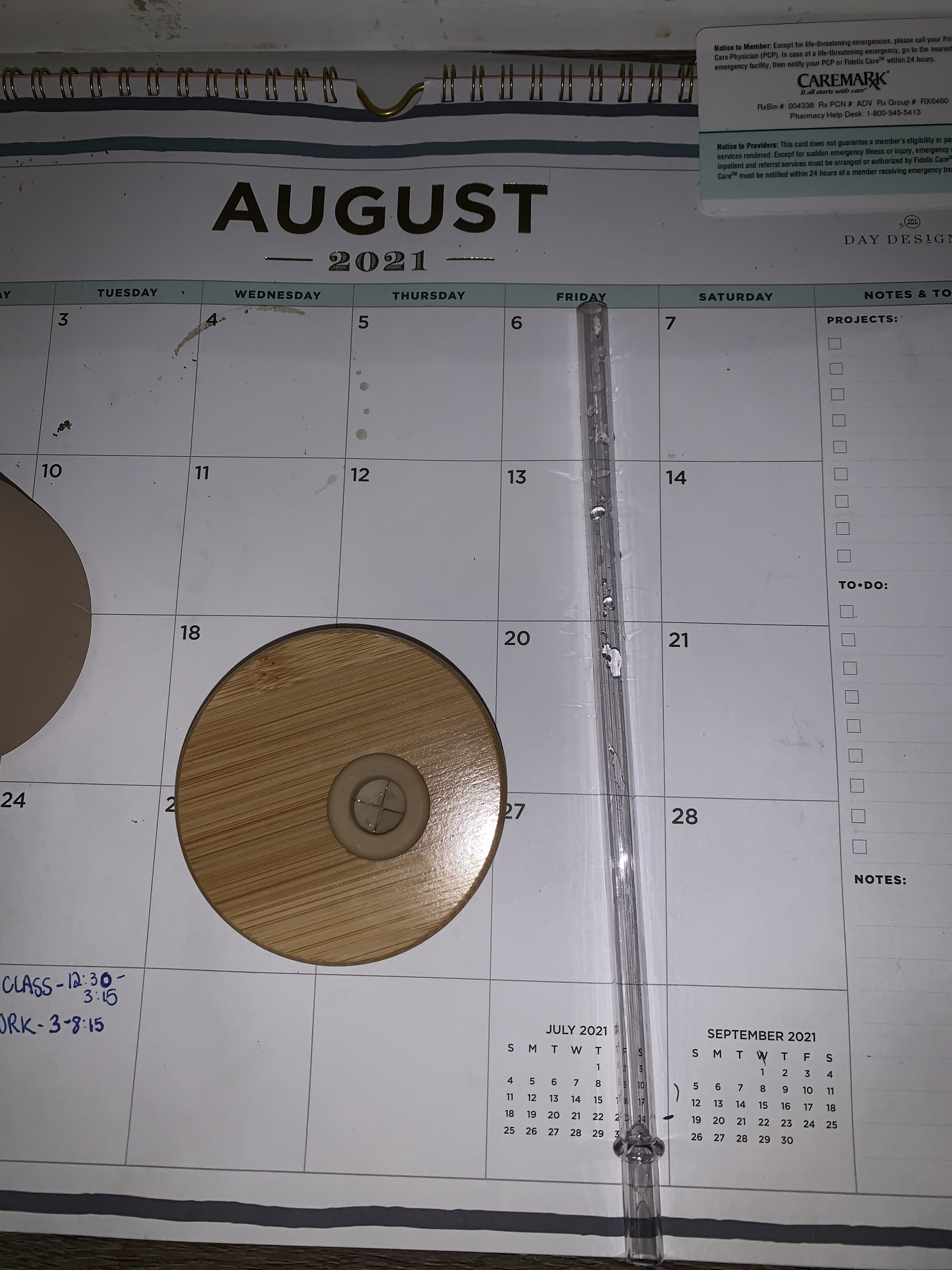
The cup consists of three features: a straw, a bamboo lid and a glass container which is protected by a silicone sleeve. The straw is plastic, the lid is made out of bamboo and the cup is glass. This tumbler appealled to me because it was made out of glass, and in my experience plastic reusable containers get moldy much faster than glass containers. Something that interested me were the selling-points listed on the Amazon ad above, such as “Natural Bamboo,” “Food Grade,” “BPA free,” and “Easy Visibility.” What are the benefits of these selling points? What exactly do they mean?

I started with “Natural Bamboo.” One component of the cup, the lid, is made out of bamboo. The major pro that I found the most appealing to me is the fact that natural bamboo is a renewable source. Synthetic/faux bamboo is not, and therefore has detrimental effects to the enviornment. Next, I inspected the “BPA free” feature. BPA is shorthand for bisphenol A, which is a chemical added to many food containers in order to make a more resilient plastic. What I found interesting in my research was the following, “However, even small concentrations of BPS and BPF may disrupt the function of your cells in a way similar to BPA. Thus, BPA-free bottles may not be an adequate solution” (Healthline). In short, BPA-free is not entirely effective as a selling point, given that there are other bisphenol chemicals that could be incorporated in this product. “Food Grade” simply means that the product is safe to make contact with food, which I would hope this reusable cup could do. Food Grade is necessary for a product to be FDA-approved (ISM).

As for “Easy visibility,” I am not sure what this means. Is it indicating that the cup is easily identifiable, or that the glass is transparent? I was not sure why the advertising of this product included this feature.

I included the above image, which I also found on the Amazon listing, because it said that “1 reusable cup = 500 coffee cups.” It included this, however, I was not sure exactly what that meant. Does this reusable tumbler lose it’s integrity after 500 uses, or does the making of the product use 500 cups? I wasn’t sure. In a similar remark, I attempted to look where the company was based, but the Kodrine website did not list it’s origin/where it’s products were made. However, Kodrine has a partnership with Amazon, and there are Amazon warehouses everywhere. I am assuming, given that I was able to recieve the object in less than 48-hours, that it must have been shipped to me from somewhere relatively local to New Paltz. All in all, the tumbler is relatively vague in it’s origins, where it is shipped from and how it got to me.

Sources:
https://www.healthline.com/nutrition/what-is-bpa#where-its-found

https://www.industrialspec.com/about-us/blog/detail/fda-compliant-food-grade-food-safe-meanings

Pigments and Colors

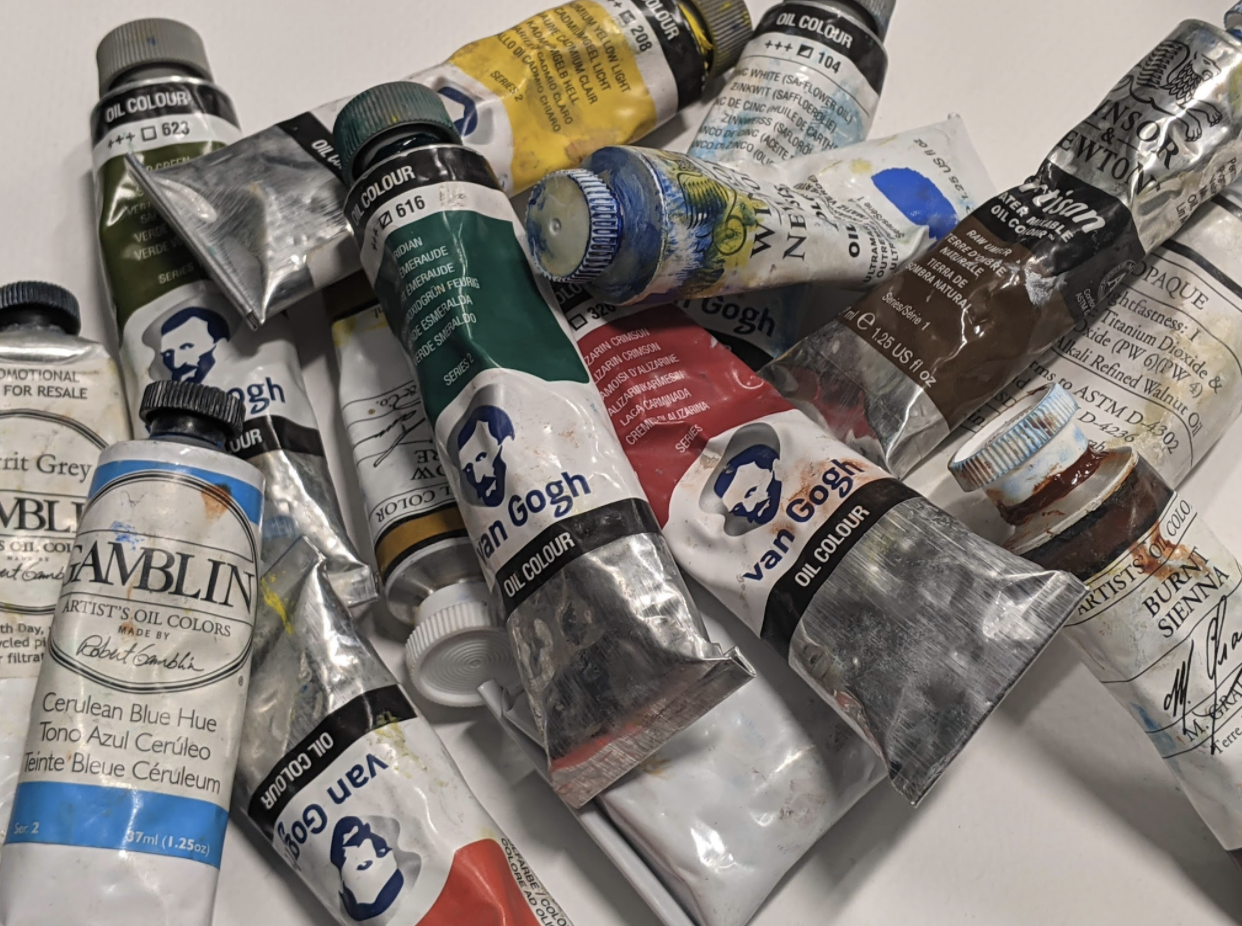
I chose to look into my set of oil paints. The paint itself consists of two major ingredients, pigment and oil. Of course, there is also packaging and mixing in the process of creating a tube of paint ready to be sold in a store. The oil in my paint comes from walnut, linseed, and safflower plants. These plants need to be farmed and processed into oil for the paint. These oils are combined with pigments to create colored paint. Pigment comes from many places like metals, minerals, and elements. Sometimes they also come from insects, such as carmine red, none of my paints do. Mineral pigments need to be mined, crushed into powder or otherwise processed, and shipped. The paints are mixed and packaged by different companies. In my case those include Gamblin, Van Gogh, or Winsor Newton. They are packaged in aluminium tubes with plastic caps. I have also heard of people mixing their own paints. But to do that they still need to get the pigments and oils, which are often impossible to produce on your own.

Pigments are one of the most complex and important parts of paint. We tend to see color as surface level, something that does not really affect the make-up of an object, but different colors can change so much about an object. They come from different places, and have different backgrounds, chemical processes, toxicities, and expenses depending on the color. Even price changes based on the pigment and oil type. While a t-shirt may not change price based on color, paint often does. It is easy to notice with a material that is so grounded in the need for color variation. At the beginning of the semester, I went to get supplies at the art store, but spent the whole time calculating which paints would burn the smallest hole in my pocket. Even among the same color, different brands can vary in hue, saturation, and viscosity.

Viridian green is my favorite color of all of my paints. It is a deep bluish green that lightens to mint. This pigment is made using powder from a rare mineral called eskolaite. This green is one of the less toxic green paints, which is why it is still used today. Other greens like Scheele’s green, which contains arsenic, were extremely toxic and are no longer in use. Viridian green was patented in 1859, and the eskolaite used to make it is mainly mined in northern Europe.

White is usually produced from metals, often heavy metals. I have two different kinds of white, titanium and zinc. Titanium white, as you might guess, comes from titanium, a heavy metal. While it is not as toxic as paints that come from lead or arsenic, it is still one of the less safe colors. My second tube of white is zinc white. Zinc is a less toxic alternative white, but it is less commonly used. It is a harder paint to make, because the zinc does not react as well with the oil, and it took a lot longer for people to perfect it in oil paints. It is also known for being a cooler shade of white that leans towards blue. Zinc is often mined in Canada, but processed in Eastern Asia.

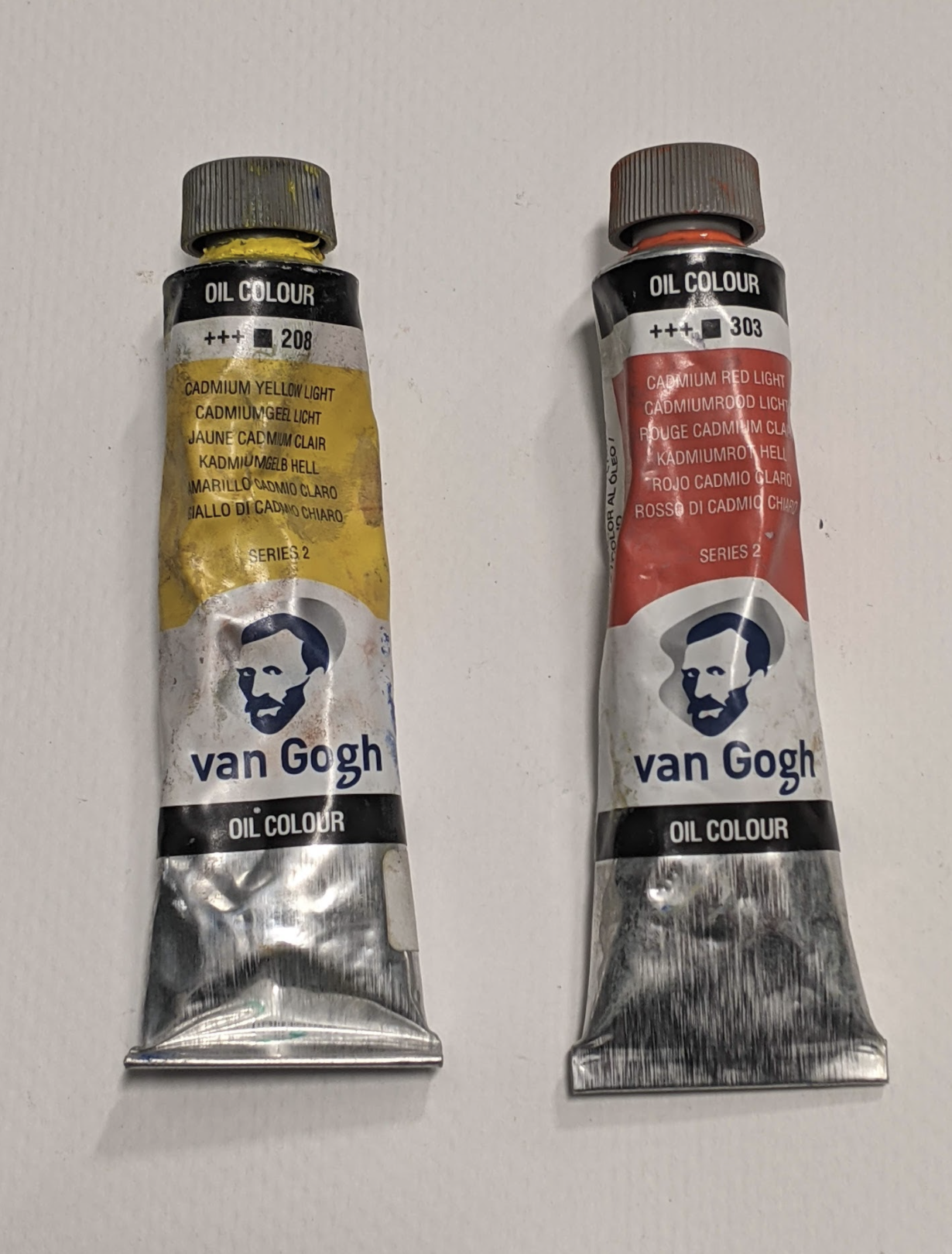
One pair of paints that interested me were cadmium red and yellow light. I was surprised how two different colors could come from the same source. Cadmium is an element, and is a byproduct of zinc ore processing. It is used in reds, oranges, and yellows, but is less commonly so due to its toxicity. Usually is produced in eastern Asia, where zinc is processed.

Ultramarine is a shade of blue made from crushed lapis lazuli. Blues in nature are very rare, and ultramarine was a very rare and expensive pigment throughout history. This has been one of the most important pigments since the renaissance, and has always seemed like a magical substance. Since it only came from very few places, the process behind making it was often a mystery. Its name means “beyond the sea” which does a great job of representing how otherworldly people considered this intense blue. When I paint with it. I always find myself cutting it with another color because of how overpowering it is. The lapis lazuli used to make it is commonly and historically mined in Afghanistan.

My paints are a collection of objects that I bought, kept, and used together. They are always grouped as the same thing and considered to be variations of the same object. But each one is very different. Because of their differing colors and brands, these paints all have different components, labor, and histories. Even though these things are often forgotten, they still matter and have an impact on our world.

For more information on paints and pigments you can look at:

http://www.webexhibits.org/pigments/