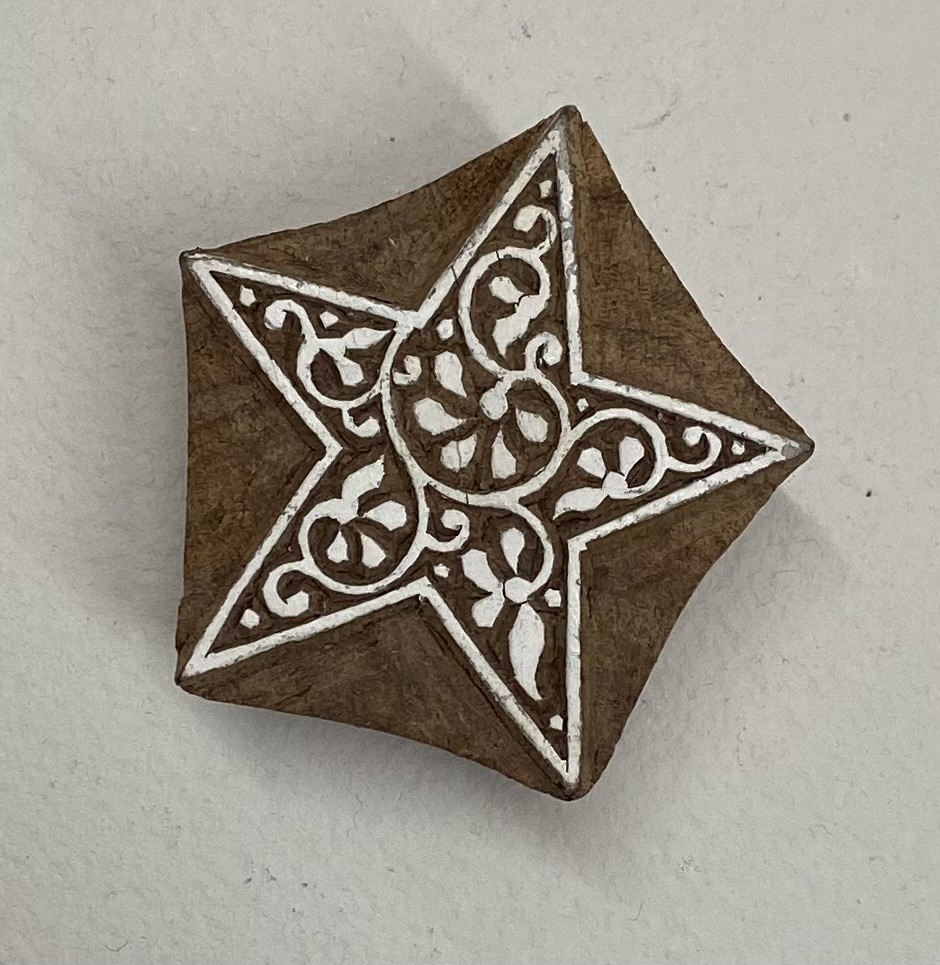
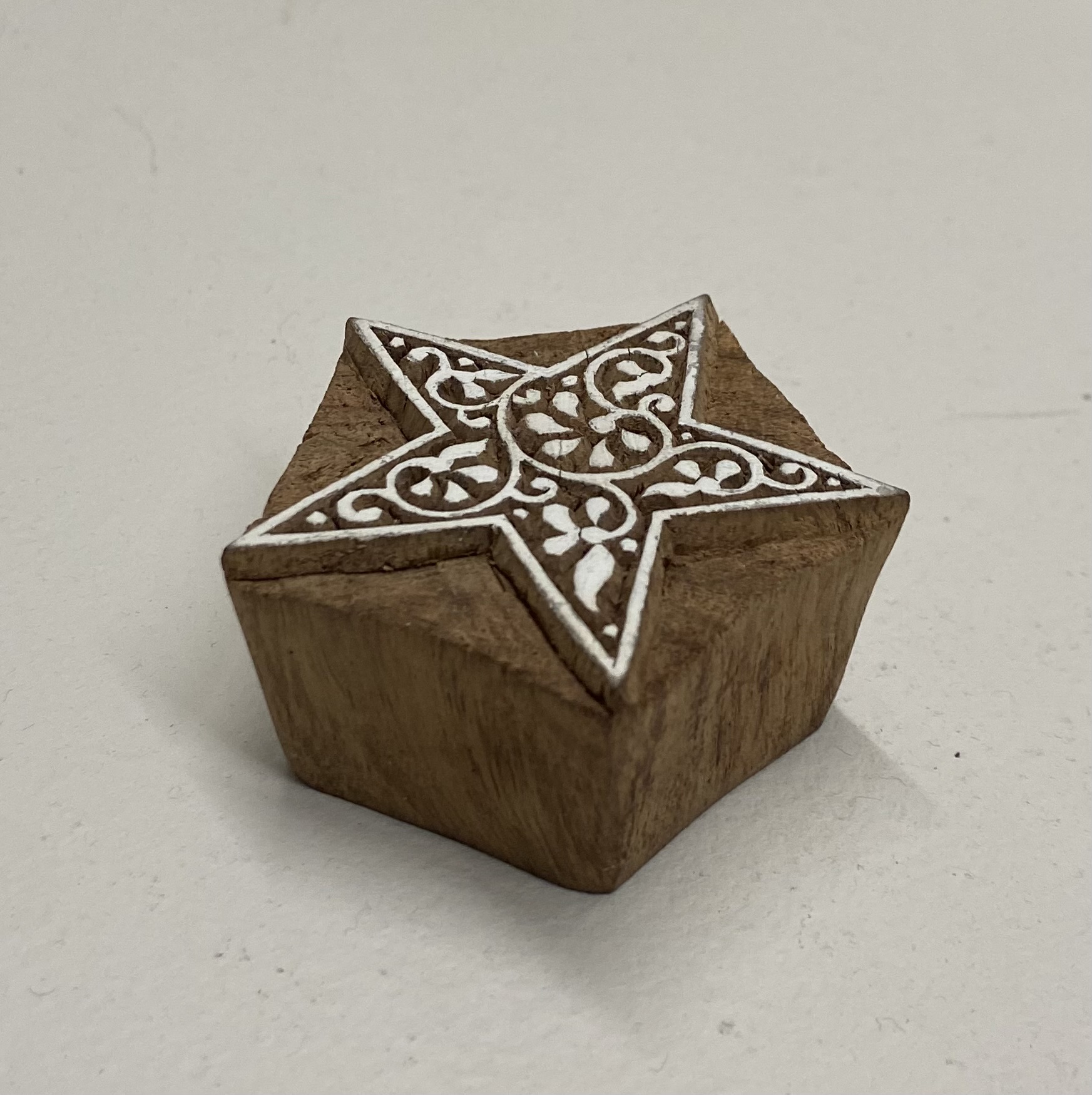
This is a woodblock stamp, one of the few that remain of a collection that my mother bought from a woman who was carving them on the side of the road in Mumbai, India when we visited my family there around 15 years ago.
The stamp is carved from a warm-toned wooden pentagonal prism with a height of around 1” not including the protruding design. The faces are parallel, with the non-incised base being slightly smaller than the incised face so that the walls are not quite perpendicular to the faces. Each wall of the bottom pentagonal base is about 1.25” while each wall of the top pentagonal face is 1.5”. The walls of the prism are slightly concave, some more so than the others. Each wall feels smooth when I drag my thumb across it vertically, but horizontally I can feel the tiny ridges of the wood grain.
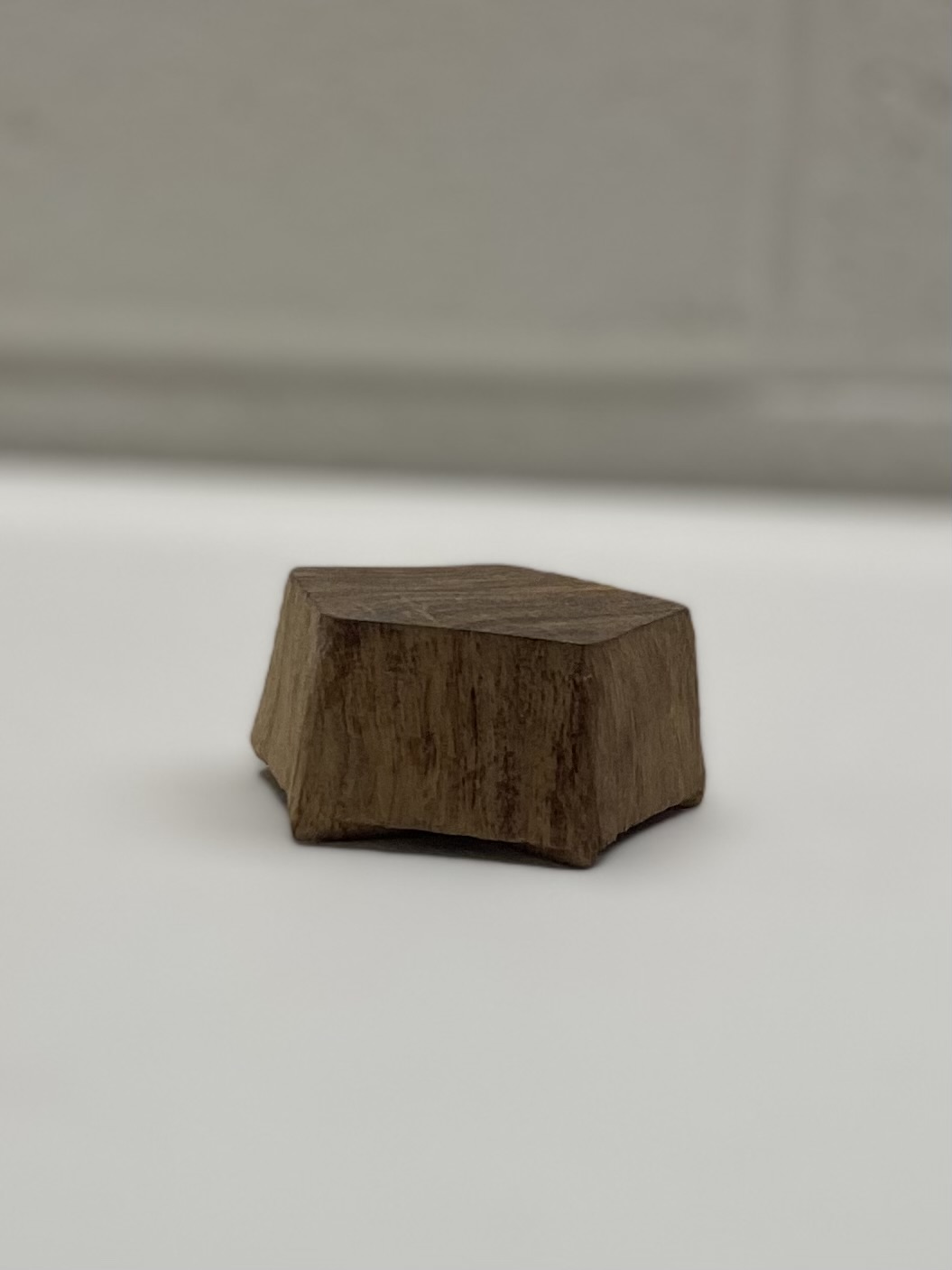
The bottom of the stamp is the smoothest, flattest face. I can run my finger along it without catching any rough patches. A pattern of wavy wood grain is visible across the base but has been disrupted a bit by a few scuffs and scratches, although these are so small that they do not affect the level feeling of the surface.
The top side has a pattern that protrudes about 1/8” off the surface of the stamp, emphasized by a thin coating of white paint. A 5-pointed star creates an outline for the pattern, each point at a vertex of the pentagonal surface. Each side of the star is around 1” long. Outside of the star’s outline, the top surface of the stamp is roughly carved so that it resembles the texture of a hard piece of cork. Cracks are visible and my finger can feel the irregularities in the wood. If I try hard enough, I can scratch little splinters off the surface.
While the star itself is symmetrical, the design inside of it is not. It is made up of a curving spiral, small dots, and organic shapes reminiscent of florals. From one inner vertex of the star comes a curve that coils through the center of the star and branches off into each arm of the star. On the arm of the star directly opposite to where this curve begins, a large organic leaf-like shape reaches up into the point from the curve. The other arms of the star each contain a piece of the same curve that spirals into a rounded end. There is a small dot in the thinnest part of all 5 arms. There are more organic leaf-like shapes and dots throughout the inside of the star, as well as some teardrop-like shapes and smaller spirals extending off the continuous curve.
Around and in between the white-painted elements of the design, the wood has been etched into so that only the design itself reaches a level height. The etching has not been done strictly perpendicular to the surface, but instead creates little irregular sections within the deeper wood, almost outlining each element of the design. This leaves unfinished areas of wood that are too small to reach but would probably be rough and splintery to the touch.
But this stamp does not exist simply to be observed; it is meant to be used. When printed onto fabric or paper, the design has a chance to exhibit itself, while the stamp remains a tool. After examining its form and craftsmanship, this stamp seems to be just as worthy of attention, if not more so, compared to the design it produces.
 The Materials of History, Thought, and Art
Hey Saj! Something I found really helpful in your descriptions was your use of the first person narrative. I didn’t think to describe the object to the reader using my own voice, but that honestly made the explanation so easy to read and understand. I was trying to remain omniscient, haha, but I think we could all take a page out of your book and try it this way!
Saj! I was so excited to read this after noticing this was the same object you brought in to the class on the first day. Introducing you to the class through this object and then reading this detailed description of it was so eye-opening. In class I learned about your connection to the object and why it made you happy. In this writing I learned about each intricacy of the object. Both things I learned are equally as interesting. I really liked when you said this: “If I try hard enough, I can scratch little splinters off the surface.” Although I have never tried to scratch splinters off of anything, this detail was really helpful in my imagination of how this part of your stamp felt to the touch. I am very impressed with your writing, specifically this line: “But this stamp does not exist simply to be observed; it is meant to be used.” In the book we are reading, we learn about the use for certain objects. The fact that this stamp is so amazing to observe, I like that it is actually more useful when stamping with it. Amazing work Saj!