In the Sheneman family, the military tradition has thrived.
My grandfather was the second youngest of thirteen, and the last to still be born on their farm in rural Mecosta County, Michigan. With three sisters and one brother passing away in infancy, there were nine healthy young men in the Sheneman household–opportune for military drafts and service.
Earl Sheneman (1915-1949) Army, WWII
James (Jim) Sheneman (1918-1973) Marines, WWII, South Pacific
Glen Sheneman (1924-1996) Navy, Korean War (N. Pacific Aleutian Islands)
Robert (Bob) Sheneman (1932-?) Army, Korean War
Fred Sheneman (1934-?) Army, ?
Neil Sheneman (1936-?) Army, ?
Keith Sheneman (1937-?) Army, ?
Bryce Sheneman (1938-2017) Air Force, Japan and Cold War
Carl Sheneman (1940-) Army and Reserves
When my grandfather was young, around 10 years old in 1948, his father passed away and his mother remarried “the meanest man in Mecosta County,” undoubtedly inadvertently preparing the young men for their difficult and challenging futures.
His eldest brothers Earl and James (Jim) were drafted by the Army to serve in World War II. Jim later told my grandfather of his experiences of the horrors of war. He spoke of the military abandoning him in the South Pacific and “sipping air through a reed” covered in mud for over a week while enemy soldiers ran nearby.
The next four men continued the tradition. Glen served in the North Pacific, the Aleutian islands in the Northern Pacific during the Korean war. As a proud German family, and a surname that made it difficult to keep hidden, my grandfather had been beaten up and called a “kraut” during the life and death of the Second World War. Once, on my grandfather’s bus ride home from school, the bus driver kindly pulled over to offer a walking soldier a ride home, only to discover that it was Glen. My grandfather recounted that “no one ever made fun of him after that.” His brothers Robert (Bob) served in the Army in Korea and Fred, Neil, and Keith served in the Army as well. Their placements are relatively historically inaccessible to me.
The youngest two were the luckiest in their placement, in terms of immediate physical harm. My grandfather’s youngest brother Robert (Bob) worked in the “Motor Pool” (a mechanic) and spent most of his time in the reserves. My grandfather would warn my parents when visiting Bob’s house that he was a thief and if they checked under any of the furniture they would find “PROPERTY OF THE UNITED STATES ARMY” stamped on it because he had access to the paperwork. As the only child to complete his high school education, my grandfather perhaps thought it was his place to help discourage this behavior from his brothers, but ultimately conceded that it was just who they were. My grandfather, slightly older than Bob, stood out among the otherwise traditional military stories for young men from rural Michigan.

Between 1956 and 1964, my grandfather served in the United States Air Force ultimately earning the title of Staff Sergeant. The academically highest performing of the thirteen children in his farm household, he likely received high marks on entry-level examinations that kept him from being placed as a “grunt.” Instead, they taught him “diddy bop” (morse code) in basic training and sent him to Hokkaido, Japan’s northernmost island, to intercept Soviet messages.


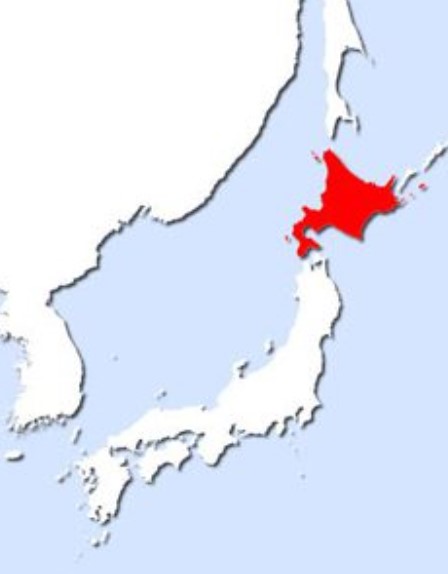
For his journey, he was issued the object that I am studying by the military: a travel trunk.

This trunk was a Korean War-era United States of America Air Force issued Aluminum steamer trunk supplied by Kowa Industry, a Japanese company. Truly a representation of primary geographic interests in the preceding and following decades, it is only fitting that its history is deeply intertwined with the Union of Soviet Socialist Republics (USSR) and the Cold War through my grandfather. The base at which my grandfather was stationed with this trunk was the base that intercepted the message and informed the president of the successful Soviet launch of Sputnik.
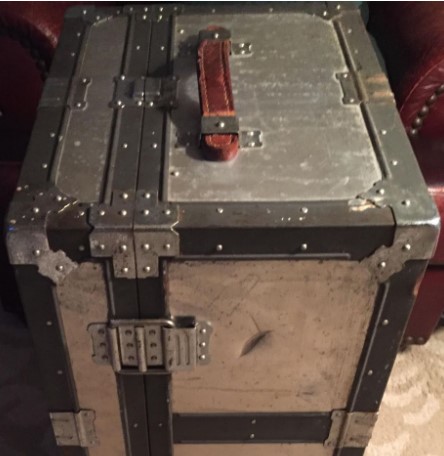
There are markings around all faces of the trunk, with one large gash, indicative of its experience being used, and confirming its journey overseas.

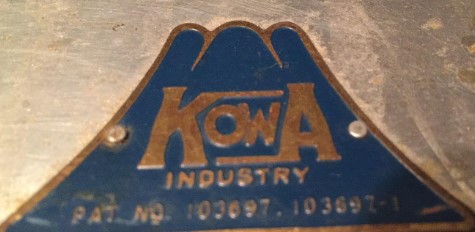
The company Kowa Industry has a logo positioned directly below the key latch in the middle of the trunk, pictured below.

The logo reads “KOWA” with the small text beneath it “INDUSTRY; PAT. NO. 103697.103697-1” enclosed in a triangular shape with a flared bottom and three curves at the top, delineating what appears to be a volcanic mountaintop. There are small screws on either side of the word “KOWA” alluding to the metallic nature of the logo, also revealed by its reflectivity under light.
A paper on the side of the trunk without a handle, pictured below, reveals its ownership, location of departure, and its destination: “BRYCE SHENEMAN; HT PATTERSON AFB; OHIO” and in the right box labelled “DESTINATION AIRPORT”: “SUU”. Bryce Sheneman was my grandfather’s name, and his base of departure was the Wright Patterson Air Force Base in Ohio, which he only referred to as “Wright Pat.” His destination, SSU, was the military acronym for Travis Air Force Base in Fairfield, California. The labels for each of the boxes appear as though they were printed with the paper, but the information personal to my grandfather appears added as if by a typewriter.
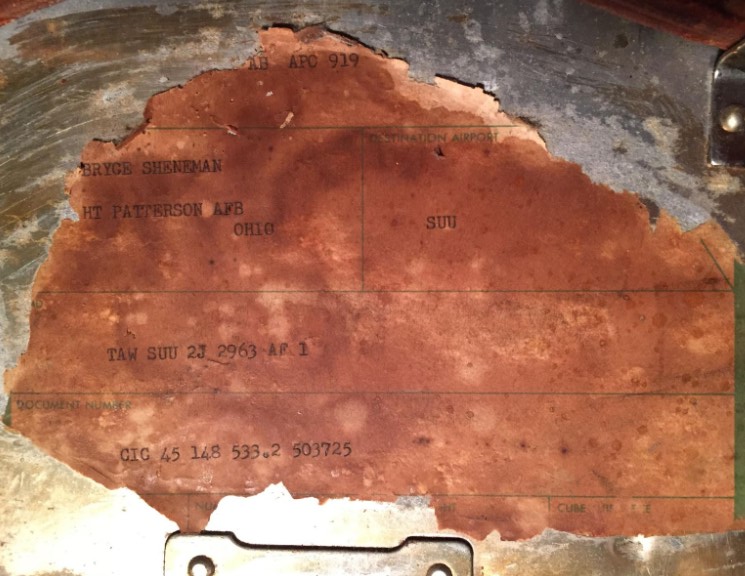
The tattered edges make some of the information elude me, but there is also information completely present that escapes my comprehension.
My grandfather traveled throughout Hokkaido, likely using this trunk, to connect with a woman he met there. Despite never directly confirming this, except according to his sister Vivian and his only other son Kurt, he was supposedly married to a woman during his time in Japan and had a son with her, named Bryce–the same name as my dad. Upon his death in 2017, my family discovered love letters they had written to each other and a photo of them together. However, due to family conflict and ties being severed with my uncle, these letters and photo are inaccessible to me. This photo, taken between 1956 and 1960 while he was in Japan, appears to depict my grandfather (right) wearing a wedding band. This band has not been recovered to my knowledge. The story I have always heard is that during his return to Ohio, trunk in tow, for the remainder of his service, he was deciding if he should bring them to the United States or return to Japan. However, according to rumor from his sister Vivian, due to an unfortunate train derailment, they tragically passed away, and within a few years my grandfather decided he no longer desired a military career and moved back to Grand Rapids, Michigan where he remained with my grandmother, step-grandmother, and then alone. When my father was young, in the late 1960s and early 1970s, my grandfather would teach him and his brother Japanese words, per their request. He used to teach them Japanese nursery rhymes, one of which my dad can still recount (and made for a fascinating experience on a bus of Japanese tourists in the Bahamas during my parent’s honeymoon). My father said that as he grew older, before the pictures and letters, he knew this story Vivian had told was true. When prompted how he knew so certainly, he asked me, “How did he know the nursery rhymes? His friends sure weren’t learning any.”


He served in Ohio until 1964. My grandfather possessed a “crypto” clearance, a security clearance higher than the general in charge of the base. The general at the base asked him what he wanted to be, seeing as they had no use for a spy and did not want to send an intelligent soldier to be one of the first few on the ground in Vietnam, and so my grandfather became a plane mechanic and engineer. The aluminum trunk remained with him there, even during the transportation of “alien” spacecraft from Roswell, New Mexico to the base.
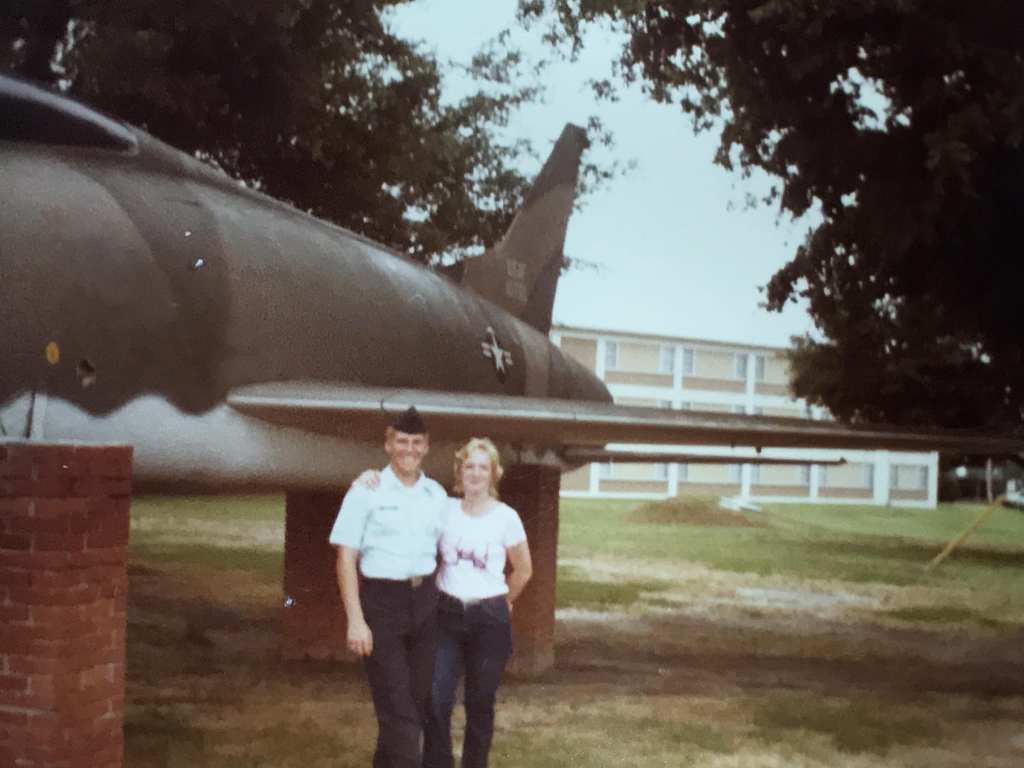
Upon the completion of his service, he returned to Grand Rapids, Michigan where the trunk rested in his closet at my father’s childhood home where my grandfather would spend the rest of his life. It acted as storage still, only in an altered context to its previous travels. He would say it was, “just taking up space.” When my parents moved into their home, my childhood and lifelong home, in 1996, my grandfather offered it to my mother who happily accepted, and my grandfather was no doubt pleased to give it to her. Despite its industrial appearance and damage, my mother sought to repurpose it as storage for her sewing and craft materials. For the next few years and into my lifetime (2002-) it has been in my parents’ bedroom sitting in their closet, holding my mother’s crafting supplies. I had always thought it was my father’s as they share the name “Bryce Sheneman” and share the experience of serving in the Air Force (photo 1: my father in the 1980s near the Air Force Base in Fairbanks, Alaska, left; photo 2: my father and his mother upon his completion of basic training in the early 1980s).

Sometimes more accessible than others with the clutter a household with young children produces, the trunk has only recently been discussed more for its history and importance, especially following the passing of my grandfather.
Now that the military tradition in my lineage has come to an abrupt halt, with my sister and I as well as my uncle’s children not serving, it is unclear who it will be passed along to. As per tradition, I suppose the eldest children get to make that determination. However, and perhaps only because I am the youngest and most invested in the history of this object, I am eager to break that tradition as well.
Citations
“Ditty Bopper.” The American Legion, 1 June 2016, https://www.legion.org/stories/my-time-uniform/ditty-bopper.
Kindy, Dave. “75 Years Ago, Roswell ‘Flying Saucer’ Report Sparked UFO Obsession.” The Washington Post, WP Company, 17 Oct. 2022, https://www.washingtonpost.com/history/2022/07/08/roswell-flying-saucer-ufo/.
“Oct 4, 1957 CE: USSR Launches Sputnik.” National Geographic Society, https://education.nationalgeographic.org/resource/ussr-launches-sputnik.
Sheneman, Allyson. “Oral History of Bryce D. Sheneman Recounted by Son Bryce W. Sheneman.” 12 Feb. 2023.
Sheneman, Allyson. “Sheneman Family Tree.” Ancestry Family Tree, Genealogy & Family History Records, 12 Feb. 2023, https://www.ancestry.com/family-tree/tree/189111176/family?cfpid=242450233905&fpid=242450248756.
“Vintage Kowa Aluminum Steamer Trunk, circa 1940’s.” Vintage Furnishing , https://www.1stdibs.com/furniture/more-furniture-collectibles/home-accents/trunks-luggage/vintage-kowa-aluminum-steamer-trunk-circa-1940s/id-f_26950522/.
 The Materials of History, Thought, and Art
Allyson, I loved the pictures and timeline you added to your writing to help convey the story of the military trunk. When you discussed the wear and tear on the trunk, it reminded me of when we talked in class about stories being almost like a patina added to objects over time. For this trunk, the signs of aging carry the story of the object.