The object that I have chosen to discuss is a floral enamel brooch passed down from my great great grandfather.

Jane and Sandor
His first shop was known as GS&H, which opened in 1920 in New York City. He worked alongside a man named Mr. Lowenstein. Their creative focus was on buttons, jewelry, and handbag frames, until Sandor married Jane, and Lowenstein retired shortly thereafter. Jane joined the business at a booming time in the industry: the Great Depression. This was great for business as wealthy women could no longer afford real stones, and turned to Sandor’s costume jewelry instead. Due to this, they mainly produced jewelry to keep up with the times, changing the name to Sandor Goldberger, Inc.
He was well-known for his enamel flowers, such as the one depicted below:
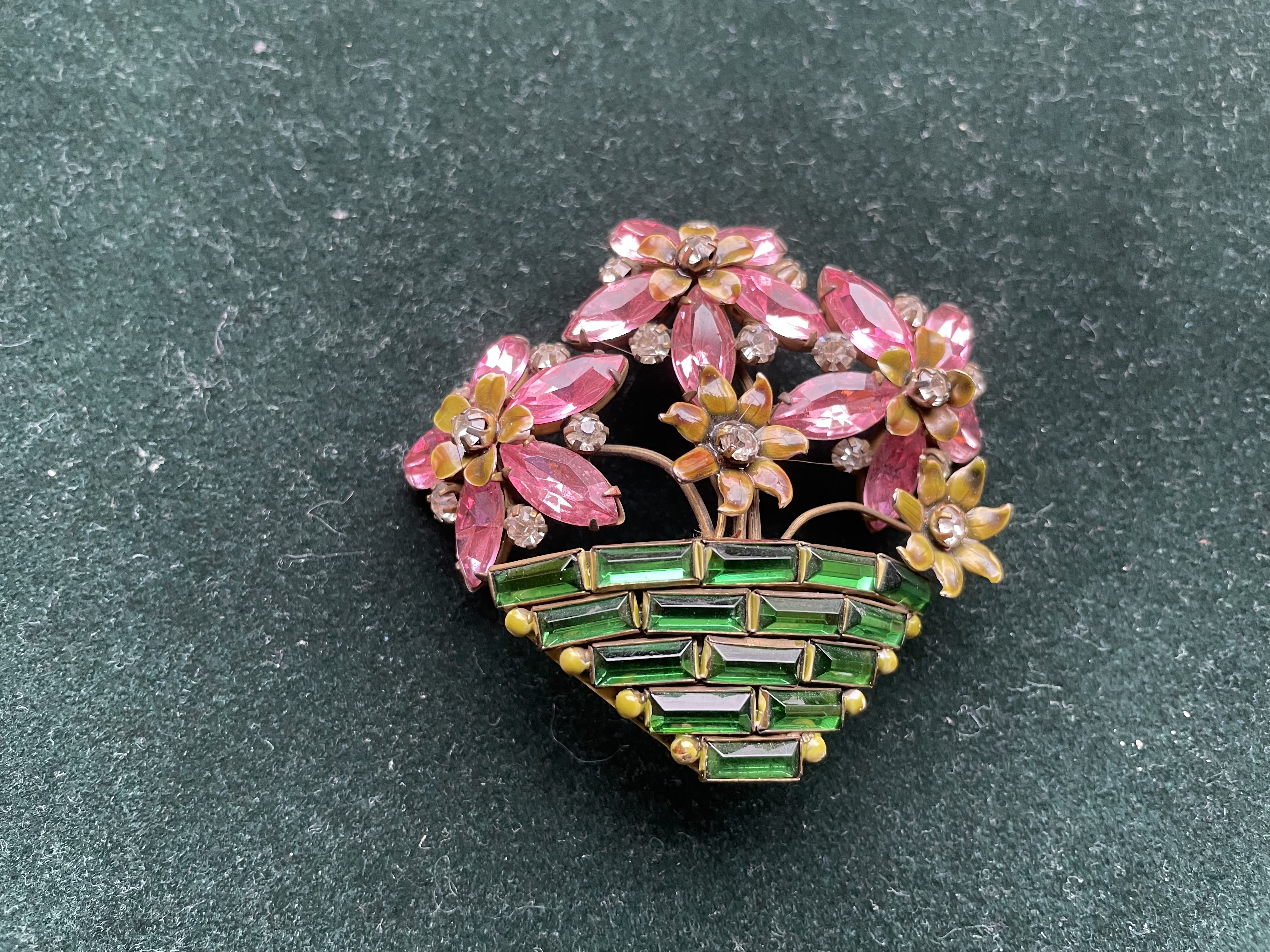
My great Grandma Janet spent an awful lot of time in his shop, helping with the jobs of the day. One day she asked Sandor for this object, and he gave it to her despite it being the best-selling one on the market at the time. This is a brooch (a pin) meant to be worn on dresses, coats, hats, and suits. Big brooches were in-style and Janet wore it everyday.
Sandor and Jane’s families both came from Hungary. When they were young they moved to the United States in search of a better life. My Grandma Carol tells me the family used to call the pieces with diamonds and colored stones Hungarian Jewelry, yet she doesn’t recall why they called them this name, especially since none of the pieces were from there.
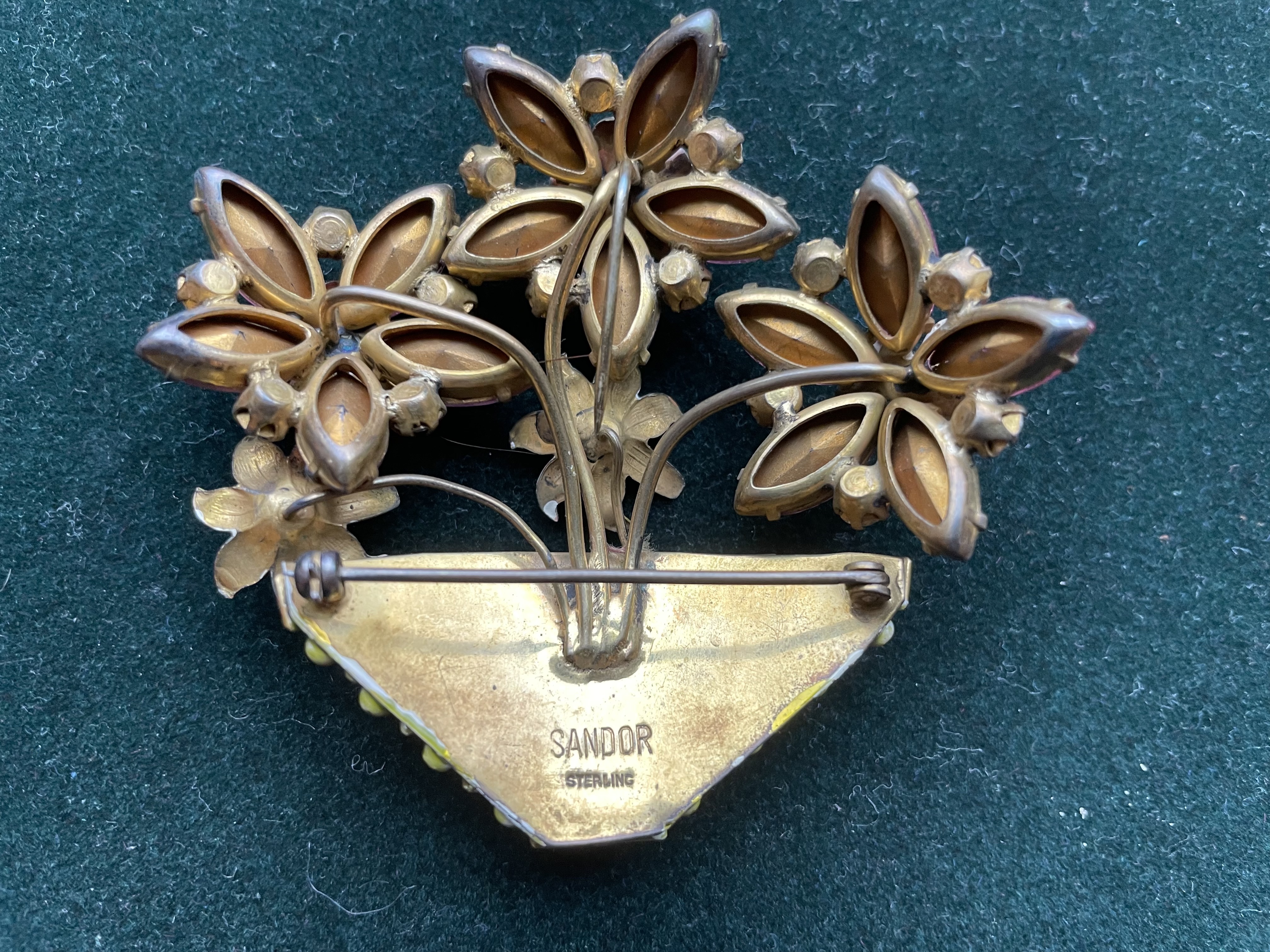
This brooch was made of sterling silver in 1943. Normally, they would be made out of brass. This is because of WWII, where brass was needed for bullets and weapons. Although it appears to be brass, it is actually silver that looks brown from it tarnishing overtime. The “stones” are made of glass from Europe, and have been set in place through careful, handmade sterling silver soldering. For a stone to be set, it means there was no gluing involved; similar to the setting of a diamond in an engagement ring. The back is engraved with Sandor Sterling,
The shop was a big open space that glistened in the light from all the stones hanging from the walls. Behind the shop was the workroom. This is where people functioned as an assembly line. The men who formed and set the designs had learned the trade in other countries. Women did the enameling and beading. Though the shop wasn’t the only place these exclusive costume pieces were sold. They could be found in department stores, and even featured in Vogue.
This piece was left for my Grandma Carol when her mother Janet died; though Carol uses this solely for special occasions. She often attaches it to a coat or a purse, specifically when seeing the Baltimore Symphony Orchestra. Carol feels connected to her mother Janet when she wears the brooch, as they used to see orchestras together ever since she was a little girl. Carol now has it pinned onto a heart-shaped Godiva chocolate box alongside other Sandor pieces she was gifted.

Sandor and Jane were focused on making good use of their resources. They would buy pieces from the United States and set them with the European “stones”, all by hand. Sandor never drew out his ideas, he just went straight into physically designing them. Each year, they would produce 3 different lines of jewelry. Each one was through Jane’s eye for future fashion trends, which she based mostly off of Europe.
My Grandma Carol says she can look at a Sandor enamel flower, and recognize it as his in a jumble of costume-jewelry flowers. The Sandor costume jewelry company lasted until the 70s, and mainly because it was all done by hand.
Nowadays, many of his pieces are being sold on Ebay for much more than they used to sell for.
My Grandma will be leaving this for me when she passes. As of now, it sits on her heart box in the center of her living room–each grandchild will receive one of the pieces. I look forward to wearing this fine piece of art and hold the family histories close to my heart.
Sources:
Carroll, Julia C. Collecting Costume Jewelry 303: The Flip Side: Exploring Costume Jewelry from the Back: Identification and Value Guide. Collector Books, 2010.
Bz, Viola. “Sandor Vintage Costume Jewelry.” Kaleidoscope Effect, 15 Mar. 2022, https://nasvete.com/jewellery-company-sandor/.
“Antiques Roadshow.” PBS, Public Broadcasting Service, https://www.pbs.org/wgbh/roadshow/season/18/anaheim-ca/appraisals/sandor-sterling-brooch-ca-1940–201303T05/.
Sue. “Sandor Jewelry – History and Collecting.” Paloma and Bianca, 5 Jan. 2023, https://palomaandbianca.com/sandor/.
“SANDOR.” Sandor Jewelry, https://oldcostumejewelry.com/sandor/.
“Sandor Jewelry Products for Sale.” EBay, https://www.ebay.com/b/sandor-jewelry/bn_7024757112.
“Sandor Goldberger.” Etsy, https://www.etsy.com/market/sandor_goldberger.
Benjamin, Carol L. “Sandor Jewelry Interview.” 16 Feb. 2023.
Benjamin, Melvin C. “Sandor Jewelry Interview.” 16 Feb. 2023.
 The Materials of History, Thought, and Art
Hi, Anna! I really enjoyed your story about your Great Grandma Janet. She seemed really passionate about her work and it’s interesting seeing how the Great Depression actually helped her business. My grandma has a bunch of broaches like that and I’ve always thought they were so beautiful:)
Hi Anna! That is such a beautiful pin. I can’t believe all of these floral designs were handmade! What careful craftsmanship! I especially love the picture of your grandparents in figure 1 and the connection of how your grandma Carol would wear it out to see the Baltimore Symphony Orchestra.