For this assignment, I wanted to see if I could trace the history of a piece that I created myself. As such, I chose to focus on this hand knit blanket that I made for my friend’s birthday last month.

The photo above shows the blanket folded into a rectangle shape. The blanket is about 3 feet wide with 5 feet long. This blanket consists of a textured design comprised of woven braids, each connected through small loops that I hand-knit. The blanket’s reds, whites, and pinks are splashed sporadically throughout the yarn, giving it a unique, splashed appearance. This blanket took four spools of yarn, $20, and 4 hours to make.
Since I made this blanket, it does not have a tag to trace its origins. Because of this, I chose to focus on who made this yarn, the history of the store I bought it from, and how this yarn came to be.
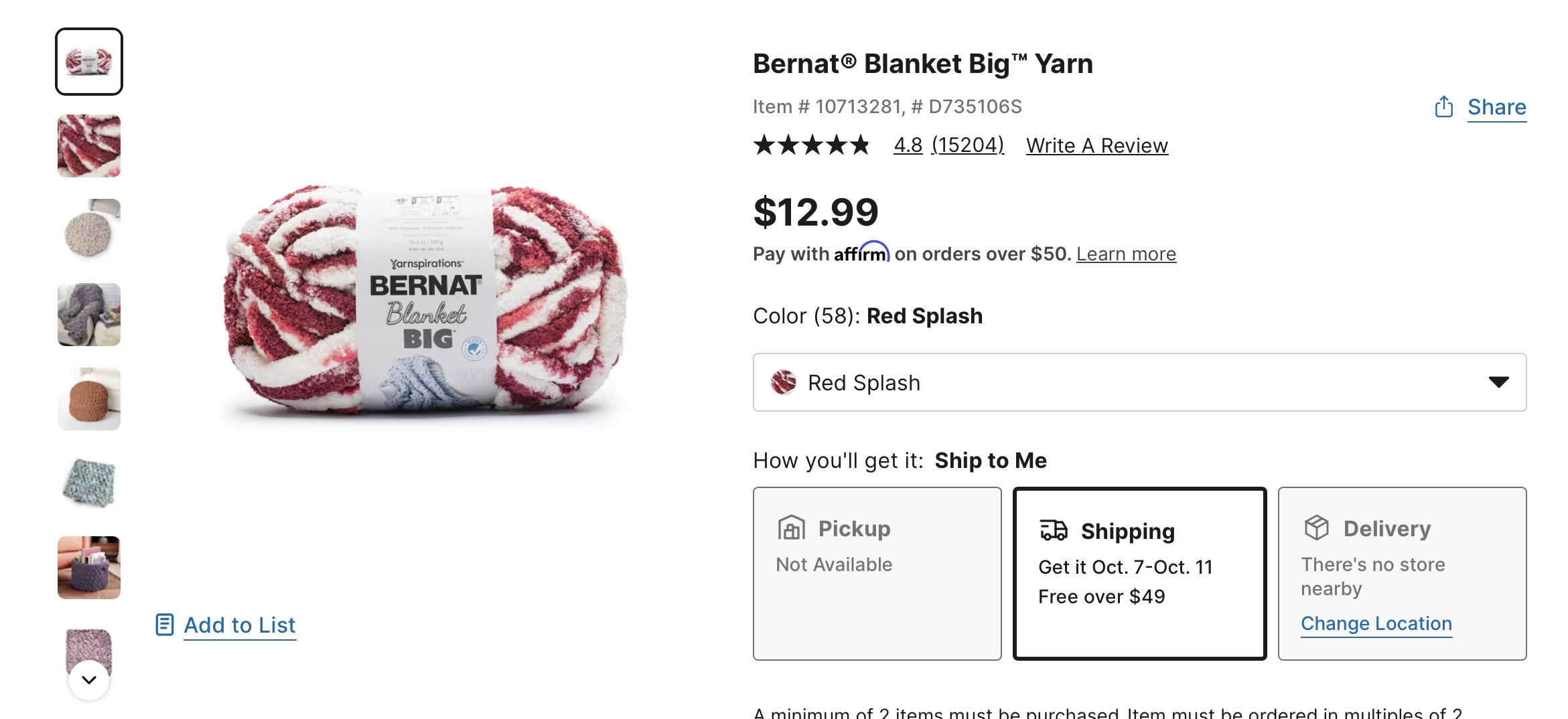
The yarn I used for this blanket was Bernat® Blanket Big™ Yarn in the “Red Splash” variety, as characterized by its red splotches against its white base. I bought this yarn online from Michaels, a widely recognized arts and crafts store.
This blanket was made of four spools of Bernat® Blanket Big™ Yarn. The color it came in was the Red Splash variety, as told by this yarn’s characteristic red splashes across its white base. I bought this yarn online from a Michaels store. A photo of this yarn on the Michaels website is shown below.
Established in 1973, Michaels is a famous craft store that’s known for its specialization in arts and crafts. With its 1300+ stores in 49 states, Michaels is a store that offers lots of art supplies both in-person and online (Michaels). I specifically ordered my yarn to be picked up at the NYC Michaels location that’s located in the Chelsea neighborhood of Manhattan. Though I did pick my order up from there, my package likely travelled from one of Michaels’ many distribution centers or warehouses by Michaels’ UPS delivery service.
I can imagine my yarn traveling in the back of the UPS van, nestled between all the other Michaels-brand supplies, and packaged in its plastic packaging that likely came from China, the “primary plastic supplier in the world” (Grand View Research). Understanding the origin of this packaging shows us how far parts of this blanket have travelled to get all the way to New York (and then SUNY New Paltz!). This plastic, derived from things like petroleum, was underground for so many years before humans decided it had another purpose — to protect the history and the work behind this blanket’s yarn.
The history of this yarn is where the Bernat Yarns Company comes into play.
The company that made this yarn is called Bernat Yarns. Originally founded in Hungary, the company relocated to Boston in 1902. Initially, Bernat focused on dyeing fabrics and restoring tapestries. Their expertise in needlework extended into fine arts, embroideries, furniture weaving, tapestries, and dye refining, exemplifying the Bernat Yarns Company’s skill with textiles (Jamaica Plain Historical Society).
In the 1950s, the Bernat Company was a pioneer in the textile industry, commercializing the use of acrylic yarns as opposed to woolen ones (Bernat). These acrylic yarns, with their polyester and nylon bases, were found to be much softer, easier to care for, and more affordable than traditional wool. This innovation allowed the Bernat Company to increase their sphere of influence, spreading through the United States and Canada. This innovation also allowed them to maintain their trademark — that baby blankets and winter items are some of the best items to make with their product.
The acrylic base of this yarn makes me think about the dyeing methods that were utilized to make the yarn the way it is now. Though the Bernat company does not have a specific process that I could find about dyeing their wool, I can infer that they likely utilize synthetic dyeing methods. I once tried to do the general cotton dyeing method with Sherpa fabric (another acrylic base). Because of the atomic composition of plastic fabric as opposed to cotton fabric, the dye did NOT hold and I was left with only grey-stained pink fabric instead of the black that I wanted. Synthetic dye, for polyester fabrics, is the only thing that will hold.
This type of dye was discovered in 1856 by William Henry Perkin, whose failed chemistry experiment created a whole new world of clothing dye (Science Museum). This dye allowed for fashion to suddenly become a whole lot brighter, and a fashion revolution in almost any shade imaginable. These dyes are now a staple in most clothing design spaces, as colors like blue and purple are very hard to come by naturally.
In 1992, the Bernat Company was bought by a Canadian company. This caused some of its doors in the United States to close, but for their outreach to grow much bigger. By the late 1990s, Bernat solidified its reputation with “the launch of staple product lines such as Bernat Softee, an affordable and durable acrylic yarn that remains a popular choice for knitters and crocheters alike” (Jamaica Plain Historical Society). This yarn is the sister of the yarn that I used for my blanket, and helped pave the way for other “chunky yarns” to become more popular.
I had assumed that the yarn was likely spun in a place where more synthetic products were generated (Asia). However, the Bernat company states that their products are mostly made in the United States and Canada by established weavers. So, for the most part, this yarn (and the blanket it became) hadn’t strayed too far from its original home.
Ultimately, though this blanket is one that was made with my very own two hands, it is a blanket that has travelled many places, and is a result of a lot of scientific innovation.
WORKS CITED:
Bernat Yarn. “About Us.” Bernat Yarn, https://bernat-yarn.com/about-us/. Accessed 4 Oct. 2024.
Grand View Research. “Synthetic Dyes Market Size, Share & Trends Analysis Report By Product (Acid, Basic, Reactive), By Application (Textile, Food & Beverages), By Region, And Segment Forecasts, 2023 – 2030.” Grand View Research, https://www.grandviewresearch.com/industry-analysis/synthetic-dyes-market-report. Accessed 4 Oct. 2024.
Jamaica Plain Historical Society. “Bernat Superior Looms Company: A Brief History.” Jamaica Plain Historical Society, 6 Apr. 2022, https://www.jphs.org/20th-century/2022/4/6/bernat-superior-looms-company-a-brief-history#gsc.tab=0. Accessed 4 Oct. 2024.
Michaels. “Bernat Big Chunky Yarn.” Michaels.com. Accessed 4 Oct. 2024.
Science Museum. “Colourful Chemistry: Artificial Dyes.” Science Museum, https://www.sciencemuseum.org.uk/objects-and-stories/chemistry/colourful-chemistry-artificial-dyes. Accessed 4 Oct. 2024.
 The Materials of History, Thought, and Art
I have also made blankets using this yarn, so this post was very interesting to me. Learning about the dye that works with this yarn as being a result of a chemistry mistake was really cool, especially your little anecdote about how you tried dying yarn yourself. This was a great post!
Hi Michaela!
This was such a cool deep dive into a unique object of your own — something you handcrafted. It really does make you think about the materials that go into not just objects we passively consume, but objects we create (even more some may argue). You also do a really great dive into the history behind synthetic dyes, a topic I remember researching back in 2021(?), so it was a sick throwback lol.
Overall really awesome and amazing that you have the skills to handcraft such a cozy looking object! I hope your friend loved it 🙂
-Sara