Tea in the 19th Century (Final Draft)

Tea has always been an important commodity in the United States. It is valuable import, and even contributed to the fight for independence from the British in the 18th century. Perhaps it was their English descent, but Americans still had a demand for tea, even after declaring independence. While it did not provide a caffeine boost like coffee, tea lasted longer. One pound of tea can pour 180 six-ounce cups, while a pound of coffee can only pour 50. With the widespread enjoyment of tea in the United States, ultimately came the phenomenon of “taking tea”.  

Tea was typically consumed with snacks as a smaller, fourth meal of the day after dinner. However, tea in America, like in Europe, was mostly consumed by the upper-class. Aristocratic women enjoyed entertaining guests with elegant parties, accompanied by elaborate tea sets and refined manners. Hosting and serving tea at these gatherings were some of the only tasks upper-class women did not delegate to servants. It soon became a symbol of femininity and domesticity to properly prepare tea to entertain guests.  

A receipt dated March 25th, 1858, of cutlery purchases made by Mrs. Abraham Deyo in Poughkeepsie, NY, indicates her purchase of a tea set. There is no indication of who made the set, or what it is made of, but it is the most expensive item on the receipt, costing $3.50. Today, that would be $118.06. Mrs. Abraham Deyo’s name was Margaret T. Deyo, she married her her first cousin in 1812, and they had four children. Together, they lived in New Paltz, until Abraham relocated them to Plattekill, NY, where he served as supervisor. He later went on to serve in the Senate, and upon his death, he left their house in New Paltz to his son, Abraham Jr. Compared to the average family at this time, the Deyos were fairly wealthy. This can be inferred from the fact that an oil painting was created of Margaret in 1844, about 15 years before the date on the receipt. In the painting, she is wearing an elegant headpiece and large earrings. It is entirely possible that Margaret had the time and the financial means to entertain guests with tea parties.
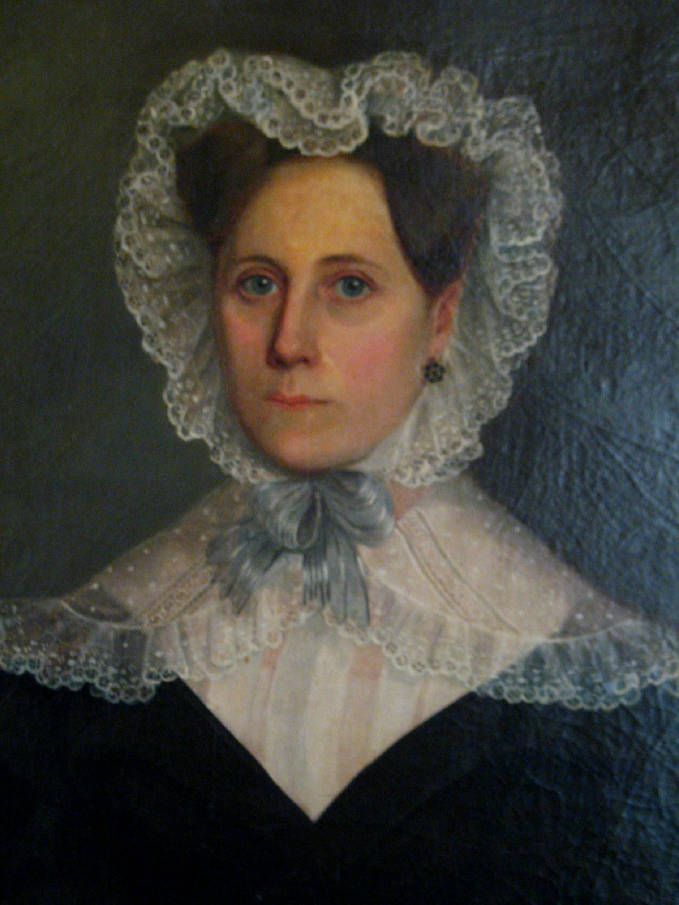
Portrait painting of Margaret T. Deyo, Creator unknown

At this time, tea sets expanded beyond teapots, cups and saucers. A typical tea set in the 19th century included other items like spoon holders, cream pitchers, slop bowls, and sugar bowls. Each of these pieces served a distinct purpose and helps to enrich the experience of drinking tea.  

Obviously, the central component of a tea set is the teapot. Tea sets were originally made from porcelain, but as time passed, silver teapots became more common. The metal allowed the water inside the teapot to stay hot longer, so they were praised by tea drinkers. They were much easier to manufacture in the United States, as porcelain crafts were most refined in Asia during this time. When they were first used in Europe and the United States, teapots were small, but by the middle of the 18th century, teapots could hold dozens of cups of tea. 

Another important part of tea sets is saucers. The idea of saucers originated in China, when the daughter of a military officer found her cups of tea to be too hot to place on a table, so she asked a local potter to create a plate small enough for the cup to sit on. Another part of the tea set that most people do not recognize is the slop bowl. Slop bowls held the water used to brew tea, and for drinkers to pour cold tea in before refilling their cup with fresh, hot tea. They also held the remains at the bottom of the teacup, so they would not affect the next cup. 

As an important part of aristocratic life in the 19th century, tea sets included numerous different pieces, each of which provides a simple function. However, without one of these pieces, teatime would not be the same. Women in the 19th century enjoyed using these sets to entertain guests and friends, and without a single one of these pieces, it would be impossible for the set to act as a whole.

Plated hollow ware from A Source Book of Antiques and Jewelry Design
More silver plated hollow ware from A Source Book of Antiques and Jewelry Design

Sources:

http://museumblog.winterthur.org/2017/08/11/the-brew-of-american-independence-tea-and-coffee-after-the-revolution/ 

Hornung, Clarence Pearson. A Source Book of Antiques and Jewelry Designs, Containing over 3800 Engravings of Victorian Americana, Including Jewelry, Silverware, Clocks, Cutlery, Glassware, Musical Instruments, Etc., Etc., Etc., by Clarence P. Hornung. G. Braziller, 1968. 

https://time.com/4640082/teatime-history/

https://www.officialdata.org/us/inflation/1858?amount=3.50

https://www.geriwalton.com/tea-ware-tea-sets-and-tea-equipage/

https://cdm16694.contentdm.oclc.org/digital/collection/elting/id/375

https://cdm16694.contentdm.oclc.org/digital/collection/hhs/id/1934/rec/1

A Family Analog Experience

Even though video games have a strong presence in both my childhood and current life, I have always had an appreciation for board and card games. At my house, we have almost three closets full of board games, when we probably only play a few of them regularly. By “we”, I don’t mean my family. In recent years, I found myself only playing board games with my friends. The youngest member of my immediate family is eighteen years old, so I suppose we all got too busy to play board games together, and outgrew them. It’s a shame, to put it bluntly, because I have so many good memories of playing board games with my immediate and extended family. When I was a child, it was practically a tradition in my house to play our Spongebob version of the Game of Life when our power went out, before it got dark. At almost every holiday gathering, someone always ends up recalling how we all used to play Uno Attack together, and how the machine lasted a surprisingly long time before it stopped working. It is extremely difficult to get a game started with my family lately, everybody is always too tired or has work the next day. However, this past Thanksgiving, I finally got to have the experience again.

My family got to host Thanksgiving this year, and it was nice to see everybody again, since we didn’t get to last year. When we host holidays, my mom likes to either set a theme, or plan something for us to do together, besides eating dinner, of course. For example, when we hosted Christmas Eve last year, we asked everyone to wear black and white. It’s never anything too complex, just something fun to do and help us enjoy the holidays together. So, this year, because my mom plays it every month with her friends, and it’s basically common knowledge among my family members, we played a 16 person game of Bunco.

For anyone who may not know, Bunco is a dice game meant for a bigger group of people, where you play in groups of four and move around different tables. There are 6 rounds, one for each number on a standard die (we played 12 rounds, 2 for each number). When seated at a table, you play on a team with the person seated diagonally from you, and you have to try and score more points than the other team at your table. There is a “head table” that dictates when a round begins and ends, once a team at the head table reaches 21 points, a round ends. Every other table keeps scoring points until the head table rings a bell to signify the end of a round. During a round, members of each time take turns rolling three dice. If you roll the number of the round (first round you roll for ones, second round for twos, etc.) , your team gets a point and you keep rolling until you don’t roll the number you’re looking for. Then the dice are passed to the next person. If you roll three of the number you’re rolling for, that’s called a bunco, and your team earns 21 points (an automatic win at the head table). If you roll three of any other number, that’s called a baby bunco, and you earn five points. At the end of a round, both teams count their scores, and determine a winner. The two members of the winning team then move to another table. Throughout the whole game, you cannot be on a team with the same person twice. During the game, everyone keeps track of how many rounds they won, and how many buncos and baby buncos they rolled. At the end of it all, prizes are distributed for the most buncos, last bunco, most wins, and most losses.

Like any group of adults would, we played this game for money. Everybody contributed $5 to the pot, creating a grand total of $80. But when the game started, nobody seemed that focused on the money. Except for one of my cousins, who was on such an impressive losing streak that she figured she was better off trying for the most losses prize (she did earn that title, she lost 10 out of the 12 rounds). It was so nice to see everyone having fun together, and to learn just how competitive my family can be sometimes. I never really look forward to family events, because everyone just talks about work and other adult topics that I can’t quite relate to yet. As the youngest members of the family, my sister and I just kind of sit there and talk to each other the whole time. Bringing everybody together allowed for family members that don’t interact often to catch up and enjoy each other’s company.

With a simple game like this, everybody had an equal chance of winning, and we were able to focus more on spending time together than the logistics of the game itself. If I were to try to teach any of my family members a video game like Mario Kart, it probably would not have been as simple. My cousins that aren’t much older than me know how to play, but teaching it to my 83-year-old grandmother probably would have taken some time and effort. Video games also come with player limitations, and you can only play with the amount of controllers you have on hand, and most games max out at four players. With board games, all you have to do is deal another person in and teach them the rules. And board games tend to be much less complex and mentally straining as video games, and don’t require skill or practice to have an enjoyable experience. I can’t say I prefer one over the other, I love the single-player experience of watching a story unfold in a video game, or just having the liberty to do what I please. However, whether it’s a game of Card Against Humanity with good friends where we’re trying our hardest not to laugh, or dominoes on Christmas day with my family, the board game is an experience that simply would not be the same if these games were digital. Being able to fan out the cards in your hand, or rearrange your pieces and tap them against the surface of the table makes the experience more physical, and therefore, memorable. It’s like how some people will only play as a specific piece in Monopoly, they create an attachment to the object. Whether the person likes the item the piece represents, or they just think it’s a charming little trinket, it becomes a part of their experience playing the game. The tactile experience of a board game makes it more appealing to people, especially those who are older, or don’t find enjoyment in video games. I truly cherished this analog experience, and I hope I can do something like it again in the future.

(Also in case anyone was wondering, I ended up winning $40 that night!)

Tea in the 19th Century

Tea has always been an important commodity in the United States. It is valuable import, and even contributed to the fight for independence from the British in the 18th century. Perhaps it was their English descent, but Americans still had a demand for tea, even after declaring independence. While it did not provide a caffeine boost like coffee, tea lasted longer. One pound of tea can pour 180 six-ounce cups, while a pound of coffee can only pour 50. With the widespread enjoyment of tea in the United States, ultimately came the phenomenon of “taking tea”.  

Tea was typically consumed with snacks as a smaller, fourth meal of the day after dinner. However, tea in America, like in Europe, was mostly consumed by the upper-class. Aristocratic women enjoyed entertaining guests with elegant parties, accompanied by elaborate tea sets and refined manners. Hosting and serving tea at these gatherings were some of the only tasks upper-class women did not delegate to servants. It soon became a symbol of femininity and domesticity to properly prepare tea to entertain guests.  

A receipt dated March 25th, 1858, of cutlery purchases made by Mrs. Abraham Deyo in Poughkeepsie, NY, indicates her purchase of a tea set. There is no indication of who made the set, or what it is made of, but it is the most expensive item on the receipt, costing $3.50. Today, that would be $118.06. Mrs. Abraham Deyo’s name was Margaret T. Deyo, she married her her first cousin in 1812, and they had four children. Together, they lived in New Paltz, until Abraham relocated them to Plattekill, NY, where he served as supervisor. He later went on to serve in the Senate, and upon his death, he left their house in New Paltz to his son, Abraham Jr. Compared to the average family at this time, the Deyos were fairly wealthy. This can be inferred from the fact that an oil painting was created of Margaret in 1844, about 15 years before the date on the receipt. In the painting, she is wearing an elegant headpiece and large earrings. It is entirely possible that Margaret had the time and the financial means to entertain guests with tea parties.

Portrait painting of Margaret T. Deyo, Creator unknown

At this time, tea sets expanded beyond teapots, cups and saucers. A typical tea set in the 19th century included other items like spoon holders, cream pitchers, slop bowls, and sugar bowls. Each of these pieces served a distinct purpose and helps to enrich the experience of drinking tea.  

Obviously, the central component of a tea set is the teapot. Tea sets were originally made from porcelain, but as time passed, silver teapots became more common. The metal allowed the water inside the teapot to stay hot longer, so they were praised by tea drinkers. They were much easier to manufacture in the United States, as porcelain crafts were most refined in Asia during this time. When they were first used in Europe and the United States, teapots were small, but by the middle of the 18th century, teapots could hold dozens of cups of tea. 

Another important part of tea sets is saucers. The idea of saucers originated in China, when the daughter of a military officer found her cups of tea to be too hot to place on a table, so she asked a local potter to create a plate small enough for the cup to sit on. Another part of the tea set that most people do not recognize is the slop bowl. Slop bowls held the water used to brew tea, and for drinkers to pour cold tea in before refilling their cup with fresh, hot tea. They also held the remains at the bottom of the teacup, so they would not affect the next cup. 

As an important part of aristocratic life in the 19th century, tea sets included numerous different pieces, each of which provides a simple function. However, without one of these pieces, teatime would not be the same. Women in the 19th century enjoyed using these sets to entertain guests and friends, and without a single one of these pieces, it would be impossible for the set to act as a whole.

Plated hollow ware from A Source Book of Antiques and Jewelry Design
More silver plated hollow ware from A Source Book of Antiques and Jewelry Design

Sources:

http://museumblog.winterthur.org/2017/08/11/the-brew-of-american-independence-tea-and-coffee-after-the-revolution/ 

Hornung, Clarence Pearson. A Source Book of Antiques and Jewelry Designs, Containing over 3800 Engravings of Victorian Americana, Including Jewelry, Silverware, Clocks, Cutlery, Glassware, Musical Instruments, Etc., Etc., Etc., by Clarence P. Hornung. G. Braziller, 1968. 

https://time.com/4640082/teatime-history/

https://www.officialdata.org/us/inflation/1858?amount=3.50

https://www.geriwalton.com/tea-ware-tea-sets-and-tea-equipage/

https://cdm16694.contentdm.oclc.org/digital/collection/elting/id/375

https://cdm16694.contentdm.oclc.org/digital/collection/hhs/id/1934/rec/1

Cornelius Agrippa and Frankenstein

In Mary Shelley’s Frankenstein, one of Victor’s greatest sources of inspiration in his journey of scientific inquiry is German alchemist Cornelius Agrippa. In chapter two of the novel, when recalling his studies of natural science, Victor states: “When I was thirteen years of age… I chanced to find a volume of the works of Cornelius Agrippa. I opened it with apathy; the theory which he attempts to demonstrate, and the wonderful facts he relates, soon changes this feeling into enthusiasm. A new light seemed to dawn upon my mind…”. Victor is immediately drawn to Agrippa’s works, and is so overjoyed by this newfound wisdom, that he shows it to his father. Upon reading Agrippa’s works, William Frankenstein tells his son “do not waste your time upon this; it is sad trash” (68). After his father shows him simple experiments with electricity, Victor abandons his devotion to Agrippa’s work, stating ” “This last stroke completed the overthrow of Cornelius Agrippa, Albertus Magnus, and Paracelsus, who had long reigned the lords of my imagination.” (70), After his father demonstrates to him the natural principles of electricity, Agrippa’s wisdom is nothing but fiction to Victor. However, it may be possible that Shelley purposefully chose to mention Cornelius Agrippa as one of Victor’s first mentors in his passion for scientific knowledge, despite his ultimately small role in the novel.

Mary Shelley was known to have radical political beliefs for her time, and she was inspired by her mother, Mary Wollstonecraft’s beliefs, which, by today’s standards would be considered feminist ideas. Mary Wollstonecraft was the author of The Vindication of the Rights of Woman, which defended the concept of natural rights, especially those of women. Coincidentally, Cornelius Agrippa had published his own proto-feminist book in 1529, titled, Declamation on the Nobility and Preeminence of the Female Sex. In this book, Agrippa argues that woman are superior to men, and combats discriminatory portrayals of the female body in the Bible, Greek medicine, and other sources considered canon at the time. Agrippa states: “Woman was created as much superior to man as the name she has received is superior to his. For Adam means Earth, but Eve is translated as life. And as far as life is to be ranked above earth, so far is woman to be ranked above man”. He also defends Eve, and condemns men for being the source of evil and sin in all of us. He states, “it was therefore the man who committed the sin in eating, not the woman, the man who brought death, not the woman. And all of us have sinned in Adam not in Eve, and we are infected with original sin not from our mother, who is a woman, but from our father, a man” (Agrippa). As an early feminist, Shelley’s beliefs had an impact on her novel Frankenstein, and her ideas were shaped by earlier influences such as Agrippa, and her mother.

Despite the lack of prominent female characters in the novel, Frankenstein can be seen as an empowering work, through Victor’s contemplation of the creation of a female companion for the creature. Victor ponders, “She who, in all probability, was to become a thinking and reasoning animal, might refuse to comply with a compact made before her creation. They might even hate each other…and might he not conceive a greater abhorrence for it when it came before his eyes in the female form? She also might turn with disgust from him to the superior beauty of man; she might quit him, and he be again alone, exasperated by the fresh provocation by being deserted by one of his own species”. Victor is not concerned about there being two of the monster, he is worried that the female will develop autonomy, and have the rationality to make her own decisions. He is anxious that the female creature may not want to submit herself to the will of the original creature, which is what men at this time assumed was natural for women. Without this feminine influence, the creature grows hateful towards its creator, and this is what ultimately causes it to take its revenge on Victor. Despite the fact that he is only briefly mentioned in the beginning of the novel, mentioning Agrippa was a deliberate choice made by Shelley to reflect her radical beliefs, and alludes to the fact that the absence of a female mate is what causes the creature to cause Victor so much grief.

Works Cited:

Agrippa, Cornelius. “Declamation On The Nobility And Preeminence Of The Female Sex (1529)”. Mrdivis.Yolasite.Com, 2021, http://mrdivis.yolasite.com/resources/Agrippa’s%20feminism.pdf.

“A Vindication of the Rights of Woman,” LIBERTY, EQUALITY, FRATERNITY: EXPLORING THE FRENCH REVOUTION, accessed November 18, 2021, https://revolution.chnm.org/d/579.

O’Shea, Ayla. “The Fear Of Femaleness: How “Frankenstein” Acts As A Feminist Platform”. Medium, 2016, https://medium.com/@aylaoshea/the-fear-of-femaleness-how-frankenstein-acts-as-a-feminist-platform-bfd3dfdf5b02.

Sparking Joy with Jewelry

(Sorry for the late post!)

Recently, I’ve started wearing jewelry much more often, and have built up quite a collection of bracelets, necklaces, and especially earrings. So, decided to tidy up my collection using Marie Kondo’s “joy test” (however, I did not actually get rid of any of the items). To store my accessories, I use this plastic container which is usually used for craft supplies like beads or embroidery floss. I have them organized in a way that seems cohesive to me, but may sound a bit strange to explain. The top left section contains a few necklaces (two of which happen to be references to Avatar: The Last Airbender). The section next to it contains all of my smaller earrings (from a set I bought at Target), and two pairs of hoops (these earrings being much more tame than the ones in the third section on the left).The second section on the left is the more necklaces, along with three glasses chains I bought in a set off Amazon, which I did not include in my process. The second section on the right is a set of chain necklaces I bought together, and another smaller silver necklace. The last two sections on the right contain bracelets, most of which I made myself.

My jewelry collection

Since my collection was already organized into categories, I was ready to begin Marie Kondo’s process of tidying up. Going section by section, I determined whether or not each piece sparked joy. With my necklaces, the process seemed fairly simple. I know which necklaces I wear the most often, and which ones I know I could live without. But there were a few that had me stumped. My necklaces of a cameo I bought in Italy, and Starlord’s blaster from Guardians of the Galaxy were two of my most worn necklaces for a long time, and their chains are evident of this. What used to be clean, shiny, silver metal now looked darker and almost black in some areas. It felt hard to let them go, but I have not worn either of them as much as I used to because of this. (Since they’re not real silver I have no way of cleaning them effectively). I ended up keeping the cameo, since it was one of my only souvenirs from my trip to Italy (and the most expensive one), and saying goodbye to Starlord’s blaster because it had served its purpose to me (and the Guardians of the Galaxy movie is much older than I remember).

The process of tidying up my jewelry box (The left column are pieces that do spark joy, the right column are pieces that do not or no longer spark joy)

Next was bracelets. I knew this category would be one of the hardest because most of the bracelets I own are handmade. I ended up keeping most of them, probably because it’s the category that has the least items. I do not wear bracelets very often, and I realized afterwards that I left out one of them because it was on my wrist the entire time, and I wear it almost every day (that bracelet obviously made the cut and stayed on me). I thought at first I would want to keep all of the handmade bracelets I had, since I was the one who got to decide what they looked like. This actually was not the case. I had two beaded bracelets, one that was a seven-layer stack of beads in the colors of the rainbow (this type of bracelet is called a cuff) and a small bracelet of multicolored star beads. As much as I enjoyed the rainbow cuff when I first made it, it’s not very good-looking and not the most practical to wear. I mostly made it to see if I could understand the process of how to do so. The same thing goes for the star bracelet. I made it using one of each color bead that came in the bag I bought, and it looks pretty, but is a little too tight, and the beads sometimes dig into my wrist when I wear it. These two bracelets did help me learn more about making kandi bracelets, but don’t serve much of a purpose in my daily life.

The final verdict

The last category was earrings. This was by far the biggest, and most recent collection of all. I only started wearing earrings daily towards the beginning of this year, and since then I’ve bought many different pairs. Most of my smaller earrings came from a set of 16 (?) pairs that I bought at Target. The bigger earrings come from a variety of sources, some from stores and local businesses, one pair from Amazon, and two handmade pairs. I ended up keeping most of the bigger earrings, except the black and white beaded ones. While I do wear them fairly often, and they match a lot of the outfits I wear, they don’t really look like the vision I had for them when I made them. They are supposed to be stars, and I’m not sure how well that comes across. I was also reluctant to say goodbye to the banana earrings I bought from the farmer’s market a few weeks ago. I’ve never worn them for more than about 10 minutes, because I did not like how transparent they are. Regarding the smaller earrings, I did not end up getting rid of most of them. I like how small and simple they are, and they match every outfit. I did get rid of one of the pairs that made me want to buy the set, a pair of black stars. I used to wear them at least 3-4 times a week, but soon after I started wearing them, the paint began flaking off of them. So, I put them to rest.

My collection after tidying up

All in all, tidying up was a fairly straightforward process. I find it pretty hard to let go of things, especially something as habitual as clothing or accessories. But since the cost of jewelry can add up pretty quickly, I am often careful when making selections. If I had it my way, I’d buy any pair of funky earrings that catches my eye. It hurt my heart a bit to consider getting rid of pieces I had made myself, but I know that if they actually were to leave my collection, they could brighten up somebody else’s outfit. I feel happiest when I am able to be surrounded by things I enjoy (which is probably the reason why half my desk at home is filled with knickknacks), but I also know that too much of a good thing exists. All of the pieces in my collection have had a chance to shine, but some of them do a better job than others. I enjoyed Kondo’s process much more than I thought I would have when I first learned what it entailed. I’m not sure if it would have been this cut-and-dry if I was actually planning on getting rid of the items, but the feelings were still there. I would definitely consider using this process on a larger collection, like my books, when I come home.

Roots of “The Dinner Party”: History in the Making by Angela Earvolino, Skylar Couch-Tellefsen and Ezra Baptist

The Making of Judy Chicago's Feminist Masterpiece, The Dinner Party - Artsy

The Dinner Party is a work of second-wave feminist art made up of a collection of thirty-nine unique place settings that each honor a historical or mythological woman. Judy Chicago spearheaded it’s creation and assemblage from 1971 to 1979 and the collection was displayed for the first time in San Francisco, 1979. This was an important first step for feminist art to become more mainstream.The primary pieces in the collection are the thirty-nine plates for each highlighted woman. The plates largely follow a ‘vulvar motif’ and are arrayed in a triangular pattern with each side of the triangle representing a different era of the history of Western women. The complexity and verticality of each plate represents the amount of liberation said woman experienced in her day. Beneath the table and the plate settings lies the Heritage Floor which contains the names of nine-hundred-ninety-nine additional women who were selected to in relation to the main thirty-nine. The addition of the is meant to convey “how many women had struggled into prominence or been able to make their ideas known— sometimes in the face of overwhelming obstacles—only (like the women on the table) to have their hard-earned achievements marginalized or erased,” (Chicago). The overall mission of the collection is to bring attention to the generally overlooked contributions of women by highlighting historical ‘heroines’ that are less known than their male counterparts and, in doing so, start to create a parallel narrative to our typically androcentric Western history.

Despite Judy Chicago’s post-feminist approach to artwork, we found that some aspects of her artwork could be interpreted differently. While the vulvar motif throughout her dinner plates depict variations on the concept of ‘woman’, the message is ultimately relying on bio-essentialist ideological perspective on women as a whole. On the other hand, it is true that the women that she incorporated at the Dinner Party were all cis women. Although you can hardly blame Chicago for not including any non-cis women in the collection, given that it was made in the late 70s, we think the collection can ultimately improve. We’d like to imagine that if this project were to be continued, that more dinner plates would be made, there would be a more inclusive sentiment that does not rely on body parts, and considers the trans women who have contributed to the feminist scene and to the world. It would be fantastic to have a Marsha P. Johnson dinner plate, and interesting to hypothesize it might look like, considering her role in LGBTQ+ politics. While Chicago’s intentions for the collection were empowering, significant improvements could be made to this collection to make it more inclusive. One of the glaring controversies surrounding this collection is that Sojourner Truth is the only black woman represented in the collection.We would encourage those who visit the collection to also check out the The Roots of The Dinner Party which contains Judy Chicago’s research documents, test plates and her notes on the evolution of the project as a piece of collaborative feminist art and historical revisionism. We would also implore those viewing or visiting the collection to consider these questions: how plates are arranged in your own live and residence. Are there plates in your home because they “feel” like your plate? How does Chicago challenge the traditional perspective of women by reclaiming the dinner table/placement as a form of adornment and recognition? What role do you think historical revisionism should play in our society going forward, do you think it’s important and/or can it go too far? What significance does a collection like this have in the 21st Century, regarding feminism and how our society views women?

Bibliography

A Stuffed Toy

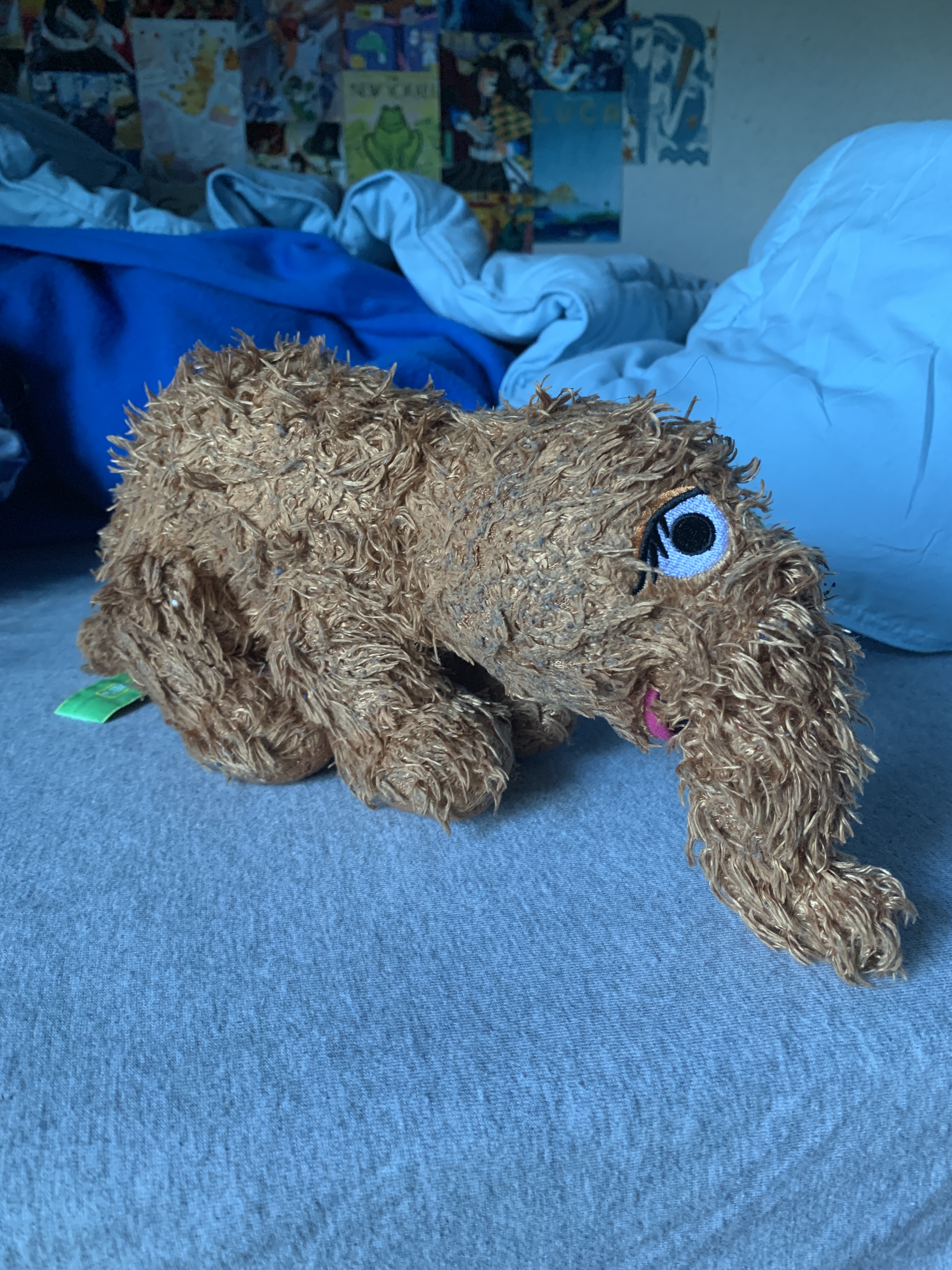
The item I chose for this assignment is a plush Snuffleupagus from Sesame Street that some friends gave to me the night before I had spinal surgery. I first found it in the hospital’s gift shop, on a rotating rack with other Sesame Street characters (I was 17 when I had the surgery, so I was staying in a children’s hospital). For reasons unknown, I felt immediately drawn to it. It was probably nostalgia, or the fact that Snuffleupagus seems like such an obscure character, even on a show like Sesame Street. It has become an important part of my nighttime routine, and I can’t seem to sleep if it’s not with me. According to its sewn-on tag, it is made of polyester fibers and stuffed with polyurethane foam. 

This plush is distributed by GUND, a Canadian-owned toy company based in Edison, NJ. However, like most products, its tag says, “Made in China”. China is an important hub for the textile business. While I could not find sources about polyester production specifically as a part plush toy manufacturing, there are numerous sources about the textile industry in China.  

Many Chinese garment factories are known for what we refer to as “fast fashion”, or cheaply made clothing typically made by exploited, low-paid factory workers. Polyester is a commonly used material in fast fashion items, so this seemed like the best place to start. Brands that partake in fast fashion usually claim their employees make “at least minimum wage”, while that may be true on paper, these minimum wage values only constitute to less than half of a livable wage. Garment workers in China face long hours, about 14 to 16 hours a day, all week long. Like the video we watched about Bangladesh, the conditions in Chinese garment factories are morbid. Workers often breathe in toxic substances, and there is little to no ventilation. The fast fashion industry is also notorious for the use of child labor, a staggering 11% of children in the world are forced to work monotonous, dangerous jobs like this.   

When researching GUND, I visited their page on Amazon and read the small blurb written about the manufacture of their products. They simply state that their products are made in China, shipped to the United States, and kept in warehouses for distribution. When stated so regularly, you would not even consider the amount of labor and pain endured to make a product as inviting as a plush toy.

Sources:

https://www.amazon.com/ask/questions/Tx32FD1XDPP3IOA?ref_=ws_cp_5d1c147625091864a89d_m_4_s_5_qa

https://ww.fashionnetwork.com/news/Textile-and-apparel-industries-still-using-child-labor,360680.html

https://www.sustainyourstyle.org/old-working-conditions

Crystal Bead Bracelet

Image 1: The beaded bracelet

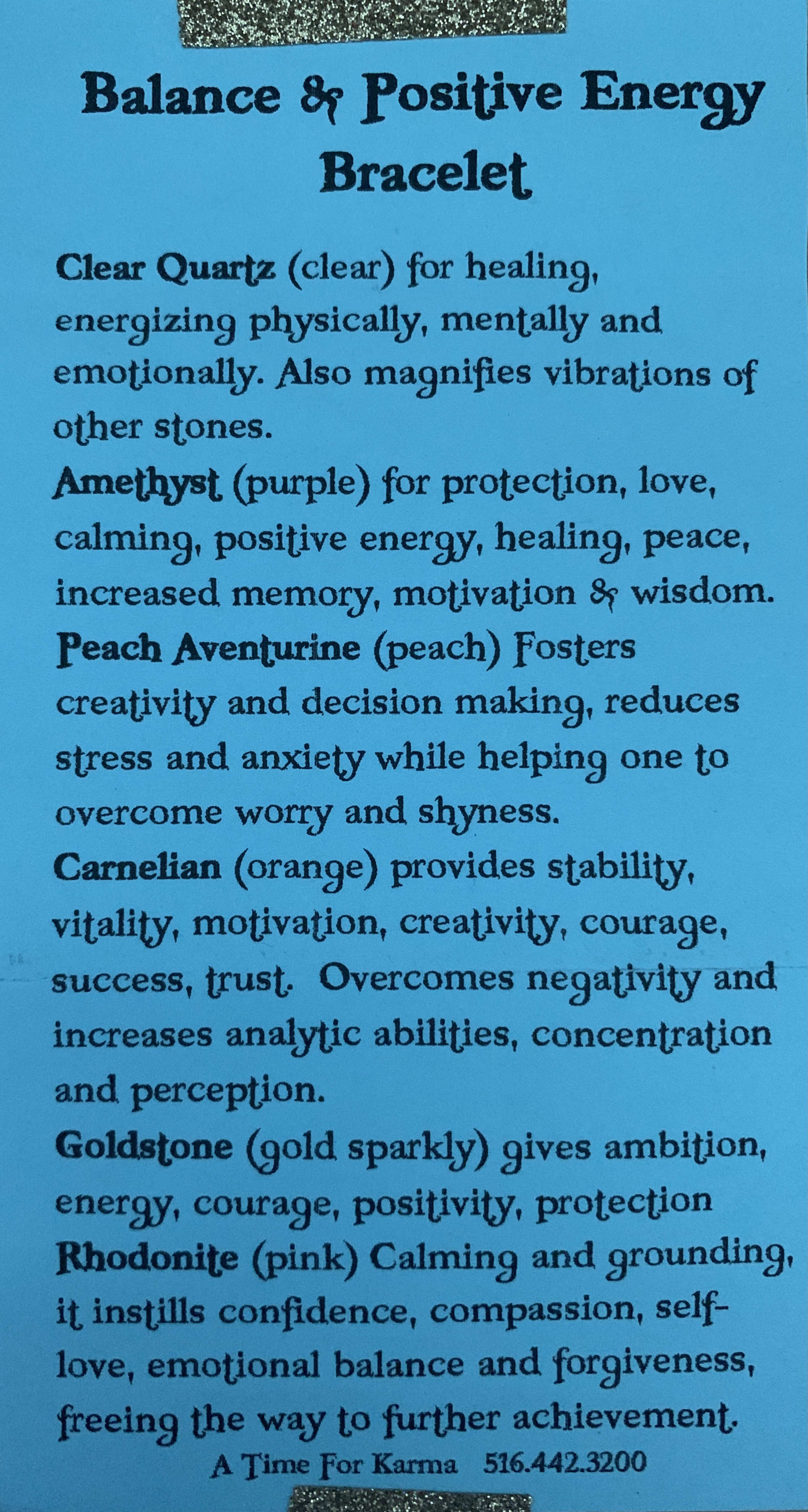
I decided to write about a bracelet I received from my nurse right before I had surgery. I didn’t know her too well, we had only met once prior when I had gone to the hospital for pre-surgical testing. Maybe she saw how fidgety and nervous I was about a simple blood test, and figured I needed some sort of grounding before walking into a major operation. The bracelet came in a navy blue gift box, and a piece of cyan paper that identifies the different crystals on the bracelet, and what their purposes are. According to the paper, this bracelet is meant to improve balance and release positive energy.

Image 2: The paper listing the different crystals on the bracelet

At a glance, the bracelet consists of 24 beads on a pearly white elastic thread, and in the middle, there is a metal charm. The bracelet is 2.5 inches in diameter when relaxed, fits in the palm of your hand, and can stretch a considerable amount to account for different wrist sizes (I’ve never tested its true limits, as I have tiny wrists).

The beads on the bracelet are perfect spheres, and click softly against each other when it is worn. there are six different types of crystals on the bracelet: clear quartz, amethyst (purple), peach aventurine, carnelian (orange), goldstone, and rhodonite (pink). The beads come in pairs, and there are two pairs of each crystal on the bracelet. The beads are arranged in a way so that each pair of the same beads is located on the opposite side of the bracelet from one another. Through the clear quartz beads, you can see the string that keeps them all together. Some of the crystals (like the carnelian and goldstone) are more opaque than the others, and the goldstone specifically has a glitter-like shimmer. Not all of the crystals look the same, one of the rhodonite stones is darker than the others. An indicator that the crystals on this bracelet are real is that the bracelet is always cool to the touch before I put it on. Perhaps that is what makes it good for releasing tension and grounding the wearer, the coolness against the skin is a constant reminder of the crystals’ presence.

Between a pair of clear quartz beads and pair of peach aventurine beads is a small charm made of a dark grey metal. It’s cool to the touch, but not as cool as the beads of the bracelet. There are two parts to the charm: the part that sits next to the beads on the bracelet, and the disk that dangles below it. The part that wraps around the bracelet has a pattern of small bumps and smooth lines, with a line of larger bumps in the center. under it is a small ring where a thin jump ring connects it to the small disk that hangs off of the bracelet. On both sides of the disk, there is a small engraving of a tree trunk with six curvy branches, surrounded by abstract swirls meant to represent leaves. the trunk and branches are carved a bit deeper than the leaves, but both are deep enough that it’s noticeable when you run your thumb over it. It makes itself known by clicking against the beads above it with even the slightest of movements.

Image 3: A close-up of the metal charm

While this may not be the most-worn accessory I own, I know I will always have it when I am in need of physical or mental grounding. If it was with me at the scariest time of my life, I know it will stay a part of me for times to come.