The Tiger Maple Grandfather Clock

IMG_3857

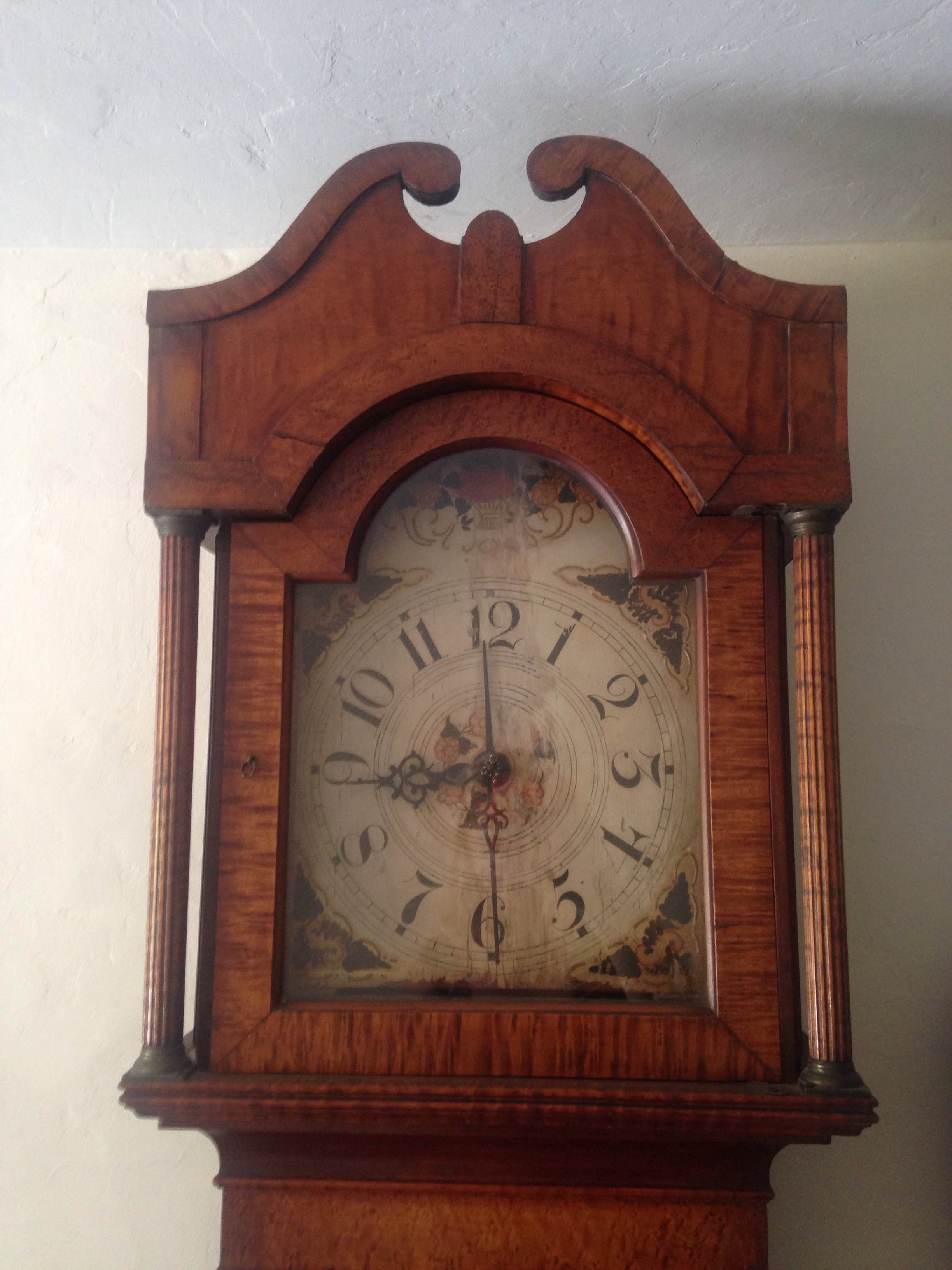
A grandfather clock that served to keep time but also served as a decorative piece of furniture, this 19th century clock belonged to Dewitt Chauncey LeFevre’s aunt and was passed down to him. This elegant clock not only functioned as a timekeeper and a living room furnishing; it’s uniquely patterned wood symbolizes the wealth of the LeFevre family.

Caption: A grandfather clock that served to keep time but also served as a decorative piece of furniture, this 19th century clock once belonged to Dewitt Chauncey LeFevre’s aunt and was passed down to him upon her death. This elegant clock not only functioned as a timekeeper and a living room furnishing; it’s uniquely patterned wood symbolizes the wealth of the LeFevre family.


Physical Description: The grandfather clock is about eight feet tall and it’s casing is composed of Tiger Maple wood. Tiger Maple wood is commonly referred to by many different names such as flamed maple, curly maple, ripple maple, fiddleback or tiger stripe. These names are derived from how the wood looks: the growth of the wood fibers is distorted in an undulating chatoyant (cat-eye) pattern, producing wavy lines known as “flames”. This type of wood is known for it’s beauty and is often used in making instruments. This clock’s wood is very noticeably striped and stained a golden hue. The face of the clock is white with a red, yellow, and green flower design and black numbers. According to Huguenot Street’s file, it once could have been a “Wag on Wall” clock – meaning before it was a grandfather clock, it did not have a base and the face of the clock probably hung on a wall on it’s own at one point. It is also said to have been reconverted from an electric clock, and while it looks like it is in good condition it has been repaired several times.
IMG_3962


Provenance: The Tiger Maple Grandfather clock is currently in possession of Historic Huguenot Street. It was gift to the foundation by DeWitt C. LeFevre, and in the archives it says that this clock was once his aunts. DeWitt LeFevre was the first president of the organization. I believe that the aunt it belonged to originally was Minnie Mariah LeFevre Jameison.


Narrative: On April 28, 1677, twelve Huguenots were granted a license that allowed them to purchase land along the Wallkill River for a settlement. The original Patentees of New Paltz were: Louis Bevier, Pierre Deyo, Christian Deyo, Antoine Crispell, Louis DuBois, Abraham DuBois, Isaac Dubois, Hugo Freer, Abraham Hasbrouck, Jean Hasbrouck, Andries LeFevre, and Simon LeFevre. Simon LeFevre was born in France around the year of 1640.

“Simon and Andries LeFevre, brothers and very much alike, were most likely the scholars of the group. From the records we would assume them to be quiet, somewhat withdrawn, giving the group of Patentees a touch of refinement, which love of books and study can bring. They were not fond of labor like some of the group, but did their share because it was the honorable thing to do. Both brothers died before old age came, so that we must draw most of our records from the children of Simon. Andries never married. By nature easy-going, they believed in peace and harmony. There has always been a tendency toward frugality. By tradition, the ancestors of the LeFevre family were scholars and most closely allied with royalty by blood and position.”


A descendant of Simon himself, DeWitt C. LeFevre also held a position of power and scholar as the first president of The LeFevre Family Association. One could say that he is almost a grandfather of the society, and the clock symbolises his family’s wealth and longevity. Bestowed as a gift by DeWitt, the clock resides in the LeFevre house on Historic Huguenot Street.

IMG_3961

The LeFevre House

My grandfather’s clock was too large for the shelf,

So it stood ninety years on the floor;IMG_3964

It was taller by half than the old man himself,

Though it weighed not a pennyweight more.


In watching its pendulum swing to and fro

Many hours he spent when a boy

And through childhood and manhood, the clock seemed to know

And to share both his grief and his joy.

“My Grandfather’s Clock”, a song written in 1876 by Henry Clay Work, from which the term Grandfather clock came into existence.

References:

Gannon, Peter Steven. Huguenot Refugees in the Settling of Colonial America. New York, N.Y. (122 E. 58th St., New York 10022): Huguenot Society of America, 1985. Print.

“History of Grandfather Clocks.” Klockit. Klockit, Inc., 2010. Web. 09 May 2015.

LeFevre Wright, Diane. “DeWitt LeFevre – The First President of the LeFevre Family, 1967 – 1973.” LeFevre Family News [New Paltz] 2002, Summer 2002 ed.: n. pag. Print.

(post in progress)

The Mysterious Ticking Noise

I spotted the clock on our class visit to Huguenot Street. Sitting on the mantle next to Abraham Lincoln, the beautiful timepiece with it’s elegant rose design captured my attention. It’s shape reminds me of a jukebox.

IMG_4297

This clock, according to Historic Huguenot’s archive, is described as having a “rectangular shaped base with molding, case with straight sides and arch at top, round clock face, white with black Roman numerals, hinged door closes over face, two round carved forms above hinged angular door with glass painting of a rose, door opens to clock works (all enclosed) two carved applied spindles gold leafed on either side of clock front, small pin for setting time.” It is from the late 19th century and is made out of wood, metal, and glass. The clock face is a little dirty and gilt and paint are coming off, but otherwise it is in pretty good condition.

1163 (

The above images are not my own, because when I went back to look at this object, the door to the Deyo house could not be opened and Ashley Trainer, who had been helping me, said the only way we would be able to get it would be to break in unless someone came to fix the lock. The clock is a mystery to me, and hopefully when I receive word that I can get back into the Deyo house, I will be able to discover more information behind it.

Even Cowgirls Get the Blues

Most books I buy now are usually used. I’ve found that it isn’t too difficult to find used books in great condition – Barner Books, right in town, has a huge selection – as well as even ordering used from Amazon and Barnes and Noble. I rarely buy new books now, especially if we’re talking those pesky, pricey textbooks. I love buying used because it’s nice to hold a book that could have been once cherished and is now once again up for grabs, looking for a new owner to make happy.

IMG_3224

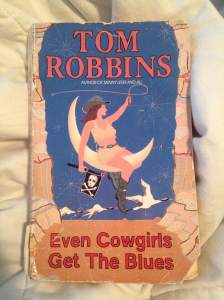
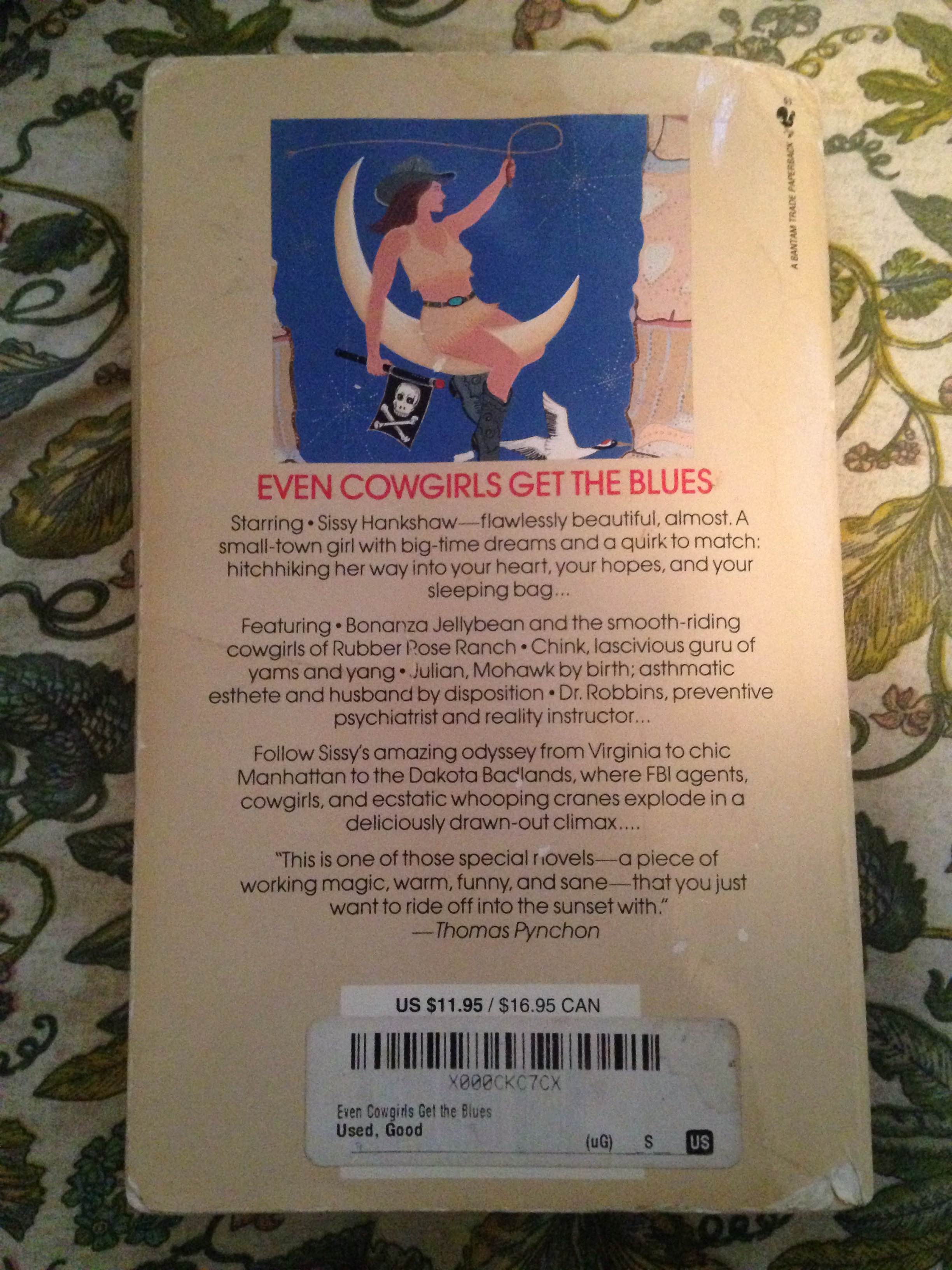
This particular book was purchased at Barner. It sits on my bookshelf beside my collection of other used books, and I think the last time I took it off the shelf was when it was sunny and I could lay in the grass by the pond on campus reading it. Even Cowgirls Get the Blues by Tom Robbins is one of my favorite books, which might be weird to say about a book I haven’t quite yet finished. There is a dog-eared page on page 261 and I think that’s where I left off. Creases on the corners of pages can be seen throughout the novel, indicating that I definitely took my time while reading Robbin’s writing. The book is in fairly good condition for a used book, and penciled in on the front page is the price whoever working at Barner set, a scribbled 8, which barely looks like a number and could easily fade away or be written over or erased. The novel must have been bought used by somebody before it was sold to Barner because it had a used barcode sticker on the back cover. The initial price of the book was $11.95, so I guess I didn’t save as much money as I probably could have on this used book. The binding is extremely creased and a little bit torn on the bottom. The front cover is actually missing it’s bottom right corner, almost like it was folded and then ripped off. Other than the slight tearing and creased pages, the pages aren’t too yellowed and I would still call this book “in good condition”. I will just be more careful when I decide to finish the story in hopes that the front cover doesn’t fall off.

IMG_3225

The title page says it’s a “Bantam Trade Paperback”, and when I researched this publishing house I found out it’s entirely owned by Random House, a subsidiary of  Penguin Random House. Basically, this book was printed by an American company that is owned by a larger American company. This book also includes a “Printing History” section on it’s copyright page.  It’s printing history says that a portion of this book has appeared in the literary journal American Review in 1976, however the edition I have is from 1990. I think that from the printing history and title of the novel, as well as the tears, one can infer that this is an American tale that takes some time to read, but it’s definitely loved.   IMG_3226

Where The Voodoo Doll Lives

I posted a picture of where I keep my voodoll in my room last week, but I will show it to you all again and further explain it’s habitus this week.

10966505_10206052283535854_1757449929_n

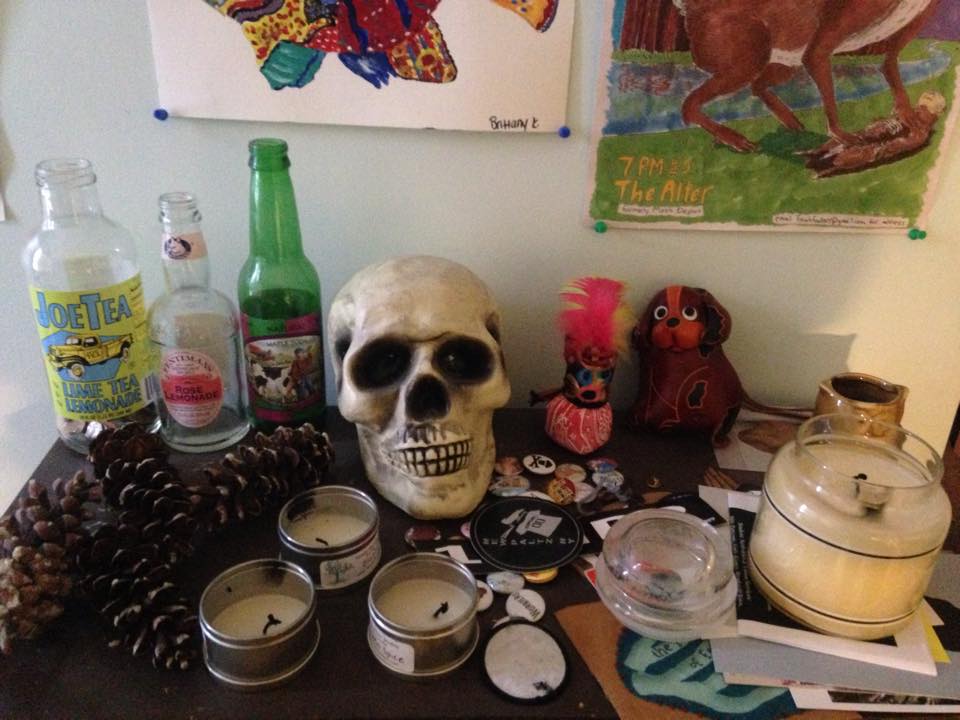
The doll sits on top of a bookshelf in my bedroom in New Paltz. Surrounded by an array of all sorts of objects, it seems like more of disarray than anything, but I think I would describe it as organized clutter, because my collection of objects is quite purposeful.

As previously mentioned, I live right near the rail trail. I can actually see people walking by on it outside of my kitchen window. Since I’ve dyed my hair pink, I’ve been calling myself a woodland fairy. A woodland fairy would have to inhabit some sort of enchanted forest, am I right?

My bedroom is very forest-inspired, and the little collection that sits on top of my bookshelf is only a glimpse at it. The pinecones at the very left edge of the shelf are ones I picked up along the walk back home one day after class in the fall. When I had found them, they were still sticky with sap. I had wanted to pick up even more than four at the time, but did not have a bag to put them in and already felt silly with the few that I had. I’ve been meaning to hang them up as wall decor, but I have decided I like looking at them just resting on the top of the shelf. The bottles sitting behind them are drinks that I’ve purchased at different food vendors around town and decided to keep because I’m a sucker for great packaging design and re-purposing glass bottles. The largest one currently is acting as a piggy bank. The skull further adds to the magic of my room. It is plastic and I’ve gotten a lot of remarks about probably liking Hamlet for having a skull just laying around. I really just like it because I’m a fan of all things macabre. The five candles including three small handmade soy candles, a large Yankee candle, and a candle in an owl shaped holder make me feel like I’m casting a spell every time I light them, especially since if I wanted to actually use the voodoo doll I would need to light them in order to use it’s magic. The leather dog coin purse was a gift from a dear friend, and I hold my laundry money in it, keeping it in plain sight so I remember to take it with me as I leave to do that chore but also because the purse is adorable and dogs are my favorite. Scattered beneath everything are patches and buttons that I have yet to put on my backpacks/purses/jackets/etc. I have made most of these buttons and have been given the patches. This glimpse of my bedroom, where the voodoo doll rests, says a lot about me and I’m not even showing you all the rest of my room (just yet, anyway – maybe one day!).

My Voodoo Doll

For this weeks blog post, I decided to write about an object that I purchased myself. This is a voodoo doll that I procured from a gift shop in New Orleans, when I went during Spring Break last March for a volunteer trip with friends from a club that I’m in (SASS, or the Student Alliance for Social Services). After watching American Horror Story: Coven, we were all pretty excited to be going to such a spooky, fascinating, culturally rich place.

10968173_10206052284855887_406591647_n

This voodoo doll was handmade in the city itself, and I was told by the shop owner that my money would go directly towards the locals who crafted the doll. Since it is an authentic voodoo doll, some would believe that it actually has power, if you actually use it for it’s magic. This particular doll is supposed to be a “Goddess to Dominate Your Man”, and inside the tag if gives specific instructions on how to use it. Supposedly, you can personalize your doll with hair, a small photo, or any small personal item by tucking it (or pining it) on to the doll. It says to make a ceremony every morning and every evening by lighting a candle or incense, sticking a pin into the heart for good, stomach for bad, say aloud your desires or intentions and concentrate on your objectives for three minutes. If you repeat this process for nine days, your wish is supposed to come true. This doll was an interesting discovery for me because before actually going to New Orleans and looking at the huge assortment of voodoo dolls, I had thought that they were always used with evil intentions. I looked up history of voodoo dolls and found out: “the voodoo tradition was brought to the New Orleans region by African slaves, often via Haiti and other islands in the eastern Caribbean. Voodoo’s arrival in the Louisiana region caused it to interlope on other traditions already in place, such as Native American and Atchafalaya Gypsy nature and rootwork practices. Ultimately, African Voodoo’s assimilation into these practices resulted in a potent regional hoodoo tradition that persists to this day. Popular among slaves, some speculate that making voodoo dolls and sticking them with pins was one method by which the slave could exert some control over the master: from the very start white plantation owners, mostly of European descent, feared this and its obvious connection to the more familiar poppet magic of their cultures. More often than not, however, the voodoo doll was employed as a weapon against other believers in voodoo, or vodusi, who did not hesitate to use it and immediately recognized its consequences.”

10958561_10206052284375875_78410055_n10984933_10206052284735884_124874553_n10966706_10206052284135869_1459355669_n

I have never actually done the ritual that is explained on the tag of the doll, although I did choose this particular doll for a reason. Around the time I was in New Orleans, my (now ex) boyfriend was planning on moving to California and I did not want him to go. Perhaps if I used the doll and held a ceremony when I woke up and before I went to bed for nine days, it would have actually stopped him from moving! Though he did end up returning, with no help from the doll, we still broke up…

Maybe one day I will learn if the voodoo doll truly works if I ever feel like I need to use it again, but for now it sits as a decoration in my bedroom. I also think that it’s quite beautiful because of the colorful feathers, fabric, and glitter, so it’s not like I bought it for nothing!

10966505_10206052283535854_1757449929_n

The Misleading Wedding Ring

ring

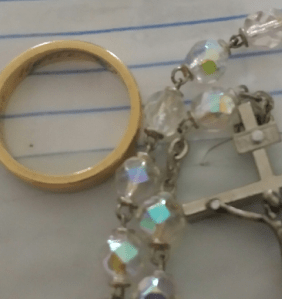
I had to hear this week’s object described to me by my mother, so bear with me! When prompted to uncover a family heirloom, she immediately thought of my grandfather’s wedding ring, which she now carries. She described the ring as yellow gold that almost looks like brass. 14k gold and very plain looking on the outside, the ring is inscribed: “Yours Forever Marie, 9/23/51” My mother told me that his father, my great grandfather, was a barber in Ridgewood, Queens and a customer that came into the barber shop was the jewelry salesman who sold him the ring. Money was tight and the ring was more affordable because they bought it from a family friend. My grandfather couldn’t even tell me how much he actually spent on the ring.

Now what I find most interesting about my grandparents is their names. Both of them come from Italian families, and my grandmother’s birthname is Maria Olivia Carbone. My grandfather’s name is Angelo Ales. For some strange reason, the names that most people actually refer to them as are not Maria and Angelo, but rather Marie and Al. My grandmother had more nicknames than just Marie. Her siblings actually called her Mary, her driver’s license said Mary, and her extended family called her Mimi. She referred to herself as Marie and signed her name as Marie, even though her mother apparently had given her the name Maria. This ring is inscribed “Marie”, so that indeed seems to be the name she wished to be refered to. However, when she was alive and I was around both of my grandparents, Al called her “Honey” so much you’d think that he would have had that petname inscribed on the ring. She called him “Albert” when she was mad. No one ever refers to him as Angelo, except for legal forms.

My grandmother died in 2009 at 83 years old. Their marriage lasted for 58 years. My grandfather is still alive and obviously does not wear the ring anymore, since my mother has it. My aunt wears my grandmother’s matching wedding band around her neck and my mom keeps my grandfather’s, and one day it will belong to me. Unfortunately the words inscribed on the ring did not really hold up to their promise. Even though the marriage lasted for almost 60 years, my grandfather was most certainly not Marie’s forever because a year after her death, he bought another woman flowers on Valentine’s day. I don’t really blame my grandfather for wanting to move on with his life, I just find his word choice for the inscription quite humorous. It’s interesting that the inscription of the ring was so wrong on so many accounts, not even having my grandmother’s actual name inside of it.

Image001Image000   Image004Image002

The Found Bike Light

Found on the rail trail behind my apartment, this bike light doesn’t necessarily seem like an object the typical person would stop to pick up.

IMG_2953

IMG_2954

Almost in perfect condition, the bike light is pretty unscathed for something that was nestled in the dirt and probably had quite the fall from a moving person’s belt while they were cycling. This object is bright candy apple red and black, and about 2 inches in width, 1 inch in height. It must have fallen off of someone pretty recently before I snatched it up and maybe they even had bought it recently, because the light works quite well.

IMG_2955

Okay, so whenever I find things and decide on keeping them I feel a twinge of guilt. Yet it also reminds me of geocaching (a fun pastime: defined as an outdoor recreational activity, in which participants use a GPS or mobile device and other navigational techniques to hide and seek containers, called “geocaches” or “caches”, anywhere in the world)  and adventure, like finding buried treasure (even if this item was not exactly hidden) and hey, if I saw the person who actually dropped it, I would definitely have gave it back to them!

Moving on, the reason why I kept this object: it is memento for another set of objects that always hold dearly to my heart: bicycles!

My father owns three different types of bikes, I have two, and my mother has one. So that makes six bikes for my small family that fit snugly into our garage, somehow, among other objects. (And I still would like to own more!)

It took me a while to learn how to ride. My dad taught me in the parking lot of the school across the street from my childhood house and it took me until the ripe age of 10 to finally get the hang of it without the training wheels. Before learning, my parents forced me into their bike escapades by putting me onto this contraption which turned my dad’s bike practically into a tricycle. Prior to that, I would sit in a little trailer, which I adored because it was like a mini moving tent. They even found ways to bring our dogs on the bike rides.

Now my father is almost 60 and handicapped and somehow, miraculously, the man can still ride a bicycle even though he can barely walk. This mode of transportation is extremely important to me because at the age of 20, I still don’t have a driver’s license, but for the past 10 years I’ve enjoyed pedaling myself to places I would like to go and feeling the wind in my hair. It’s exhilarating and feels rewarding when you reach your destination. To me, a bicycle is a magical object.

My parents have taken their bikes up to New Paltz to ride on the very trail I found this light on.

I’m thinking of giving my dad the light for his birthday so he can put it to good use.