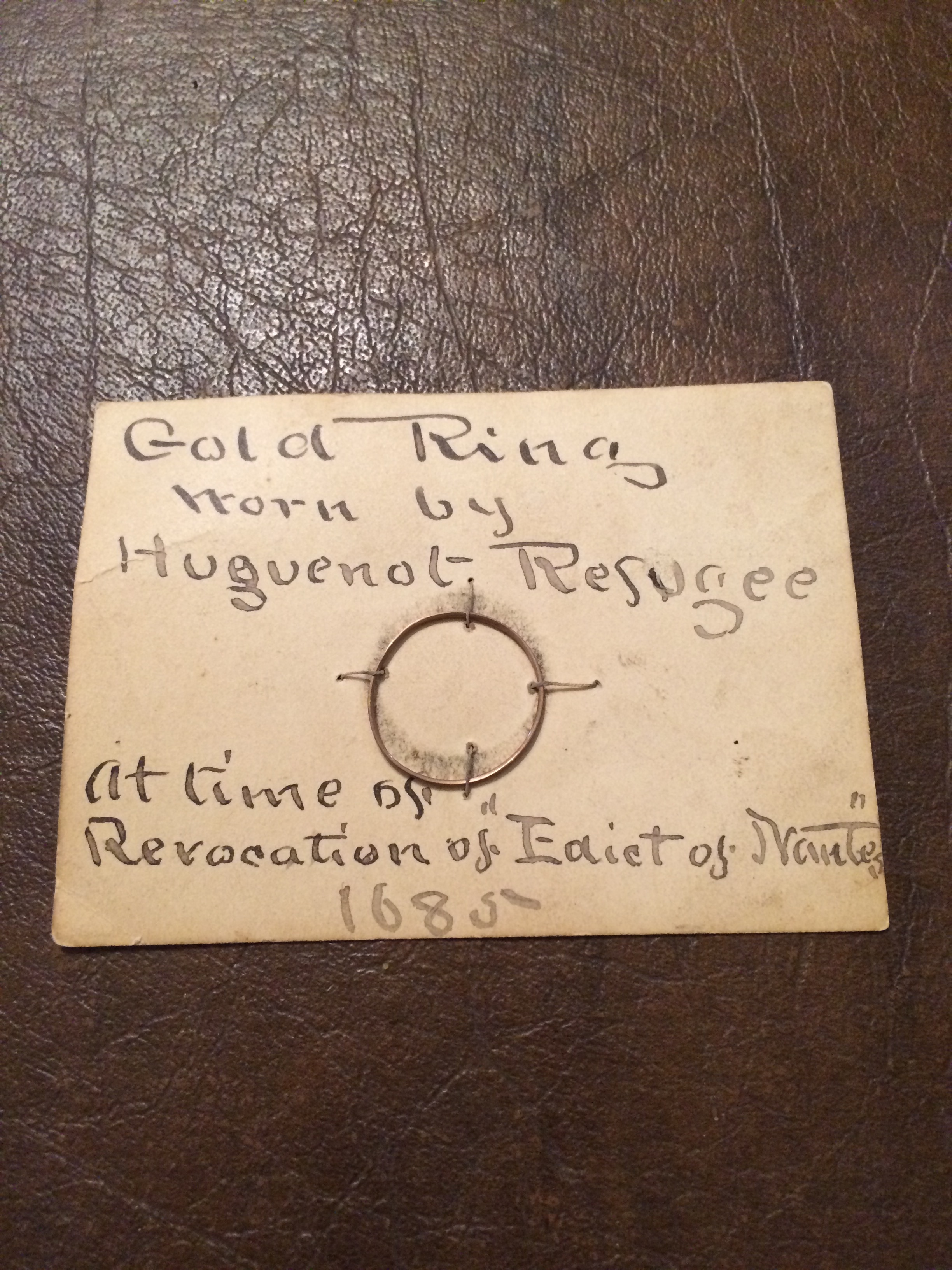
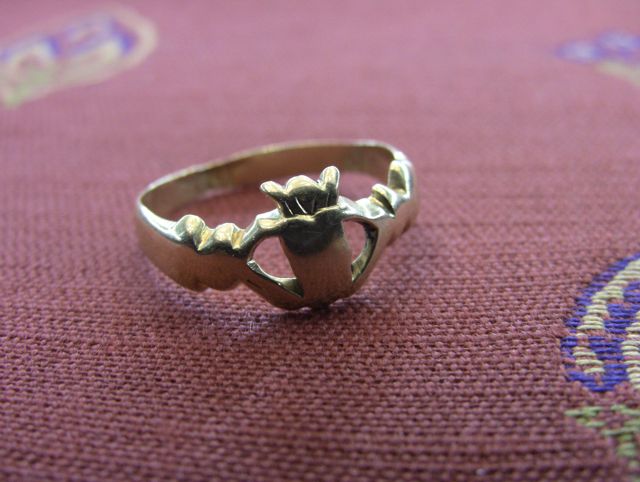
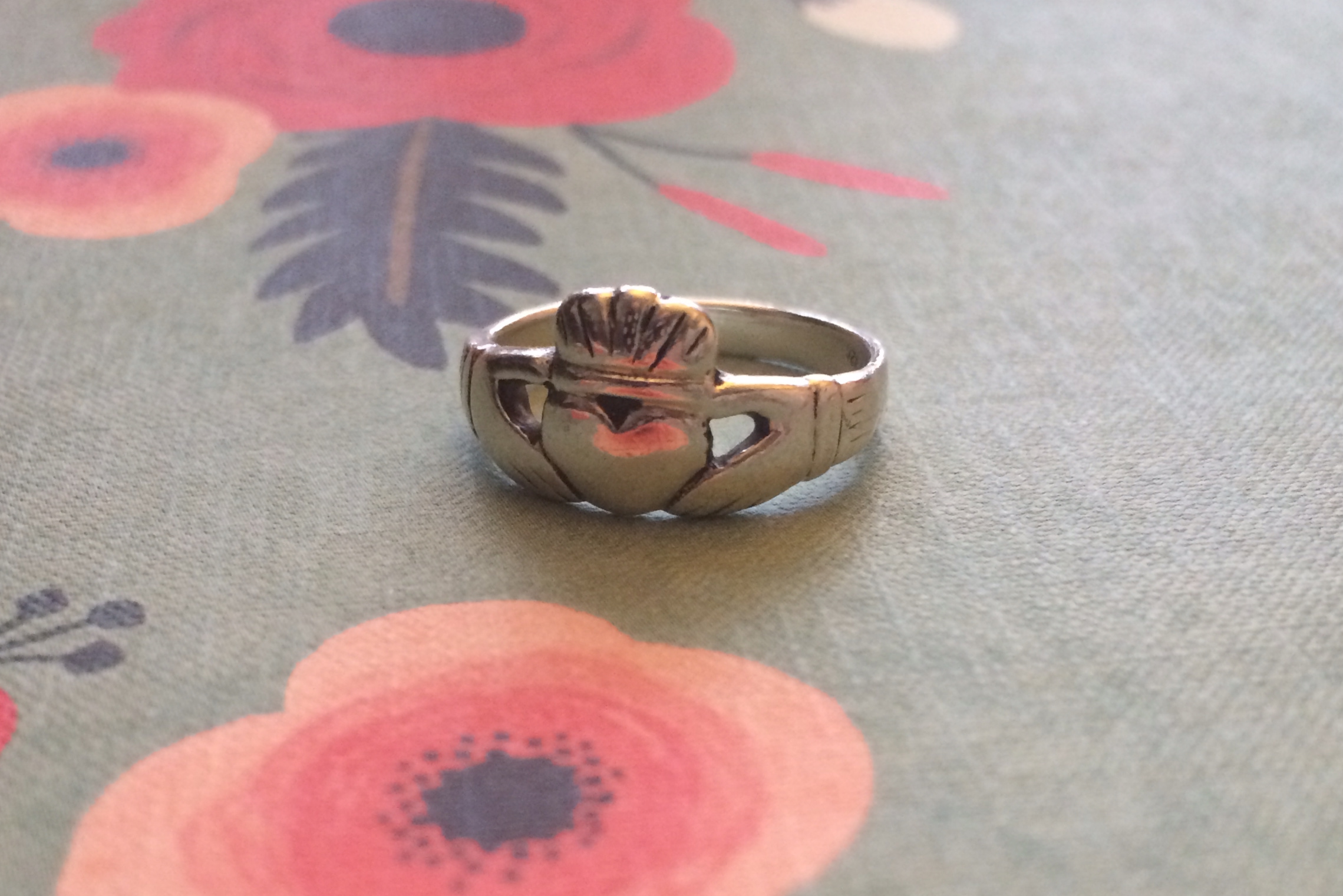
Rooney, Megan. “Huguenot Refugee Ring.” 2015. jpg.
Caption: Tucked away, inconspicuously in the corner of a collection box under a thin cloth laid a piece of paper with a ring fastened onto the rectangular sheet. For the Historic Huguenot Street historians however, it is an item that could possibly be one of the oldest and most interesting to their collection if legend can be proven as fact.
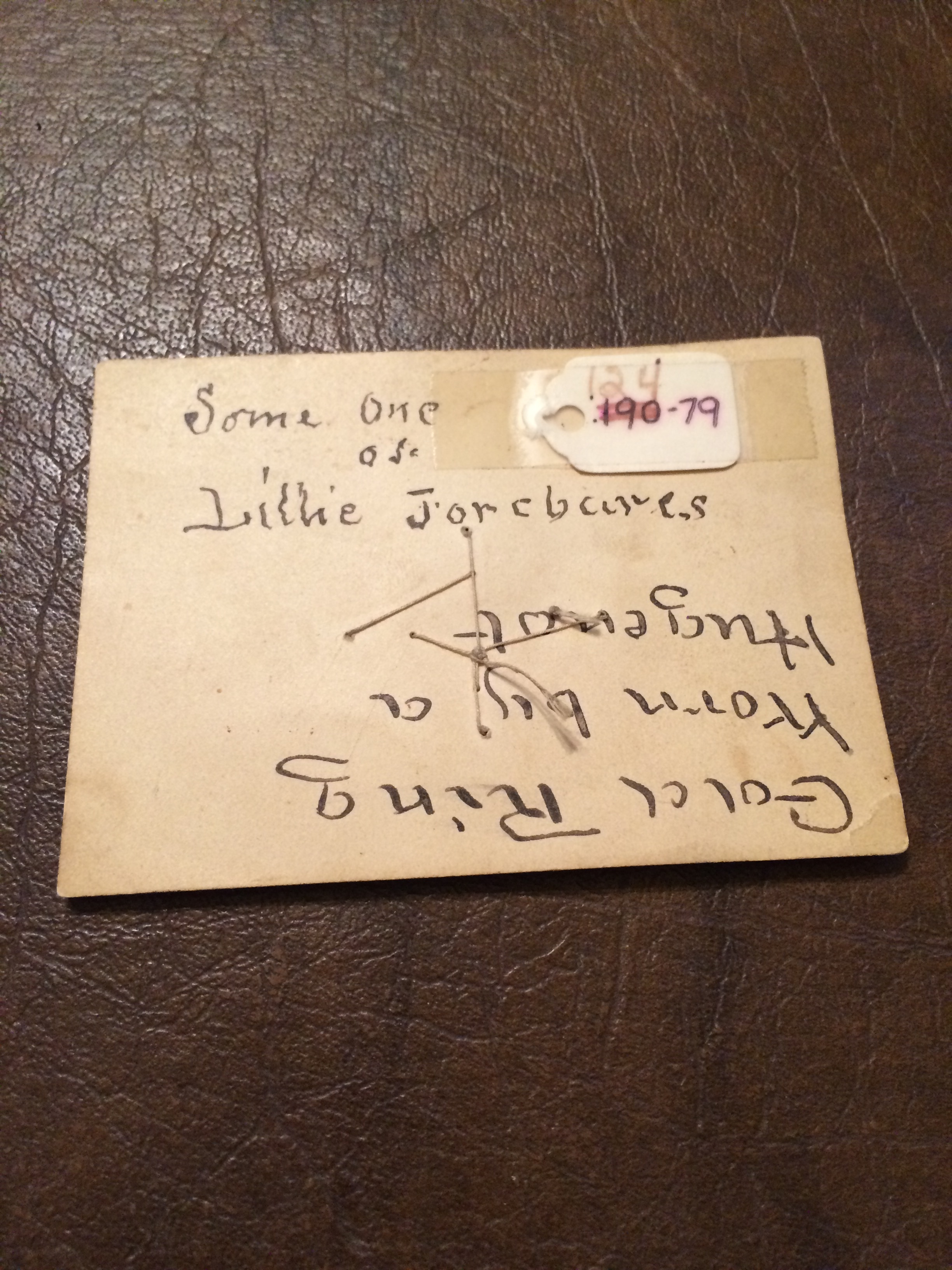
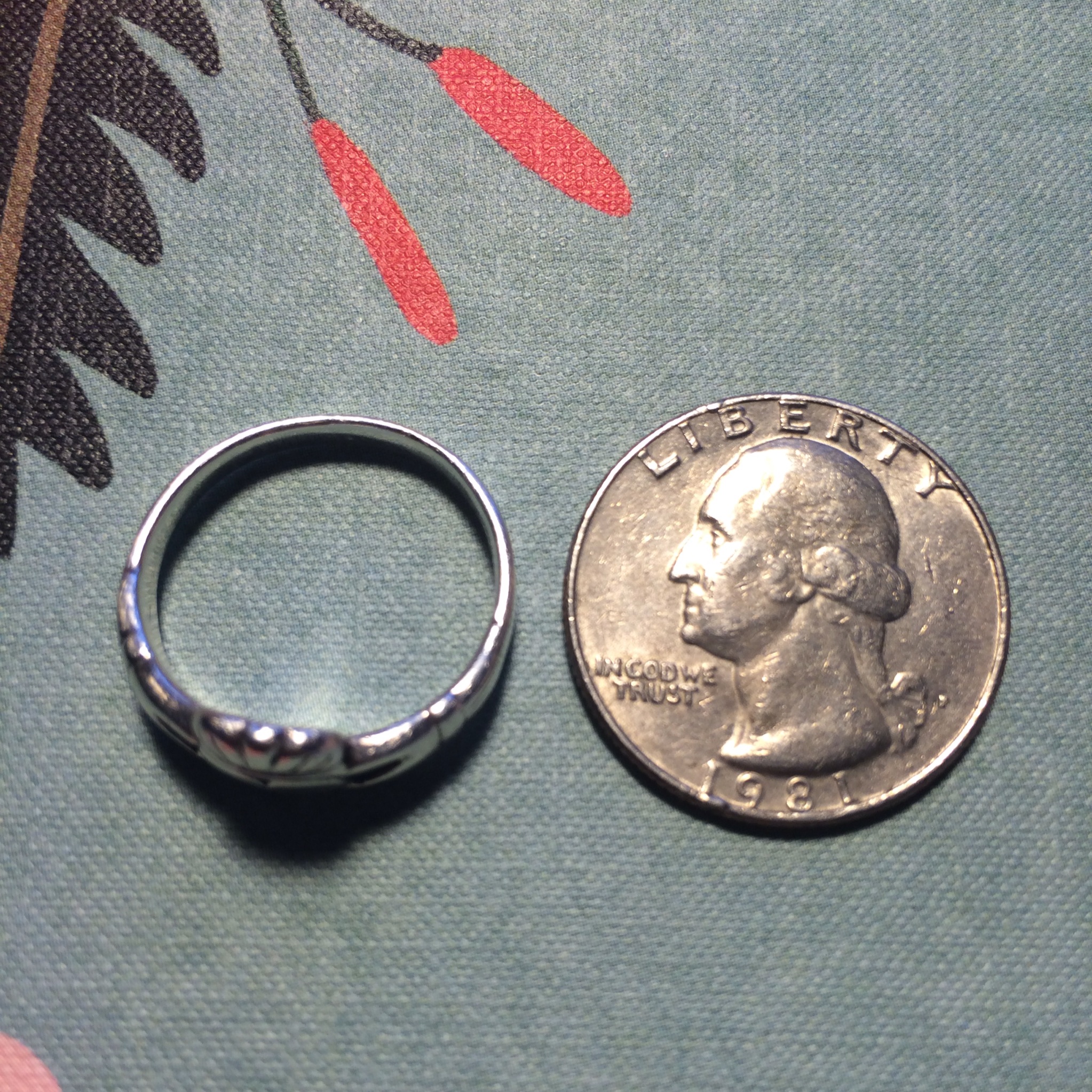
Rooney, Megan. “Huguenot Refugee Ring Reverse.” 2015. jpg.
Physical Description: The ring is fastened to a piece of somewhat thick paper, thicker than typical writing paper of today. It is fastened to the middle of the paper by four pieces of string, punctured through the paper and tied together on the backside. The ring has left a grey circle on the paper where perhaps the material of the ring has rubbed off onto the paper like tarnish from years of being attached. Information has been written onto the paper on which the ring is secured that suggests a great history for such an unassuming object. “Gold Ring worn by Huguenot Refugee // at time of Revocation of “Edict of Nantes” 1685” is written in ink onto the front of the paper above and below the placement of the ring. The script certainly looks like it was written from a different time where words were written on paper by quill and ink with a more expressive style. The back of the paper possibly reads: “Some one of Lillie Forebares” though the handwriting is somewhat illegible as compared to the other writing on the paper. Additionally, written upside-down and opposite the aforementioned description is a repeat of the front detail, this time stating: “Gold Ring worn by a Huguenot”.
Provenance: The object was donated to Historic Huguenot Street from a Ms. Katherine Wells and Mr. Freeman Lasher in memory of Edith E. Hasbrouck. A ring of such simplicity could have been a wedding band worn by one of the Huguenots who sought refuge in this area of New York or possibly in one of the European countries the Huguenots fled to such as Ireland, England, the Netherlands or Germany. The secondary object, the piece of paper the ring is attached to, comments on “some one of the Lillie forebears” which is a potential link to the rings ownership.
Narrative: Little can be determined about the ring’s history by just simply observing the ring itself. It is a humble piece of jewelry that would call little attention whether on a finger or off for it is thin and without markings, as plain as a ring can get. On the sheet of paper it is fastened to, it is referred to as a gold ring though that is an assumption thus far. It bares no markings or decorative details that would signify a maker, time period, or owner. The ring is simply a circle of metal. The claim on the piece of paper that a Huguenot refugee wore this ring during the Edict of Nantes is of both huge significance as well as speculation. It is simply a claim after all; hearsay, a myth. We cannot directly ask the object questions or will it to provide us with all the answers.
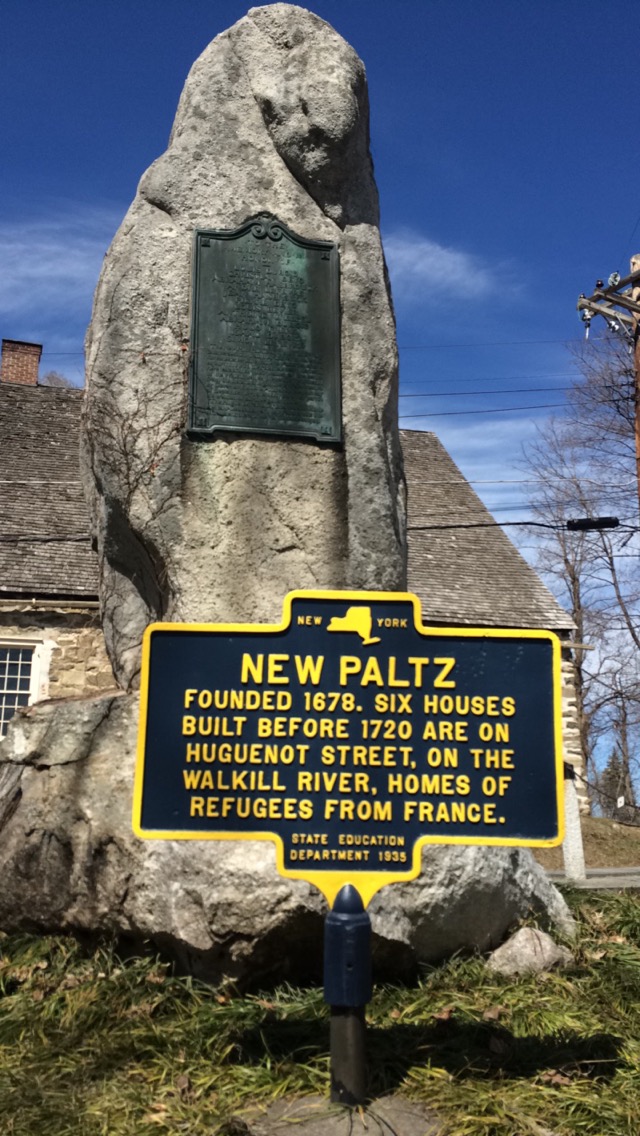
Rooney, Megan. “New Paltz Placard.” 2015. jpg.
The object combines fascination and frustration—it could potentially be an object of great importance for it could be a material link to the very event that caused the great emigration of Huguenots to various places around the world, in this particular case, our home of New Paltz. However, it could unfortunately be of no consequence at all—a story of make believe thought up by perhaps a history fanatic with a grand imagination or a distant relative related to someone in the New Paltz genealogy that could have sworn that’s how the story went about the ring in the retelling of a tale.
This object has been a source of enchantment. Regardless if its history is true or false, when one thinks about this ring, it is likely that nostalgia will take over as it has the potential to be a miniature piece of a dramatic history that is so dear to the town’s past.
The Edict of Nantes was a French law passed by King Louis IV allowing French Protestants a degree of religious freedom to publically worship their religion with full civil rights. The Protestants of France are referred to as the Huguenots and it was they who found freedom of persecution following the Revocation of the Edict of Nantes decades later by King Louis XIV in the New World. The overturning of the edict in 1685 spurred the emigration of the Huguenots to what would become New Paltz. If the description on the paper were indeed true, that would mean this ring was worn by a Huguenot seeking refuge in response to the revocation of the Edict of Nantes and furthermore, this person could belong to that of a Lillie ancestry but there is still much to explore. In contrast, if this is false, then who crafted this story and why? Who are the Lillie’s, if anyone at all? Who may have worn this ring and from where did it come?
In initial searching, little has been found about a Lillie family connected with the Ulster County settlement by the Huguenots. However, some information was found about the Lillie Family of Lisburn in Northern Ireland. These Huguenots are descendants of de Lilles from the town of Lilles in France who left the country for Ireland in the 1570s following the Massacre of St. Bartholomew’s Eve in 1572. Is it possible that one of the Huguenots who came to the Hudson Valley is connected to this family line and wore this ring? If no Lillie family is connected to New Paltz or elsewhere in New York then it would be important to determine any connection the donors may have had with this ring and why they chose to donate it in memory of Edith E. Hasbrouck.
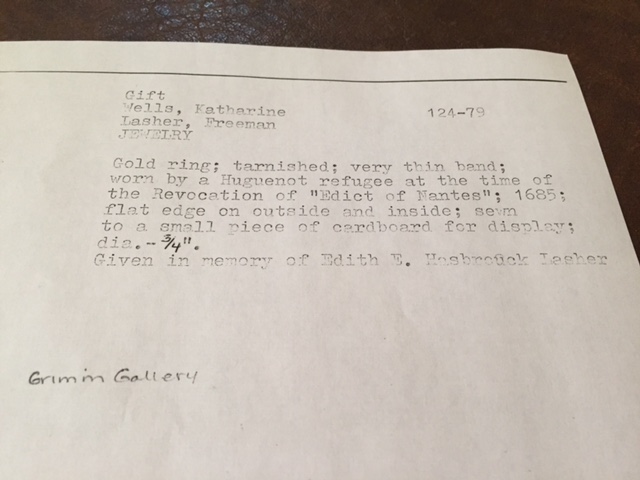
Trainor, Ashley. “Donor Card.” 2015. jpg.
The ring is so painfully simple that upon inspection, nothing can be derived from the materiality of it. However, the object does show us that we can emotionally connect to even the most basic of items. If this was in fact a wedding band from the 1600s, then the society has in its hands an item that bound two people through the placement of this item on their finger. Those people’s histories are a part of the ring as well in addition to anyone after them that wore this ring and carried it with them through their life. Now the ring has a new layer added onto it as it resides at Huguenot Street, its new home. We perpetuate the utter fascination with this object with the legends we imbue in it since its origins ultimately remain a mystery.
Bibliography
Best, E. Joyce. “The Huguenots Come to Lisburn.” Lisburn. Web. 13 Apr. 2015.
Cavendish, Richard. “The Edict of Nantes.” The Edict of Nantes. History Today, 4 Apr. 1998. Web. 13 Apr. 2015.
Trainor, Ashley. “Donor Card.” 9 April 2015. Digital Image










 The Materials of History, Thought, and Art