For this week’s blog post I decided to look at a text that lives on Dr. Pat Sullivan’s bookshelf. I thought it was be intriguing to observe one of the books she owns and keeps in her office. Dr. Sullivan is a scholar of rhetoric and focuses on gender, race and class in political rhetoric. The book she suggested to analyze is Cicero on Oratory and Orators, translated and edited by J.S. Watson and was a new edition of Cicero’s De Oratore and Brutus which was written way back when in 55 B.C.! The inside flap  of the paper cover introduces the text as “a significant publishing event”. Ralph A. Micken, was a professor of Speech and Chairman of the Department of the Southern Illinois University, wrote the introduction for this particular text. The back flap of the cover informed me that Micken lectured on Cicero for over 30 years and completed extensive research at the British Museum and British Universities, reviewing manuscripts of Cicero’s De Oratore. I learned that J.S. Watson prepared and published this edition of the text in 1878 and it was Micken who selected this edition for reprinting as it is considered one of the best translated versions with its textual and historical notes made by Watson. The preface to the text is by J.S. Watson from his original publication where he credits the work of George Barnes, a Barrister of the Inner Temple, whose translation of De Oratore in 1762 provided the ground for Watson’s further translation.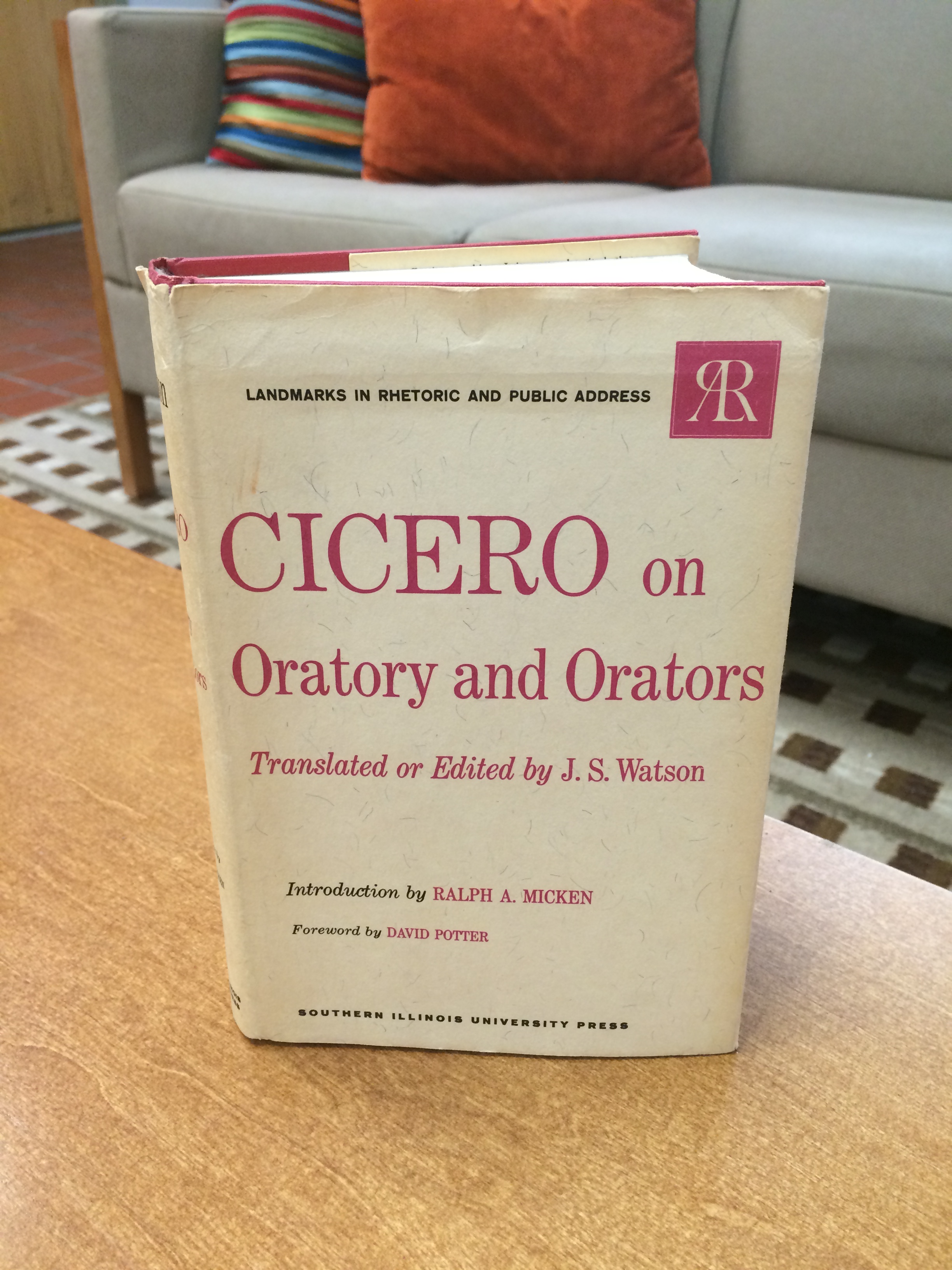
This version of the text was published in 1970 and is a part of a series called “Landmarks in Rhetoric and Public Address”. It is a hardcover book that could have been purchased for $8.50, according to the price printed on the inside flap of the jacket. It was printed using the process of “offset lithography” in the United States of America. Offset lithography is a process that uses printing plates to transfer images and text to paper and was created in 1796. It requires a chemical treatment on the plate to allow for the transferring of the specifically inked areas that utilizes the repulsion of oil and water.. I looked into the 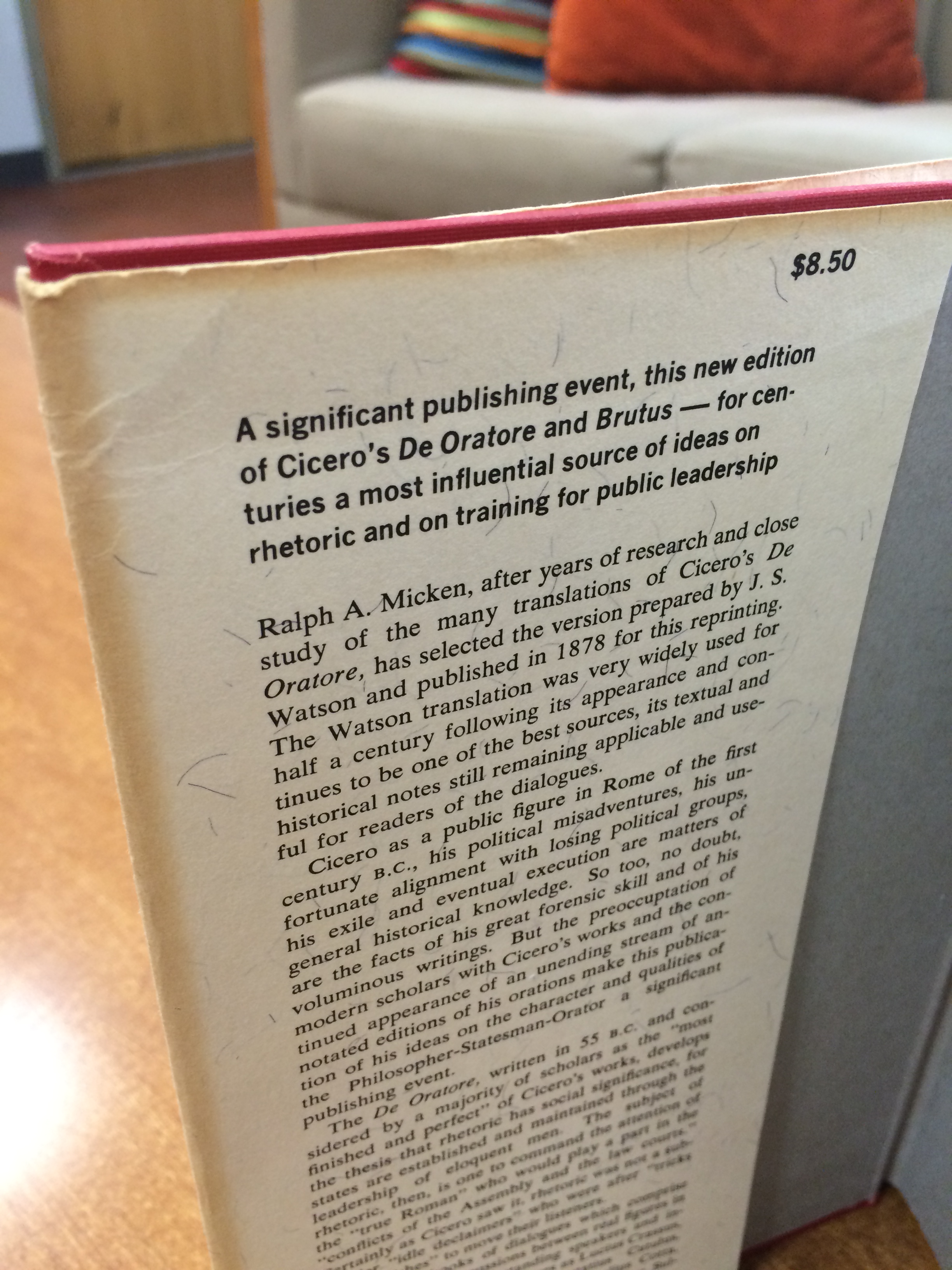 process online and it was rather confusing to me even though it was one of the most common ways to print materials. Looking into this facet of the book as object research was eye-opening–I had no idea how many different processes have been invented and innovated for printing materials and that a book printed in 1970 would use a process first created nearly 200 years earlier!
Most hardcover books that I own or have come across have a paper cover that has been printed with a glossy finish. The jacket of this text however looks a lot like manila paper to me! The inside flap reveals a color that would have been much closer to its original color which appears to be buff in color though the outside back, front and 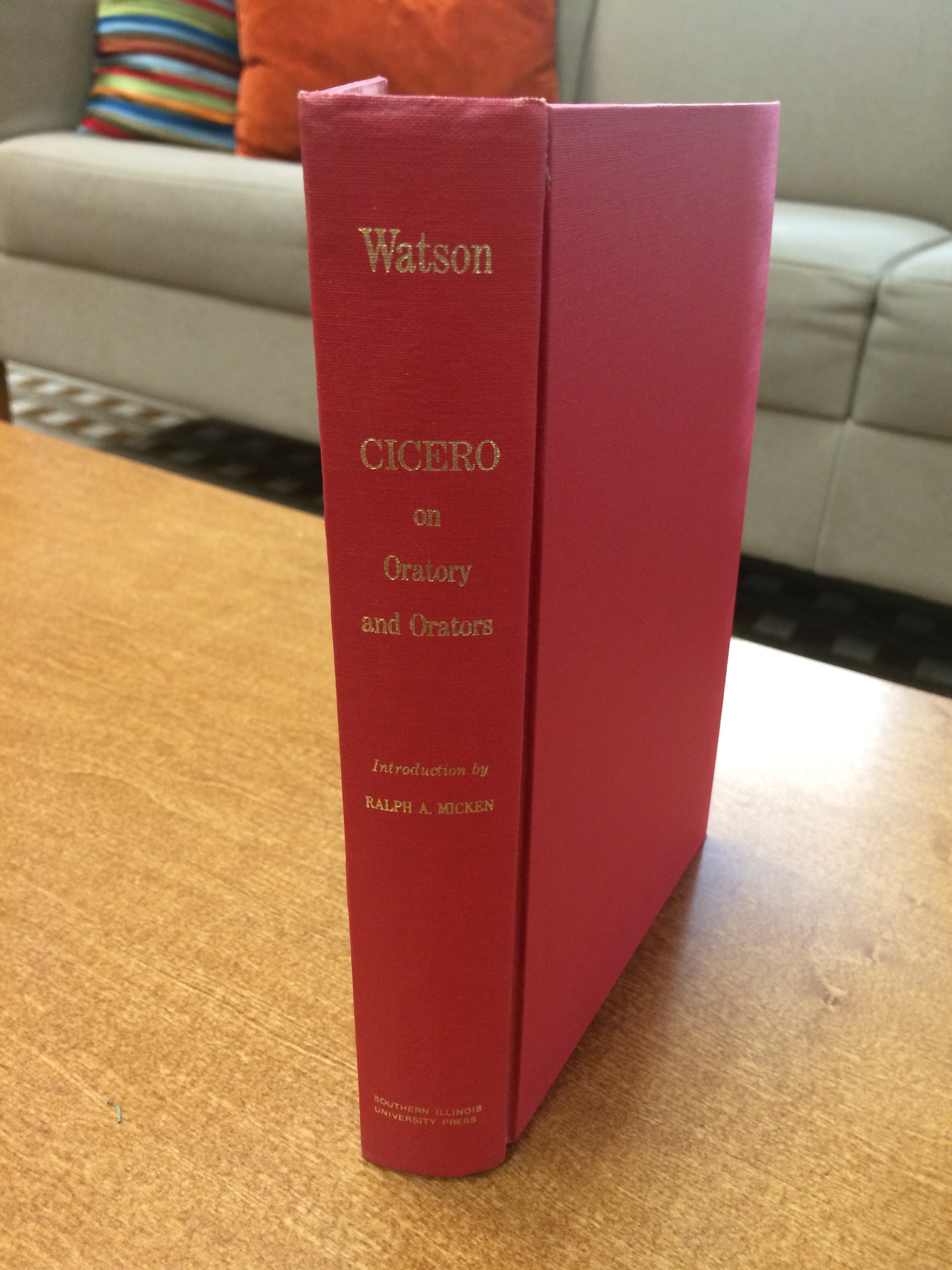 spine have certainly yellowed with age. It has this interesting design to it with that looks like fine blue marks that may have been a choice by the designer of the paper product. The book itself is a bright red color and the spine has the editors last name, Watson, the title of the text, Mickens name as well as Southern Illinois University Press all printed in gold. The book is about eight by five inches and contains over 400 pages of text. Within the pages of the text are notations written by Dr. Sullivan. She marked
  passages with a blue pen, preferring to underline sections of interest and writing key words from the text that struck her such as the phrase, “memory exercised through practice” in her familiar handwriting.
I enjoyed using the little clues within the text to determine its origin story even though I really only scratched the surface with this post! It was interesting to me to select one text off Dr. Sullivan’s bookshelf because it allowed me to take a small peak inside her academic journey, having acquired the text in 198o while she was at graduate school for a course on classical rhetoric that Pat attests to being “really intense”! A text such as Cicero’s shows that it continues to transcend time thanks to the effort of translators and the influx of interest and continued relevance in consuming such works of one of the great orators.


I think it’s really interesting how you decided to look at a book that belongs to someone else, especially since Pat is able to talk about her experiences with it. I also liked how you were able to find out about the printing process. I wanted to know this information for my book but didn’t fin anything, so reading what you found about offset lithography was nice.