Carrie’s Books

I feel that I have gone through the history and significance of my first edition copy of Little Men, at least as much as I can without the specific details of where it was purchased and who owned it previously, as this is difficult to do without it being a family heirloom. However, I am still greatly interested by the history of books and so I turned to the rest of my collection to see if I could dive into another book’s history. I looked for books which had previous owners’ names or dates inscribed inside. Though many of my books do have these details, I found myself most taken with a four specific books, of which I had forgotten their relation as I have owned them for several years now.

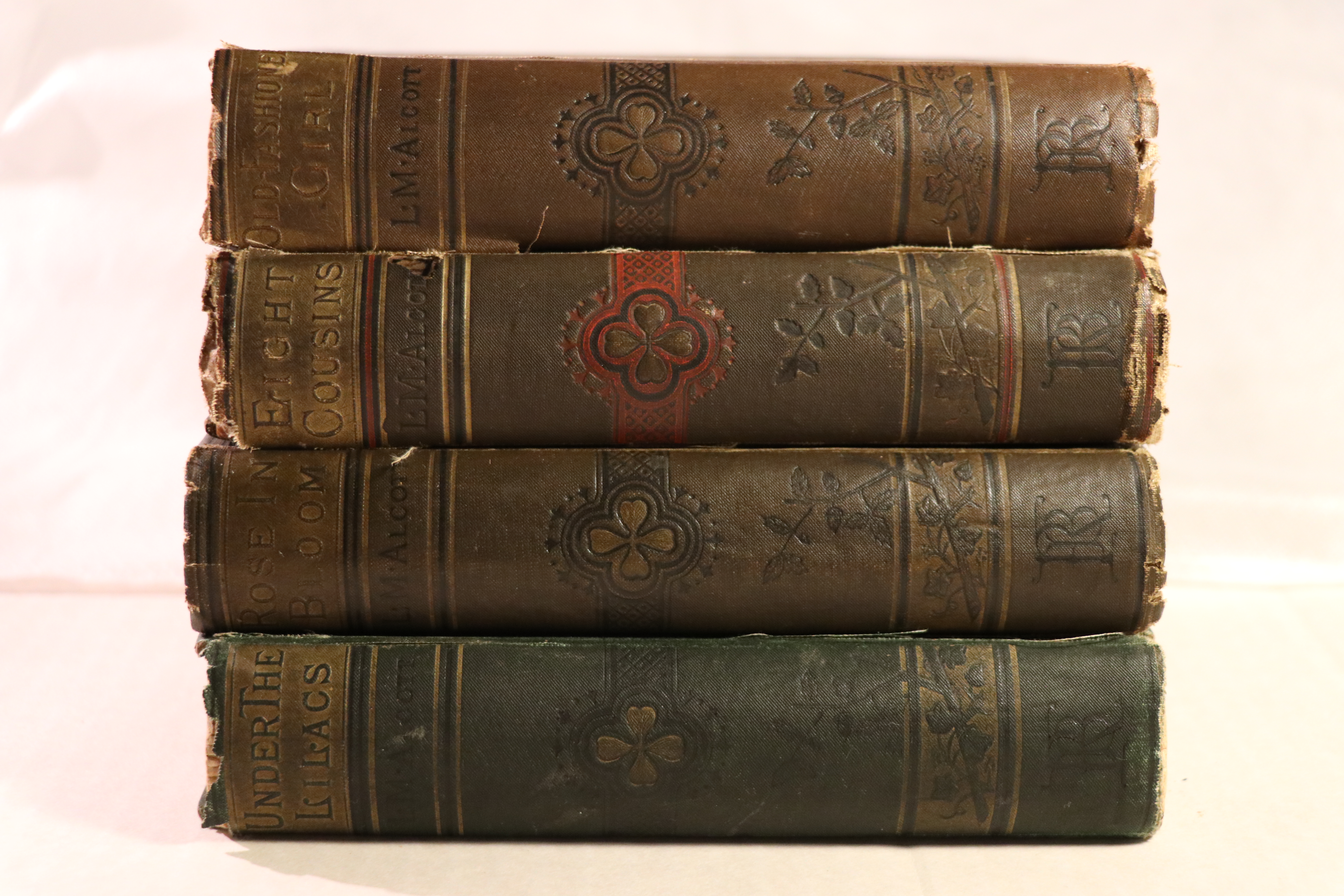
These four books–Rose In Bloom, Old-Fashioned Girl, Under the Lilacs, and Eight Cousins–have many things in common, as well as with most of my collection. They are all written by Louisa May Alcott and published by the Roberts Brothers. Rose In Bloom, printed in 1893, is bound in a dark brown cloth with black lettering and floral designs on the front and black, brown, and gold lettering and accents on the spine. Eight Cousins, printed in 1888, has the same brown cloth binding but with gold lettering and black floral design on the front and black, gold, and red accents on the spine. Old-Fashioned Girl, printed in 1892, is bound in a lighter brown cloth with black lettering and floral design on the front and black and gold accents on the spine. Finally, Under the Lilacs, printed in 1892, is bound in green cloth with black lettering and design on the front and black and gold accents on the spine. These four books were purchased together as a gift to me by my grandparents, who also love books and antiques and are always on the lookout for specific ones that would fit into my collection, such as this author or publisher. They were found in a large antique warehouse (from what I remember) in Pennsylvania. They had said this place housed items for anyone’s interests and was a treasure trove for hidden collectibles, as most of their items were from estate sales or the clearing out of large collections. Because my grandparents were buying all four, they were not very expensive and was a substantial edition to my collection.

However, there is another detail which unites these four books: all were originally owned by the same person. This information is found on the inside covers. When opening the cover of Old-Fashioned Girl, in faded ink there reads:

“To Carrie

From Mamma

March 6, 1892”

Though I am unsure of the significance of this date, I can assume that it may be her birthday or another special occasion. On the inside cover of Under The Lilacs, there reads:

“To Carrie

From Papa

December 25, 1892”

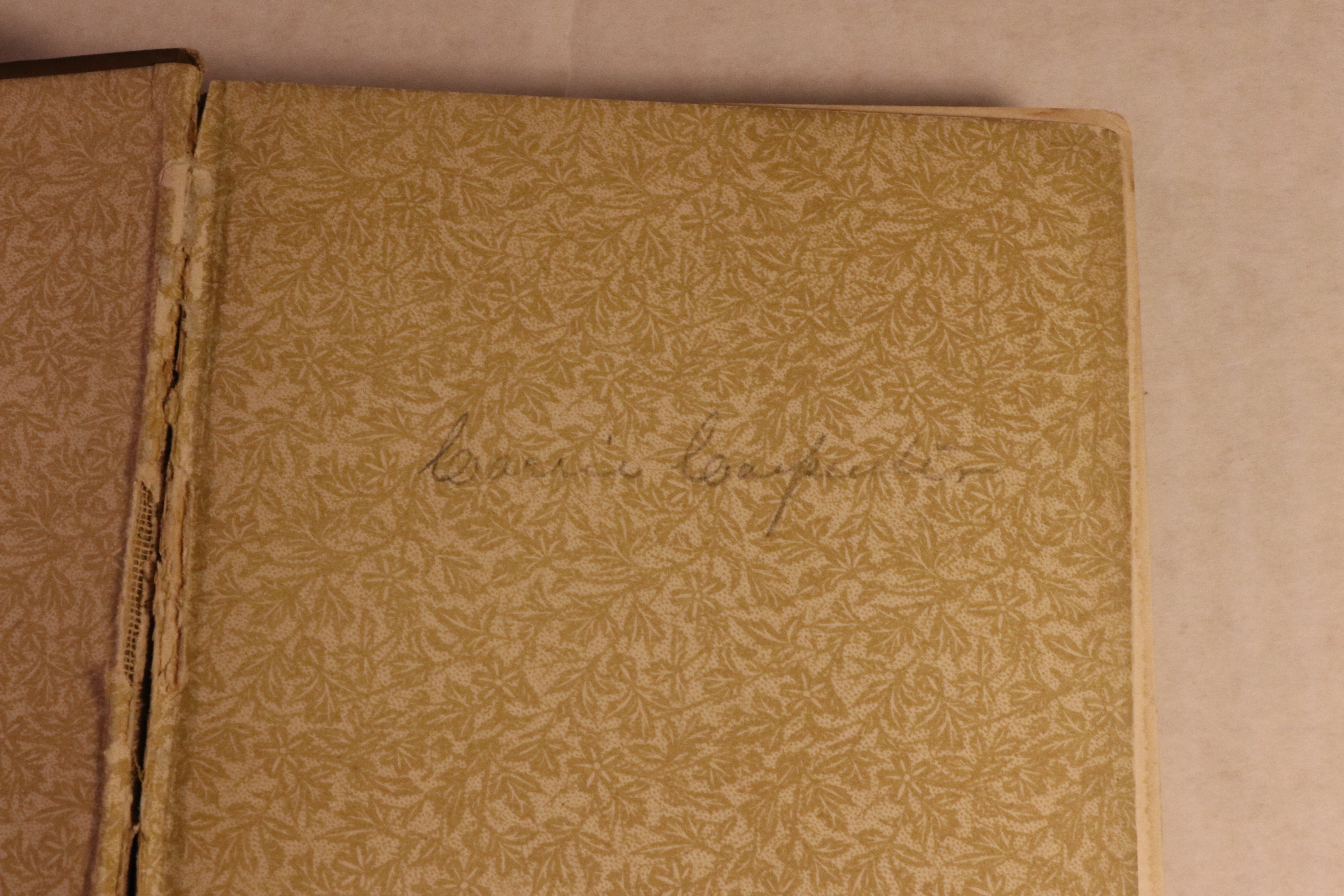
Though “from” different people, the handwriting makes me think they are both written by the same person with the same type of fountain pen and so probably written by just one of the parents. The other two titles do not have one of these messages, but rather a first and last name written in pencil in the same spot. The first name clearly reads Carrie, though after much effort I still cannot confidently make out the last name, though in Eight Cousins there is a middle initial ‘L’ also included. I am pretty confident that it was Carrie who wrote the names in these two books as one of the reasons I cannot make out the last name is due to the pencil handwriting not being very clear. Additionally, the letters, though I can tell it is the same last name, are made in slightly different script styles. This possibly indicates a couple year difference in when they were written and therefore the child having more practice or development of her handwriting.

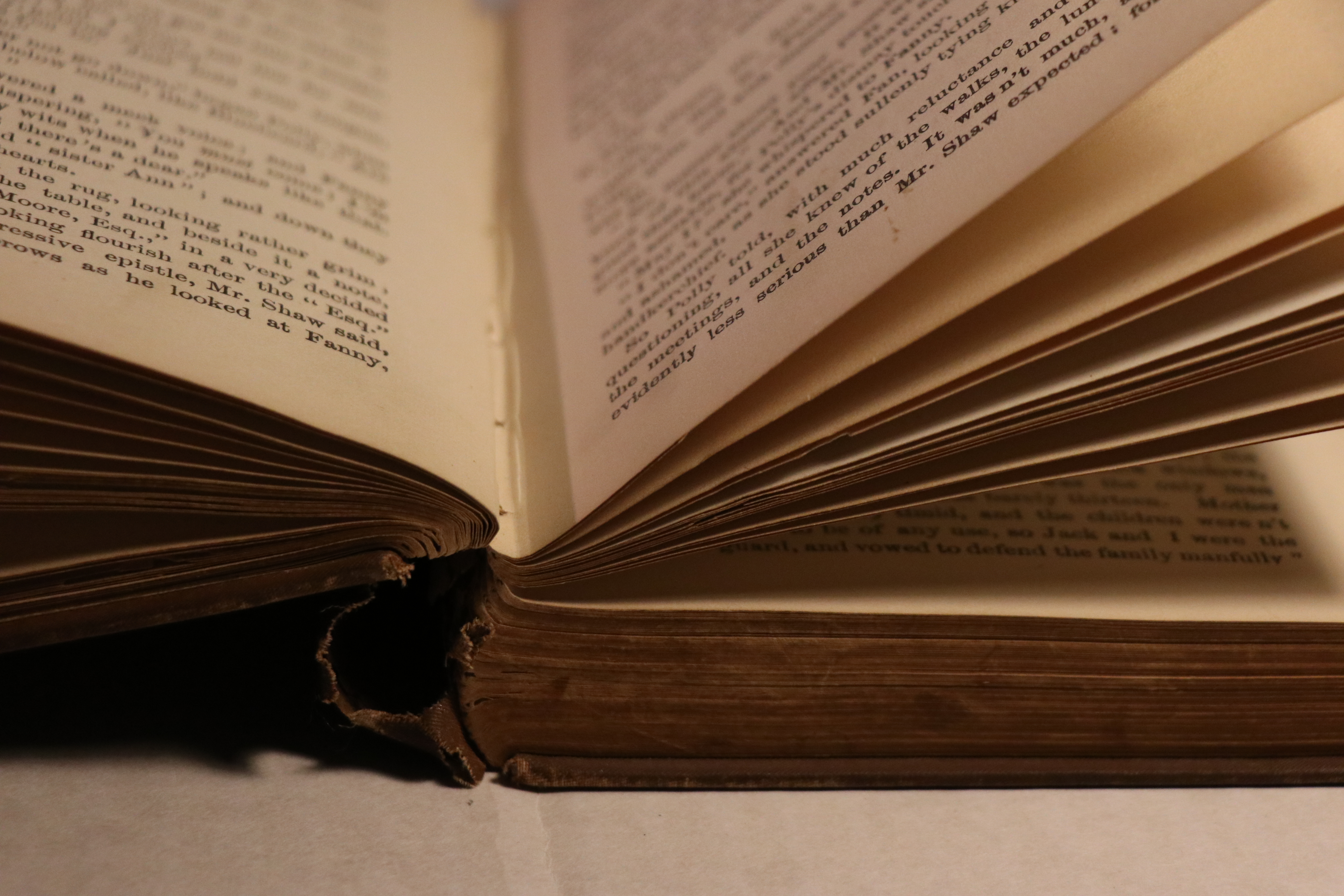
While it is disappointing I cannot make out the last name, I am also unsure of how much more information I would be able to find on her or her family. She probably would have been married young and taken another name and I do not have the first names of her parents. However, I enjoy the idea of having a unique collection within my collection, and it brings to mind many questions I have about both her and the books’ lives since her ownership. I can tell, unlike my copy of Little Men, that these books were well read from the wear of the spine, cover edges, and the inner seams of the pages being loose and showing when opened. I do wonder of what financial means this Carrie girl and her family were, if she were spoiled and these were frequent gifts of which there are a few remaining. Or, if her family had to save for these and were only given for special occasions throughout her childhood. I also wonder at what point she parted with them, and if there were other Alcott books of hers that have since been separated. Or, even, how many owners they had before they became property of the antique warehouse, then of my grandparents, and now of mine.
The Family Bible

For this week’s post, I decided not to continue discussion of my grandmother’s old recipe book; there is not a very substantial chain of ownership, and when I asked my mother, she was uncertain as to whether the recipes themselves had been passed down or if my grandma simply made them up on her own (or, possibly, just copied them out of a cookbook)!

Instead, I am going to focus on an object that I forgot even existed until this week (after a great deal of time spent bothering my mom, asking if we had any other heirlooms): the family bible. I do not currently have possession of the family bible, but it was the object I was able to discover the most history about, as it literally holds a record of the history of my mother’s side of the family back to the 1800’s (albeit a limited history of names, and the dates of births, marriages, and deaths). After my grandfather passed away, my Aunt Linda, my mother’s oldest sister, took possession of the family bible and provided me with some information and photos about it for the sake of this post. When I have the time, I would be curious to go to her house and see it in person (apparently I have seen it before, when I was very young, but I do not remember). Pardon the quality of some of the pictures – my Aunt Linda is technologically challenged and did her best.

The Family Bible (it reminds me, a bit, of something out of Harry Potter)
Inside front page of the family bible

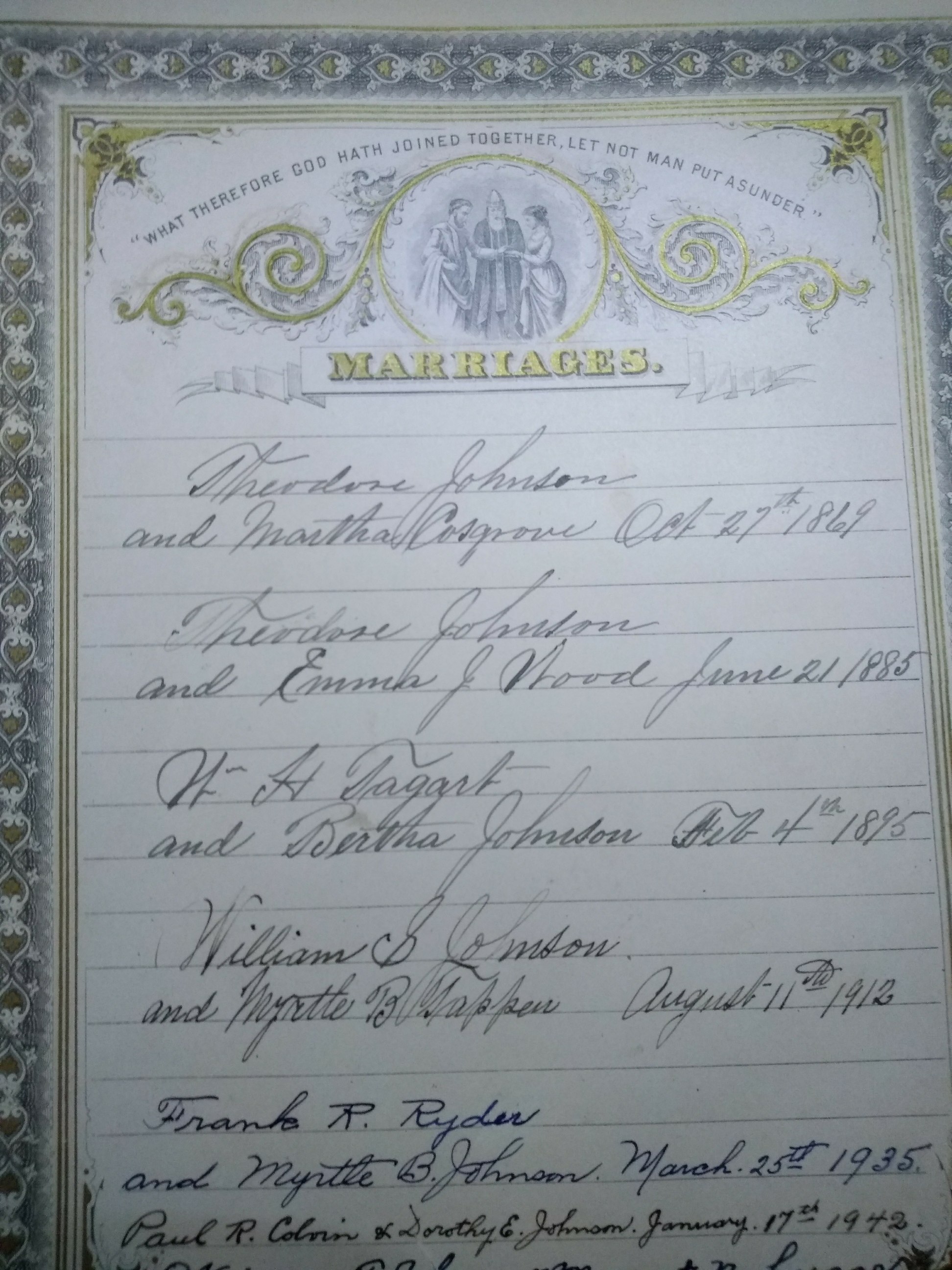
The duct tape is an unattractive necessity; it takes away from the overall fantastical and grandiose appearance of the family bible, but was put on by my grandfather when the book started to fall apart. The bible was bought and started by my grandfather’s parents – William and Myrtle Johnson, my great-grandparents – in 1912, the year they got married. They were able to document back as far as William’s great-grandfather, Theodore, and his marriage to a woman named Martha Cosgrove in 1869. In terms of births, my great-grandparents were able to trace the Johnson lineage as far back as Stephen Johnson, who was born in 1798.

Marriages in the Johnson family
Births in the Johnson family (my mother, Cindy, and her four older sisters listed in the bottom right corner)
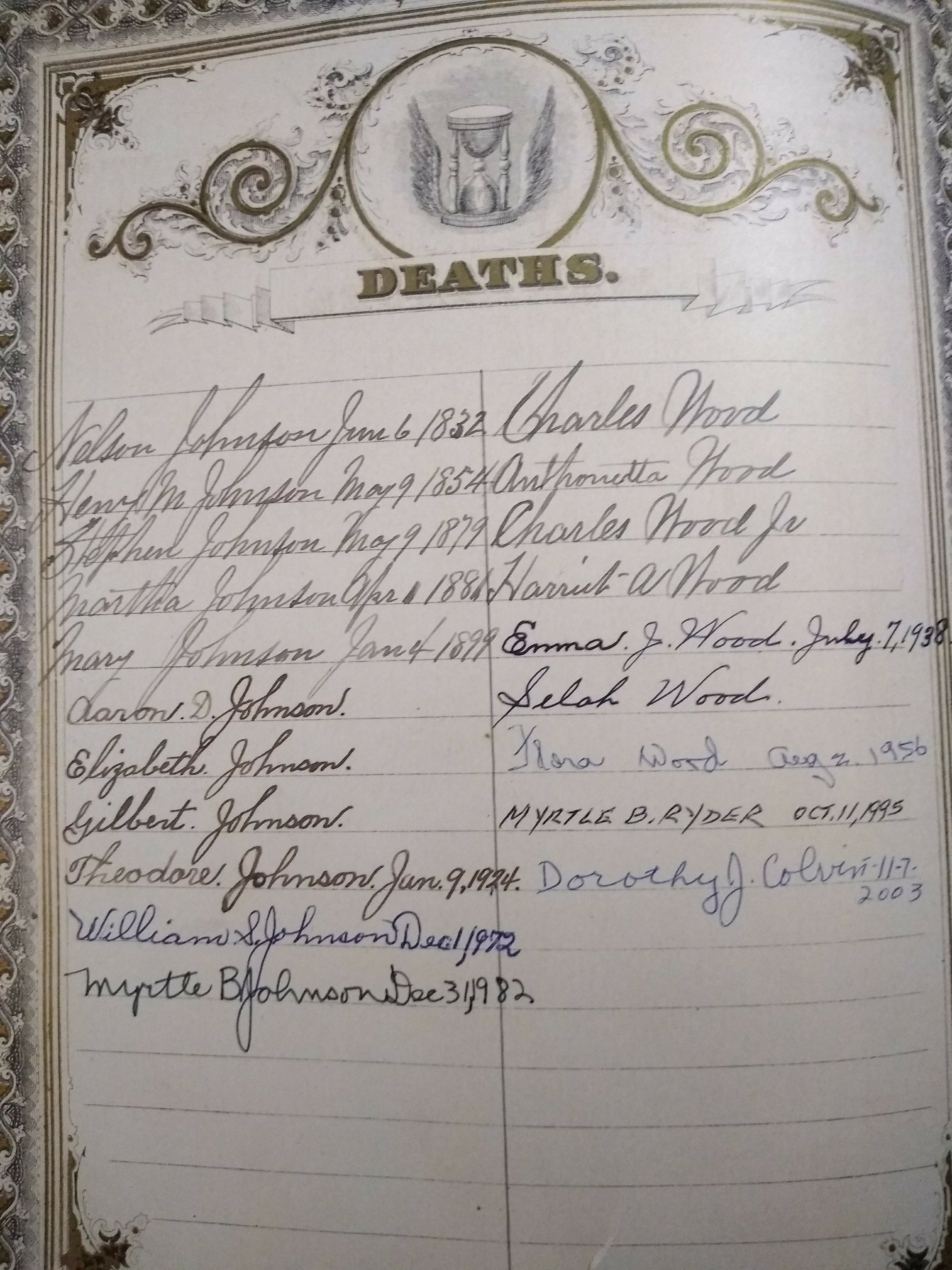
Deaths in the Johnson family

After my great-grandma passed away, the responsibility of the bible fell to my grandpa and grandma, and after their deaths it fell to my Aunt Linda. Interestingly enough, the deaths of my grandma and grandpa are not written on the Deaths page, even though they both passed away quite a few years ago; Aunt Linda told me she could not bring herself to do it. My mom said perhaps one day, when she is over, they can do it together. The more recent births and marriages within the large Johnson family could not fit on those pages and my Aunt Linda had to start writing on additional loose papers that she keeps with the family bible.

This item did not necessarily have a very extensive chain of ownership – only one generation more than the recipe book – but I felt that it unearthed so much. I am a Cavallucci, not a Johnson, and I have always identified more strongly with my father’s Greek and Italian side of the family, but I had never known very much about my mother’s side. It is both astonishing yet deeply bizarre to see your heritage written down, and the sheer number of people within the Johnson clan. The family bible actually inspired one of my older cousins to delve deeper into the Johnson lineage using Ancestry.com a number of years ago, revealing supposed connections to infamous horse thieves and even ancient Scottish royalty. I was young when he did this research and was disinterested at the time, but am certainly much more interested now to learn more about the people upon people that are my ancestors.

Although this book only contains names and dates, I loved learning about it as I gathered information from my aunt and my mother for this week’s post. I love seeing how the handwriting on the pages changes as the family bible was passed down – a testament to its continual inheritance. Heritage and family history are something that I have become quite fascinated with in recent years, and the family bible is something I think I hope to have one day, and to write and record the legacy of our family in, ugly duct tape and all. The object will continue to be weathered with time, but as my mother jokingly told me of the family bible: nothing can break the bonds of family.

Where the Hoosier Hutch has been

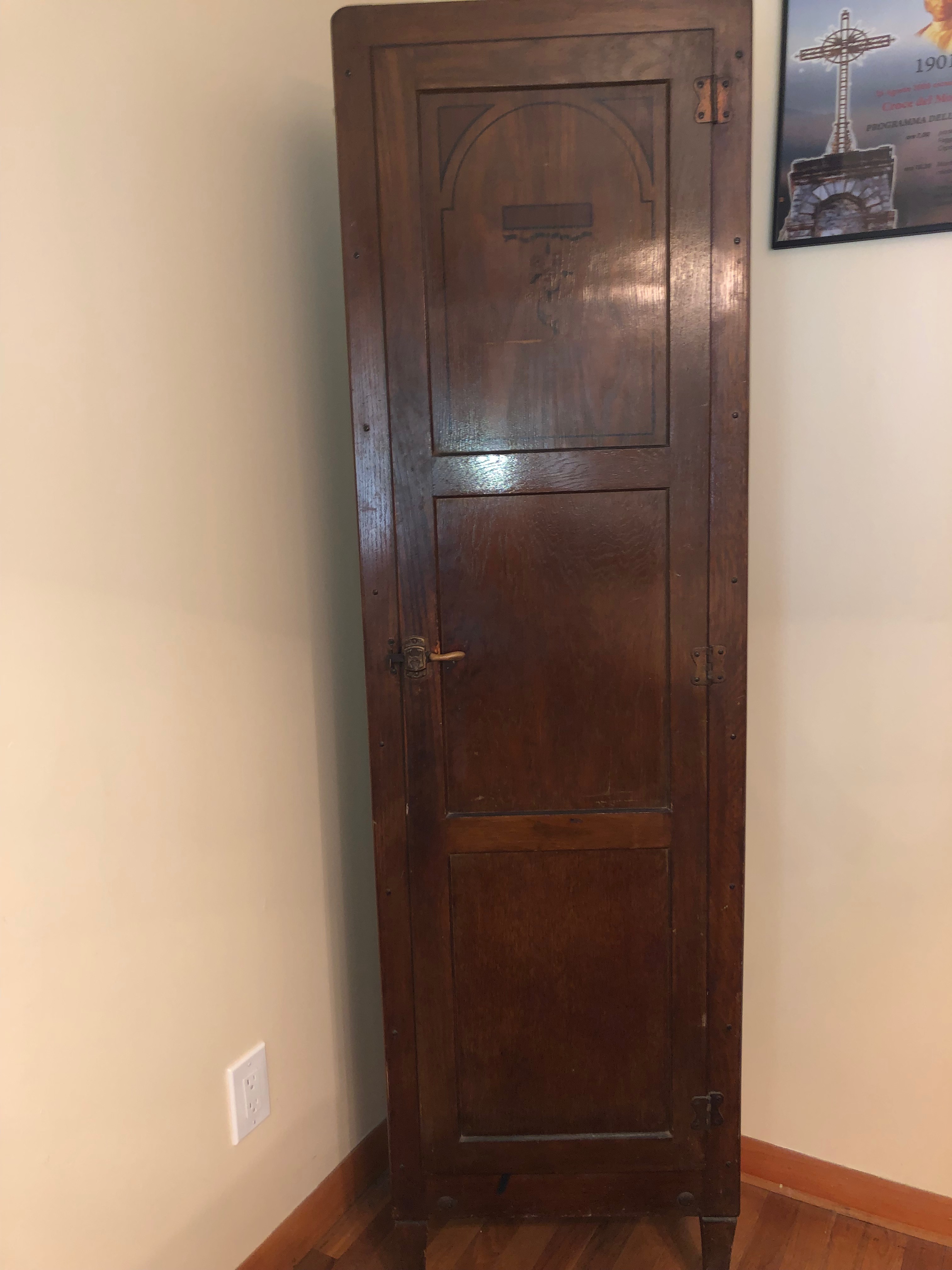
For this blog, I have decided to look deeper into the chain of ownership of the Hoosier hutch in my dining room. Before diving into my research I thought about how exactly I would do this, and how would I be able to learn more about it. Since the hutch is rather large, I can only imagine how difficult it would have been to move such a large object. Therefore, there must be a story somewhere in my family telling about its travels. However, since all the relatives who have had previous ownership of this hutch have since passed away, tracing it back without their help might be very difficult.

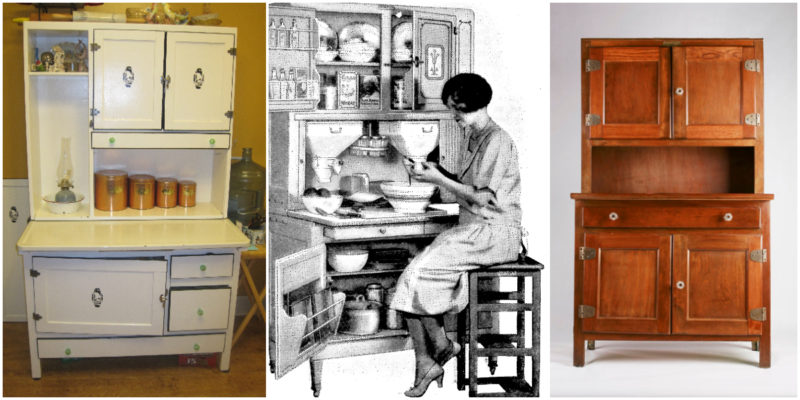
A standard Hoosier model

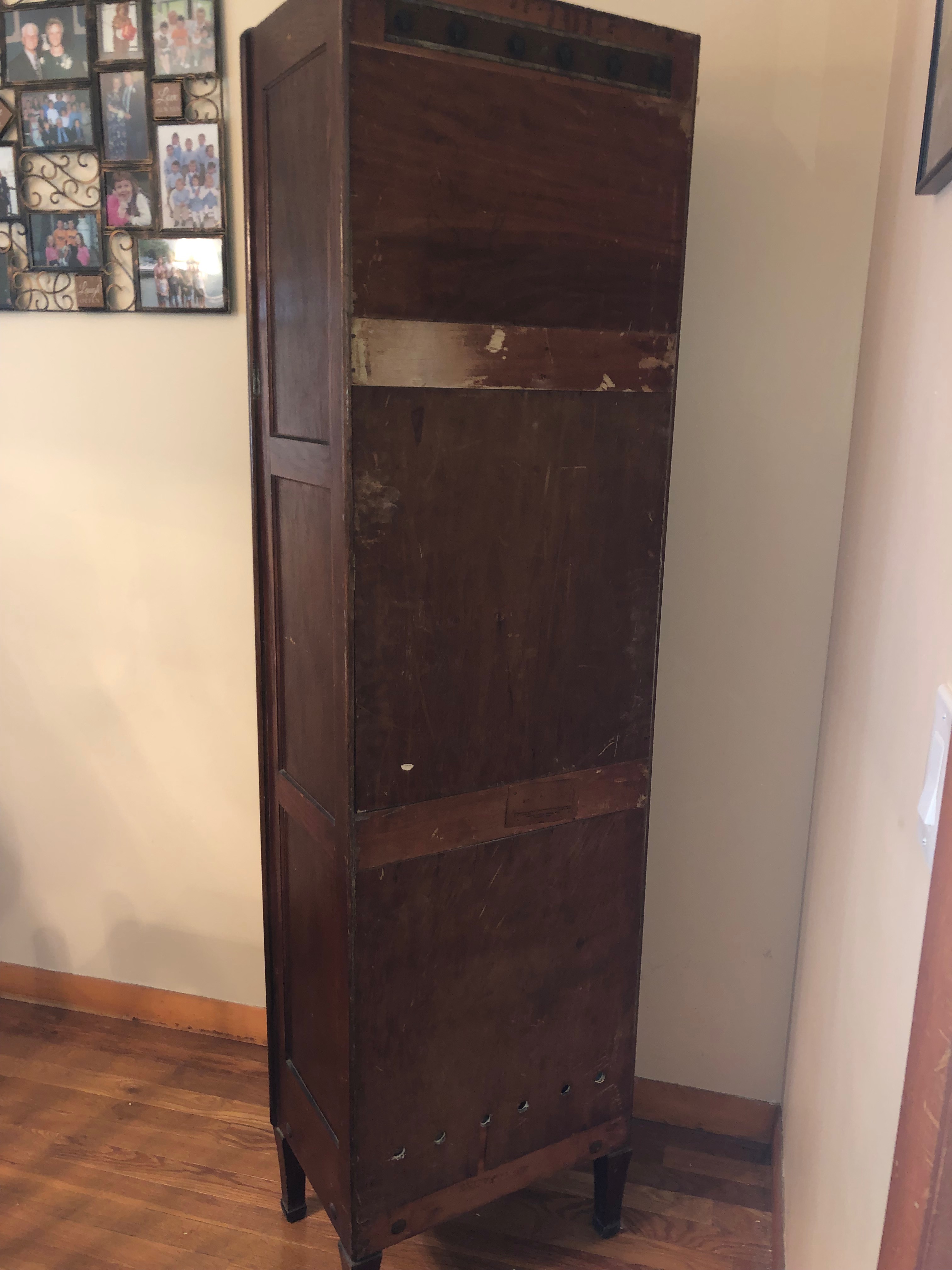
This hutch was originally manufactured in New Castle, Indianna. When researching more about the production company, I discovered just how popular these cabinets were. According to Radford (2013), one in every ten homes in the U.S. had Hoosier kitchen cabinets by nineteen-twenty-one. Most models were designed so that they could be an all in one kitchen work station and storage. Some models had mixers, flour sifters, and baking ingredient specializations. Somewhere in this company’s fourty year business, my great-great-grandparents purchased a specific model of these cabinets. Their cabinet is a right facing one, model number 6001-SGO unit, which is a bit different from the other popular models. It has five shelves, and air flow holes in the top and bottom so that baking supplies will not get stale.

It was shipped from New Castle, Indianna to Hazelton, Pennsylvania, where my great-great-grandparents lived. While I do not know much information about when it was ordered, or how it got to their home in PA, I do think that it was used for baking and kitchen storage. A possible missing link in how this hutch went from my great-great-grandparents to my Poppa, could be through his parents or my great-grandparents. However, this would have meant that the hutch traveled to Brooklyn, New York, which is where my great-grandparents lived and where my Poppa grew up. This sequence in the story, could most definitely be true, and could explain why it had been continually passed down. Having said that, I do know for sure that this hutch traveled to Endicott, New York, at some point over the years, and this is where it remains. It has been in the same house since its arrival here years ago, and has only moved rooms.

Since moving into my grandparents house, almost fifteen years ago, this hutch has been in my dining room. My mom and dad cleaned it up, and brought it back into our dining room. Since it had been moved into the basement where my Poppa used it for tool storage. When I asked my mom for more information, she said her sisters had a hard time deciding who would keep what furniture and other objects that belonged to my grandparents including who would keep this hutch. It was then decided that this hutch, along with a couple other pieces of furniture would stay in the dining room of the house, and this is where this hutch remains. It is now overflowing with baking supplies, like sprinkles, chocolates, containers, aprons, sugar, flower, pots and pans. This is how I’ve always remembered the hutch looking, but now I’m glad that I’ve learned more about it, and how just as our family has moved and changed, so has this Hoosier hutch.

Everything but the kitchen sink in the hutch now

References

Radford, G. (2013). Hoosier kitchen cabinets: An unforgettable impact. The Courier Times. Retrieved from:

http://www.cityofnewcastle.net/eGov/apps/document/center.egov?view=item;id=1117

Of Medals and Dragons

I got in touch with my uncle to discuss my grandfather’s medals in further detain, and much to my dismay, found out that they are in fact not authentic to my grandfather. Rather, my uncle bought them at the Navy Store in 1991, and says the original copies are lost, and that he never saw my grandfather with them. He did help me pull up my grandfather’s military record, which lists that he was a Carpenter’s Mate Third Class, Construction Battalion (CB), and earned the Victory Medal, American Theatre Medal and the Asiatic Pacific Medal. That at least confirms that the medals are correct for his service record, but they’re still not authentically his. My uncle says he picked them up for between $8 to $10 each, along with the pin.

And so, with a bit of disappointment in my findings and the story of the medals completed, I decided to post about something from my dad’s side of the family; Advanced Dungeons and Dragons.

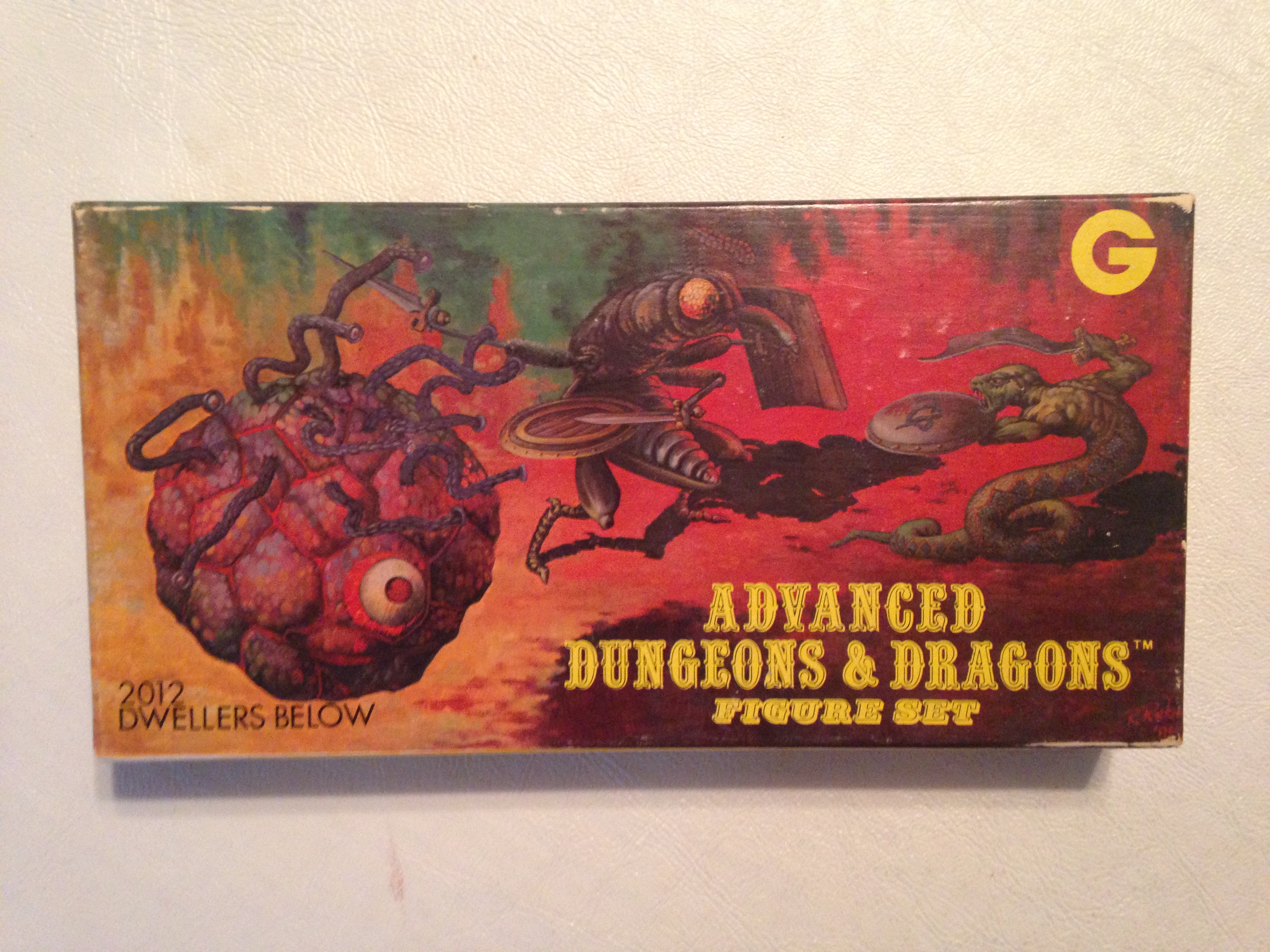
The Box from the Front
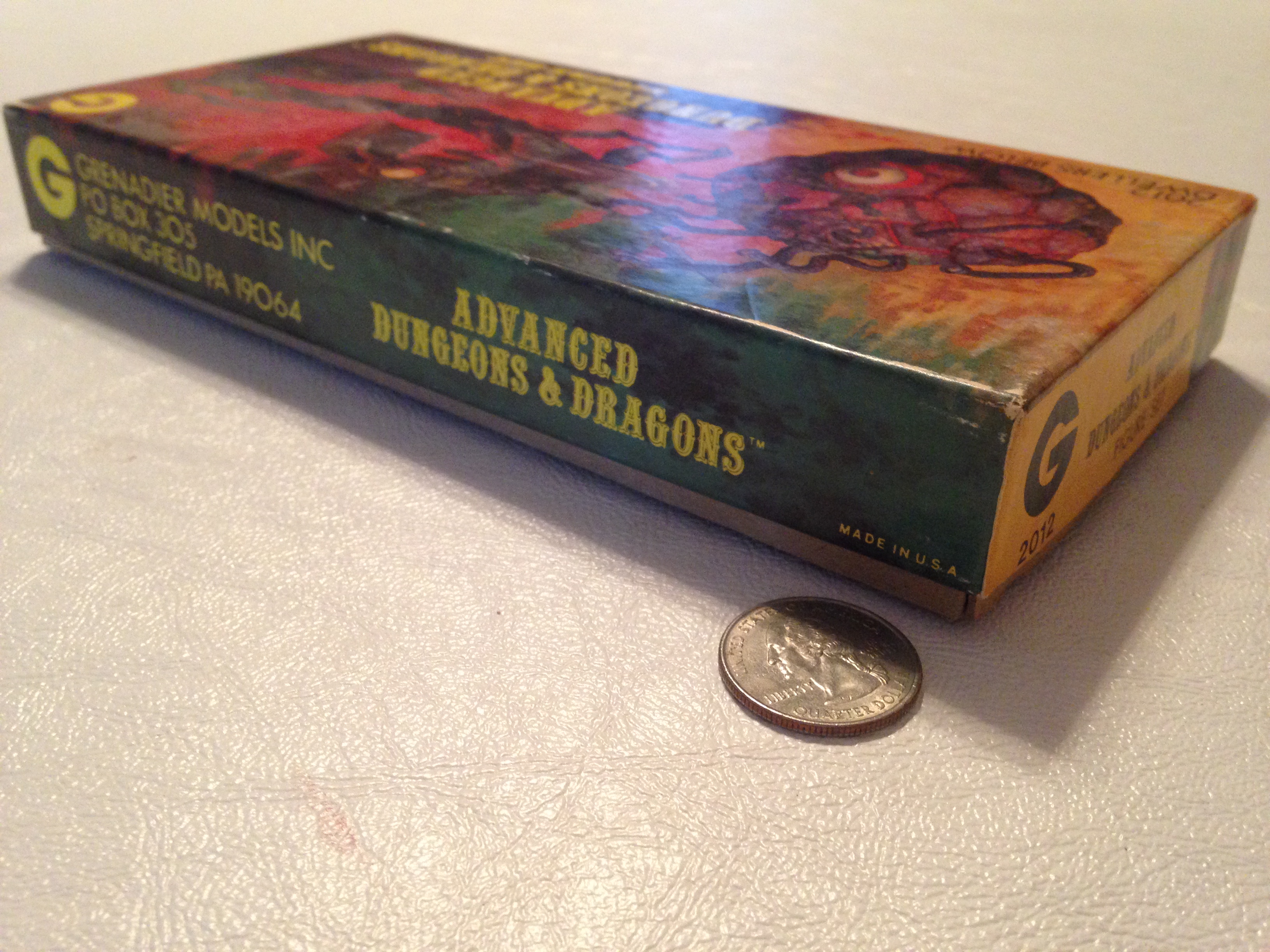
One of Two Identical Sets of Sides, Quarter for Scale

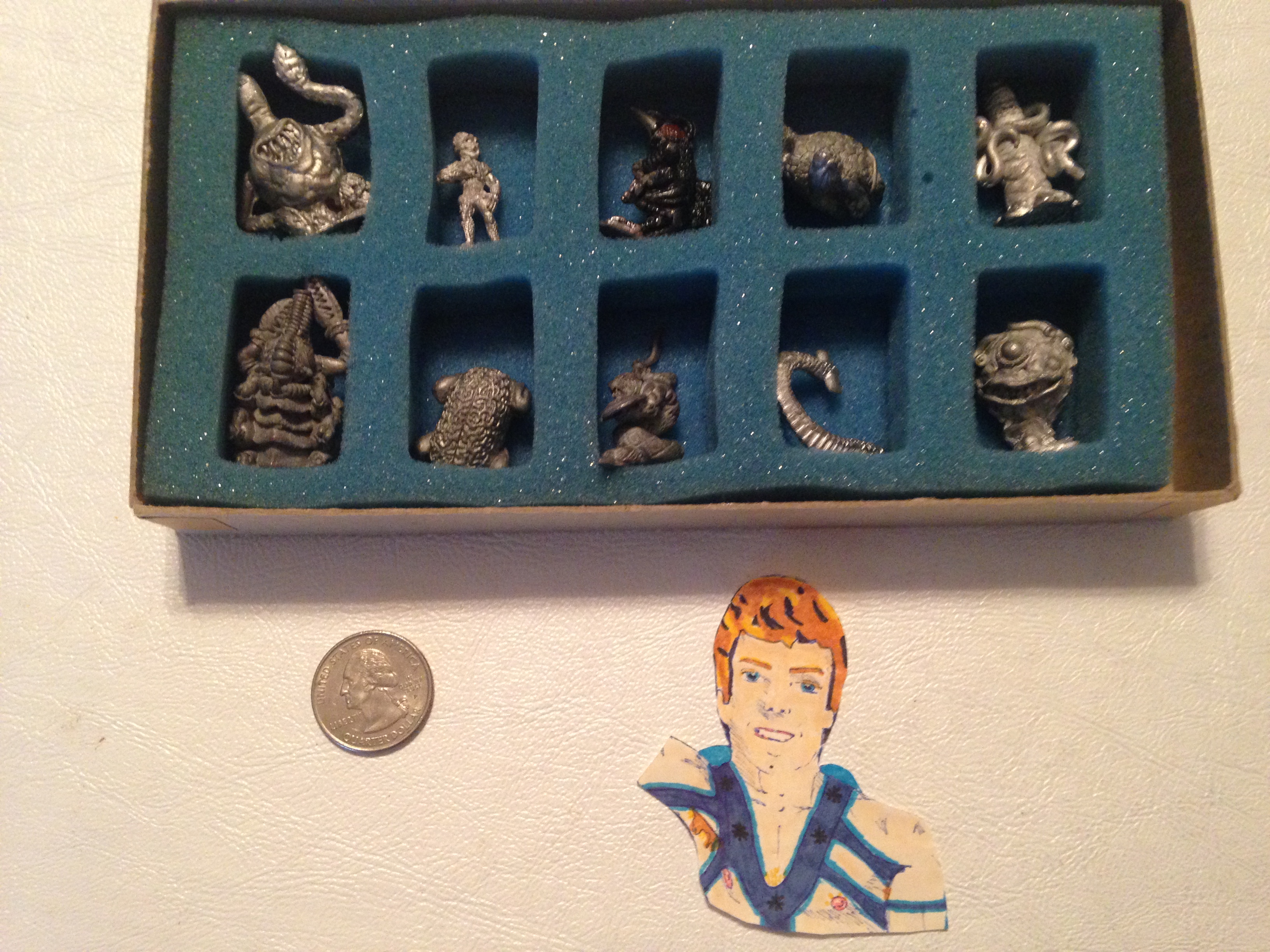
The Advanced Dungeons and Dragons Figure Set clocks in at 8” long by 4” wide and 1” tall, and has on its surface the image of a Beholder, a floating mass of snakes and flesh with a giant eye. He seems to be watching a Fly Man, or Aarakocra, fighting against a Snake Man, called a Yuan Ti. It has a number 2012, placed above the phrase “Dwellers Bellow”, and has two yellow sides with “Advanced Dungeons and Dragons Figure Set ” and two green sides that say “Advanced Dungeons and Dragons ” again, with the company information “Grenadier Models Inc. PO Box 305 Springfield PA 19064, and Made in USA in the bottom right corner. It’s made of cardboard that is beginning to deteriorate at the corners, and has a brow cardboard backing. Inside the box are several figurines kept in rectangle cutouts that are set in blue foam.

The Figurine Set, and a Drawing I Found with it
A Close-Up on the Beholder and Aarakocra

The box is filled with figurines representing various characters and monsters. They are all about as big as a quarter, though the larger ones are almost 1.5” long. In particular, there’s a drawing of a man with red hair, and a painted Aaarakocra with two shields and a sword, along with my favorite monster, the beholder.

The figures are made from a soft gray metal that I’m 90% sure is lead from the way it rubs off on my fingers, giving them a slimy (perhaps toxic) feel that renders them far from pleasing to touch; quite a contrast from DeWall’s netsuke.

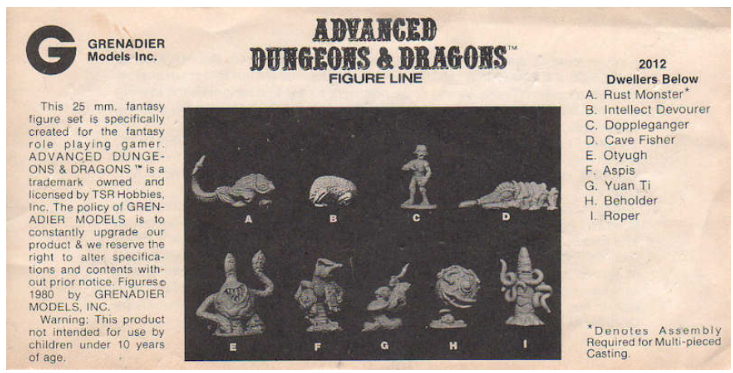
Grenadier Inc. is a company long out of business, so it took some digging to find just where these came from. The company ran from 1975 to 1996, and produced this particular set in 1980 at its plant in Springfield, PA (Cook). They were made from a die mold, and were indeed cast out of lead, prompting me to wash my hands. I was able to confirm that these figures are authentic 1st edition casts, since there were no reprints.

The 1980 Catalog for this Set (Cook)

I picked these up because they belonged to my father, who played D&D with his brother and his friend Chris when they were in high school in the early 80’s. The Aarakocra is my dad’s work, and the drawing was done by Chris, representing one of his characters. My father used to tell me about the adventures they’d have, how my uncle would try to kill every creature he stumbled upon, and how my grandfather, a self-proclaimed bodybuilder, played a few times as a barbarian. These figures would be at the center of the table, standing menacingly on hand-drawn grids representing dungeons and caves, helping the players imagine the sinister obstacles their heroes had to overcome. Chris would write all the encounters, and went on to make a side job for himself telling ghost stories at “haunted” places.

My father somehow ended up with all of the D&D materials, and gave these to me when I turned 12 in 2009. We played a few adventures with my younger brother, and I later became an avid board game player. Whether I like these figures so much because I like board games or I like board games because I played with the figures remains to be answered.

Now that they’re with me, the figurines (and four similar sets) have transitioned from pieces used to play a game into a shared memory with my father. I display the figures in their box and never take them out; partially because they’re lead, but mostly because I’d be afraid to lose the characters that connect me to my father when he was close to my age, doing the same things I do.

Works Cited

Cook, Jim. “Grenadier’s AD&D Solid Gold Line.” Paintbrushes for Miniatures, http://www.dndlead.com/Grenadier/Grenadier.htm.

Family Photograph from 1921

After exhausting every detail of the 1907 Silver United States Barber Dime, I have decided to discuss the history behind a special family photograph from 1921. Often when I sit down with my one-hundred-year-old great aunt, who we lovingly call Auntie Dot, she talks about the difficulties her family endured during the 1920s and Great Depression. Growing up in a tenement apartment without a father and six other siblings where basic amenities such as a private bathroom or fresh fruit were too expensive, Auntie Dot observed from a young age my great grandmother persevering through extreme circumstances, trying to earn enough money each week to ensure the whole family had enough food, coal, and a roof to sleep under each night. With all this under consideration, this is precisely why I am perplexed to present a well captured photograph of my family.

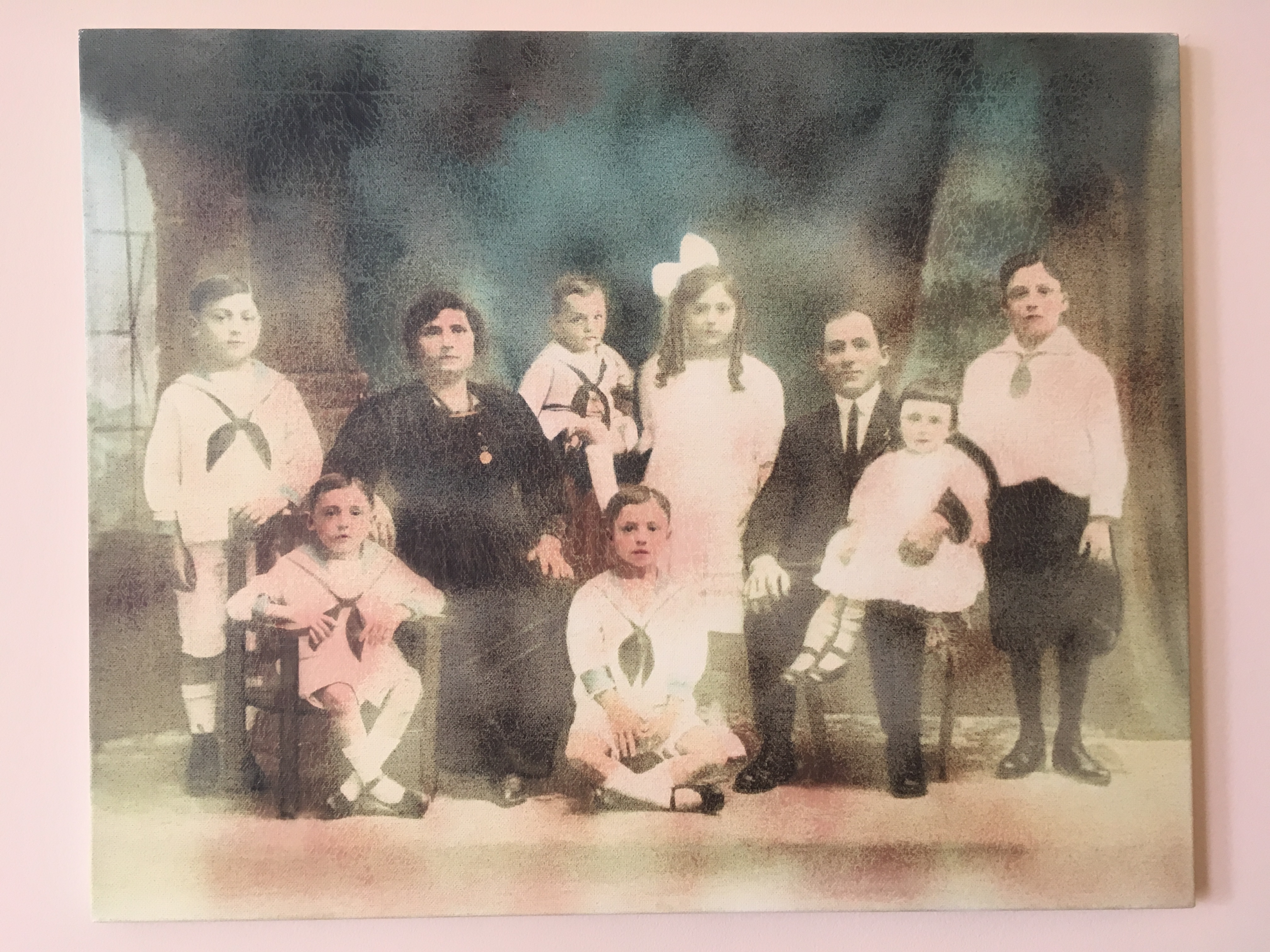
In 2014, after nearly eighty-five years of living in the same apartment building in the Bronx, Auntie Dot moved to an assisted living facility in Westchester County, New York. While I was helping remove furniture from Auntie’s apartment, I noticed behind one of the couches a partially torn canvas with a faded photograph of my family from two generations ago. Presented in Figure 1 is the restored canvas and photograph of my family from nearly one hundred years ago. In all my visits to Auntie Dot’s apartment as a child, I had never seen this family photograph, and after showing my other family members, no one else recognized it either. Auntie Dot, on the other hand, through a verbal description, knew immediately what I was talking about, and began telling me the story of how and why this photograph was taken.

Figure 1 – Family photograph from November of 1921

As I mentioned before, my great grandparents lived in a tenement apartment building in New York City where they could not afford clothing for all their children, forcing my great grandmother to hand sew all the sailor suites and dresses depicted in Figure 1, so the fact that they went to a professional photographer’s studio and paid, according to Auntie Dot, a significant amount of money is stunning. Upon conferring with Auntie Dot, I was told one of the primary reasons why this photograph was taken was because my great grandfather was terminally ill. In 1921, my great grandfather was diagnosed with a rare blood condition – Auntie Dot and my other relatives are not sure of the specific blood condition, unfortunately – which was not treatable at the time. This left my great grandfather with a time table ranging from six months to a year to live. Even though these photographs may have cost the family a lot of money, it was important to my great grandfather to memorialize himself in a family photograph so his children and future children could have an idea of who their father was as a person. In July of 1922, my great grandfather passed away; while Auntie Dot was three years old at the time, she does not have many memories of her father, so this photograph is a great way for her to keep a connection to her father.

Another key detail Auntie Dot mentioned, which adds an entire new dimension to the photograph’s story and early twentieth century photography, was the fact that my grandfather, the little plump child between my great grandmother and the young, curly haired girl (Aunt Marie), was not alive when this photograph was taken. According to Auntie Dot, this photograph was taken in November of 1921; my grandfather was not born until April of 1922. Originally, the photographer had placed a flower pot between my great grandmother and Aunt Marie, most likely to fill the small amount of negative space between the two ladies. Once my great grandfather died in the summer of 1922, my great grandmother decided to bring the photograph to another photographer to see if it were possible to superimpose a separate photograph of my grandfather into the family portrait, considering my grandfather had no photos together with his father. Attached below in Figure 2 is the original photo the photographer referenced to superimpose my grandfather into the family portrait. To this day, I find it remarkable how photographic technology from nearly one hundred years ago supported an early version of photoshop. While this family photo was not digitally enhanced, of course, it still shows how the fundamental concepts of manipulating photos existed at the early stages of the twentieth century.

Figure 2 – My grandfather (left) and Auntie Dot (right)

Regarding the mechanics of the photograph, Auntie Dot made an interesting observation on how the photographer posed her mother, my great grandmother. While I did not know my great grandmother – she passed away in 1969 – Auntie Dot and other older relatives always tell me that she was the most loving and thoughtful woman they knew. In this photograph, however, my great grandmother appears to be very stern, a person you would probably not want to engage with in a conversation if you were in trouble. I am not sure if this was a compositional technique employed by photographers in the early twentieth century, portraying the matriarch of the household as a strong, resourceful, and authoritative figure, but based on my relative’s accounts of my great grandmother, this photograph does not accurately represent who she was as a person.

I found this assignment to be rewarding. I have never had the opportunity in another academic setting to discuss this family photograph in detail.  While other people may view this as a basic photograph of an immigrant family from the early twentieth century, there is much more buried underneath the cloth of the canvas and ink of the photograph. Considering this is the only photograph in existence of all my family members, I place a significant amount of value on this photograph. I hope to pass this photograph down to my children down one day and explain to them the incredible story behind this family portrait.

Nunley’s Carousel

After writing my blog post on the brass ring from the carousel I decided I wanted to get more into detail about where this carousel has been and how much it has traveled. While I was home this weekend I decided to go to Nunley’s Carousel and ask my boss about the details behind the ring machine and carousel which have always traveled together.

The ring machine, the rings and its accompanying carousel were created by the Artistic Carrousel Company in Brooklyn, New York under the ownership of Stein and Goldstein, German immigrants in 1912. The ring machine and carousel first saw operation in Golden City Park in Canarsie, Brooklyn.

Following a devastating fire in 1912 to the center of the park. The carousel building was built in the center of the park next to the roller coaster where the fire had destroyed the previous rides. This carousel was in continual operation until 1939. At that point Robert Moses devised an extensive plans of roads and parks, one of which, the belt parkway was designed to run right through Golden City Park. The park closed in 1939 for the construction of the Belt Parkway.

Nunley’s Carousel when located in Baldwin, NY

William Nunley brought his beloved carousel east to Long Island. He traveled down sunrise highway looking for a new home to start a small amusement park. He settled on a strip of land in Baldwin, opposite the Long Island Rail Road. There he opened a park, he erected a building he dismantled and took from golden city park that housed a different carousel. This carousel he brought to the 1939 World’s Fair in NYC. He placed the 1912 carousel in this building and opened it to the public. The carousel became the centerpiece of a new park called Nunley’s Amusements. The park eventually changed hands and was run by three brothers known as the Larcari brothers. The brothers ran Nunley’s Amusements including the carousel which became known astorages “Nunley’s Carousel. In 1995 the brothers retired and put the carousel and other amusement rides on the auction block. Public outcry over the thought of the carousel being sold in piecemeal caused nassau county to condemn the carousel for the “greater good of the people.” This was a landmark decision since an amusement drive has never been condemned for this purpose.

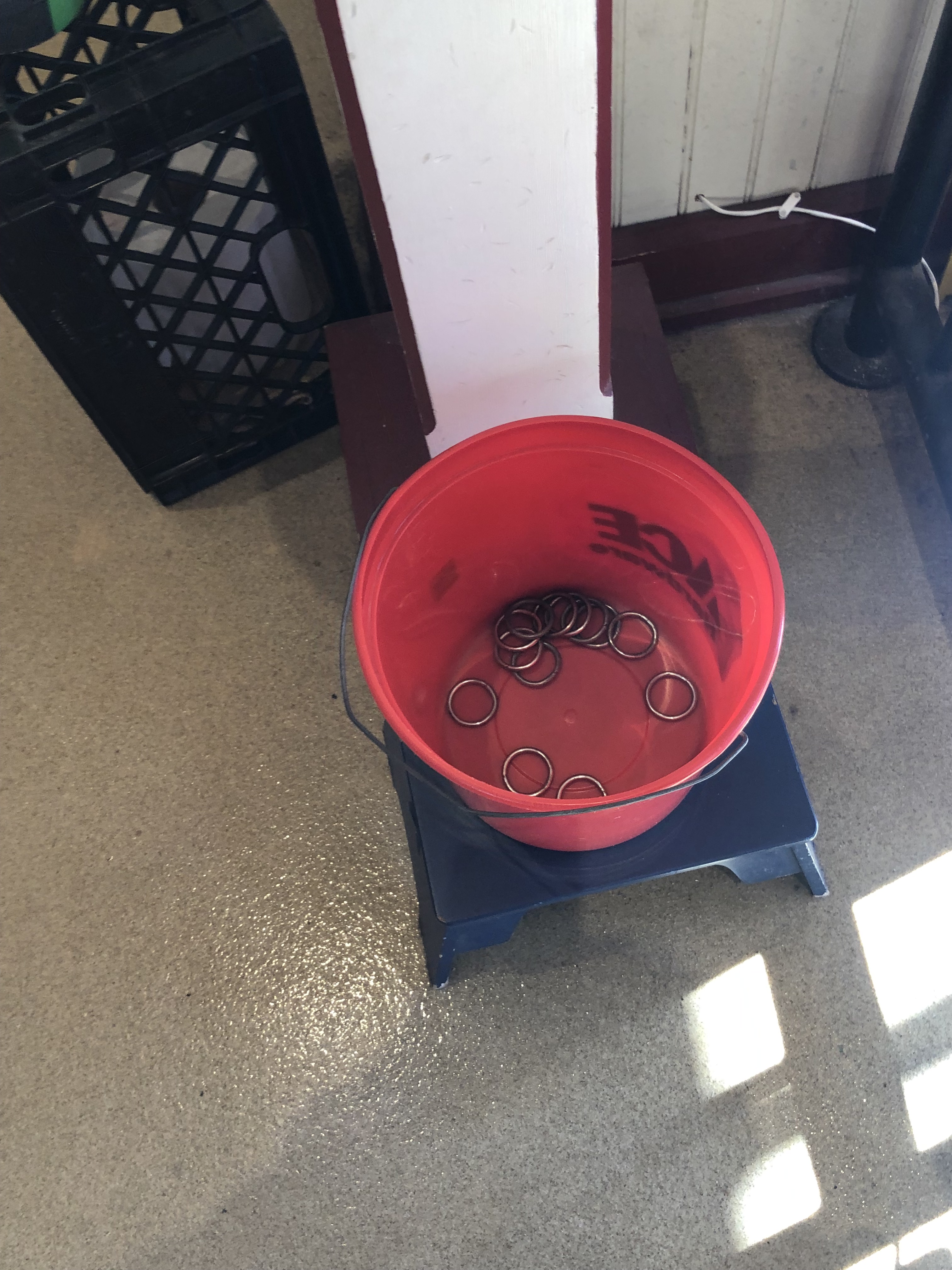
Rings still used today

The carousel was dismantled and stored in a hanger adjacent to the Cradle of Aviation Museum. It remained in storage in 2008 when Nassau County agreed to build a new building for the carousel and have it restored on Museum Row 100 feet from the storage facility. This restoration project was fueled by grassroots fundraising effort by a second grade student called “Pennies for Ponies.” In 2008 the dismantled carousel was loaded onto trucks for its journey to Mansfield, Ohio to Carousel Works, the only carousel restoration facility in America. Located directly behind the Mansfield State Penitentiary featured in the movie “Shawshank Redemption.”

Same Ring Machine since 1912

In 2009 the fully restored Carousel and ring machine returned to Long Island for its grand opening in May 2009. For the past 10 years rings such as mine have been loaded daily into the ring machine to the delight of tens of thousands of visitors. This 107 year old masterpiece continues to turn. Today, visitors still continue to grab the rings in hopes that they grab the coveted brass ring for a free carousel ride as visitors have done for the past century.

Hongbao

Lunar New Year is an annual holiday celebrated by my family. This year, it’s the Year of the Pig. It’s the one day that we can all come together and forget our differences. We eat at a round table surrounded on both sides by family. Dishes of authentic Chinese food are whisked out of the kitchen and onto the dining room table. There would be roasted duck, snails, squid, all sorts of seafood, noodles, vegetables and more. Sometimes our family has a hard time getting along but New Years is always the one holiday that we can gather and make up with one another. I don’t know what is in the air but we seem to be able to breathe easier, give and receive with open arms. The red envelopes are the children’s favorite part. It is still mine. Hongbao holds money and is added to our savings. When my siblings and I would open our hongbaos it would be like Christmas morning, the excitement to see how much we got this year.

Hongbao

Hongbao is a traditional gift given to family members during Lunar New Year. Lunar New Year lasts 15 days and it’s a celebration of family and friends. Hongbao is a red envelope that is eye-catching and colorful. The envelope is red and gold, which is reflective in the light. There are red flowers in the left upper corner and bottom right of the envelope. The golden characters in the middle come off the page and has texture, so it looks almost 3D. The hongbao is given out during New Years, birthdays, weddings or other celebrations. The surface of the hongbao is smooth and the flowers and vines have many details. Sometimes I trace the outline of the red flowers and the golden vines when I think about my family.

People putting Sacrificial offering food for pray to god and memorial to ancestor in Chinese New Year day at home on February 7, 2016 in Nonthaburi, Thailand.

Lunar New Year is celebrated differently in every household, but in mine, my mom always makes offerings to Buddha and our ancestors. She lays out all sorts of food such as hard boiled eggs, duck, chicken, fish, oranges, pork, and two candles with fifteen mini cups of wine. The wine symbolizes the 15 days of celebration. On top of every food item, there is a red, circular paper with a chinese character on it that symbolizes the offering. Then one by one, every family member must take two lighted candles and stand outside and pray to the Buddha. I always thank him for my parents, my education and my friends. I alway ask for a bright future full of happiness and full health. Then we burned fake paper money in a handmade fire pit. This fake paper money is called joss paper. The paper money can have red, gold or silver decorations. We must hold them in our palm while using our other hand (in a fist form) to spin the napkins in a spiral. My mom says that doing this gives the money some luck. Then we toss them into the fire pit as we bless our ancestors full health and prosperity in the afterlife. Lunar New Year is about starting the new year with a clean slate.

Joss Paper

One of my memories from Lunar New Year is when my mom almost burned the kitchen down because she decided to do the blessing indoors. It was windy and cold the week before Lunar New Year and my mom always does a blessing and offering the week before, the day of and every day after the New Year. I was doing homework that day upstairs and all of the sudden, the fire alarm in the house started blaring and I smelled smoke. I ran downstairs to the kitchen and I slide open our wooden door and a huge flame shot out of the doorway. I jumped back and my mom screamed for me to close the door and yelled at my brother to get some water. Eventually the flame was put out, but from that day on, we had a burned mark on the kitchen floor, which was made out of wood!

Bookmark From Spain

A bookmark may seem like an obsolete object in the grand scheme of life. You can place a multitude of objects inside a book in an effort to hold the page you’re on. This goes against my better judgement in saying this, so I hope no book lovers hold it against me, but realistically, you do not even need another object to hold your place in a book. You can just…fold the page…

Although I recognize this, I tend to prefer having a special designated object to hold the place of whichever book I am currently delving into. Folding the page only comes as a very last resort for me (and makes me feel guilty). This leads me to a new object I will be discussing this week. My favorite book mark.

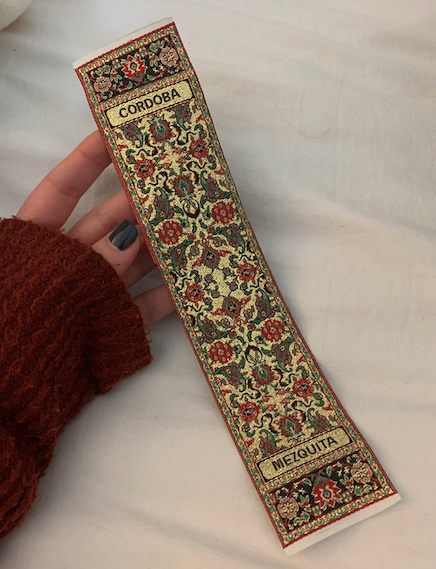
This bookmark measures approximately 8 inches long and 2 inches wide. It is so thin I do not have a ruler that can get me an accurate measurement, but it is about as thin as the edge of one of my finger nails. It is made of a material I am unsure of, some kind of textiles, embroidery floss or something similar. They are woven or sewn together very tightly on the front side, but when you flip it over to the back you can see all of the various colored strings. The pattern on the front is very ornate and intricate. On the top there is the word CORDOBA etched into a gold rectangle with black stitching. The word MEZQUITA is etched in the same fashion on the bottom. When this bookmark is in directly contact with the pages of a book it feels scratchy, it does not glide smoothy over the paper.

I was given this bookmark as a gift at the end of my senior year of high school. It was not a gift for any momentous occasion, it was extremely random – which happen to be my favorite kinds of gifts. During this time of my senior year with not much work to do, I was working on painting a large mural as a sort of legacy to leave behind in the school after I’d left. So, as I spent most of my days in the basement back corner stairwell painting away, my friend stopped by to visit. He, in one very swift motion, pulled two thin and upon first glance indistinguishable items out of his pocket and handed them to me.

Screen Shot 2019-02-15 at 12.40.25 PM.png

My Bookmark

Screen Shot 2019-02-15 at 12.41.36 PM.png

Backside of Bookmark


At first, I was perplexed, he hadn’t given me a gift before. I believe I stared at him in confusion- asking without asking for clarification. He then went on to tell me he bought these for me two years prior on a trip he took to Spain. He and I were very close when he took that trip, I missed him greatly while he was gone. Though, our relationship became increasingly complex between the time he went to Spain and the time he gave me this gift.

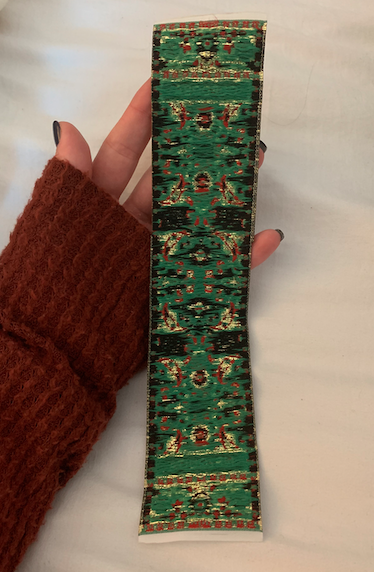
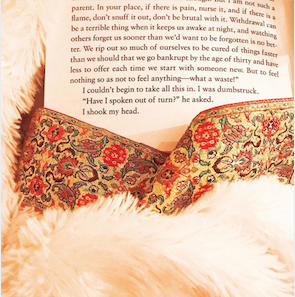
He gave me two bookmarks, though I am now only talking about one. This bookmark means a lot to me and has now been in my possession for around four years or so. It has lined the pages of some of my favorite books and has served as a constant reminder of how small gestures can serve as the ones that are the most meaningful.

Screen Shot 2019-02-15 at 12.46.55 PM.png

Lining one of my favorite passages from Call Me By Your Name by Andre Aciman

Prior to my owning of this bookmark, my friend owned them for two years. I believe they likely became objects that blended into his bedroom going unnoticed for awhile. He claims he was too awkward to give them to me, so I imagine from time to time he looked at them and considered giving them to me and then decided against it.

I had never inquired in depth about where he purchased the bookmarks, until now. These bookmarks originated in the south of Spain at the Mosque of Córdoba, also known as the Great Mosque of Córdoba and the Mezquita.


image.png

Mosque of Córdoba

This mosque is located in the Spanish region of Andalusia. Looking this Mosque up online, it is breathtakingly beautiful. The architecture is unlike anything I’ve ever seen. It makes me wish I was there too, so many years ago to experience this incredible structure with all of my senses. Although this mosque has a deep religious history, I do not think it necessarily pertains much to my bookmark, it was just a souvenir. Perhaps if my object were of a more religious nature delving into the history here would be worth considering, in this case although, I do not think it is overwhelmingly relevant.


image

Another Look

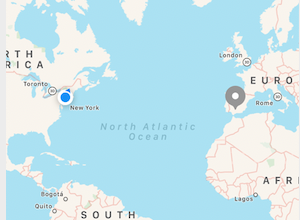
I don’t often consider where my objects have originated, even when I bring home souvenirs from other places around the world. I tend to forget how far they have traveled or where they originated until I am asked about them. However, it is remarkable to consider that this object made its way across the Atlantic Ocean, through various airports, spent two years on Long Island and is now currently residing in New Paltz, New York.

Screen Shot 2019-02-15 at 12.42.38 PM.png

The Original Distance Traveled

It was refreshing to delve deeper into this object I’ve had in my possession for so many years and discover not only where it has came from but also where it has been. I can only wonder where else it will go in its lifetime.


More than a decoration.

How someone chooses to decorate their rooms can tell you a lot about that person. Are they neat? Is their bed made? Is there anything on their walls?Wall decor is important because it usually takes some effort to mount, and will most likely always be in view. One specific wall decoration that has graced the walls of teenagers for decades, is the poster.

Posters are usually quite large, and can depict anything from your favorite musician to your favorite piece of artwork. They are something that you use to define your space, objects that you are okay with looking at every day. I have gone through several posters throughout my life, and I have recycled the same ones for most of my time living in New Paltz. Posters serve the function of decoration, but can also induce reflection.

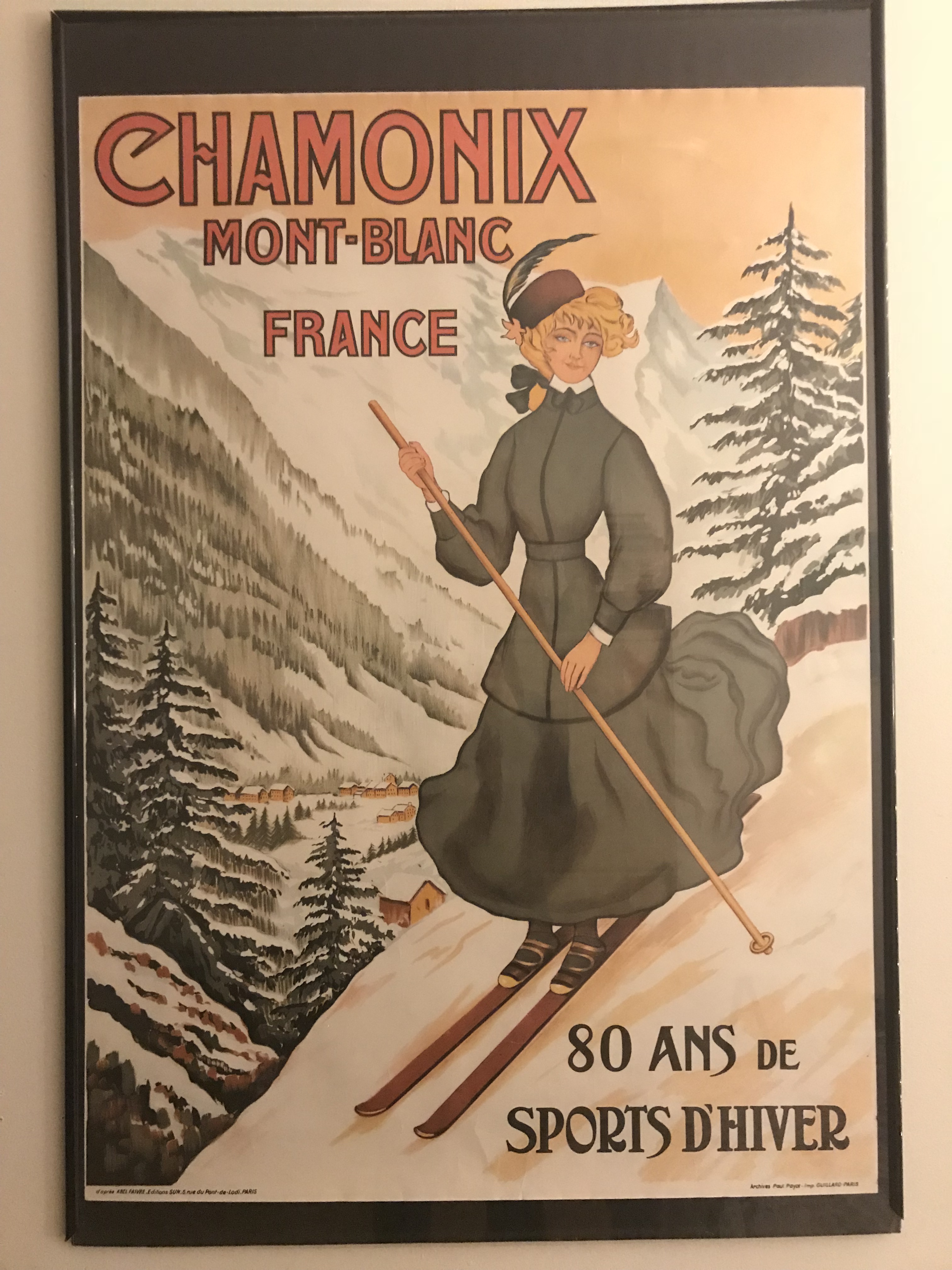
I’m choosing to reflect upon this specific poster, one that used to hang on my wall at my parent’s house but is now here with me in New Paltz. It belonged to my mother, and was purchased in 1984 during a ski trip she took with her brother in Chamonix, France. She was supposed to go with a friend who ended up getting sick, resulting in her brother needing to somehow obtain a passport in two weeks. Luckily, he worked for someone with connections in Washington who pulled a few strings. The poster had caught her eye in a shop window, and she purchased it right away.

My mother’s poster, now on my bedroom wall.

The poster was given to me in the frame pictured above, which may be the cheapest frame I’ve ever seen. It has four plastic caps for each edge, but they frequently slide off and fall on the floor. The poster somehow manages to stay secure despite the frame’s tendency to not do its job.

The style of the poster makes me think that it once functioned as an advertisement. The words at the bottom translate to “80 years of winter sports,” which seems like some sort of tagline that the ski mountain may have used. However, in the hands of my mother, this poster served as a souvenir or memento of a trip she took with her brother. It amazed me that she kept it long enough for it to end up on her youngest daughter’s bedroom wall. Interestingly enough, when she got back from France the poster stayed rolled up until she got married and moved to Rockland in 1987. Why didn’t she unroll it and mount it on her wall when she got back? For three years, was its function just to take up space? She told me that her apartment “was ugly and she didn’t want to put the pretty poster on the wall,” but wouldn’t the pretty poster make the ugly apartment a little more attractive? The poster has some wrinkles in it as proof of wear over time, yet the colors seem just as vibrant as they were in 1984.

For me, this poster is a wall decoration that is visually pleasing, and is an important piece of the puzzle in creating the ambiance of my space. Sometimes I forget that it ever belonged to my mother, but occasionally I do think about the trip she took to France with her brother all those years ago. Its function for me is decoration, with the occasional spark of reflection on the past.

1871 Edition Little Men

I have decided to continue pursuing the life of my first edition copy of Little Men. To understand the significance and history of this novel, I will first explain some of the context for its creation. As previously mentioned, this is the second novel in the Little Women trilogy written by Louisa May Alcott. The original classic, Little Women, was initially published as two separate editions in 1968 and 1969. These books exist on multiple levels due to the Roberts Brothers who not only published the titles but also pressured Alcott into writing them in the first place. The Roberts Brothers were initially bookbinders starting in 1857 in Boston, Massachusetts, consisting of Austin Roberts, John Roberts, and Lewis Roberts, but soon became listed only under the names Lewis Roberts and Thomas Niles. Niles became involved with the firm five years before the publishing of Little Women. It was Thomas Niles who approached one of his writers, Louisa May Alcott, to give rest to her original short stories write a novel for young girls. She was not interested in this type of writing as she did not value the stereotypes and expectations placed on women, though she attempted it and end up being a hit when shown to young girls. This was due to its somewhat negative grappling with issues girls often faced such as individuality, family pressures, and domesticity–while still being charming and idealistic. Therefore, the Roberts Brothers printed 2,000 each of these first two volumes of the future classic, Little Women.

When it comes to this edition I own, it had a very similar origin. Alcott was shocked with the success of the first novel and so she was asked to write a second, to please the readers waiting to hear of the fates of the relatable characters. Due to its demand, there were 10,000 copies released in its first printing in 1871. All were clothbound with color choices in terra cotta, red, and green. As I have hopefully explained in these first two paragraphs, this book was most definitely intended to be read. However, we must consider who was intended to read this novel. As printed in the book, this novel and others written by Alcott were listed at $1.50 each. I knew this price was not at all accurate to what we now value $1.50, but I was surprised to find that this would be equivalent to about $30 today. Though its expense surprised me–even with its detailed cloth and gold embossed binding–I also know that books in the late nineteenth century were still a symbol of status, wealth, and education. Therefore, I would assume that a book such as this would have been bought for a young, educated girl in a financially stable family. I would also guess that most of the initial readers of this book lived in New England, both because this is where it is set and published, but also due to the beliefs expressed in the novel about the disgrace of slavery and racism through its discussion of the Civil War.

While I do not know of the specifics about the extended chain of ownership before I acquired this book, I do know that I found this in an antique store or old book shop in New England. And, although this book was intended to be read, I know based on where it was found and its condition that this use has changed over time as it often does with old books, especially classics. In considering the condition of this book, especially in comparing it to other later editions of the same publisher I have in my collection, I would say this book was not read often. Most of the wear is located on the outer edges of the binding, from its contact with other objects and people. However, the inner binding itself and the pages are in some of the best conditions I own, which makes me believe that someone realized early on the significance of it being a first edition. Most likely this book has spent most of its 150 year life on a shelf with other books of similar value or condition in someone’s collection–perhaps someone who has not even read the title. This is what makes it interesting that it found its way to a crowded shelf of an antique store where its monetary or cultural value was not known. Today, a book from this printing can be worth somewhere in the realm of 300 to 500 dollars. However, I believe its chain of ownership will have an extended stop with me.