For this post, I have chosen to discuss an elephant figurine that I have been in possession of for about two years now. Given to me as a gift, it holds great sentimental value to me. It is also part of my ever-expanding collection of elephants, a hobby I have kept up since I was in early elementary school.
As pictured below, the elephant is approximately 5 inches wide and 4 inches tall. The material it is made out of is wood, and when touching it you can tell it was hand carved and still has a bit of a rough exterior. The wood displays many curved lines in it that give it an authentic and natural look. I like this about the object because, being that it is an elephant, I appreciate the fact that it was carved out of a natural substance. Also as shown in the following images, it has a few chips and scratches on it. One of the ears has been chipped, and the result is a jagged wooden edge. Personally, I don’t mind this. I feel that it gives the object more character.
I feel as though this an object that can span across many cultures, as well as time periods, and hold the same meaning. Animal figurines have been used for thousands of years all across the world. To many cultures, they were used for good luck and to ward off any unwanted negative presences. In Indian culture, Buddhism in particular, elephants have been known to symbolize power, wisdom, and good luck. Many believers often collected elephant figurines to place in their household to protect it. There is an ancient superstition that by facing the elephant so that its trunk faces the front door, it will prevent any bad from entering.


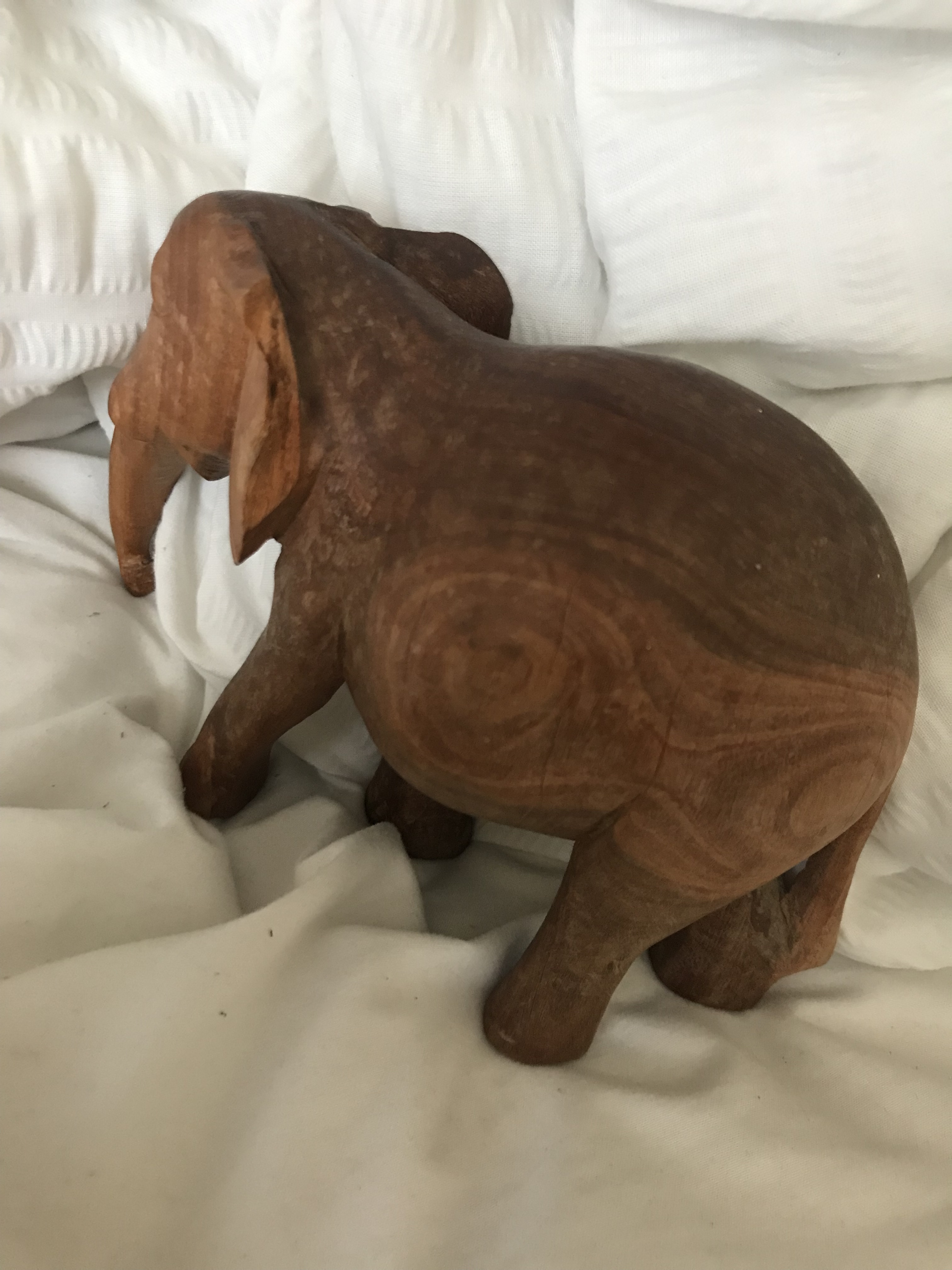

Inspecting my object further, I am interested to know how old it is–and not just the figurine itself. I want to know how old the wood from which it is carved from is. Somewhere, at some time, this little elephant was part of a tree. That tree could’ve been local, or it can be halfway across the world. Being that my friends found it in an antique shop, I am led to believe that it is quite old. I wonder if someone had it before me, and if it held the same meaning to them as it does to me. Were they merely a collector, finding joy in having multiple elephants around their home? Or were they a Buddhist, using this little elephant for religious purposes, warding off bad spirits and hoping to bring prosperity into their home? Regardless, as touched upon in the assigned article, “Material Culture/Objects: Where is it now and how did it get there?” I am led to believe that my particular object has held a similar meaning to all prior owners. In the beginning, the article discusses how many cultures wouldn’t understand some of the household objects I am currently surrounded by, such as a toaster or a Keurig. However, this elephant figurine holds a fairly simple meaning across all time periods and cultures.
Studying my object so closely has made me incredibly curious about where it came from. I doubt I would be able to trace it back to its roots, but it still something that is interesting to dwell on. It raises questions such as who made it, how many people have been gifted this, and will I someday pass it down to a similar antique shop as the one it came to me from? Furthermore, it makes me ask the same questions about my collection as a whole. I have elephant figurines made up of all kinds of mediums: glass, aluminum, clay, etc. I wonder if those elephants have long histories as well, and if the prior owners (if there are any) felt the same about them as I do.















 The Materials of History, Thought, and Art