Learning about Where I Do My Learning

Object Description

My object is van den Berg Hall.  As a business major, most of my classes are in this building, as it is the current home to the School of Business.  The van den Berg Learning Center is located in the northwestern corner of the SUNY New Paltz campus.  It shares a border with Plattekill Ave. and is directly adjacent to Hasbrouck Park.  The exterior of the building is made largely of brick, along with a metal roof to prevent fire damage (more on that later).  The building itself has a vast area of 67,700 square feet.  While ground was originally broken for the building in 1930, multiple renovations have been made to the building.  Most intensively, these include the replacement of the original clock tower and large technological infusion that occurred in the mid-2000s.

Van_den_Berg_Hall_-_SUNY_New_Paltz

A photo of the front of van den Berg Hall – the home of the School of Business

Vandenberg_2_930x470_72dpi

The contracting company’s photo of new van den Berg classrooms, there is a projector that can be turned on and off remotely or at the touch of a button.

Historical Context

The current home of the School of Business, van den Berg Hall, is the second oldest building on campus, only behind Old Main (1909). As many would know, the educational institution now known as SUNY New Paltz was founded in 1828. At the time, it existed as the New Paltz Charter School. In 1933, it became New Paltz Academy, and then in 1885, the New Paltz Normal School was founded. New Paltz Normal existed as a school and training program / facility for young professionals and high school graduates to learn to become teachers. The school’s principals may sound familiar; Eugene Bouton (1886-1889), Frank S. Capen (1889-1899), Myron T. Scudder (1899-1908), John C. Bliss (1908-1923), Lawrence H. van den Berg (1923-1942).
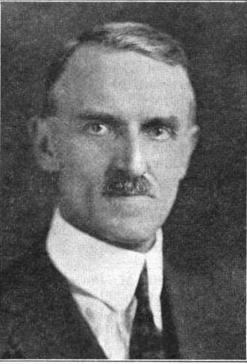
Screen Shot 2017-04-25 at 7.41.25 AM

Lawrence H. van den Berg circa 1923 – when he was appointed principal of New Paltz Normal

At varying times during the first 45 years of its existence, New Paltz Normal grew and expanded, but during the 1920s, there became a need for a new training facility. In 1929, Principal van den Berg approved the architectural design for a new school. As perhaps one of the most interesting events attached to this story, a ceremony was held for the breaking of ground on this new project in October of 1930. The speaker at this event was Governor Franklin D. Roosevelt (who actually had trouble getting in as the crowd was so large in size). In 1932, this new school opened its doors, and in May of 1934, it officially became the Lawrence H. van den Berg School of Practice. The program offered slowly began to evolve as the improvements to the training process were implemented, and students began attending classes at the New Paltz State Teachers College. This new entity was founded in 1942, and van den Berg was the first president. Six years later, New Paltz was one of the founding members of the SUNY system. This new program served as a school for students ranging from Nursery school ages all the way through eighth grade. In 1982, the van den Berg school closed its doors to students, as the final graduation was held that June.
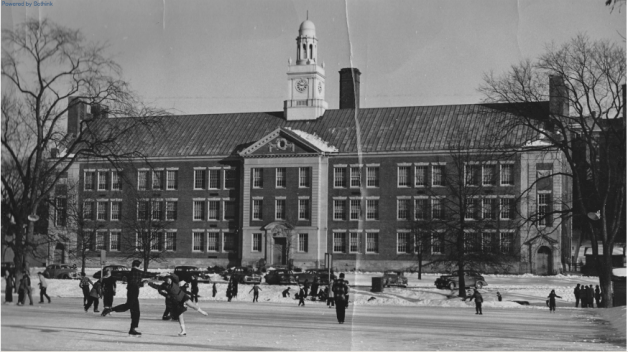
Screen Shot 2017-04-28 at 8.13.00 AM

An old photo of the van den Berg School of Practice, featuring a view of Hasbrouck Park, where children are ice skating… Not something seen there anymore
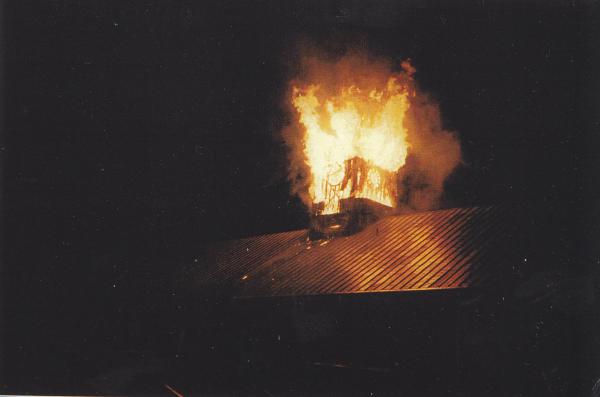
vdb_1990

The 1990 Clock Tower Fire

vdb_2005

Installation of the new clock tower in 2005


Narrative

After the van den Berg Learning Center closed in 1982, the building served as the home for the Children’s Center.  In 1987, SUNY New Paltz created an accounting program, effectively laying the framework for what would later become the School of Business.  One would speculate that given my father’s personal experience in van den Berg as a student from 1988-89, that van den Berg housed this program.  In 1990, van den Berg Hall became an academic building under the umbrella of SUNY New Paltz, housing the School of Business. In May of 1990, there was a fire in the clock tower that caused damage in the building, but this was limited due to the fire retardant nature of the metal roof of the building. It is important to note that in the history of SUNY New Paltz (dating back to 1828), the primary building housing its programs had experienced severe fire damage, so it is likely the metal roof was planned as a precautionary measure to avoid a third occurrence. The new clock tower was installed in 2005.


Impact on New Paltz

There is a clear impact van den Berg Hall has on New Paltz, as it is an academic building on campus.  The building served as the home of the school prior to the founding of the SUNY system, so it gave New Paltz a platform to be a site for a public entity of the state when the system was established in 1948.  Now, van den Berg Hall houses the School of Business, which is why I’m here… So if nothing else, it is largely responsible for this blog post.  The SUNY New Paltz campus leans on an integration of its history and the future to create a strong academic environment.  When the van den Berg Learning Center closed, the education program shifted into Old Main, where it remains today.  At the time, the institution was named the State University College of Education at New Paltz, its name did not change until the academic programs became more diverse, officially changing to the State University of New York at New Paltz in 1994.  Since re-establishing van den Berg as a member of the campus, SUNY New Paltz has grown to encapture the spirit of New Paltz Academy and the Normal School; all of the dormitory buildings are named after former school presidents.  SUNY New Paltz is stronger than ever, creating more academic buildings and a firm place in the SUNY system, as one of the top schools in the state.  Integration of van den Berg Hall back into the SUNY New Paltz family was one of many steps that allowed the school to strengthen its reputation in the last 25 years.  Now, the institution is nearly 190 years old, and some of its richest history has occurred in, thanks to, or because of van den Berg Hall and its place in the New Paltz community.


Works Cited

Mid-Hudson Library System. Campus School programs : annual commencement programs, International Night programs, music concert programs, Children’s atre Workshop programs, also various brochures, newsletters and miscellaneous material from events held by the Campus School.n.d.: n. pag. Print.

“College History Collection – SUNY New Paltz Timeline .” Sojourner Truth Library. SUNY New Paltz, n.d. Web. 01 May 2017.

“History of the Campus.” SUNY New Paltz. N.p., n.d. Web. 26 Apr. 2017.

“New York State Education.” Google Books. N.p., n.d. Web. 26 Apr. 2017.

“Rehabilitation of van den Berg Learning Center.” SUNY New Paltz. N.p., n.d. Web. 01 May 2017.

Simons, Joshua. “Historic Preservation Commission.” Van den Berg. N.p., n.d. Web. 26 Apr. 2017.


Tools of a Trade

img_4524.jpg

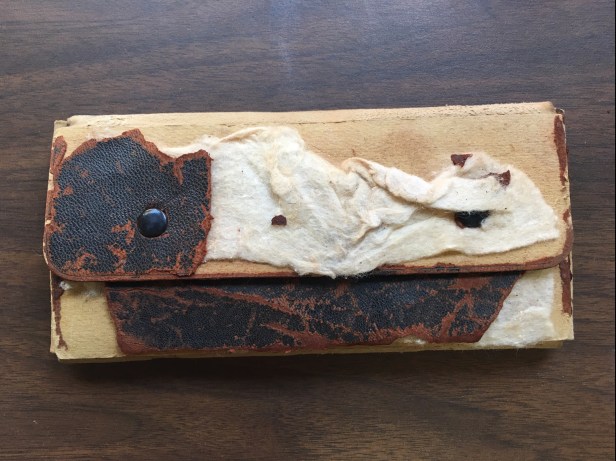
There is much to this object at first glance: the tattered case, the various tools within, the licenses approaching a century of existence; this set of tools speaks on behalf of a dying art, an art that has enabled feats of engineering inconceivable for us to live without.

img_4528.jpg


Battered and torn, decrepit and worn, the old brownishcase sat among three similar objects on the table of the Research Library at Historic Huguenot Street. Immediately I took an interest in it above the others; there was something about this one. A greater amount of associated information, of course, was notable to me, and certainly played a role in my selection of the object; but there was something else, something I couldn’t ascribe to a single feature—the whole pulled me more than any of its parts. It was just begging to be chosen. The other objects that the lady working there had retrieved for me were fine, but only this one intrigued me. So completely and utterly worn – and not just from age, either; it was clear that this wear was from decades of use – it almost felt as if this tool set was so incredibly accustomed to being employed in all sorts of endeavors that it longed to be touched, inspected, handled, used in some way, any way; even if only for a minute before being returned to the dark, solemn archive that must offer it such an uneventful subsistence.

Slowly and carefully, the lady assisting me folded back the flaps of the case, revealing the century old instruments within. There was no rigidity at all; not in the least. The flaps had been opened and closed so many times that they fell along their folds as if they were paper—folded back and forth along a crease so many times that separation seemed imminent. Written in thick black ink on the bottom right of the inner case that holds the tools is a name, “H. Keator,” a place, “Kingston N.Y.,” and a year, “1908.”

But we are ahead of ourselves. What is this thing? —this “tool set,” as I’ve called it.

Before the widespread availability of computer simulation services and computer aided design in general, it was necessary that professional engineers and land surveyors master the process of drafting. This now nearly extinct practice is patently artistic, requiring an array of different tools, all tailored to specific purposes, as well as a high degree of patience, dexterity, and a well-developed capacity for mental imaging. The instruments required in order to draft successfully are organized into drafting sets, and the object of this research is, indeed, one of these sets. This particular set contains space for ten tools, one of which is missing: from the shape of its space, the missing tool seems to be a smaller version of the one directly below it. The set is comprised of several sizes and varieties of compass, used to make circles and certain other shapes; as well as a few dividers, used primarily to segment lines. Also in the kit is a small metal container of Red Top Eversharp pencil leads.

In theory, this drafting set could have been used by anyone for just about any purpose requiring clean, exact drawings or schematics; the set itself is not enough to tell us about its history. Luckily for us, however, the set contains a few research leads. Firstly, and most significantly, inside of the case there are two licenses: one is stapled to the right hand flap, the other is free. The licenses, pictured below, certify one Harold E. Keator as a professional engineer and land surveyor for the years 1926 and 1935, respectively. The licenses and the inscription are enough to deduce that Harold E. Keator was the owner of this drafting set; perhaps the man can give us some hints about the history of the object.

IMG_4525

Research indicates that Mr. Keator was born around the year 1888 and lived in Kingston, New York. He had a wife, Adelaide, and a son, Harold E. Keator Jr. (Ancestry, 1940 Census). An attendance report from the 1912 meeting of the Society of Automobile Engineers at Madison Square Garden lists Keator’s name, followed by “Draftsman, Wyckoff, Church & Partridge, Kingston, N.Y.” (SAE Transactions). Wyckoff, Church & Partridge was a New York City based automobile company that took over the W. A. Wood Automobile Company in Kingston in early 1911 (W. C. & P. Reorganizing without Stearns). Being a resident of Kingston, it is likely that Keator worked at the Wood manufacturing plant, as opposed to at W. C. & P. itself.

Further research revealed much more about Keator. I was able to uncover a grayscale PDF of the Wednesday, March 23, 1960 issue of the Kingston Daily Freeman, which contains the obituary of Harold E. Keator Sr. of Lake Katrine, NY. According to this obituary, Keator – or “Knobby,” as he was apparently called – died on 3/23/1960 after being ill for a short while. Further information about his family is included: his mother’s name was Carrie, his father’s, Edgar; and his son, Harold Jr., had two daughters, Christine and Kathleen. Most relevantly, the obituary confirms that the Harold E. Keator in question was, indeed, a professional engineer, and that he retired from the New York Central Railroad sometime during 1953—for me, this statement removes any doubt of this being the same Harold Keator who owned the drafting set. Keator was also very active in his community: he was a member of the Kingston Kiwanis, several rod and gun clubs, as well as the Ulster County Chapter of the New York State Society of Professional Engineers (Local Death Record).

Though the obituary confirms that Harold Keator was a professional engineer employed with the New York Central Railroad, the story may go a little deeper. The New York Central Railroad was a massive railroad conglomerate, buying dozens of smaller rail systems and individual railways and incorporating them under the NYCR umbrella. Indeed, one of the rail systems purchased by New York Central was the West Shore Railroad, in 1884, which, under its umbrella, controlled the Wallkill Valley Railroad.

The Wallkill Valley Railroad was operational from 1866 to 1977. It ran from Kingston, through New Paltz, and down to Montgomery (Wikipedia). Though currently defunct, much of the railroad was converted to foot trails, the Rail Trail running through New Paltz being one of them.

Harold Keator was born over a hundred and thirty years ago and was not famous, so it is difficult to reliably determine the course of his professional career. So, based on the information obtained during the course of my research, I want to speculate on what I feel to be the most likely trajectory of the professional life of Harold Keator, and, thus, the working life of this drafting set.

Recall that the date written on the set itself is 1908, when Keator was twenty years old. As a young man just starting out, it is conceivable that the drafting set was gifted to him by family or friends: perhaps he had just gotten the job working at the Wood automobile plant, which we are reasonably sure that he was working at only four years later. It is likely that, as a draftsman for an automobile manufacturer, Keator would have used his tools to draft designs of either cars themselves or of car components. I was unable to find any information bridging the gap between Keator’s years with Wyckoff, Church & Partridge and the beginning of his employment with New York Central, unfortunately; but, based on the date of the first license (1926), I am inclined to speculate that it was at least sometime during the 1920’s, perhaps the early 30’s. I suspect that he would have needed prior certification in order to begin working for New York Central, so I don’t think it was any earlier than that.

Now, as mentioned earlier, New York Central was gigantic, and thus to work for New York Central did not necessarily imply that you worked for any of its main branches or offices; indeed, as a resident of Kingston, it is highly probable that Keator, during his employment with NYCR, actually worked on the Wallkill Valley Railroad. If this is indeed the case, then the drafting set of my research may have been used for a variety of different purposes as Harold Keator worked to maintain and improve the Wallkill Valley Railroad, and he would have been doing so during the 1930’s, 40’s and 50’s, when the railway was bringing characters of all walks of life from New York City and elsewhere to and through the New Paltz/Kingston area, many of whom were likely vacationing to the Mohonk Mountain House.

It is fun to think of Mr. Keator toting this humble drafting set up and down the lengths of what is now our beloved Rail Trail; and though he is a stranger to me in time and in relation, I imagine him at work, perhaps reclined against the base of a tree alongside the tracks, his trusty drafting set opened up on a rock next to him as he sternly sketches the course of the track—perhaps it was a particularly rainy spring and the track must be slightly diverted around unstable ground. Absorbed in his drawing, he sets his compass down next to him in haste as he reaches to grab a more suitable tool before he loses the image in his head, and next thing he knows the one he set down has vanished, never to be seen again. Please excuse my wildly speculative narrative; obscurity invites invention.

Unfortunately, I was not able to obtain any information about the chain of ownership of this object: the documentation that I received from the Historic Huguenot Street staff did not indicate the donor, though I do know that it was received by HHS in 2013. I allow myself to speculate one last time, however, as it seems to me most likely that, after Keator’s passing, the set collected dust for half a century, eventually being donated by one of his children or grandchildren. Regardless of its journey from Keator to HHS, this object fascinates me, as do its connections to New Paltz and the surrounding area, vague as they may be; and together they demonstrate to me the importance of conducting research into the materials of history.

  1. SAE Transactions, Volume 7, Part 1. Vol. 7. New York, New York: Office of the Society of Automobile Engineers, 1912. Part 1.Google Books. Web. 21 Apr. 2017.
  2. “Harold Keator in the 1940 Census.”Ancestry. N.p., n.d. Web. 21 Apr. 2017.
  3. “W. C. & P. Reorganizing without Stearns.”The Automobile. Vol. 24. N.p.: n.p., 1911. 752-53.Google Books. Web. 3 May 2017.
  4. “Local Death Record.”The Kingston Daily Freeman 23 Mar. 1960: 10. Web. <http://fultonhistory.com/newspaper%2010/Kingston%20NY%20Daily%20Freeman/Kingston%20NY%20Daily%20Freeman%201960%20Grayscale/Kingston%20NY%20Daily%20Freeman%201960%20Grayscale%20-%201501.pdf&gt;.
  5. New York Central — Historical Information, Mohawk & Hudson Chapter, National Railway Historical Society. Ed. Ph.D. Steve Sconfienza. N.p., 10 May 2001. Web. 03 May 2017. <https://web.archive.org/web/20060717080407/http://www.crisny.org/not-for-profit/railroad/nyc_hist.htm#westshore&gt;.
  6. https://en.wikipedia.org/wiki/Wallkill_Valley_Railroad


Lincoln and His Family


image1

Lithograph on the wall in the office of the Deyo House

Description

This is a lithograph entitled “Lincoln and His Family”, which currently resides in the office of the Deyo House. It was made in 1866 by William Sartain and engraved from a painting of the same name by S.B Waugh. It shows Abraham Lincoln sitting at a table with his one arm around his youngest son, Thomas, and his other arm resting on the table. Thomas is sitting next to Lincoln with one leg and arm pushed back and his opposite leg lunged forward and other arm relaxed on his father’s leg. His oldest son, Robert is standing behind the table with his arm resting on an empty chair and other arm resting at his waist. Mary Lincoln, his wife, is sitting to the left of Lincoln and Thomas. Her right elbow is resting on the table and her hands are in her lap. They are all in elegant clothing; Lincoln in a suit, the boys in a nice shirt and pants, and Mary in a large gown. On the left wall, light is coming in through a window, which through the Capitol Dome can be seen. Next to the window is a bust of George Washington. On the center back wall is a portrait of William, Abraham and Mary’s son who died from Typhoid Fever during Abraham’s first term as president. On the table rests an elegant looking tablecloth and on top of it sits a vase of roses, magnolias, sweet clematis, and Virginia creeper (Lincoln Collection). This current print has been shifted in its frame and hides the engraving,  “Lincoln and His Family” on the bottom.

tumblr_inline_nz08881KzF1se3si9_540

Full image where the engraving “Lincoln and His Family” can be seen

Historical Context

This print is particularly interesting since it’s not based off any actual photo of the Lincoln family. There has never been a photo of the entire Lincoln family together. Mrs. Lincoln had taken a group photo with both William and Thomas and Lincoln has only had a picture with Thomas. After Lincoln’s death in 1865, many artists wanted to show they’re grievances by painting pictures of him and his family, yet since there was no full family photo, they had to combine multiple photos to form one. By doing this, they somewhat alter history, making Lincoln seem more like a family man than he really was. But romanticizing the “great” presidents like this wasn’t uncommon during the colonial revival period when this was made. They also idealized his looks; Lincoln was a bit rough around the edges looking and often was self-deprecating about his appearance. Yet after his death, painters created a more flattering image than reality, bringing more color into his skin and smoothing his complexion. (Holzer)

Understanding the context of the colonial revival movement is crucial in fully developing what this print means and why it was made. After the industrial revolution (1760-1840), American’s were overwhelmed by how complex the country had became. America, a once “simple land”, was now a world power filled with millionaires, factories, and new immigrants. The wealthy elites found nostalgia in the simple past, connecting it with democracy, moral superiority and patriotism. Through architecture and art the people of the time tried to re-create the past to reflect their feelings of discontent with the modern world. But most furniture or artworks created in this time were widely inaccurate. What was made was an idealized past where people tried to display middle class values in order to show their moral superiority. Artists then wanted to put those values onto the great presidents in order to make the connection that both the presidents and the middle class share the same morals. This is why both Lincoln and Washington are depicted with their family, when they were not historically family men (Connecticut History).

The Lithographer: William Sartain

While William Sartain himself may not have gone down in history as a famous artist, his surname has. Not only was his father a famous engraver, but his grandfather and uncle as well. The Sartain’s are known to be the greatest engravers of the time. William (1843-1924) was mainly a painter though. He held some resentment towards his father and didn’t want to necessarily follow in his engraving footsteps, yet he didn’t have the means to do so. He attended the Pennsylvania Academy of Fine Arts, and after gaining fame from making “Washington and His Family” in 1864, he was able to leave and study in Paris at the age of 25. The success he accomplished and the move to Paris allowed William to get away from his family connection to engravings and focus on what he truly loved which was painting. While his paintings were not loved by the public eye, critics revered his work and he influenced many young artists within Pennsylvania Academy of Fine Arts. His work transcended the realist painters of America and France, as he worked in the realm of romanticism. His paintings have been compared to the like of the infamous Decamp. (Ackerman)

Symbolism

There is also a lot of symbolism in this print that can go easily unnoticed. The George Washington bust is one that connects very well to the historical Colonial Revival time. The bust is meant to show the connection between the “father” of our country and “savior” of our country.  What is also interesting is that Sartain is known for another piece called “Washington and His family” which is seen as a companion piece to “Lincoln and His Family”.

03458r

Sartain’s “Washington and His Family”

The flowers on the table are also an important symbol. The roses in the bunch are meant to represent the north while the magnolias, sweet clematis, and Virginia creepers are flowers that grow in abundance in the south. The vase is meant to be the union of these flowers, therefore stating there should be peace between north and south (Lincoln Collection).

Since “Lincoln and His Family” is a print, many have been produced but it appears to be the most popular of the Lincoln family prints made during the time. There isn’t much record on the current value of each lithograph either. Yet Saunders in American Faces: A Cultural History of Portraiture and Identity, states that at the time made, it was worth $7.25 for a print and $20 for an artist proof.

Provenance/Narrative

The print’s connection to New Paltz is practically unknown since there were many copies of “Lincoln and His Family” made and there is no known donor of this specific print. Another print of “Lincoln and His Family” was donated to an organization in Osage and the family who donated it has said that it has been passed down in their family for generations. It’s not a stretch to say this specific print could have a similar background. To own a piece of art like such at this, one must have had a considerable amount of money. Therefore, one could hypothesize that this lithograph was handed down through generations of the Deyo family (if it’s placement in the house is historically accurate), since they were a wealthy family. It also makes sense of the time period of the mid 1800’s for wealthy people such as the Deyo’s to collect items that reflect the colonial revival movement.


Works Cited:

Ackerman, Gerald M. American orientalists. Paris: ACR, 1994. Google Scholar. Web. 4 May 2017.

CTHumanities. “Colonial Revival Movement Sought Stability during Time of Change.” ConnecticutHistoryorg. N.p., n.d. Web. 04 May 2017. <https://connecticuthistory.org/the-colonial-revival-movement-sought-stability-during-time-of-change/&gt;.

Holzer, Harold. “How the Printmakers Saw Lincoln: Not-So-Honest Portraits of ‘Honest Abe.’” Winterthur Portfolio, vol. 14, no. 2, 1979, pp. 143–170., http://www.jstor.org/stable/1180612.

Lincoln Financial Foundation Collection. “Lincoln and His Family.” Lincoln Collection. N.p., n.d. Web. 04 May 2017. <https://www.lincolncollection.org/search/results/item/?q=71.2009.081.1869&item=53980&gt;.

Saunders, Richard H. American faces: a cultural history of portraiture and identity. Hanover: U Press of New England, 2016. Google Scholar. Web. 4 May 2017.

Silas Hoadley Mantel Clock

This slideshow requires JavaScript.

(Mantel clock made in 1820 and manufactured by Silas Hoadley. Mantel clocks are clocks that can be placed on top of a shelf or mantel)

Physical Description of Object

The clock has a pillar and scroll shelf type design. This means that there are two pillars on the sides of the clock with scroll work on top. Scroll work is a form of art that includes spirals and rolling designs. The clock is veneered in mahogany. It also has a painted wood dial along with Roman numerals. The lower portion of the clock contains an image of a landscape with homes and trees. The glass containing the image is in eglomise decorations. According to Eglmosedesigns.com, eglomise is a French word that means “‘glass gilded,’ decorating glass by painting on the back or reverse side, sometimes gilding with gold or metal leaf.” The image is contained within a border designed with leaves referred to as foliate borders. The three brass finials on top of the clock are suspected to be unoriginal (Ashley). However, images on the web show the same brass finials on the same clocks as this one. There is also the chance that they were replaced. Movement on the clock is intact, but not in running order.

Provenance

This Silas Hoadley mantel clock was never owned or used by any of the families that resided in Huguenot Street. The clock was acquired through a donation from clock collectors that are New Paltz residents. Gloria and Jerome Gilman were the donors of this clock, and they believed that this clock would help fulfill time period interpretations that Huguenot Street creates. When the clock was acquired in 2015, it was used in the Lefevre House as a part of an interpretation of a Civil War doctor that lived in the house. After some time, the outer glass that covers the numerals of the clock was broken by an employee of Huguenot Street in a minor accident. Lucky enough, the glass was replaced with glass from the same time period as the clock was made.

This clock can be found lying on a table in the Deyo House collections storage. The clock is not currently being used as a part of a time period interpretation because the Lefevre House is under construction. For now, the clock has taken a place among many other objects that Huguenot Street has acquired over time. Like most objects, this mantel clocks lays there waiting for someone to inquire about it; someone like me. Even though the clock has no direct association with Huguenot Street, it still holds significance because, as we have come to learn in this course, objects carry their history with them wherever they go. Whether or not I find the history complete history of this clock, coming across it and piecing together the little information I have gathered makes it a rather fascinating find.

Narrative

This mantel clock was manufactured by Silas Hoadley in Connecticut. Silas Hoadley (1786-1870) was an American clockmaker born in Bethany, Connecticut. He formed a clock-making partnership in Plymouth, Connecticut with Eli Terry and Seth Thomas as Terry, Thomas & Hoadley. These three clock makers pioneered the mass-production of clocks using water driven machinery to tool parts. According to Encyclopedia Britannica, “Terry, Thomas, and Hoadley, after about a year of setting up the required machinery, produced some 4,000 clocks in the following two years.” Those “following two years” were after 1807.   The partners gradually withdrew to create their own firms – Terry in 1810, Thomas in 1814 – leaving Silas Hoadley as sole owner. Hoadley continued to make clocks until 1849. Standard references spell his name Hoadley; however, the “e” in his name is missing from the paper label on this clock.

There is not much information on Hoadley aside from Wikipedia, but there is ample information on his partners Eli Terry and Seth Thomas. In fact, on a bidding website the same mantel clock is listed as “Rare Seth Thomas Off-Center Pillar & Scroll Clock.” The clock was in a lot with other clocks and apparently sold for $2,091. Seth Thomas appears to be more of a pioneer (he has a town named after him called Thomaston) in clock making than Hoadley who is often only referred to as a partner or employee.

  • Interesting fact: A 1992 article on the Hartford Courant mentions are revival of the old Seth Thomas factory that still exists in Thomaston.

Even though Hoadley, Terry and Thomas were pioneers in clock making during the 19th century, they were not the first of their kind in the Connecticut region. Thomas Harland was also a pioneer in clock making after he emigrated to Connecticut from England. When Harland arrived in Connecticut, he established a shop in Norwich circa 1773 where he was “repairing watches and making clock movements with brass gears and finely engraved dials” (Muller). Furthermore, Harland hired a “number of apprentices working under him” one of them being Daniel Burnap (1759-1898). Burnap was also a clock maker who ended hiring apprentices of his own, Eli Terry being one of them. During Terry’s time as Burnap’s apprentice, he learned “the craft of making brass movements in small quantities using foot-powered machinery” (Muller). After Terry had set up his own clock shop his work attracted the attention of merchants, Edward and Levi Porter, “who in 1807 contracted with Terry to produce 4,000 tall-case wooden clock movements in three years” (Muller.) It was during this three-year contract that Terry hired Silas Hoadley and Seth Thomas.

What this object tells about Historic Huguenot Street is that this place is not just an isolated, glorified space that only focuses on the history of the Huguenots and their journey to New Paltz. This object has no connection to Huguenot Street but it has a connection to New Paltz. The donors of the mantel clock are New Paltz residents who collect antique clocks. Collaborating with Huguenot Street for this project goes to show the extent with which they go to make sure that their interpretation of the New Paltz Huguenots is as close to accurate and specific to the time periods as possible. Their collections also show are more interesting and fascinating aspect of collecting and museum culture at large.

From what we have learned through Ashley Trainor and Carrie Allmendinger, a lot of the objects and artifacts in Huguenot Street are not original pieces or did not belong to family members that made that street their home. Some of these objects are like the Silas Hoadley mantel clock; they help curators like Ashley and Carrie interpret time periods for the public but have no real connection to the Huguenots. The way that this clock found its home in Huguenot Street is fairly simple, but doing research about it and the owners has proven to be completely fascinating yet unsatisfactory. There are so many more questions I have, but unfortunately the lack of information on this clock makes it hard to piece everything together to create a fairytale-like narrative, as I would like.  However unsatisfactory and frustrating not finding enough information about this clock is, it teaches an important lesson in doing academic research and writing in general: sometimes what you have is all you need to create a beautiful and worthy narrative. This is not just a story about a clock or about Huguenot Street and New Paltz, it is also a story about entrepreneurship and the beginning of mass production as a result of the Industrial Revolution in America.


A Grave Matter

The tombstones that commemorate the remains entered in the Huguenot Cemetery give off an undeniable first impression of eeriness and melancholy. The humble markers are cracked and crumbling, and one might fear that simply breathing on a stone would turn it to dust. Some of the stones are over 200 years old, and the passing of time as well as the elements brought with it have obviously taken their toll on the cemetery.

Lineages can be traced through the cemetery quite easily, as families were often buried in plots close to one another. The family that is the focus of this project is the Eltings, one of the families with the oldest stones and who have a plethora of archival documents detailing their family history. Yet, as one looks through the archives on Huguenot Street, it becomes clear that much has been muddled by time, for there are confusing gaps in generations within the cemetery that are not quite clear. Nonetheless, the presence of the Eltings in the cemetery began with the burial of Noah Elting, who was entered at the Huguenot Cemetery after his death in 1725. Providing a comprehensive family history through tombstones proved to be an interesting venture, and it provided a lot of insight into the burial practices of the Huguenots and how that exemplified their relationship with material culture.  

Physical description:

Depending on the time of burial, the tombstones are constructed of either sandstone or marble. Sandstone headstones are what the older tombstones in the cemetery are made of and they are most identifiable by their simple engravings, usually only including a name and the deceased’s age and date of death. They vary in height, but most are either about two feet tall. Marble headstones are usually gray in pallor, and they are smooth to the touch–almost too smooth, for their ability to be preserved is minimal due to their lack of durability when it comes to their contact with rainwater. All of the Elting tombstones are plotted close to one another, lining the short stone wall that borders the sidewalk on Huguenot Street.

Jacomentje

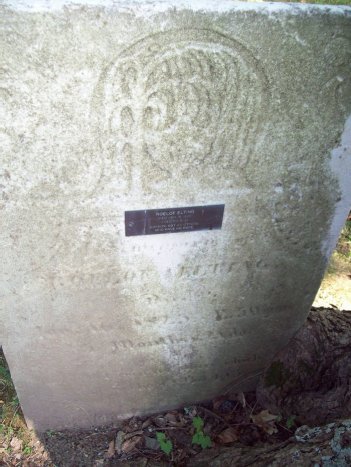
The tombstone of Noah Elting and his wife Jacomentje is made of sandstone, with a humble inscription that reads: “Noah Elting, Esq. Died Sept. 27, 1773, Aged 57. Jacomentje, His Spouse Died August 27 1790, Aged 75.” There is a tiny brass plaque with this inscription affixed to the withered tombstone due to the natural decay of the stone in order to ensure that visitors can distinguish who is buried where, for “In an effort to preserve the names of those buried, brass plates were fixed to the stones in the late 1960s by the Huguenot Historical Society” (Schenkman).

roelof josiah


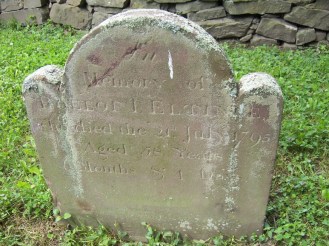
The following Elting to be buried in the cemetery was Roeloff Josiah Elting. His tombstone is made of sandstone and stands about two feet tall. The inscription on it reads: “In Memory of Roeloff I. Elting. He died the 21st July 1795. Aged 56 years, 6 months and 4 days.”

8039541_125764549507


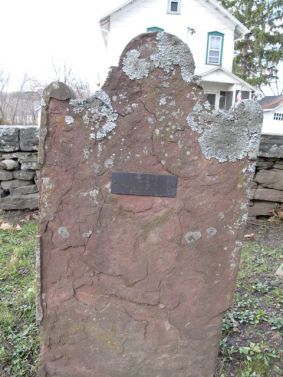
The tombstone of his wife, Mary Lowe Elting, is plotted right near his. It is also made of sandstone, topped with a bell curve design. The inscription, only legible via the brass plaque affixed to the stone, reads: “Wife of R.J. Elting. Died August 24, 1800. Aged 48 years, 7 days.” Mary’s tombstone is pleasantly tall and sleek compared to some of the others in the cemetery.


josiah rev war

The next stone feels a bit out of place in the cemetery, that of Josiah Elting. It is a stout stone, made of marble and only about five inches thick. It is incredibly legible, reading: “Josiah Eltinge, 1760–1813. Rev. War.” I hypothesize that the distinguished craft work of this stone is indicative of a more Americanized burial practice associated with veterans at the time, which is interesting considering that the Huguenots are stereotyped as being as Calvinistic as they get, when in reality this stone is one of the least decorative of the Elting’s headstones.

hester broadhead elting


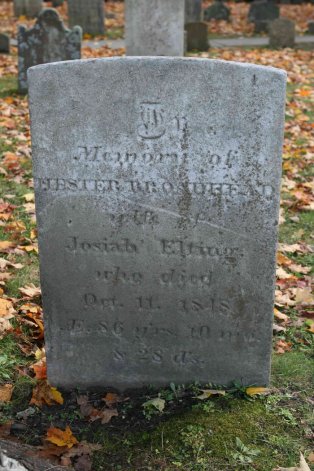
Josiah’s wife, Hester Broadhead Elting, has a lovely marble stone that stands about three feet tall. It is very plain but strikingly elegant, it’s simple geometric shape and faded inscription adds distinct Victorian panache. The stone reads: “In Loving Memory of Hester Broadhead. Wife of Josiah Elting Who Died on Oct. 11th 1848. Age 86 years, 10 months and 28 days.”


roelof fatherWhile I kept the stones of Josiah and Hester together, the rest of the headstones described were all erected decades before Hester’s death. The first of these stones was that of Roelof Elting, whose marble headstone stands about three feet tall and features some fascinating motifs. The face of the stone features a prominent carving of what could be a weeping willow tree. Below this decorative carving is the inscription: “Roelof Elting. Died Jan. 18 1825. Aged 50 years, 5 months and 21 days. Sorrow Not As Others Who Have No Hope.” This is the first and only time a quote appears on a Elting stone, making it an especially beautiful yet melancholy stone on display.

ann elting


Roelof’s wife, Dinah Elting, however, is not entered in this cemetery. She “…died March 02, 1819 in Kingston (Ulster Co.), New York” (Elting). However, two of Roelof’s children were buried in this cemetery. The first was Ann Elting, whose simple marble stone stands about two feet tall. It reads: “Daughter of Roelof & Dina Elting. Died March 2nd, 1813. Aged 5 months, 15 days.”


elting tree


Her brother’s tombstone is probably the most peculiar in the entire cemetery, for it is only about 10 inches tall and is partially grown into a tree. The size of the stone probably has much to do with his premature departure from this earth, for his tombstone reads: “Roelof Elting, Son of Dinah Elting. Died Feb. 2, 1825. Aged 11 days.” The metaphor is almost too easy to make; the necessity of death in order to create life, a kind of ouroboros that is implicit in the natural world.


Historical Narrative: 

The persecution of the Huguenots in France and their subsequent migration to America had much to do with their heterodoxy in relation to their burial practices. Huguenots often shared cemeteries with Catholics, which actually made cemeteries a site of immense religious tension during these times. The sharing of cemeteries, then, was not born out of an attempt to unify but rather due to the fact that provincial towns could not afford the construction of more than one cemetery. Yet: “Shortages of funds, however, only partially account for shared cemeteries. The notion remained powerful that a parish cemetery was common ground used by all members of a community, who buried their dead in familial tombs or in graves near ancestors, even if they had been of the opposing faith…This sense of belonging, not religious affiliation, determined one’s place of burial” (Luria). This “sense of belonging” only lasted for so long, though, and that is how the Huguenots ended up in New Paltz in the first place. But it is crucial to understand the discrimination that the Huguenots faced in their burial practices in France in order to understand their significance in New Paltz.

The widely held idea surrounding the Huguenots is that they were the opposite of materialistic, often opting for the least ostentatious option available to them. Perhaps this is true in their Calvinistic ideological views, but there is definitely something to be said for the Huguenot’s desire to commemorate the dead in a way that often called for the sparing of no expense. But, a distinction needed to be made when it came to funerals held by Catholics versus funerals held by Huguenots, so there was actually a mandate by the state that called for them to tone down their funerals, for: “In France, Huguenots were more likely to be held to simple funerals by doctrine and the need to distinguish themselves from majority Catholics, but also, and perhaps more significantly, by the state’s restrictions” (Luria). The act of mourning itself was restricted, reducing the Huguenots to the stereotype that is still thought of them today–unpretentious, plain, and unembellished.

The reality is that social class was still a very tangible signifier in Huguenot culture, simply meaning that the more money and social standing that one had, the more likely their funeral was to at least parallel the pageantry of Catholic funerals: “The most frequent contraventions of Calvinist simplicity came from members of the Huguenot elite, who sought funeral pomp commensurate with their social status. When the great were buried, the Discipline’s rules were most likely to be frustrated, for instance on the issue of funerary monuments. Although cemetery walls did sometimes carry biblical inscriptions, the Discipline discouraged tombs and tombstones. But synods had to wrestle again with local custom and with the Huguenot elite’s assertion of their status.” This bit of research is so interesting when examining the Huguenot cemetery in New Paltz simply because it contains nothing but tombstones, something that was apparently condemned in French state restrictions of Huguenot burial practices at the time. Therefore, this could mean that the cemetery itself radical because it is a place of defiance of French doctrine that attempted to marginalize the Huguenots by way of regulating their burial practices. Especially in the case of the 12 Patenees, an aura of high social class (or perhaps status?) still surrounds them posthumously. This could mean that the tombstones that marked their final resting place were not only a symbol of their status at the time of their death, but also a hallmark of a new time for Huguenots, where everyone could have a tombstone and a dignified funeral without persecution.

 
The Elting family, then, served as an interesting study in Huguenot tombstones, but their specific stones say less about the implications of Huguenot burial practices in New Paltz than the existence of the cemetery itself. Furthermore, some interesting gaps in the family tree of the Eltings have much to do with the fact that with the birth of so many children from generation to generation, that many moved to neighboring towns (or further) for marriage, business, etc. For example, Roelif Josiah Elting “…had eleven children and seventy-seven grandchildren who lived to maturity” (Elting). Needless to say, the Elting family history is immense and almost daunting, but at least those entered in the Huguenot cemetery in New Paltz can find solace in their proximity to one another, lining the stone wall bordering Huguenot Street.

Works Cited

Luria, Keith P. “Separated by Death? Burials, Cemeteries, and Confessional Boundaries in Seventeenth-Century France.” French Historical Studies, vol. 24, no. 2, Spring2001, pp. 185-222. EBSCOhost.

Elting, James W. The Descendants of Jan Eltinge: The Genealogy of the Elting/Eltinge Family. Charlotte, NC: James W. Elting, 2002. Print.

Schenkman, A.J. “Old Huguenot Burying Ground.” Historic Huguenot Street. N.p., 2016. Print.


Inventing History: “Washington’s Reception” Lithograph

Caption
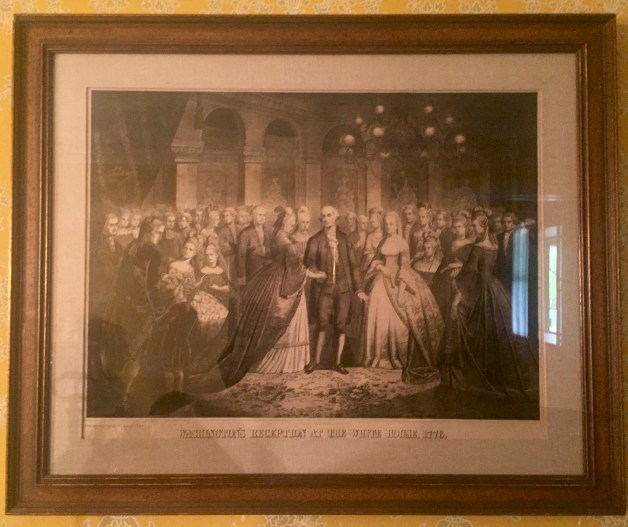
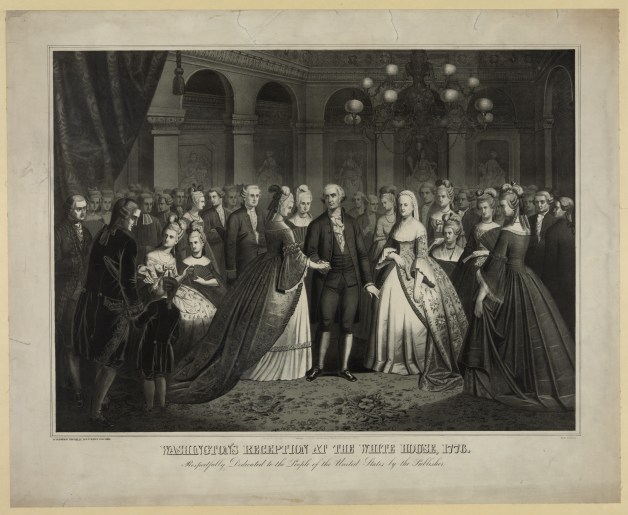
At first sight, Washington’s Reception looks like just one of countless prints depicting a founding father. However, US history tells us that much of what is going on here is actually completely wrong! To understand why someone would produce such a falsified account of history, we have to examine the role of art in households of a family like the Brodheads.

Washington's Reception, Deyo House

Copy of the framed print Washington’s Reception at the White House, 1776 in the Deyo House’s East Parlor

Washington's Reception, LoC

Full print underneath the matte and frame
Source: “Washington’s Reception at the White House, 1776.” Library of Congress, US Congress, http://www.loc.gov/pictures/item/2006677658. Accessed 20 Apr. 2017.

Physical Description
The print is a lithograph, sized 33.5 inches by 27.5 inches (Trainor). It depicts the historically impossible scene of President George Washington greeting guests in an ornate ballroom of one of the US’s most prestigious buildings, the White House, with his wife Martha standing by his side. The room is very opulent for the White House and resembles more closely the interior of a palace like Versailles. Regarding the guests, close observation reveals that nearly every single one them has the same face, giving the image an eerie quality.

The title is printed in serifed block letters reminiscent of fonts printed on contemporary US currency, with line weights varying to give the illusion of embossing. Below the title, written in delicate calligraphy, is a dedication to the American people, and above in very fine print is, written recognition of a copyright for the print to the publisher, Thomas Kelly. A light gray linen matte and wooden frame with subtly gilded edges display it simply and cleanly, keeping with the Colonial Revival aesthetic popular at the time of its creation (Trainor)

Provenance
This print was conceived by a lithographer named George Spohni (also spelled Spohny and Spohn) in Philidelphia and then published by Kelly in downtown Manhattan in 1867 (Falk 1817, 3128). Since the print is in the style that was popular in the late nineteenth century, what seems likely is that a collector of historical prints purchased it from Kelly, and that it later made its way upstate where it decorated a home in the Colonial Revival style (Kennedy). A descendant of that original homeowner probably decided to give it to Historical Huguenot Street once the Colonial Revival went out of style in the mid-twentieth century. This, however, is admittedly speculative.

Narrative
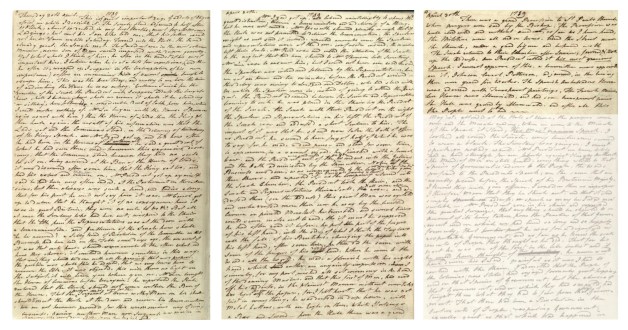
In the late nineteenth century, Americans became enamored with the Colonial Revival aesthetic, which celebrated historical figures and events in the US’s past. Sometimes, artists took this idealization further by fabricating events and placing these figures in them, as is the case in Washington’s Reception (Kennedy). Regarding the scene depicted, it should be noted that Washington and Martha have been placed in a building that, in 1776, would still have to wait twenty-four years to be completed. It is also worth mentioning that Washington was not elected president until 1789, which means that he and his wife would not have belonged in the White House in 1776, even if it had been standing. Even if the timing in this print was accurate and Washington had been elected immediately following the American Revolution (and the US had simply skipped over the confederacy stage), his inauguration took place not in Washington DC, but in New York City (Maclay 1). The Pennsylvania Senator William Maclay who witnessed the inauguration specifies in his diary that it took place at Federal Hall (1). Contrary to that which is depicted in the print, Washington was in fact not so calm and put-together at his inauguration; in fact, the senator describes him as trembling from nerves and consequently unable at times to read what he had to the Congress (2). After anxiously fiddlin with the papers he was reading from, continues Maclay, Washington apparently made an attempt to incorporate hand gestures to add emphasis to his address, but he came off as awkward rather than engaging. Our revered founding father, it seems, was just as human as anyone else attending the inauguration that day and appears to have suffered from stage fright! The calm, diplomatic Washington in the print is an invention of the lithographer, Spohni.

William McClay Diary Entries

Diary entries by  Senator William Maclay about the inauguration (faded section is an entry for the following day)
Source: Maclay, William. “Journal of William Maclay, April 30, 1789, [Original journal].” Library of Congress, US Congress, n.d., http://www.loc.gov/resource/msspin.pin0102/?sp=1&st=gallery. Accessed 2 May 2017.

Given that this print is evidently rife with inaccuracies, an investigation into the motivations behind making it seems warranted. As previously mentioned, given when it was created, its subject matter makes sense: the postbellum period was a time when Americans reverted to older styles associated with proud events in their nation’s history, and with that came imagery of historical figures (Russo). With uncertainty and violence of war fresh in their memories and the nation still reeling from the war, many Americans longed for stability and a sense of purpose. Great figures from the US’s past provided them with the consolation they sought. In the Northeast, this fixation with the past was paired with a reactionary disdain for and fear of immigrants entering the country from Europe, who, it was believed, were a threat American values (Gyure). These great figures Americans had hanging on their walls fought for a free and safe society that many were intent on depriving immigrants of. This nugget of information might explain the why Kelly, an Irish immigrant, and Spohni, a French immigrant, would have created and published such a mysterious piece (Falk 1817, 3128). As immigrants to the Northeast, they no doubt experienced intolerance, and in reaction, they may have decided to mock the country’s arguably shallow postbellum nostalgia by producing a sort of “political cartoon.” They might have decided to have all the guests have the same face to critique the wave of patriotism that was encouraging intolerant and insular—“un-American”—behaviors, as well as causing Americans to ignore the fact that their country was founded by a group of individuals of differing origins.

A print like Washington’s Reception would have likely hung in the Deyo House’s East Parlor. This room was where the Brodheads entertained guests both formally, and, because the parlor has only one door and is as a result the most isolated, privately as well, according to Jaquetta Haley’s Furnishings Plan: Deyo House (94-95). The fireplace, which is purely ornamental, established the room’s refined and formal atmosphere, which, in turn, called for the showcasing of “heirlooms inherited from earlier generations of Deyos as well as decorative pieces symbolic of their sophistication and broad ranging experiences” (Haley 95). Among a collection of objects of this sort, patriotic prints were to be expected, as they expressed one’s connection to the glory of the nation’s past (Holloway 142). The Brodheads probably had a print like Washington’s Reception that romanticized a great historical figure in US history, hanging in their home. Haley explains that it was important to legitimize the family’s status by impressing guests with these intriguing pieces in an entertaining space like the East Parlor (95). Historical accuracy, it can be assumed, would not have been as important as the impact of an effective—albeit potentially inaccurate—story told by these kinds of prints, so while the Brodheads would have probably known if the print they owned was accurate or not, they probably would not have cared either way as long as it served it purpose in the parlor.

East Parlor Display Pics

How the print is displayed in the Deyo House’s East Parlor

Works Cited

Falk, Peter Hastings. Who Was Who in American Art: 400 Years of Artists Active in America, 1564-1975. 3 vols. Madison (Conn.): Sound View Press, 1999. Print.

Gyure, Dale Allen. “Colonial Revival in America : Annotated Bibliography.” Edited by Dale Allen Gyure and Karen L. Mulder, Colonialrevival.lib.virginia.edu, 2003, colonialrevival.lib.virginia.edu/. Accessed 20 Apr. 2017.

Haley, Jacquetta. “East Parlor.” Furnishings Plan: Deyo House, Historical Huguenot Street, New Paltz, NY, 2001, pp. 94–102.

Holloway, Edward Stratton. American Furniture And Decoration Colonial And Federal. Read Books Ltd, 2013.

Kennedy, Martha. “Library Question – Answer [Question #12435925].” Received by Nathan Bergelson, 19 Apr. 2017.

Maclay, William. “Journal of William Maclay, April 30, 1789, [original journal].” Library of Congress, US Congress, n.d., http://www.loc.gov/resource/msspin.pin0102/?sp=1&st=gallery. Accessed 2 May 2017.

Russo, Courtbey. Personal interview with author. 25 Apr. 2017.

Spohni, George. Washington’s Reception at the White House, 1776. Lithograph. Historic Huguenot Street, New Paltz, NY, 1867.

Trainor, Ashley. “Nathan Bergelson: Dimensions of and materials used in ‘Washington’s Reception’ print.” E-mail received by author, 20 Apr. 2017.

“Washington’s Reception at the White House, 1776.” Library of Congress, US Congress, n.d., http://www.loc.gov/pictures/item/2006677658. Accessed 20 Apr. 2017.

Tea, Anyone?

Physical Description:

113931

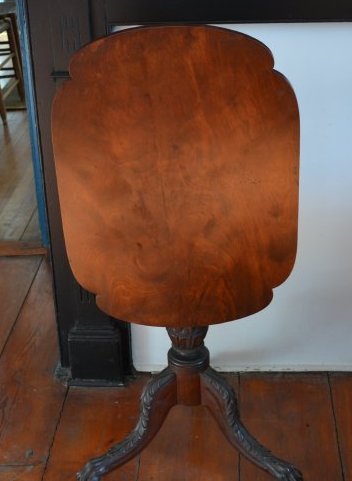
Photograph provided by Ashley Trainor: Front view of Charles Warner’s Tilt-top table

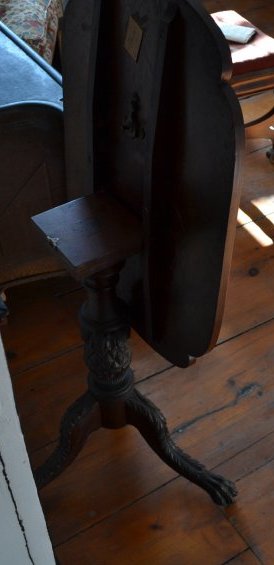
The table displayed to the left stands about 2ft off the ground when the table top is parallel with the floor. The table top is hinged allowing it to be turned on it side when is not being used to hold various objects. In its entirety, the table has minimal scratches/ chips. The base of the table has been constructed out 5 separate pieces of mahogany wood. The central piece is an urn-like base that appears to have been turned on a lathe with a pineapple carved into the center of it. The base is connected to three arched, tapered legs. Each leg consists of acanthus leaf carvings that transition into the paw of an animal (likely the paw of a lion). Attached to the center base and legs is a smaller table top, likely to function as a seat. The table top is an ovular shape with pinched corners that it approximately 2ft x 1.5ft. Beneath the tabletop is a makers mark inscribed “Charles Warner, Cabinet Maker, Poughkeepsie.” This type of table (hinged table top with smaller attached smaller seat) is referred to as a tilt-top table. This table was constructed approximately 1800-1820.

leafpawlegpineapple

splayedleg

Illustrations of the decorative motifs most common in this style.

Furniture being designed during this time (1805-1830) which overlaps with the same time of Charles Warner’s life was referred to as American Empire style furniture. Influenced by neoclassical and french empire during the reign of Napoleon. Specifically this style was largely inspired by Napoleon’s architects Percier and Fontaine after Napoleon returned from a trip to Egypt in 1798.(LaChuisa, 2005) This style uses decorative motifs including rope twist carvings, animal paw feet, Acanthus leaves, stars, eagles with spread wings, etc. It was common during this era design to use oak, mahogany, and other dark woods for building furniture. However, dark woods were so popular that often mahogany was painted black. Also, inlays were often used and were made of ebony or maple veneer. This style varied within utilizing this set of visual motifs with New York City being the center of this design style. (LaChuisa, 2005) New York city was also the center of fashion at the time, which will relate to the utility of this kind of furniture explained later in this post.

Provenance:

113931-3

Side/Back view of Table. The Gold square at the top of the table is the Makers mark engraves “Charles Warner, Cabinet Maker, Poughkeepsie”

Sought out by furniture historians as a major landmark in cabinet making, Tilt-top tables arrived in America in the early eighteenth century from England. From their start in England, Tilt top tables were associated with a gentile behaviors, namely tea drinking. Tilt top tables were also referred to as tilt- top tea tables. Other common nomenclature used to refer to this kind of table was the “claw table” and the “snap table.” The tables became an indispensable unit of the ritual of tea drinking. Tilt top tables were just as necessary as the tea, kettle, and cups as they contributed to the fashionable parlors and heightened the status for politicians, artisans, laborers, etc..  Generally speaking, people invented new types of furniture to accommodate the continuously changing needs at the time. (Fayen)The tilt top table did contribute to the solving the problem of spatial efficiency however, this table gained recognition for its appearance more than its utility. Historians figure that this was in part due to the state of consumerism at the time. It was during this period that the production of goods were becoming more affordable and widespread to produce. The fashionable experience of tea drinking that was once only afforded to the rich and wealthy became accessible to those in the middle class. Between 1740-1790 tilt top tables were omnipresent components to American parlors.  This time frame leads right into about the time of Charles Warner and his desire to construct these tables. Based on the provenance of the tilt top table it becomes clearer the intention of building such tables. (Fayen)

Makers Bio/Historical Narrative:

113931-2

Detail image of the base of the table

Charles Warner worked as a cabinet maker in Poughkeepsie in 1820. It appears that Charles Warner was born and raised in Poughkeepsie, dying in 1834. He was the son of Thomas Warner who purchased a lot of land in Poughkeepsie “beginning at the northeast corner of Myndert Van Kleek’s garden fence along the new street” 1785. Warner was not only a cabinet maker but also, a businessman. He owned a considerable number of stock shares, including stock in the Poughkeepsie Whaling Company, the Farmers and Manufacturers Bank, the Eastern Market, the Poughkeepsie Steam Boat Company, and the Dutchess Whaling Company. Financial records indicate that Charles Warner was a successful cabinetmaker and businessman, with considerable financial resources for the period.(Fallen)

Charles Warner’s table, which now lives in the Empire gallery room in the Deyo House, signifies not only a time of advancement in consumerism and commercial trade, but also lends itself to the attitudes of status and fashion in the early 19th century in the Hudson Valley. Although little is known about the local artisan himself we can deduce by his financial resources that he was an affluent man who enjoyed and benefited off of the popularized gentile lifestyle of the early 19th century. Additionally, I ascertain based on the quality of craft that was involved in the construction of this table that there are a wide variety of Charles Warner tables scattered through the Hudson Valley. Although it is unknown who was utilizing this table, the specific qualities of this table indicate that the individuals were mindfully curating an image of what I like to call efficient elegance.

Work Cited

1. Fayen, Sarah Neale. “Tilt-Top Tables and Eighteenth-Century Consumerism.” Chipstone.      N.p., n.d. Web.

2.Fallen, Todd. “A Regional Study in Early Nineteenth-century Cabinetmaking: Charles Warner, Cabinetmaker, Poughkeepsie, New York.” 2005. WAG Postprints. Web.

3.“American Empire (1800-1840).” Guide to Furniture Styles from Connected Lines. Connected Lines, n.d. Web. 04 May 2017.

4. LaChuisa, Chuck. “Furniture – Empire Style.” Empire Style. N.p., 2005. Web. 04 May 2017.

Creating an American Culture: The Federal Style

Caption

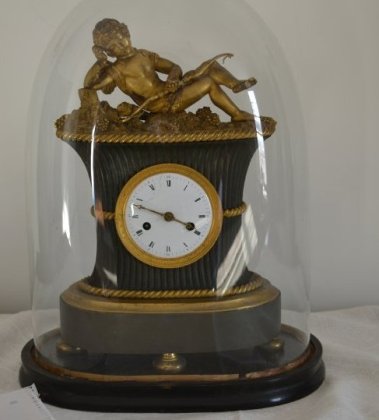
As baby Cupid rests on grapes and leaves, the United States has only just been born.  Made in 1788, this clock represents the Federal style, an artistic movement that impacted how architecture, furniture, and interior design styles were made. This clock would find its way into the home of Josiah DuBois, a Huguenot descendant and owner of an extravagant Federal inspired home. The house, as well as this clock, are the symbols of an attempt at creating a true “American” culture in the 1800s.

Object Description

Clock

Federal style clock feat. Cupid. Picture Credit: Jessica Wiessner.

The clock contains several parts: a wooden plate for a stand, the main part of the clock where the face is, a golden Cupid laying in leaves and grapes while holding his bow and arrow, and a glass covering.  The clock’s face uses Roman numerals as a signifier for time and is quite small in relation to the whole clock.  The frame containing the face and Cupid is wood painted black with gold trims around it. There are also ridges carved into the wood, giving it a bumpy texture.  Inside are the gears which are no longer functional.  Cupid lays in a comfortable pose on leaves and grapes with his bow facing straight ahead.   The glass is dome-shaped and covers the entire clock to protect it.  The whole clock is approximately 13.5 inches high and 9.5 inches wide and is quite heavy to pick up or handle.

Provenance

This clock is dated to 1788.  It originated from an apartment on Pine Street in New York City owned by a man named Samuel Boyd.  I have not been able to find much historical information on Samuel Boyd other than he lived there and may have owned some type of store.  It ended up at the Blake House, owned by William H.D. Blake, who died in 1926.  The family continued to own the house and its objects until 1984 when the items in the Blake House were donated to Historic Huguenot Street. The clock now resides in the Federal Style Room in the Deyo House.

There are a couple of possibilities as to how Blake acquired this clock. According to the Historic Huguenot Street website, Matilda Blake was very close to her cousin Amy L. Hepburn, whose parents were named Samuel Boyd and Sarah Booth Hepburn, therefore making Samuel Boyd the brother-in-law to William and Matilda (Booth) Blake. Perhaps this is the Samuel Boyd from Pine Street who owned the clock, and William Blake purchased the clock from him or otherwise received it as a gift. It has been extremely difficult, unfortunately, to find evidence of this relationship as the name Samuel Boyd was extremely common. It could also be possible that the Samuel Boyd on Pine Street is a completely different person from William Blake’s brother-in-law, and that William Blake simply purchased the clock directly from this person or from an antique shop.

Narrative

William Henry Dill Blake (1843-1926) was born in Montgomery, New York and served as an officer in the Civil War.  He married Matilda Booth in 1875 and together they had three children: Alfred Booth, William Culbert and Matilda. They moved to New Paltz in 1881 when Blake purchased the late Josiah DuBois’ house and 250-acre farm. He continued to live in New Paltz until his death in 1926. All three of his children graduated from the New Paltz Normal School and were heavily involved in the New Paltz community, especially Matilda.

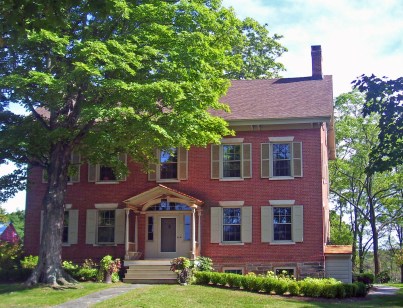
William Blake’s house is a story in and of itself and is important in understanding where the clock fits in.  It was constructed in 1822 on a large portion of land owned by the DuBois family since 1677.  Josiah DuBois owned and lived in the house until his death in 1869.  His daughter Elizabeth and her husband moved in the same year but only lived in it for twelve years until William Blake purchased it.  The house has become a historical landmark in New Paltz due to the property’s involvement in the original Huguenot settlement and the Revolutionary War.  The house was constructed in the Federalist style of architecture, so the clock this project focuses on must have fit in nicely with the theme of the house.

Josiah DuBois Farm House

Josiah DuBois Farm House. Source: WikiMedia Commons (link in references)

The Federal style was a movement in the three decades following the inception of the United States.  The developing system of government largely influenced the term Federal style, and the style itself served as a way for the newfound United States to create its own identity.  A prime example of the Federalist style is the White House, which has come to be a symbol of America and American identity. In addition, Neoclassicism, or a revival of ancient Greek and Roman art and culture, also heavily influenced furniture in this period. This would explain why the clock contains Cupid as its focal point.  Federal style furniture often comprises of thick, dark wood, simple designs, and marble.  Although elements of Neoclassicism (a relatively European movement) exist in the Federal period, the style is representative of the beginning of an American culture.  It is interesting that Josiah DuBois would choose this style for his house and William Blake would choose to maintain it.  The DuBois family were part of the original twelve French

Federal Style Ex 2

Colonel George Handy House, built 1805 in Maryland. Federal Style. Source link listed in references.

Huguenot settlers in New Paltz and brought their European culture and traditions with them when they emigrated to New Paltz in the 1600s.  The property they owned still contains several older structures, including a 1775 Dutch barn.  It is as though DuBois and Blake, like much of America at the time, were attempting to erase their own histories and ascribe to the new “American” story that was emerging through creating and preserving this Federal style.

References

“Landmark Designation Form.” Historic Huguenot Street. Town of New Paltz, New York.  2003.

“William H.D. Blake Family Papers.” Historic Huguenot Street revised 8 June 2005. <www.huguenotstreet.org/william-h-d-blake-family-papers/>

Thurlow, Matthew. “American Federal Era Period Rooms.” In Heilbrunn Timeline of Art History. New York: The Metropolitan Museum of Art, 2000-. <www.metmuseum.org/toah/hd/fede/hd_fede.htm> (November 2009).

Picture of Colonel George Handy House in Maryland. Built 1805. Source: http://www.oldhouses.com/archives/1800-1810?searchname=Built%20between%201800%20and%201810

Picture of Josiah DuBois House. Source Link: https://commons.wikimedia.org/wiki/File:Josiah_DuBois_Farm,_New_Paltz,_NY.jpg

The Bigger the Better

Context and Research

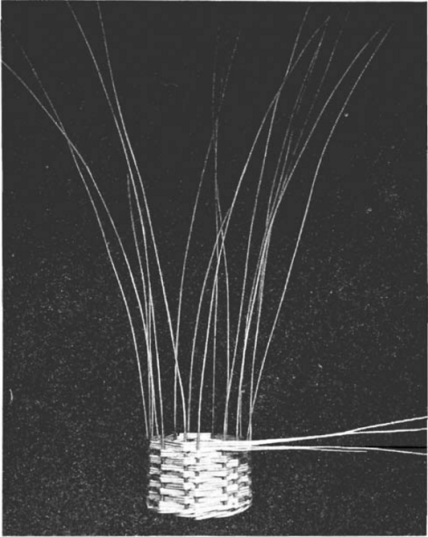
In Thomas Okey’s An Introduction to the Art of Basket Making, he details the experience one would have weaving a basket, right down to the tools used and the names of each type of strand of material. To form the “butt” of the basket, the basket-maker would first create a cross with pairs of smaller pieces (Slath-rods), and proceeds to weave a longer piece over and under the crossed pieces. To keep it still, the basket-maker takes one of the slath-rods, “brings it tightly over to his right, and lays it alongside the two sticks under his right foot… (Okey, 25)” This process created the bottom of the basket.

…and as the basket-maker weaves upward, we see the piece come to life.

in progress example

An example of a basket in progress. Okey, 31


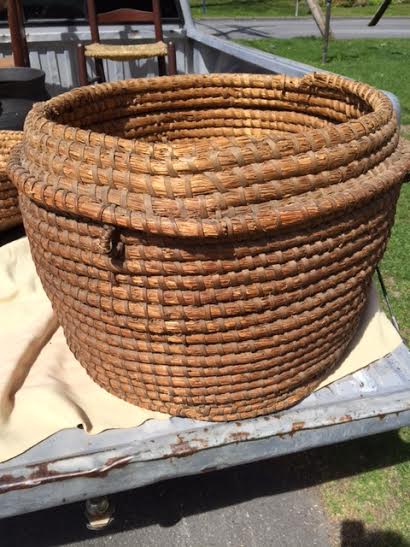
A lot of physical effort had to be put into basket making, using all parts of the body. My particular basket (pictured below) is huge, much wider than the example used by Okey. It is evident that a great effort must have been put into this creation by the particular basket-maker. Basket weaving has been one of the most common practices throughout human civilization. Instead of Glad tupperware containers like we have nowadays, people had baskets. They held everything from foods, to clothing, to seeds and crops, and were also used to transport goods. This enormous basket could have easily fit a relatively large toddler inside of it. It is rounded, composed of rawhide, reed, and is bound with straw. It is also tightly woven, with two small loops of either side, possibly to string some kind of strap through them. It now resides in the Jean Hasbrouck house, sitting flush against the wall of Joshiah Hasbrouck’s shop as part of the current interpretation of the room.

77301

Here it is, the big man. Photo courtesy of Ashley Trainor.

The family lore attached to this basket claims that it arrived in America with Louis DuBois in the 17th century, when the Huguenots originally fled religious persecution. In actuality, it is said to most likely be a 19th century basket. This is a period of 200 years that could separate fact from fiction. From the beginning, I knew I would have to do some mythbusting. After researching general material on Artstor, I’ve found that there are many more results for “19th century basket” than the term “17th century basket.” The first search also yields many similar looking artifacts: woven baskets, some of them enormous. Right off the bat, this makes me believe that the family lore is simply lore indeed. But, to add only more confusion, the basket was also mislabeled as a clothing basket upon its donation by Evelyn DuBois McLaury. The donation date is prior to 1990, however there is no exact date.

Still on my general ArtStor search, I found several sketches of cotton pickers. Pictured were slaves carrying enormous baskets full of cotton. After seeing those images, I immediately thought that this basket was used for farming. Since it is so large in size and so tightly woven it would make sense that it was used for storing freshly picked crops, specifically grain or seed. Since it is so tightly woven, it seems as if the person building it wanted nothing to fall out. If I were to go down the 19th century track, this would be the most plausible assumption.

Narrative

When fleeing to the new world in the late 17th century, this basket was brought by Louis DuBois in his escape from religious persecution. With them, the Huguenots brought the only things they knew: their families, their religion, and food. When settling on the banks of the Wallkill River, they constructed the notable stone houses that can be found on Historic Huguenot Street today. And inside are interpretations of their lives. This basket, being made of rawhide, this indicates that it is made of animal skin. Assuming the basket was made locally, it most likely would have been made of cow or sheep skin. Josiah Hasbrouck owned a country estate called Locust Lawn, located in present day Gardiner (“A Notion to Sew”). Crops grown there included rye, oats, corn, wheat, and apples. Animals owned were milk cows, chickens, beef cattle, and pigs, all of which were used completely to their full potential (“A Notion to Sew”). Photos collected in New Paltz Revisited indicate that a popular crop grown in New Paltz and surrounding areas were potatoes and other spuds (Johnson). Soil was rich in nutrients due to the establishment being along the banks of the Wallkill River. According to “New Paltz Town Records,” it states that once the town of New Paltz was founded, it “survived for the next two hundred years as an ‘isolated, conservative, tightly-knit farming community.’” Additionally, the Huguenots worked on a maintaining a healthy and prosperous relationship with the nearby Esopus Native Americans (Esopus Trails).

Throughout the Huguenot’s years establishing the town of New Paltz, they became an independent and self-sustaining community. Farming was the primary means of acquiring food. In addition to harvesting and maintain their own crops, there were also small shops set up, much like the one Josiah used in the preserved Jean Hasbrouck house, to sell goods, which was only the beginning of the exchange economy we have today.

Although I have absolutely no information on this basket’s creator, I can very well infer that it was made with the intention to be used in farming. The tightness of the winding and the sheer size of it indicates that it was used for something with harvesting crops: to gather as much as possible at one time, to store a large amount without fear of anything seeping into it, among countless other possibilities. Agriculture is a huge component of every early civilization’s way of life. It was what the Huguenots knew in France, and it was something they brought over to the Americas upon fleeing for life.

 Special thanks to Ashley Trainor and Carrie Allmendinger for all of their assistance!

Works Cited

“A Notion to Sew.” Hudson River Valley Heritage. N.p., 2 May 2008. Web. 28 Apr. 2017.

Esopus Trails: The History of Esopus Township. Ulster Park, NY: Maple Ridge School, Maple  Ridge Bruderhof, 2005. Print.

Johnson, Carol A. New Paltz Revisited. Charleston, SC: Arcadia Pub., 2010. Print.

“New Paltz Town Records (1677-1932).” Historic Huguenot Street. N.p., 27 June 2005. Web. 3 May 2017. <http://www.huguenotstreet.org/new-paltz-town-records/&gt;

Okey, Thomas. An Introduction to the Art of Basket Making. N.p.: n.p., n.d. Google Books. 13 Apr. 2013. Web. 2 May 2017.


Tilson’s Timepiece.

Narrative

Tillson_Residence_Highland_NY

“Lake Ledge,” the family home of the Tilson’s, Highland, New York.

1853 map

Oliver Tilson’s Ulster County, 1853. {HRVH}

August 7th, 1863 Harry C. Tilson was born to Mary and Oliver J. Tilson, of New Paltz Landing (now known as Highland), NY. His father Oliver was a fruit farmer, Rosendale town supervisor, and established cartographer for the county of Ulster (1853 map is stored with the Huguenot Historical Society’s Map Collection). On October 13th, 1886, Harry married Mathilda “May” Allen, daughter of a methodist reverend. Their marriage was cut short by the sudden illness and subsequent passing of May. They had three children the youngest being 5 years of age. Harry Tilson met his end 53 years later, after suffering a heart attack, post surgery, where he had relocated in the years following May’s death, in Deland Florida. The Kingston Daily Freeman reported that he was active in the Presbyterian church and the ancient order of Good Fellows (a now defunct masonic group).


Physical Description

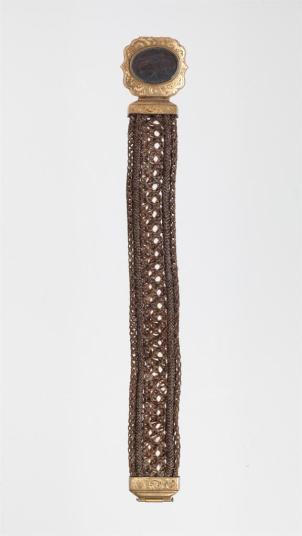
This item, once belonging to Harry C. Tillson, is a gold pocket watch, donated by the Tilson estate (Oliver Tilson II, Grandson to Harry) to the Historic Huguenot Street collection. The watch is that of a full hunter-cased style, a case which can be opened with one hand, and is roughly two inches in diameter. This design has a latching front and back, which closes to protect the crystal, hands, and dial (face) from dust and scratches. The mechanism on top is a push button type crown which opens the outer casing and winds the watch. The front outside is elaborately engraved with finial design of  the initials HTC. In the watch cover, there is also simple scripted engraving that reads “California 1875.” Both front and back closures are hinged at the bottom, which aligns with 9 on the dial. The outside, or rim of the timepiece itself is grooved, which is most likely for secured holding or pure decorative accent, as like the rest of the outer portion, it is gold. Immediately linked to the hoop surrounding the crown is a standard clasp, is a tightly woven chain of human hair, accented with gold, measuring approximately 7-½ inches. Connected on the opposite end, a latch to keep the watch worn, to a something such as a button hole, a belt loop, pocket, so as not to lose the watch, or as adornment. In the center of the chain there is an additional accent, which may act as an additional support, attached is two small charms or fobs, which have a design that has patinaed and worn away, and is now indistinguishable, but are likely to have matched the ends, or signified something of the bearer.

hair 2

Full Hunter Case Pocket watch with watch chain, made of human hair.                                      [Photo provided by Ashley Trainor, collections manager, Historical Huguenot Street]

Provenance

The watch is thought to be made in California 1875, rather than Harry purchasing it in that time, as he would have been twelve. In scaling the Tilson genealogy, it was determined to be Harry’s monogram, not only because the grantor is the paternal grandson, but because, any other Tilson carrying the HTC initials were born well after the inscription. Although I was unable to see the engraving itself in picture or person (collection unavailable), I am pressed to believe it is in/or the backside of the hunter-casing, as a maker or jeweler’s marked inscription or inception. Curiously, it is a practice for the maker to include his Name or Mark above the made date, as trademarking at this time, on casing is a sign of value or worth. Perhaps this has been worn away. Harry, himself, can be traced to California via his coal business of which he had built, along with the house next to the family home “Lake Ledge,” in the former New Paltz Landing, on Vineyard avenue. In the 1908 listing of copper mines, it is established that Mr. Tilson was in the business of mining copper in New Mexico, placing him much closer to California. This is a seminal reason as to why May Tilson’s death had been reported in a Los Angeles newspaper May 4th, 1900. The tight braid connecting this watch to Harry himself may have been made to commemorate his wife’s death in 1900, and is very likely to be made of her hair, a token of his love for her. Although this is speculative, it is common practice during this time and being so far from home, it may have been his only resolve at the time. It is unknown at this time as to where Mrs. Tilson is at rest, further burying the mystery of the hair attached to the watch.

Historical Hair Ornamentation

The use of human hair as adornment and memory begins in France and England in the 1700’s, something which Queen Victoria herself popularized. This trend became an evolving craft of wig makers, inevitably reaching to becoming another parlor craft of home makers and funerary momentos throughout Europe and the United states in the following century. This home craft extending beyond mourning, to include ornamental hair samples of lineage from children of the women weaving, keeping a very personal family album, an estrangement from bible cover lineage. In the United States this practice may have been adopted not only in craftwork, but to make special, as the sentimentality of the losses of the very recent Civil War and the onset of the manufacturing boom of the Industrial Revolution.

AWSS35953_35953_32666739 (1)

Women’s bracelet made of intricate hair work, American, 1850-1899 (Artstor

The hair mourning jewelry typically worn by women can range from elaborately woven laces to simple lockets containing a small snippet of hair. Being so popular towards the end of the 19th century, it was common for many jewelers to have in-house hair weavers, custom fitting precious metal (predominantly silver and gold) to chains and in this case, a watch chain. This particular chain and many like it often had charms accenting the rest of the metal work and clasps. These accents were particular to the owner of the watch of of the taste, and often a piece of jewelry belonging to the deceased.

Men’s accessories were not as elaborate of their counterpart’s however, the sentimentality remains, as an embodiment of the hair-owner’s soul, forever in  functional capacity with the bearer. In the cases of long braids, such as this example, it would be necessary for the hair to be long, and tightly woven so as to minimize fraying. The hair is often taken from the body before burial and for such a memento, it is likely to be conditioned to minimize its deterioration, as it is likely to be touched and used more than that of a women’s piece of jewelry, such as a brooch, pendant, or bracelet. It would be sensical then, for Harry to display his mourning practice and love for his deceased in this manner. As a business man, it would be important for Harry to keep time, and secondly, to have adequate remembrance of his wife. New Paltz’s rich history includes many items of hair-craft. It would befit the cultural practices at the time and his hometown if he were to display such a mourning practice.


American. Bracelet. 1850-1899, Woven hair, ARTstor. Web, 18 April 2017.

Holm, Christiane. “Sentimental Cuts: Eighteenth-Century Mourning Jewelry with Hair.” Eighteenth-Century Studies, vol. 38, no. 1, 2004, pp. 139–143.

“Los Angeles– Mrs. Harry C. Tilson”. May 4 1900. XIV, Page 226. Local Obituaries, Elting Memorial Library, New Paltz. 11 April 2017.

Lutz, Deborah. “The Dead Still Among Us: Victorian Secular Relics, Hair Jewelry, And Death Culture.” Victorian Literature and Culture, vol. 39, no. 1, 2011, pp. 127–142.

“Obituaries.” Kingston Daily Freeman 1 May 1953, Notices sec.: n. pag. Print. “Harry C. Tilson”

“Oliver J. Tillson Family Papers (1787-1899).” Historic Huguenot Street. Huguenot Historical Society, 17 May 2004. Web. 8 Apr. 2017.

Stevens, Horace J. The Copper handbook: a manual of the copper industry of the world. Vol. VIII. Houghton (Mich.): H.J. Stevens, 1909. Print. p. 1431

“Tilson: Mathilda”. October 13 1886. VII, Page 125. Local Marriages, Elting Memorial Library, New Paltz. 11 April 2017.

Tilson, Mercer V. The Tilson Genealogy. Vol. 1638-1911. Baltimore: Gateway Press, Inc., 1982. Print.

Tilson, Oliver J. “Map of Ulster County, New York.” The Library of Congress. N.p., n.d. Web. 12 Apr. 2017.