Joy Test Report; Discussion of Object Relationships

img_4255

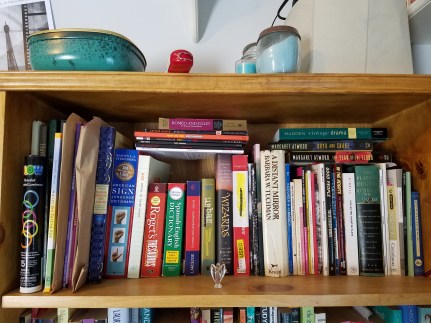
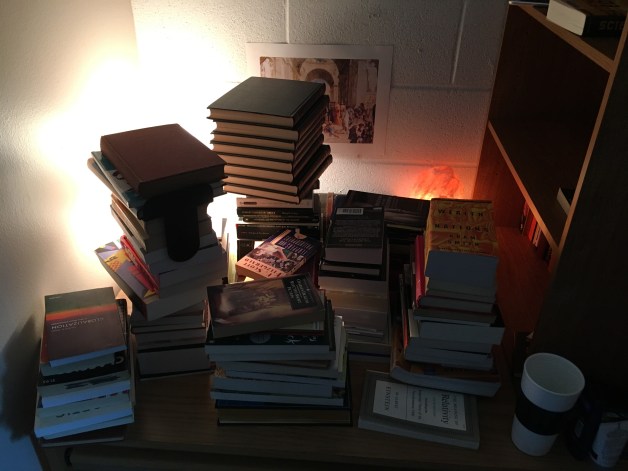
Before. Sorry for the crappy lighting

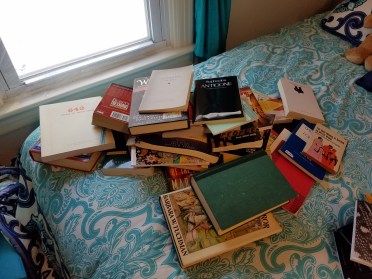
Like many other students, I decided to use KonMari’s joy test on my books. I removed all books from the three tier shelf on my desk, gathered the stacks in the other room, and piled everything on my desk: in total, they numbered about one hundred and fifty volumes. Now, as there was never any possibility that I was going to dispose of any of them, my only purpose in this exercise was to isolate that specific group of books which I would like to keep on the shelf that I stare at every day­­—as KonMari would say, those which gave me a “tokimeki” (props to my Japanese roommate for knowing the word for “spark of joy”) and move all others to a different location. I broke this down further, dividing tokimeki books into four categories: principal characters—this includes volumes that I engage with very often, such as Cooper’s edition of the Platonic corpus, a collection of Jung’s writings, Shakespeare’s Sonnets, and perhaps a dozen or so others; auxiliary characters—this being the largest category, incorporating all books that I engage with often to semi-often, and which round out the different sections of my library; present engagements—i.e. books that I am currently reading, but which may not necessarily be returned to regularly once I have finished them; and, lastly, books that are in semi-dormancy—i.e. books that I am reading, but at super-snail pace, sometimes with weeks between readings. Books that fit any of these categories were maintained on my shelf; all others were relegated to stacks in another room.

img_4256

After

The process of filtering out books that gave no tokimeki was somewhat familiar, as I had unconsciously used similar techniques in the past; but employing KonMari’s method consciously was interesting nonetheless. I will say, however, that, while books are certainly objects, I disagree with KonMari’s seemingly commonplace characterization of them: I think that books are particularly peculiar objects with which we form equally peculiar relationships. I will now attempt to explain what I mean by this in a long, drawn out, painful fashion:

No relationship that a person may have with any object is static: this would require that both parties to the relationship remain entirely static, which ­– considering that one party is living – is impossible. All objects that we acquire ­– or meet somewhere – begin either as strangers (when we have no familiarity with the object itself or with its essential characteristics), or from some level of familiarity: say, perhaps, that a person has never encountered pen X before, but is familiar with pens in a general sense: thus, pen X is not entirely foreign to the person. This external general familiarity is automatically imported to the relationship that the person forms with the specific pen X. From here there are, again, two options: first, the person may never encounter pen X again—this would seem to indicate that the relationship with pen X would remain static – in limbo, so to speak – but, in reality, the relationship on the human side will alter and degrade with time as the person changes and as the characteristics of pen X are slowly forgotten; second, the person may re-encounter pen X—it may be generally stated that the person who encounters pen X again will encounter it n times, n being the number of instances in which the pen is encountered before the person never sees it again. Now, each time that pen X is encountered, the relationship (insofar as it is dependent on the ever-dynamic human system) will update to integrate the circumstances of the newest instance. For the vast majority of objects, each update is minuscule, with the change between some instances even approaching negligibility (some updates, of course, may be significant, but this is uncommon and is more dependent on typically unpredictable external happenings involving both us and the object, than on the interaction based evolution of our relationship with the object itself); but, nevertheless, the relationship will not remain static—we may notice changes in the way that we feel about an object when considered over medium to long time frames. However, there is, of course, a minority of objects which do not correspond with the characterization that I just explained: these include, for example, computers and books/documents. Objects such as these are still objects, but our relationships with them have the potential to change far more rapidly than can our relationships with objects such as pen X. Why is this?

Here I will illustrate by considering an arbitrary relationship between a person and a book. First comes initial contact: the person is drawn to the book, perhaps because s/he has heard of it, or of the author, or is merely interested in the topic (the other option is that the person encounters a book about which nothing is known, but I will not consider this option here); let us say, for simplicity, that there is nothing printed on this book except for its title and author, so this is all that is readily discernible about the book without opening it. The person buys the book, brings it home, and it is placed onto a shelf where it resides for some time. As long as the person sees or touches the book, but does not read from it (and hears nothing regarding the content of the book from external sources), the relationship will proceed as would a relationship with a typical object—that is, at an almost negligible rate; however, once the person begins to read, the course of the relationship is altered drastically. From thereon out, the book becomes a medium for a relationship between the reader and the thought and feeling of the person who wrote it; but the information that is gleaned from the text by the reader also becomes inextricably related to the object that is the book itself: thus, each time the book is read from, the relationship that the person has with the book is updated, and these updates have the potential to be quite significant in comparison with the updates discussed for typical objects: perhaps this is why relationships that people have with books can become so intense. Further, information that we learn in a setting entirely removed from the book may also, upon a later reading of the book, give new meaning to text within the book that we did not initially recognize as significant: thus allowing for an even greater alteration of our relationship with the thought of the author and with the object that is the book.

So, even though books are technically objects, the relationships that we form with them seem to occupy some finely integrated grey area between an object relationship and a personal relationship—something that cannot be said of pen X. It is for this reason that I call books peculiar objects.



Oxford Mania

Over the past few years, my affinity for preppy clothes has grown immensely. Since my freshman year at college, my collection of band t-shirts and tattered jeans has slowly dissipated and turned into a wardrobe filled with twill slacks and J. Crew Oxford button downs. I hadn’t really thought much about this casual aesthetic progression before, but after our discussions in class, and sitting down in my room to analyze my surroundings, my eyes went straight to my overabundant closet and the significance of the clothing I now possess.

My clothing and the way I dress have always been things I have been extremely cognizant of. Growing up in a relatively poor family in an upper-middle class area, I was always judged, and even bullied, for the clothes I wore. Subsequently, I have become extremely meticulous of how I present myself to the world through my clothing choices, and now use my clothing as a medium of self expression.

The J. Crew Oxford has consequently become a staple of my wardrobe, primarily because of the intrinsic aesthetic significance of the Oxford style shirt, but also because of the ascribed status of the J. Crew brand. (I am admittedly not immune to the trivial associations of brand named goods and status, like most people in society). I chose to work with my collection of Oxfords because of what they mean to me now, and how they resonate with my experiences as a poor kid in my past.

At first glance, my closet can be a tad overwhelming. After counting the shirts lining the span of it, my collection came to a total of 29 Oxford shirts. I was actually a bit surprised by this number, not realizing how many shirts I had accumulated over my past few years of sporadic online shopping sprees. After recognizing this number, I was eager to get rid of some of the shirts that I wasn’t too crazy about. I ended up finding 5 shirts that I’m going to be giving to my younger brother; freeing up some space in my closet, while also having a stash of birthday gifts for him for the next few years.

Emotionally, I was a bit torn. Even though many of the shirts I was willing to give away didn’t ignite the “spark of joy” Marie Kondo spoke of, I was still a bit reluctant to get rid of some of them. I thought about how important my collection of shirts was to me; how they helped me present myself meaningfully to the world, and how I used them as an extension of myself and my desires. I was however glad to recognize this unreasonable attachment to my shirts, and quickly bagged them up before I could change my mind. The collection I was left with was a bit smaller, but I honestly felt better getting rid of the Oxfords I wasn’t too crazy about. I feel as if my downsizing did help me hone my “joy” for my better shirts, and I ended the downsizing ultimately feeling more organized.

The most significant part of going through my shirts was in fact the thought processes I underwent throughout the haul. The main themes I thought about were regarding image and self-extension, both of which pertained highly to my collection. I thought about how society’s perception of people based on the way the dressed stylistically was so arbitrary, and how the association of style and status has defined generations for centuries. I also realized that my relationships to my objects were rooted in self-loathing, self-consciousness, and memories of bullying from my past. I used my J. Crew Oxford collection to detach myself from the poor, fat kid I used to be in middle school, and to obtain self-worth and pride from a silly label every time I button myself up in one of my pieces. I thought about how I use my Oxfords as a shield from people’s negative perceptions of me, because how can anyone think negatively of a boy in a nice plaid Oxford, right? My relationship to my shirts is subsequently dichotomous, serving as both a way to make myself feel good and clean and worthy, while also serving as a harrowing reminder of my past.

20170203_133554

A small snapshot of my shirts

The KonMari Method & My “Komono”

I chose to use the KonMari method with my miscellaneous or komono drawer. I chose this drawer mainly because it was the messiest drawer in my entire room. I tend to be very organized, but for some reason this drawer looked like this:

before

Yikes

Pretty awful. I don’t know exactly how many objects I had in there, but it must have been up there in the thirty or forty range. It was certainly time for a clean-up, so I did what KonMari suggested and took every item out first. I looked at them, and tried to use a combination of her “joy” test as well as whether or not the object had some functional value. For example, somewhere in there is my wallet, deodorant, DayQuil and NyQuil, Excedrin migraine, etc. Some of these things I use everyday (like my wallet), others are saved for a rainy day (like the Excedrin). I decided to start putting stuff back in with some sort of organization, so here’s what it looked like about halfway through the process:

For the record, my SpongeBob Squarepants laundry hamper was not a part of my tidying and is here to stay. Anyway, I thought I was making some significant progress, until I came across a few items. While I could come up with a reason for keeping the NyQuil, the moisturizers, and my apparent soap hoard, there were a few items that had absolutely no purpose being there and even gave me the opposite feeling of joy: anger. For example, one item was a bottle of “special contact solution” that actually burned my eyes when I used it to rinse out my contacts last weekend. Since I am terribly sightless without contacts or glasses I failed to notice the bright orange warning labels with the instructions for use. I just thought it was regular contact solution. It wasn’t, and the hydrogen peroxide in the solution burned my eyes.  Another item I found was a LifeProof iPhone case that I bought when I first got my iPhone 6s. It worked really well in that it effectively protected my phone from breaking. However, it had a cover over the headphone jack, so I could not use my favorite headphones without prying the phone case completely off. This is hard to do, since the case essentially seals and locks shut when you put it on. It got annoying, so I stopped using it. It wouldn’t be so bad if the thing didn’t cost me almost $70. Yes, okay, it “technically” works, which is why I’ve kept it, but I can’t even listen to music, the one thing I mainly use my beautiful iPhone for! The fact that I paid money for such a useless item is super irritating.

The other two items were a plastic bag and a New Paltz ID card case. The plastic bag was annoying because I had absolutely no use for it and, in general, I hate plastic bags due to their negative environmental impact. The New Paltz card case doesn’t give me nearly as much anger as the other items, but it just kind of gets in the way and I don’t really ever use it.

no-good-items

The annoying items, excluding my TV and remote

Maybe I am a bit petty or over-dramatic for being so angry at a few items. Nevertheless, I left these items out while I put the others back in. It was quite nice to have a clutter-free drawer without these useless and annoying items! I honestly didn’t expect the project to go the way it did. Seeing the items I had bad experiences with and the emotional reaction I had to them made me appreciate the things I do like/use a lot more. Although I’m not quite sure that was what KonMari intended, I think I ultimately got to where she would want me to be: finding joy in the items I keep. I decided to get rid of the contact solution, as this project prompted me to give it to a friend who uses it. For now, the others are okay sitting in the back of my drawer. Perhaps one day I will need that LifeProof case or plastic bag. Overall, I did not find this process to be too difficult, but I did find it interesting that the KonMari method can apparently work backwards – in finding anger, you can also find joy.

after

Not the most beautiful tidying job, but good enough for me

Decluttering the Desk

I found this reading timely. I just moved into a new building on campus last week, so my things, especially small things, were strewn around my new room in comforting chaos. My desk both at home and here is the go-to spot for little papers, junk in my pockets, as well as my laptop, vitamin bottles, and anything else imaginable. So, you can imagine what it looked like in the recent days while I was unpacking all my bins. While doing this reading, I was sitting at said desk in Lefevre Hall. I suddenly became horrifically aware of everything that was in front of and around me. There was, at the time, a bright orange file holder (of which I put things in never to take them out again), a notepad labeled “shopping list,” a stray dryer sheet, my favorite pen with no cap, my checklist for the day, one of those round Eos chap-stick things, and a mug of tea. Those being but a few of the items, I immediately felt the need to clear my workspace. I contemplated using the “joy test” that KonMari praises and recommends, however, I thought the junk on my desk was not up to the standards of the joy test. If I applied the joy test, my desk would probably be totally empty. After our discussion in class on Tuesday, many of the things on my desk were those practical items; my set of mini drawers holds writing supplies and post-it notes, which I need but do not necessarily bring me joy. If the joy test extends beyond the object itself, though, then you could say it does bring me joy. If I did not have any pens, pencils, or post-it notes, I would have to take the bus that always runs late, as I do not have a car. Alternatively, I could walk to the store in the freezing cold. So, all in all, those pens and pencils in my little green set of drawers in a way does give me joy.

I picked up each item, trying not to think in such an extended way. Instead, I asked myself “do I need this?” I am usually a “I might need this later” type person, but once in a while, I get into those moods where I need to clear everything out. This turned into one of those moods. I picked up small papers that laid helplessly around and got rid of them. I put the chap-stick away in my first aid box. The dryer sheet found a permanent home in the garbage, and the orange file holder found a temporary home under my bed and out of the way.

It was strange going through my items, I think because I used a modified version of what we read about. Instead of asking if my shopping list notepad gave me joy, I asked myself if I really needed it. I became acutely aware of each item I had on my desk. Some of them were there because it held objects I needed like pens, scissors, and erasers. Some of the things were there simply because I placed them there days ago while unpacking, and I forgot about them. It was definitely not difficult because, as I stated before, the items I was dealing with were practical. Not a lot of them gave me any kind of joy. I am glad I got to do this experiment while also experiencing this move across buildings. If I hadn’t been assigned to do something like this, the poor desk would most likely be cluttered until the end of time.

The Necessity of Self-Evaluation in Tidying

Considering all the clothes I have, I figured it would be simpler, as far as the experiment is concerned, to examine my book “collection”.  Not to be a contrarian, but based on the discussion in class, I appear to have a much lesser affinity for books and literature than the others taking this seminar.  Recently, I tidied up my room, essentially cramming unnecessary objects in places where they will be out of the way.  Among those objects, at least for me, were my books.  Now not to get it twisted, I have not yet thrown away, donated, or otherwise disposed of my books, nor do I know if I eventually will.  When I looked at the collection, I discovered the books of my childhood, the some of the first series and books I’d ever read, including Harry Potter and even the works of Shel Silverstein, of whom I was a fan, and still am today.  Those books, ones that are all-time favorites, and ones I would like my children to read, ones with that great level of sentimentality that even my parents (who didn’t read the aforementioned titles) can appreciate, have been moved to a separate bookcase in our “extra room” in the house.  For the most part, the books that remained in my room were kept in a crate placed on top of a dresser, which in hindsight is a little dangerous, as I tried to get them down and it was not a simple task.  And therein lies the rub, since I put the crate up there about a year ago, this was the first time that I actually went to take anything from it.  Immediately I knew that if I adopted the KonMari practice, all the books would go.  I must admit though, when I took the books out of the crate, I became nostalgic and realized why I kept them in the first place.  Many of them are sports related, most heavily based on the Yankees, of whom I have been a huge fan for years, even though my dad is a Mets fan..  Anyway, I had moments where I remembered when I chose to buy the books, or who gave them to me.  Some came to me a long time ago, and others fairly recently.  Two were heavily a part of the beginning of my collegiate life, two books that I actually read for English 101 back in Senior Year of high school.  I remembered my appreciation of these books as I read them, and a lack thereof for those I never got around to reading.  I have long realized that I do not enjoy reading the way many others, like those in the seminar, do.  It’s certainly not something I take pride in, but something I’ve learned to “deal with”.  It’s entirely possible, and in my opinion likely, that I will never again have the compulsion to pick up a book and begin reading, although there have been books that have made me feel so before, and there have certainly been required scholarly materials that have felt glued to my hands.  So my pile on the floor is probably underwhelming and exceptionally modest to some, though to me, the weight of sentimentality outweighs that of the physical weight of my pile.  My after picture is of the crate, empty, fittingly so, as if I were to fully participate in the experiment, at least 90% of those books would no longer be in my possession, and there would be no need for a crate.  I wish that there was, or maybe for a personal bookshelf instead, but alas, I am not a reader, only a collector of things.

A blurry reminder of what once wasDisplaying IMG_2488.JPG


Perhaps what the future should beDisplaying IMG_2489.JPG

All your books are not belong to us: a brief exploration of the KonMari method

overall

Due to a strenuous work schedule, I was not able to actually empty my whole bookshelf and go through each item. Instead, I focused on the top bookshelf, where I seem to keep most of my plays and books that I classify as “reference.” Like most English majors, I have more books than I have space for, and the thought of parting with any of them is just as painful as pulling teeth. However, for the sake of this exercise, I decided what I would “keep” and what I would “discard” based on the KonMari method mentioned in The Life-changing Magic of Tidying up.

On this shelf I have 51 items; 49 books and 2 objects. I have read about or drawn in about 45 of the books. The other 4 were given to me, and I simply wasn’t interested. However, the thought of parting with any book was almost too much to bear, and like KonMari mentions within the book, I was tempted to riffle through the pages to remember what the contents were. It was actually difficult simply to hold the book in my hands and think about whether or not it made me “happy.”

(I think the concept of  happiness as pertaining to books is so subjective. A book can make you cry your eyes out, and still cause you to love it. I tended to think of “happiness” when it came to books as a book or play that moved me in some way.)

Going through the books also caused a deep sense of nostalgia, especially because the shelf contained yearbooks from my secondary school years. Again, I had to try hard not to confuse this nostalgia for “joy”, and try not to go through the books and read the inscriptions inside. Thinking about what really caused “joy” was hard, and in the end I only really had about 9 objects that made me objectively “happy” to look at.

keep

The “keep” pile

These contained the most sentimental value, and the plays that I enjoyed most out of my collection. Likewise, in this pile there is a precious book that my one of my teenage best friends gave to me on my sixteenth birthday. But I did not “hold” onto it because of the nostalgia, but because the thought of that friendship gave me joy, and therefore the object imbued it.

discard

The “discard” pile

On the other hand, naturally the discard pile was much larger. Most of these things I cared very little about, even if I had enjoyed the story at the time. A lot of these were plays I’d had to read for a class, and according to the KonMari method they had therefore “fulfilled their purpose in [my] life”. Not that any of these works were necessarily bad, but they did not provide as moving an emotional experience (either during the deliberation process or at the time I’d read them) as the objects in the first pile.

I find the KonMari method fascinating, but I’m not sure it would be very effective for me. As idealistic as it is to think about having as few things as possible, someone like me can’t simply get rid of books. It is food for thought, though, that I continue to cling to books that didn’t necessarily have a great weight to them.

Venerable Veneer: The Bronze Door Knob and Escutcheon on the Deyo House

The front entrance of the Deyo-Brodhead house.

The Deyo-Brodhead house.                                           -Picture Credit: Elise Bruce                                  

Door1

Picture Credit: Elise Bruce

Caption

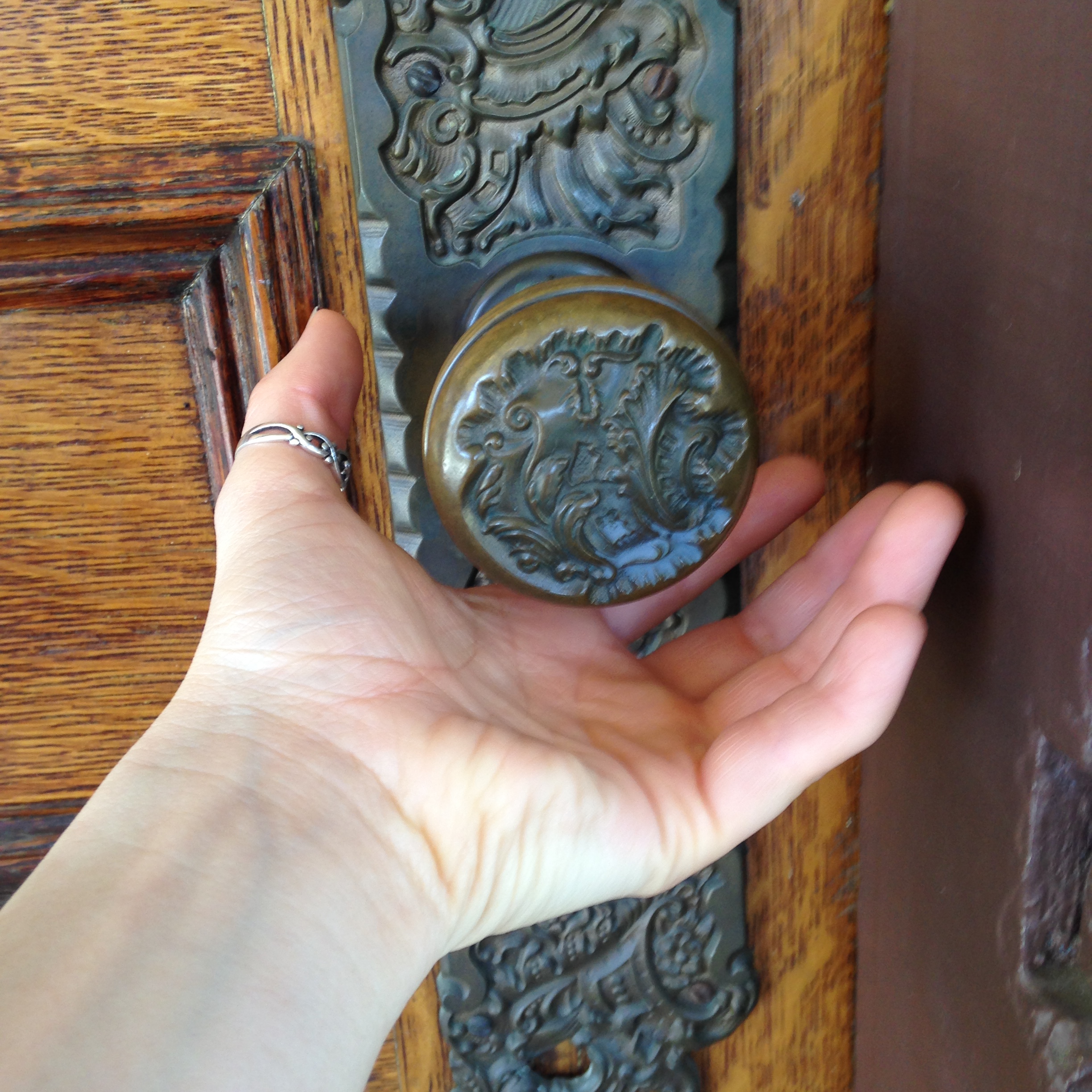
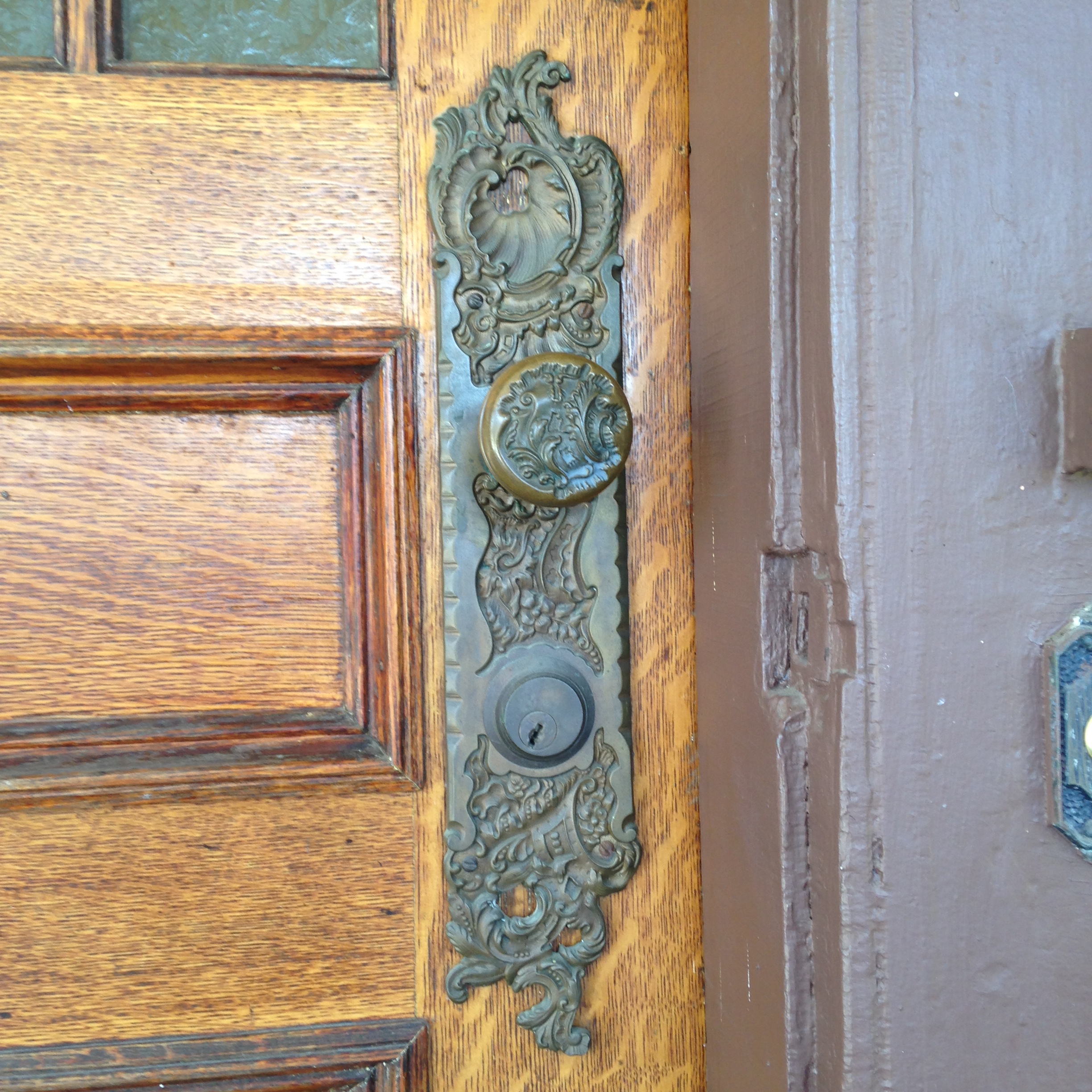
On February 27, 1895, Abraham and Gertrude Deyo-Brodhead opened the doors of their newly renovated home, “fitted up in the most elegant manner,” to “a large company who had come to pay their respects” (“At Home”). With their rococo design and burnished gold finish, the bronze door knob and escutcheon which grace the front door of the Deyo House are the first of many elegant fittings meant to impress visitors. Yet, their highly ornamental nature hints at the economic and cultural impact of the Industrial Revolution on the New Paltz community as well as one family’s fall from fortune.

Physical Description

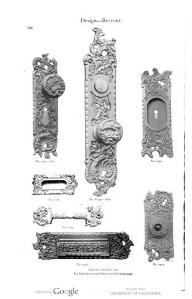
Both the knob and the escutcheon have an elaborate floral pattern cast on the surface, giving the set an eye-catchingly elegant (or ostentatious, depending on one’s tastes) air. The escutcheon is especially attention-grabbing. Measuring sixteen by three inches, it is a roughly rectangular shape. However, the top and bottom have been molded into the form of acanthus leaves, creating an asymmetry that draws the eyes away from the relatively simple wood door to the more impressive hardware. Although the bronze has become dull and tinged with verdigris, one can imagine that its original burnished gold color would have made the set even more beautiful to those coming to greet the Deyo-Brodheads as they settled back in, particularly when it was lit by the house’s recently installed electrical lighting, a feature that would have been something of a luxury at the time.

The acanthus leaves  at the top and bottom of the escutcheon are beautifully molded, giving the otherwise rectangular shape a fluid appearance.

The acanthus leaves at the top and bottom of the escutcheon are beautifully molded, giving the otherwise rectangular shape a fluid appearance.       Picture Credit: Elise Bruce

Provenance

Picture credit: Reading Hardware Catalogue

Picture credit: Reading Hardware Company

Reading Hardware

Picture Credit: Reading Hardware Company

The set was manufactured in the late 1800s by the Reading Hardware Company, located in Reading, Pennsylvania. According to Morton L. Montgomery’s history on the area, the company, founded in 1852, specialized in “furnishing all the necessary hardware in the construction of large hotels and office buildings” in large cities such as New York and Chicago and was particularly well known for its “unique and artistic designs in fine bronze” (Montgomery 189). The design found on the Deyo house knob and escutcheon, a rococo style called Belfort, was available for purchase through the company’s widely circulated Illustrated Catalogue of Fine Locks and Builders’ Hardware. It is likely that the Deyo-Brodhead’s selected the door knob and escutcheon from this catalogue as they planned their renovations. The set has remained on the front door ever since although the house has changed hands three times. The last owner, Harold L. Wood, sold the house to the present owner, the Huguenot Historical Society, in 1972.

Historical Narrative

The knob and escutcheon embody a much larger struggle in terms of the culture and economy in New Paltz at the turn of the century, a struggle that comes to a head in the 1895 renovation of the Deyo house. Built by Pierre Deyo around 1692, the original Deyo house was modest stone structure not unlike the neighboring Bevier-Elting house. While later descendants added a wing to accommodate the growing family, the exterior of the house otherwise remained relatively the same. This changed when the Deyo-Brodheads inherited the house in 1893. Although indubitably proud of their Huguenot heritage (both could trace their lineage back to Christian Deyo, patriarch of the Deyo family and one of the twelve signers of the original patent), Abraham and Gertrude nonetheless desired a much more ornate space than the stone house built by their ancestors. As Jaquetta Haley notes in her summary of Deyo House history, the couple was highly involved in New Paltz social life, at one point even hosting a masked ball for a group of notable local figures (8). Their decision to modify and expand the house seems motivated partially by their desire “to entertain on a grander scale” (8).

Yet, Haley implies that the couple’s social ambitions may have been curbed had it not been for a modest inheritance bequeathed by a wealthy relative. Although they owned a significant amount of land in New Paltz area, the Deyo-Broadheads were not a particularly wealthy family. Instead, their social prominence was tied to the family’s deep roots in the area as well as the Deyos’ long standing participation in community leadership, starting with Christian Deyo and extending on through Abraham’s great grandfather (a judge) and grandfather (a local sheriff). However, in 1890, the death of one of Abraham’s paternal great uncles left the newly wed Abraham and Gertrude with $150,000 (Haley 7). While it was not a huge sum, this inheritance allowed the couple to pursue their interests on a much larger scale than they had previously. For Abraham, this meant investing in the construction of a small horse racing track, the Brodhead Driving Park. Built on some of Brodhead’s holdings on the other side of the Wallkill, the track helped to supplement the couple’s income as well as bolster their reputation in the community. Although it is less clear what Gertrude’s interest were, Haley indicates that she enjoyed her role as a “social doyenne of New Paltz” (17). It seems plausible, then, that in her drive to throw larger and more tasteful events, Gertrude would be the one to prompt the renovation of the old stone house into the elegantly fitted space that so impressed the reporter of the New Paltz Independent on that February night in 1895.

Regardless of who proposed the renovations, the Deyo-Brodheads began making plans to modify the house almost immediately upon taking ownership, transforming it from a simple stone house to a Queen Anne Style manor. It is in, in the words of Kenneth Hasbrouck, “an example of how a residence must submit to remodeling as the occupants acquire wealth” (Hasbrouck). Hasbrouck’s comment hints at the discomfort with which New Paltz residents met the Deyo-Brodhead’s plans to renovate. An article in the New Paltz Independent dated July 13, 1894 laments, “The changes in the building will make it scarcly [sic] recognizable” (NPI).  Indeed, the stone first floor is the only vestige of the original structure still visible. The same article argues that “at least of them [the old stone houses on Huguenot Street] should be set apart and strictly guarded from the march of modern improvement in order that future generations may know in what manner of houses their ancestors lived” (NPI).

The fear of “modern improvement” obscuring the historical character of New Paltz indicates the community’s fierce loyalty to their heritage, but it also suggests the conflict between traditional local values and the cosmopolitan trend towards the ornate, even theatrical, sensibilities amongst the area’s wealthy citizens. Almost every feature of the Deyo-Brodhead’s home is meant to inspire reverence and respect not only for the Deyo-Brodhead’s heritage but also the family’s more recent wealth and achievements. Positioned prominently on the front door, the bronze door knob and escutcheon affirm this prestige, reminding all visitors that this house belonged to influential individuals. Yet, the grandeur rests on a certain superficiality made possible in part by the relatively new ability to mass produce luxury items using machine labor. The result was seemingly elegant items that were relatively affordable, especially when bought in bulk. The advertisement in the Reading Hardware Company’s catalog notes that the Belfort knob and escutcheon could be purchased for around $3.90 (roughly $100 today) (RHC). While that might seem expensive for a door knob, it pales in comparison to the cost of purchasing a similar piece from a blacksmith.

However, what they might have saved by buying machine fabricated hardware, the Deyo-Brodheads spent or invested elsewhere, requiring them to eventually take out two mortgages on the property. A confluence of financial problems, starting with the collapse of the race track as a source of income, would at last cause the couple to lose the house and their ancestral land holdings. Unlike most of their property, which was auctioned off to recoup the family’s losses, the grand door knob and escutcheon would remain with the estate, a silent testimony to their hopes and dreams as well as an embodiment of the changing times.

.

References

“At Home.” New Paltz Independent. 1 Mar. 1895. Print.

Blumin, Leonard. Victorian Decorative Art: A Photographic Study of Ornamental Design an Antique Door Knobs. California: Victorian Design Press, 1983. Print.

Davey, Weston. Personal Interview. 9 Apr. 2015.

Haley, Jaquetta. “Furnishing Plan: Deyo House.” New York: Huguenot Historical Society, 2001. Print.

Hasbrouck, Kenneth E. Old Stone Houses: Huguenot Street, New Paltz, N.Y. New Paltz: n.a., n.d. Print.

Montgomery, Morton L. Historical and Biography Annals of Berk County, Pennsylvania. Chicago: J.H. Beers & Co., 1909. Print.

New Paltz Independent. 13 Jul. 1894. Print.

Reading Hardware Company. Illustrate Catalogue of Fine Locks and Builders’ Hardware. New York: 1899, Print.

The Spinning Jenny

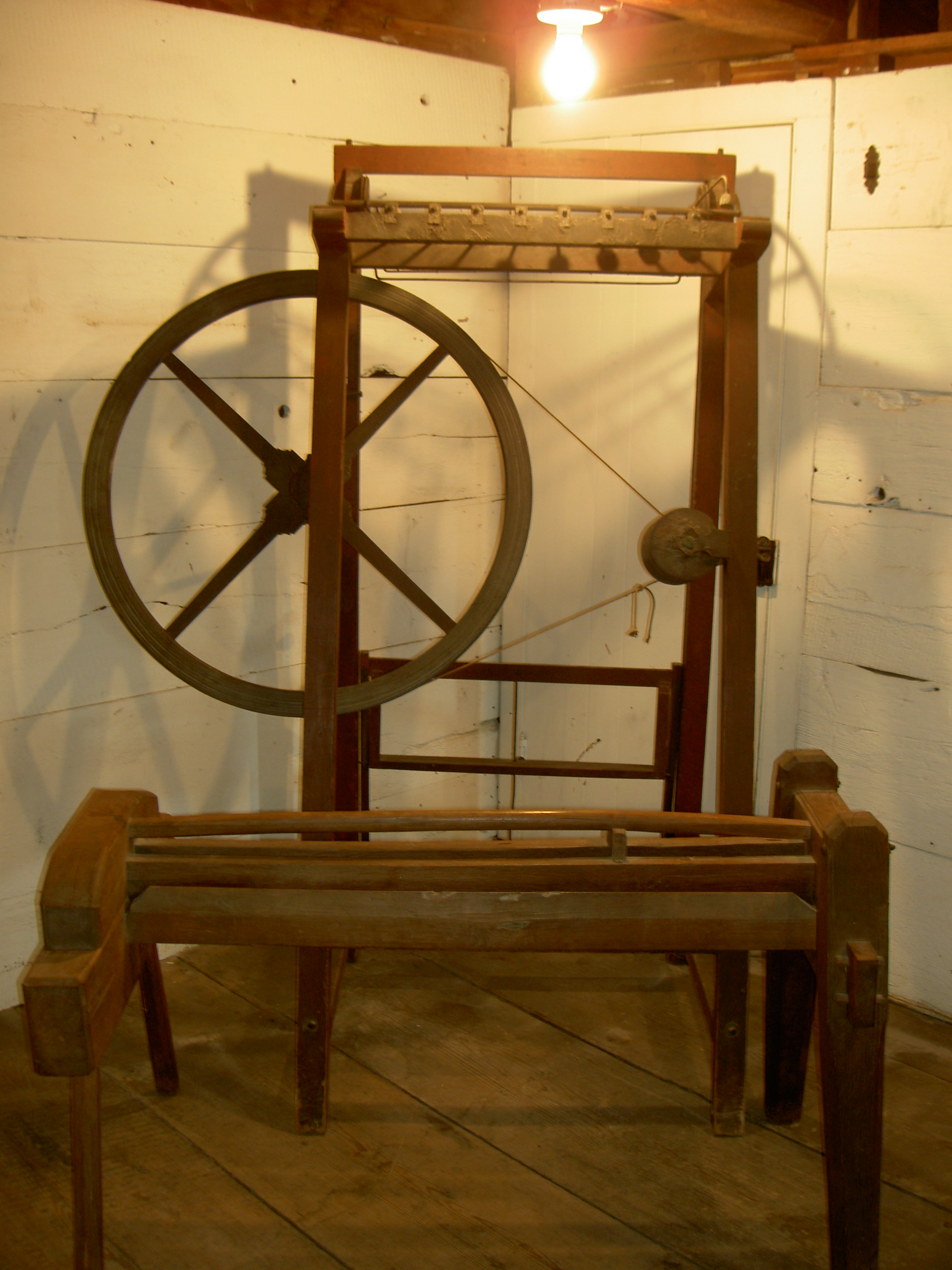
Caption: This spinning jenny is a typical specimen of the kind often found in homes during colonial and post-colonial times. 837.1It was given to the Memorial House (the Jean Hasbrouck house) by its owner, William Henry Dill Blake, whose family owned the spinning jenny before him and whose wife and daughter (both named Matilda Booth Blake) likely used it regularly as a household chore. Built in the late 18th century, this spinning jenny is a reminder of the role of women in the establishment of one of New Paltz’s successful families.

A photograph of the Jean Hasbrouck House where the jenny is located.

A photograph of the Jean Hasbrouck House where the jenny is located.

Physical Description: This spinning jenny is comprised of a wooden frame and a large, slightly corroded iron wheel with four spokes placed at even intervals. On the right-hand side of the wheel is a grooved iron cylinder (also sporting slight corrosion with age), likely used for winding the finished thread. On the front left pole of of the frame are scratched the initials “HB;” additionally, the spinning jenny is marked with the number 213, likely a production or maker’s mark. According to the file in Historic Huguenot Street records, there are likely some pieces  missing.

Diagram of a Hargreave spinning jenny

Diagram of a Hargreave spinning jenny (since the image above is the only one available of the Blakes’ jenny.

Provenance: The first clue to determining the origin of the spinning jenny is the inscription “HB” on the frame. As this spinning jenny was built in the late eighteenth century, while the invention was still fairly new (American Fabrics Magazine 220), and also considering that William H.D. Blake was born much later, in 1843 (according to the Blake family papers on file at Huguenot Street), it is logical to assume that the spinning jenny was probably first owned by Blake’s grandfather or great-grandfather.  Also according to Huguenot Street records, the spinning jenny was owned by the family until Blake’s donation of the piece in 1910; it most likely came into his possession as a family object that was passed down to him. The maker’s mark, “213,” yields no significant results, though a search of the history of the spinning jenny reveals that several were manufactured underground (that is, without the inventor’s permission) because the design was so brilliantly simple and that there was dispute during the time of the spinning jenny’s true inventor and origin (Baines, Arkwright); Blake’s spinning jenny therefore could have been manufactured by any number of individuals.

Narrative: The Blake family moved to New Paltz in 1881, when they purchased the DuBois farm; shortly thereafter, William and Matilda, the two youngest Blake children, were born. During this time, spinning, weaving, knitting, and almost all other forms of textile production were considered “women’s work,” as such activities allowed them to work primarily in their homes (thus fulfilling the typical duties of wife and mother) while still providing the family with additional income from selling the resulting product. Family workshops were the norm, to such an end that almost every household contained at least one “knitting frame” (loom) and one spinning wheel (AFM 217). According to Historic Huguenot Street records, the Blake spinning jenny replaced an older spinning wheel previously owned by the family; one can easily imagine the mother Matilda spinning yarn at home on a typical day to the sounds of her children’s laughter and the pitter-patter of little feet. Later, as the daughter Matilda grew bigger, her mother would have taught her how to spin the yarn herself, to the end of her being expected to produce her own quantity of yarn as an adult. Unlike her brothers, Matilda spent her entire life on her family’s farm on Libertyville Road in New Paltz. It is likely that she continued to make use of the spinning jenny through her school years up until her enrollment in the New Paltz Normal School. Beyond that, the latest mention of the spinning jenny in historical records is a newspaper clipping, dated May 6, 1910, that announces William H.D. Blake’s donation of the piece to the Memorial House. While a seemingly random choice, the spinning jenny is actually a quite significant piece, as it symbolizes an industry and a community of workers that played a very large role in shaping the economy of New Paltz, as well as a symbol of the financial success of one of New Paltz’s most successful farming families.

Works Cited:

American Fabrics Magazine. Encyclopedia of Textiles. Englewood Cliffs, NJ: Prentice-Hall, 1960. Print.

Baines, Edward (1835). History of the cotton manufacture in Great Britain;. London: H. Fisher, R. Fisher, and P. Jackson.

Roth, Eric. Ed. “William H. D. Blake Family Papers (1794-1982).” Historic Huguenot Street Archives. Historic Huguenot Street, 10 July 2002. Web. 12 May 2015. <http://www.huguenotstreet.org/william-h-d-blake-family-papers/&gt;.

Infinite thanks to Ashley Trainor and Carrie Allmendinger from Historic Huguenot Street for sharing their records, knowledge, and expertise with me for this project.

Colonial Revivalism in the Deyo House: The Purpose of a Print

IMG_1716

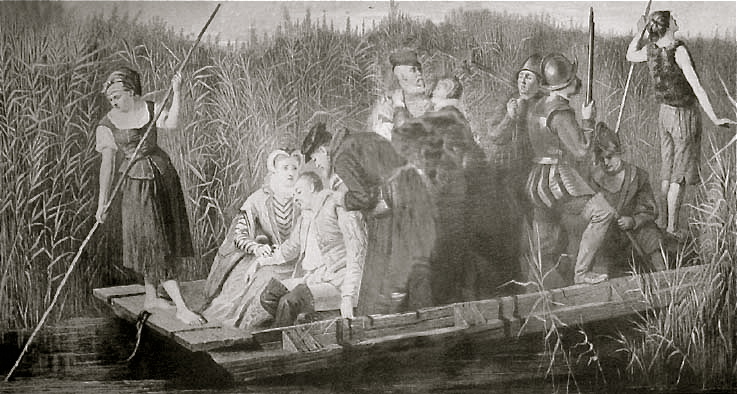
This late 19th century print depicts a romanticized scene of the Huguenots as they fled religious persecution in France. It is one of three such images in Abraham Brodhead’s office that act as a visual reminder of his cultural participation in the Colonial Revival movement that once swept through the Hudson Valley. (Personal Photo)

“Escape of a Huguenot Family after the Massacre of St. Bartholomew”

London published June 1st 1880 by Henry Graves & C° the proprietors publishers to HM the Queen and TRH the Prince & Princess of Wales, 6. Pall Mall – copyright registered. Entered according to Act of Congress in the year 1880 at the Library of Congress in Washington.

Engraved by J. Scott

Printed by Holdgate Brs.

boatpicture

“Escape of a Huguenot Family after the Massacre of St. Bartholomew” (Courtesy of betheafamily.org)

Caption: This late 19th century print depicts a romanticized scene of the Huguenots as they fled religious persecution in France. It is one of three such images in Abraham Brodhead’s office that act as a visual reminder of his cultural participation in the Colonial Revival movement that once swept through the Hudson Valley.

Physical Description: Hanging on the north wall of Abraham Brodhead’s small second story office is a 25.5 in. x 34 in. print, set within glass and against a 3 in. linen mat. The frame is ornately carved wood, about 2 in. thick and decorated with gold colored paint. The prints’ somewhat ostentatious frame very much reflects the propagandistic nature of the scene, and both serve to catch the visitors attention almost immediately. The composition pictures a young peasant woman standing at the back of a raft, steering it through tall reeds while the elderly woman sitting next to her looks worried as she consoles the disheveled elderly man leaning on her shoulder. Behind the couple are two bearded gentlemen, one who leans down to aid them, and another who stands proudly turned towards the front of the raft while a woman wraps her hand around his neck and gazes desperately at his profile. Just in front of them are two men wearing armor, one faces frontally while the other looks back towards the party sympathetically. Lastly, two young peasant boys crowd the front of the boat, one attending to his weapon, and the other standing with his head up, looking eagerly towards whatever might lie ahead.

IMG_4297

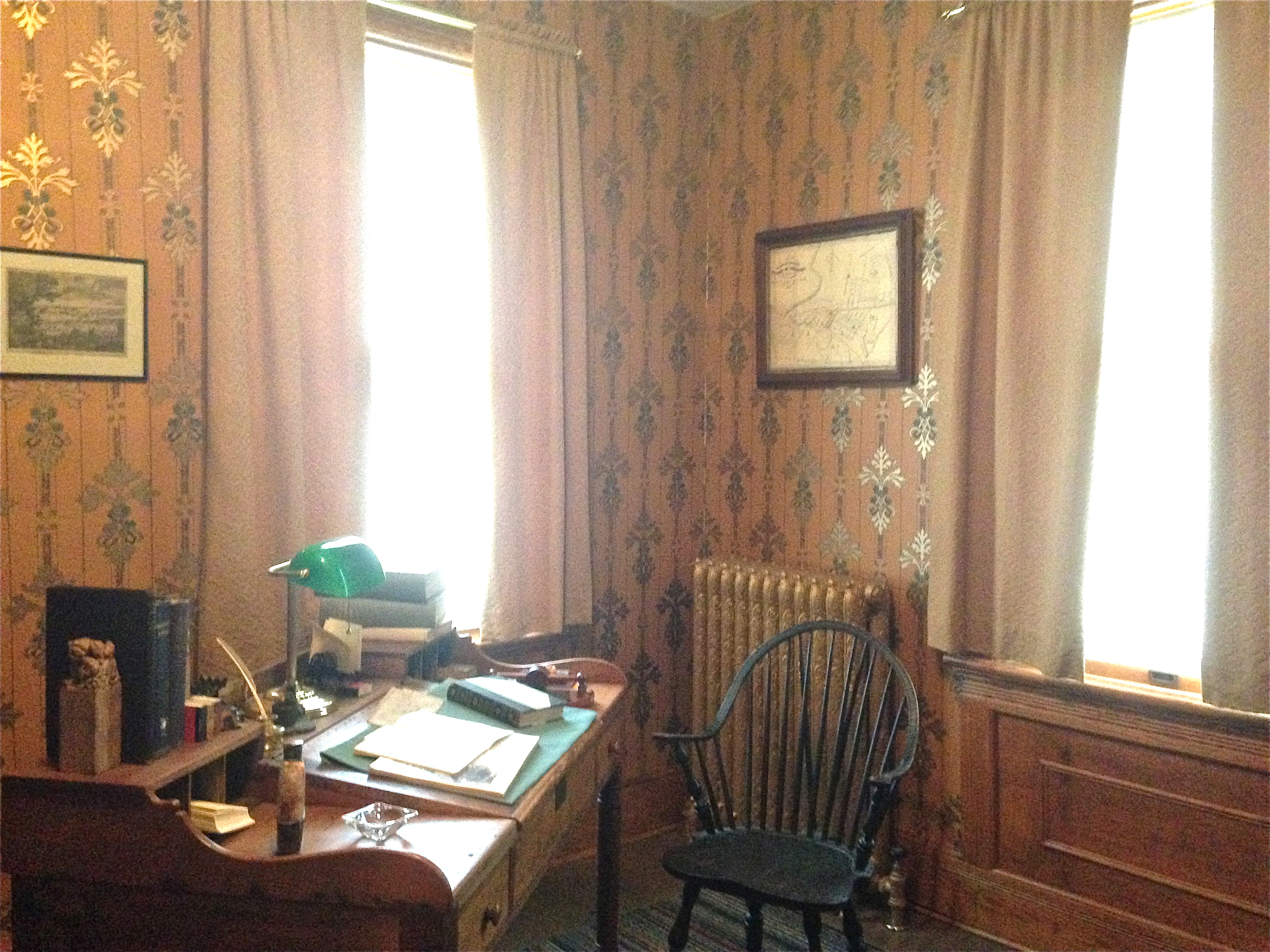
The northwest corner of Abraham Brodhead’s office. Half of the print is visible on the right side of the picture. It is the first decoration that a visitor encounters upon entering the room, and is situated directly opposite the door. (Personal photo)

Provenance: The printed inscription that lies just below the image is a key factor in discovering the origin of the print. James Scott (ca. 1809-1889), whose name is found on the lower right hand corner, was one of the finest English engravers of the mid to late 19th century. Not much is known about his art education, but he became equally talented in the genres of portraiture, history paintings, and sporting subjects. Scott earned notoriety when his portrait of the Duke of Wellington was published in 1837, and over the next fifty years he engraved a large number of designs after the works of contemporary painters. Henry Graves & Co. was a publishing house in Pall Mall, London that was active between 1844 and 1899, and it ended up publishing over one hundred of Scott’s prints within that time period. The National Portrait Gallery in London now houses over two hundred prints published by Henry Graves & Co., twenty-two of which are attributed to the artist James Scott. The inscription informs us that this print was published on June 1st, 1880, and dedicates the work to Her Majesty the Queen of England, and Their Royal Highnesses the Prince & Princess of Wales. This formality may seem odd in modern practice, but it was customary to honor the head of state in all matters of fine and high art especially for those who distributed prints & literature. Although it is not known how this particular print came to be in the Deyo-Brodhead family collection, we are able to infer that it was some point after 1880 when, as the inscription tells us, it travelled to Washington and passed through the Library of Congress.

IMG_4295

The northeast corner of Abraham’s second floor office. (Personal photo)

Narrative: You may wonder how this unique foreign print became a part of the modern day Historic Huguenot Street collection. It’s a dramatic image of a purely fictional event; the raft that all ten Huguenots seem to be floating on could have never held the weight, and the socioeconomic diversity of their fleeing party (as is evident in the clothes they’re wearing) appears democratic, but highly improbable. It is true that over 5,000 French citizens were killed during St. Bartholomew’s massacre on August 23, 1572 in Paris alone, and thousands more fled the country permanently, but this particular rendering of the escape is inaccurate. What, then, is the point? Why would a respectable descendent such as Abraham Brodhead want a romanticized print that remembers this traumatic moment in French Huguenot history hanging in his primary office? Understanding the owners’ personal history and examining the broader cultural context of the Hudson Valley during the late 19th century yields quite a fruitful explanation.

IMG_1720

A detail of the printed inscription. Only the title is visible without a magnifying glass. (Personal photo)

In 1894, Abraham and Gertrude Brodhead received notice that they had inherited what they believed to be a large sum of money from a “rich banker uncle”. Pierre Deyo was one of the original Patentees of New Paltz and had built his stone house along the main thoroughfare of the settlement in 1720. Slowly over the years, Deyo’s grandchildren added other stone additions to the rustic house, but none as dramatic as what Abraham and Gertrude decided to build nearly two centuries later.

At the ages of 37 and 32, Abraham and Gertrude regarded their inheritance as an opportunity to join a new, upper-echelon of society. The period of Colonial Revivalism that emerged in 1876 was a national expression of Early North American culture; although its underlying goal was to create a particular historical consciousness pertaining primarily to the original East coast colonies, the movement manifested itself as a style of architecture, decorative art, and landscape design. In keeping with the trend, the couple took out several bank loans (all of which they believed they would be able to pay off after the family money came through) and began reconstructing their small ancestral stone house into a three-storied mini-mansion. The stone foundation was retained as an important reminder of the family history, and once construction was complete, the original one room stone house became the couples’ main entertaining space. Abraham and Gertrude were able to welcome their guests into their lavish, contemporary home and point to the exposed wooden beams of their sitting room as a visual reminder of their ancestors’ hard work (and more importantly, of the Brodhead’s inherent privilege to that status).

abrham brodhead

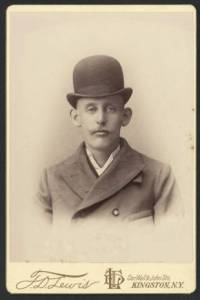
Studio portrait of Abraham Deyo Brodhead (b. 1863-1926). Photo ca. 1880-90 (Courtesy of Hudson River Valley Heritage)

getrude broadhead

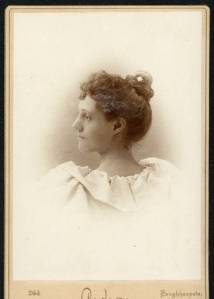
Studio portrait of Gertrude Deyo (b. 1868-1926), daughter of Matthew Deyo & Julia Etta Dubois Deyo. She married Abraham Deyo Brodhead in 1890. Photo ca. 1890 (Courtesy of HRVH)

At this point in history the Brodheads were “competing”, for lack of a better term, to be part of this new realm of American society, and were hoping to achieve the same level of opulence and grandeur that they saw in families like the Roosevelts & the Rockefellers. The Hudson Valley had turned into a hot spot for Colonial Revivalism and in an effort to stand out, the Brodheads chose to advertise their heritage.

DSC_0535

A modern view of the Deyo House. Evidence of the original stone structure built by Pierre Deyo in the 18th century can be seen on the exterior of the first floor. (Courtesy of Tania Barricklo/Daily Freeman)

Besides their newly impressive home and manicured gardens, what better way to display that particular connection than through decoration? This is where the interior of the Deyo-Brodhead house becomes important to the underlying Colonial Revivalism theme; family heirlooms and antique furniture inhabit every room, and dozens of prints & portraits dot the walls. In 1894, the Brodhead’s family home had become a stage, and these objects, their props. The image that James Scott created in 1880 is obviously sympathetic to the Huguenots, but more importantly, it portrays them as a resilient and brave people. The proud man comforting the emotionally distraught woman on his chest as he looks towards the future is an overt symbol of the Huguenots’ heroism. They were persecuted as French Protestants and run out of their own country, but instead of dying out and accepting defeat, the Huguenots became pioneers of a new land. When Pierre Deyo and the eleven other founders of New Paltz came to settle the area, they faced deadly inclement weather, starvation, and hostility from the Esopus Indians who were ready to fight for their land. These are the types of stories that would have been told as esteemed friends and colleagues visited with Abraham in his office, and these are the pieces of history that served to glorify the Brodhead name.

gertrude 2

Studio Portrait of Gertrude Deyo in Hat. Photo ca. late 1890’s. (Courtesy of HRVH)

It seems somewhat strange that the true value of this print is indeed the lie that its able to tell. Its ornate frame indicates that the print was most definitely displayed and appreciated as a piece of fine art, but its true function was that of an ancestral advertisement. Although a modern perspective could perceive the Brodhead’s as power-hungry, it is crucial to remember that they were one family among a large scope of the American population who participated in this cultural obsession. In many ways, the Deyo House and the 19th century art and artifacts that are now kept protected inside are able to add to the rich history of the original settlers. By examining the Brodhead’s and the way in which they attempted to re-establish a family legacy, we are able to better understand the complexity of this noteworthy print, and the role it had in reviving an idealized memory of the Huguenot settlers.

REFERENCES:

“August 24: This Day in History, St. Bartholomew’s Day Massacre.” History. A&E Networks Digital, n.d. Web. 12 Apr. 2015. <http://www.history.com/this-day-in-history/saint-bartholomews-day-massacre&gt;.

“Henry Graves & Co. (active 1844-1899), Publishers.” The National Portrait Gallery. NPG, n.d. Web. 12 Apr. 2015. <http://www.npg.org.uk/collections/search/person/mp12751/henry-graves–co?search=sas&sText=Henry+Graves+%26+Co&OConly=true&gt;.

“James Scott (ca. 1809-1889), Engraver.” The National Portrait Gallery. NPG, n.d. Web. 12 Apr. 2015. <http://www.npg.org.uk/collections/search/person/mp15031/james-scott?role=art&gt;.

“Massacre of St. Bartholomew in France.” The Bethea Story: First Generation of Bethea Family in North America . N.p., n.d. Web. 8 May 2015. <http://www.betheafamily.org/Bethea-Story.htm&gt;.

Mitchell, Paula A., and Tania Barricklo. “Fleeing French Founders and 300 Years of Huguenot Street History.” The Daily Freeman. San Jose Mercury News, 1 Aug. 2013. Web. 8 May 2015. <http://www.mercurynews.com/digital-first-media/ci_23772113/fleeing-french-founders-and-300-years-huguenot-street&gt;.

“The Katherine Deyo Cookingham Downer Collection.” Hudson River Valley Heritage. N.p., 19 Mar. 2007. Web. 14 Apr. 2015. <http://www.hrvh.org/cdm/search/collection/hhs/searchterm/Katherine%20Deyo%20Cookingham%20Downer&gt;.

Trainor, Ashley. “Professor Mulready’s Class.” Message to the author. 2 Apr. 2015. E-mail.

Weikel, Thomas. “Professor Mulready’s Class.” Message to the author. 3 Apr. 2015. E-mail.