Jennie C. Overton’s Autograph Book.

When Jennie C. Overton passed around her velveteen autograph book in June of 1889, she was creating a souvenir of her years at university that would last her a lifetime. Fellow classmates inscribed their names, inspiring quotes, and loving memories on each page, sometimes accompanied by photographs or hand-drawn illustrations. What the graduates of the New Paltz Normal School may not have realized at the time, however, was that their signatures, scrawled in perfect script, would document their experience for centuries to come. 

The book itself is moderately sized, approximately 8.25 inches in length, 7.25 inches in width, and .5 inches high. The cover, wrapped in plush, soft, blue-grey velvet and imprinted with the word “Autographs,” is starting to fray and become patchy with age. The pages, once crisp and firm, are yellowed around the edges and delicate, smooth but slowly turning to dust. A beautiful cover page, decorated in blues, creams, and browns, pictures a young lady reading, perched comfortably on the letter A for autograph.

And on the first page of the book, written in slanted, neat cursive, the name Jennie C. Overton

We might picture Jennie, perhaps sitting at her writing desk, perhaps in her bedroom, casually writing her name in her brand new autograph book, unaware of how this one single act would lead a future SUNY New Paltz undergraduate student to research her life and death, her impact on the world. Who was she? Where was she from? What was she studying? 

Jane C. Overton, nicknamed Jennie, was born on October 29th, 1865 in New York. Her parents were Wallace and Anna Overton, and she had three siblings: William, ten years her senior; Edna, two years her junior, and Lillie, four years her junior. The family started in Islip, on the south shore of Long Island, NY, but eventually moved to Bayport, NY by the time Jennie was 14. Her father was a farmer and her mother a housewife. 

There is not much documentation of Jennie’s life in the years before her arrival at the New Paltz Normal School. Once there, however, Jennie studied English and obtained her degree in 1889. At her commencement ceremony, Jennie presented an essay called “The Universal Language,” in which she discussed the promise of the Volapük language. Volapük is a constructed language that was created in 1879-1880 by Johann Martin Schleyer, with the goal of creating one language that all people of different countries could learn and speak. In her speech, Jennie said, “The world needs a common and simple medium of expression. Many attempts have been made to supply this need, but Volapük is the first and only one that gives evidence of success.” 

Jennie returned to New Paltz Normal School a second time, graduating with a second degree in old elementary English in 1893. Her roommate of that year, Bessie Monsell, wrote lovingly in her book, “I shall always look back with the greatest pleasure to the happiest year of my life which was spent with you, and to that time when I found a friend, that was a friend indeed. Remember me ever, as your loving room-mate of 1892-93, Bessie R. Monsell, Greenport, NY.”

Jennie disappeared from records again until 1900, when she is documented living with her parents in Bayport and working as a teacher. At this point in time, aged 35, she was still unmarried.

Another page of her autograph book is signed by Clara T. Hawkins and reads:

“To Miss Jennie C. Overton,

‘Only do thou in thought
And heart, to Him hold fast;
Be patient; more than thou
Hast sought,
Will come to thee at last.’ 

Lovingly yours,
Clara T. Hawkins,
South Haven, L.I.” 

The inscription would prove to be prophetic in a way. Sometime between 1900 and her death twelve years later, Jennie C. Overton would marry Clara T. Hawkins’ brother, Irving Hawins. They never had children. 

In July of 1909, the Kingston Daily Freeman noted that a Jennie C. Overton of Bayport, NY, entered Sahler’s Sanitarium in Kingston, NY. It is likely, judging by her death a few years later, that this was the same Jennie.

Jennie’s husband died in 1911, followed shortly by Jennie herself on the 28th of April, 1912. She shares a plot with her husband in the David Hawkins Cemetery in Suffolk County, New York.

The Psychology of Things

ImageIf our bodies were corporations, our brains would be the big bosses in crisp black suits that hold all of the power and make the executive decisions. Our brains are so powerful— they determine our outlook on life, how we interact with the world, and how we think about objects. Psychology is the scientific study of the mind and its functions. Psychologists have scrutinized the relationship between people and objects for many years since objects play such a significant role in our society. Even thousands of years ago, before items were easily available to many people, groups of humans used the environment around them to create objects that had some sort of purpose, either for enjoyment, survival, or simply to make life easier.

So what is so fascinating about our minds when it comes to objects? Each individual perceives the world around him or herself differently, which leads to many perspectives on objects between different individuals, families, communities, and cultures. If one specific object could travel around the world and meet every culture on our planet, it would be treated in hundreds of different ways since many cultures would view the object in unique ways from another culture.

Because the mind is so complex, there are thousands of topics psychologists can study in relation to objects, including differences in cultural views on objects and materialism, attachment to objects in adults and children, and consumer psychology. Through study of these topics, psychologists have been better able to understand how the human brain works and explain why humans act the way they do towards objects.

Image

Through researching worldviews on objects and materialism, psychologists have discovered that because cultures are so diverse, many cultures find it terribly difficult to understand other cultures’ views on objects. For example, in 1848, Native American culture was extremely different from the settlers of European descent. Over 300,000 Europeans flooded into California to look for gold, because in their culture gold was a source of wealth. However, in Native American culture, one did not become “wealthy” from obtaining objects like this. Gold had no value in their lives. Because their culture placed no emphasis on the value of gold, some tribes believed that the gold must have been a supernatural deity, since they understood and believed in the supernatural. This was the only way that they could “understand” the settlers’ obsession with gold. When we don’t understand the way another culture thinks about an object, we often project our own values and beliefs onto their thinking because it is the only thing that our mind can truly understand.

 Psychologists have also learned how different cultures view materialism and possession and which countries are the “most” materialistic. The United States seems like the most “materialistic” culture, since we are obsessed with making and spending money. However, according to a study conducted by Gülitz and Belk, there is a country that is more materialistic than the United States— Romania. It is interesting to think about Romania as a materialistic nation (since many people only think of Romania in reference to Dracula and Frankenstein). Romanians desire many household objects that we take for granted or don’t even consider having want for. This view may be because there was a debt in Romania, which led to rationing on many items. When we are denied something, psychologists have found that we tend to desire it even more.

Image

 Happiness is really the one thing that human beings desire above all else. Through study of humans and their objects, we can learn that having more objects does not necessarily make us happier. Take Graham Hill, for example, who was miserable while surrounded by thousands of fancy objects, but is now incredibly happy leading a simple life with much less “stuff.” We live in a material world, and we are surrounded by people and advertisements telling us to buy, buy, buy! We tend to feel that if we just buy one more object, we will be happier. Companies take advantage of this belief, and have created an entire field called Consumer Psychology. Psychologists are hired by companies to tweak their advertising to make their products more appealing to consumers. However, the happiness we feel from purchasing new things is only temporary, and we soon discover that having more does not necessarily bring the happiness we desire. This can be seen through attachment to objects, which many psychologists choose to study. Attachment to objects has become such a big problem in our world today that there are psychologists that specialize specifically in excessive attachment such as hoarding.

As much as 5% of the US population has an unhealthy attachment to objects, and 4 million people in the United States are hoarders. Hoarding has recently been placed under the spotlight with the new TLC show, “Hoarding: Buried Alive,” which follows the struggles of hoarders trying to part with objects that compromise the health, happiness and order of their lives. Although these people have lots of stuff, they are not necessarily happier, and their quality of life is both low and unsafe. Psychologists have studied hoarders to find that they keep, buy, and treasure items because they feel they will need them in the future or they truly believe it has sentimental value to them. Understanding the psychology of hoarding objects has helped psychologists and a hoarder’s family members to be able to help the individual clean out his or her house and keep from hoarding again. This is very important because understanding this could help change up to 4 million people’s lifestyles, making their homes safer for them and their families.

Image

Attachment to objects is more frequent than most people think. In fact, 70% of children are attached to a particular childhood toy or blanket. Psychologists have developed the attachment theory, which suggests that people attach to objects in order to compensate for perceived unreliable close relationships in their lives.

Image
Objects are a huge part of our environment as humans. In order to understand the mind, we must begin to understand how we interact with objects and what effects they have on our lives. For better or worse, material things surround us. The key to happiness is to understand which objects are helpful or harmful to our mental state and how their presence influences the way we think and behave.

BIBLIOGRAPHY:

“Filling the Void.” Hoarding: Buried Alive. TLC. 18 April 2010.

This television series shows various cases of hoarding. The types of materials hoarded vary from clothing, yard sale items, garbage, animals, and food. In most cases, there is a tragic event that triggers hoarding. In all cases, the lives and well-being of the hoarder and their family are compromised in the presence of so many objects.

Ger, Gülitz. Belk, R. “Cross Cultural Differences in Materialism.” Journal of Economic Psychology 17.1 (1996): 55-77. Web. 31 Mar. 2013.

http://www.provost.bilkent.edu.tr/guliz/economic_psychology.pdf

A study is conducted to examine various cultural differences in views towards materialism, possession, envy, non-generosity, and preservation. Results show that consumers from affluent Western countries and consumers from less affluent countries are not more or less materialistic than one another. Results also hint that the most socially and economically dynamic countries show the highest levels of materialism (Romania, Ukraine). Surprisingly, The United States does not have the highest level of materialism.

Hill, Graham. “Living With Less. A Lot Less.” Sunday Review: The New York Times. The New York Times, 9 Mar. 2013. Web. 20 Mar. 2013.

http://www.nytimes.com/2013/03/10/opinion/sunday/living-with-less-a-lot-less.html?pagewanted=2&_r=2

A young man shares his story of how materialism consumed him. He came into a great deal of money by chance, and found himself living lavishly with an abundance of clothing, furniture, and motor vehicles. He later finds that life with less objects is more freeing and results in happiness and appreciation.

Morris, Steven. “Why children become to attached to toys and comfort blankets”. The Guardian. The Guardian, 8 Mar. 2007. Web. 31 Mar. 2013.

http://www.guardian.co.uk/science/2007/mar/09/psychology.uknews

A study is conducted to test if children are more likely to choose an “original” toy that they cherish versus an identical toy that is brand new. Results show that the majority of children that came in with a toy or blanket they were attached to were likely to choose their original toy, rather than the new “duplicate” of the toy. Psychologist Bruce Hood suggests that children often anthropomorphize certain objects and give them an essence that cannot be duplicated.

Taylor, Steve. “The Madness of Materialism.” Psychology Today: Out of the Darkness. Psychology Today, 10 Mar. 2012. Web. 21 Mar. 2013.

http://www.psychologytoday.com/blog/out-the-darkness/201203/the-madness-materialism

Briefly discusses the European view on gold in the 17th century and the difficulty Native American’s had understanding why the Europeans valued it so much. The author discusses different explanations for materialism, and ultimately suggests that we feel the need to accumulate wealth and materials as a means of alleviating our inner discontents.

Tool of the Past

get-attachgment.aspx

get-attachment.aspx

CAPTION

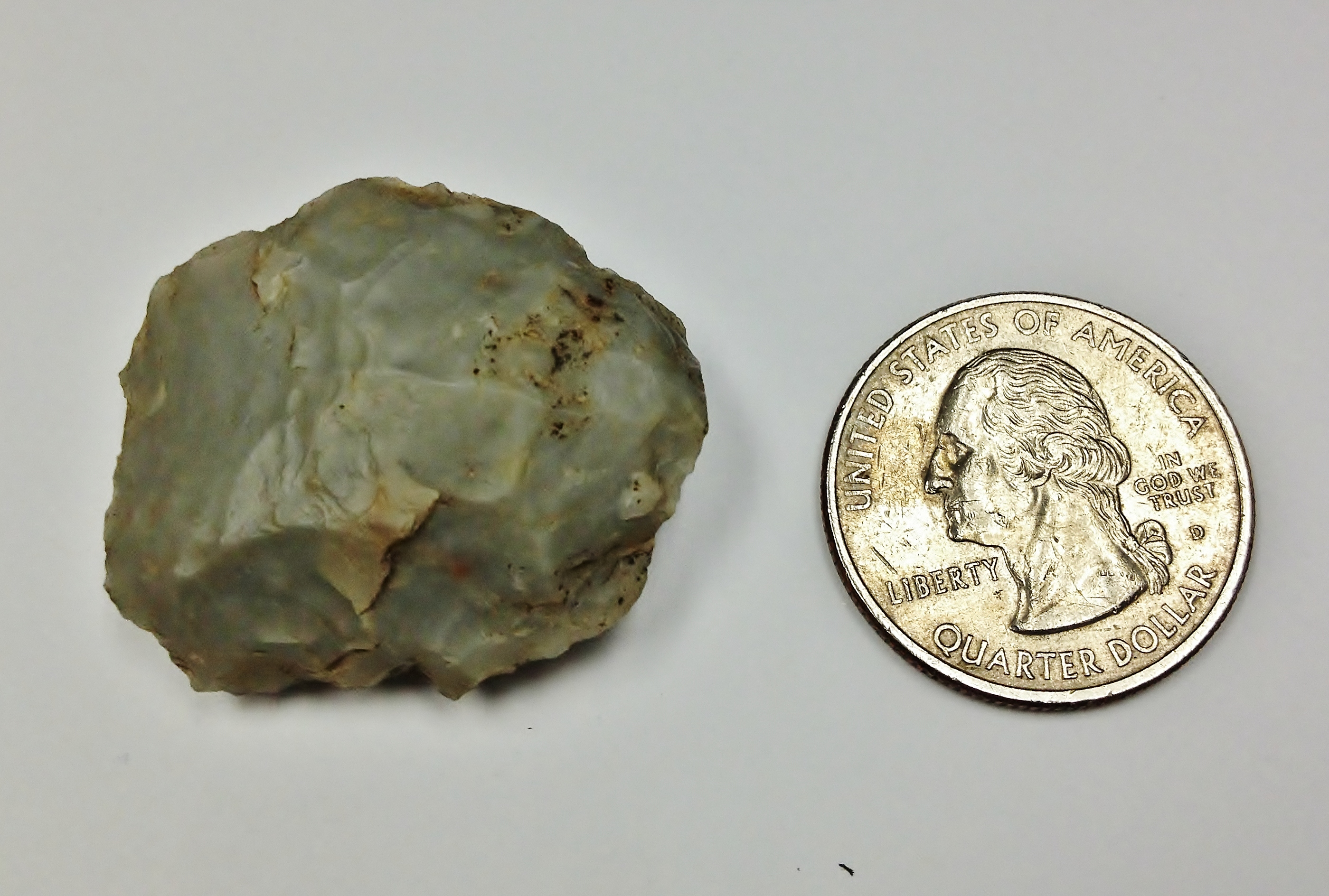
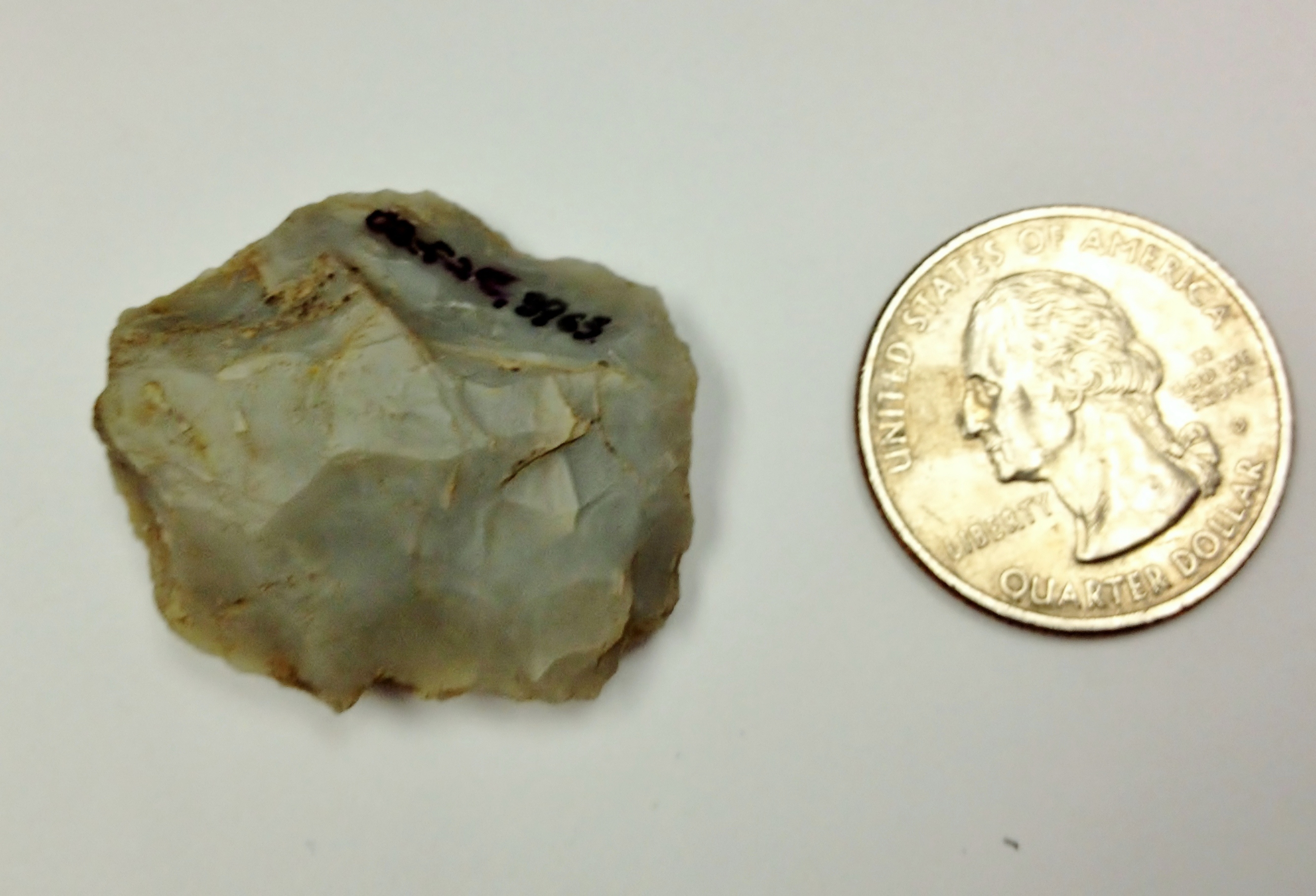
This Native American stone knife, among other stone tools, was essential to the survival and development of the Lenape civilization. It may seem insignificant, but these tools were used throughout Native American history, and it is even more effective in strength and sharpness than our steel knifes today. Because its exact date is unknown, this object speaks for centuries of history at New Paltz.

DESCRIPTION

This stone knife measures around 3.5cm by 2.6cm by .8cm. It is known as a cryptocrystalline lithic, and is made out of chert—either Eppler or Harmonyvale. It was sharpened by chipping flint, and the small sharp pieces could very well have had their own uses. It is a milky white/grey color, has percussion marks, and appears to be flat. It is temporarily non-diagnostic, which means it could have originated anywhere in the time span from 7000 BC-1678.

PROVENANCE

This artifact was found by archeologists in New Paltz on July 27th 2002, in unit 60 at the grid coordinate South 59, East 10. This is the location in historic Huguenot around the corner between the Jean Hasbrouck house and the Deyo house. It was then taken to be cleaned in a lab on August 15th of the same year. The archeologists who procured the small knife go under the initials: JG, LE, LN, and NH. It finally ended up in Dr. Joseph Diamond’s collection where it remains among several other historical and Native American objects found in New Paltz.

gtg

NARRATIVE

Native Americans from anywhere between 7000 BC and 1678 could have used these helpful objects. It is possible it was much bigger than this and chipped with age, or that it was made to be small, which can be useful as well. Perhaps it was from the earlier time periods, before the Dutch settlers came to the Huguenots to colonize. The Native Americans, known then as Munsee’s, had many stone tools like this. This particular tool is a knife, used to cut meat, vegetables, string, or create sharp flints. It is surprising how efficient these tools are, suggesting an understanding and intelligence in the Indians beyond settlers’ conception of them as barbaric. This knife, when chipped properly, is even sharper and stronger than our steel ones today. It was still widely used even after various trades were made between the Europeans and the Native Americans. In place of land, they received various metals, tools, industrial products, and alcohol. Some of these new objects were exponential to their survival, but were also the catalyst to their demise. This particular knife is significant to New Paltz history broadly, as it encompassed the lives of the ones who lived here initially. This item is indicative of how they used nature and what was around them to create sustaining lives and culture.

Because the exact date of this knife is unknown, it encompasses the entire Indian history on the land of what is now Huguenot Street, where it was found. The history of this time span is large and extensive, and takes us back from the beginning of the Indian culture in Munsee country to their demise from European settlement, war, and disease. The knife could have originated around 7,000 BCE, almost 10,000 years ago. This is very early in Native American history, when people belonging to “archaic cultural traditions” began hunting small game like deer and gathering plants more intensively in the Northeast. Between 4000 and 1000 years ago, Native American civilizations began to emerge, and their technological innovations developed, such as pottery, bows and arrows, longhouses, and vegetable cultivations.

It is likely possible this efficient tool originated around this time, or anytime hereafter, as its uses was not diminished by Native American advances or European settlers. It is necessary to unveil this timeline of Native American history in order to cover the potential histories this ambiguous object holds. Around 500 years ago Europeans began sailing to northeastern North American shores, and by 1607 it is discovered that the total Indian population in Munsee country may have been as large as 15,000 people. Around two years later Dutch merchants commissioned an Englishman named Henry Hudson to sail east to find a northern passage to the Orient. He sailed across the Atlantic to find a northwest passage instead and became the first European known to sail up the river that today bears his name. It is around this time fighting between the Indians and Europeans began, and shortly after various foreign diseases plagued the Indians, and by 1618, the 30-Years War broke out in Europe. The expansion of Europe, diseases spreading, trading, and fighting continued over the following 20 years, such as the first Mohawk-Mahican War, which ended in 1628. By 1634, the Indian population in Munsee country declined to somewhere around 6000 people, and by 1645 it dropped to 4000. In 1652, Esopus sachem Harmen Hekan, better known among settlers as Ankerop, started appearing in Dutch records, and by 1659, fighting broke out between Indians and settlers at Esopus. The Indian people living in Munsee country are reduced to less than 3000 as the colonial population in New Netherland reaches 9000 by 1664, and the Dutch signed a treaty ending the war with the Esopus, and New Netherland falls to an English fleet and is renamed New York.

Perhaps this object contains in it the more peaceful beginnings of this account of Indian history at New Paltz, being used and reused by a tribesman or woman to cut various meats, vegetables, and fashion tools and other creations. Maybe it was tossed in favor of a bigger stone that would serve more cutting purposes, or it was lost on a hunt, slipping from the strong mans hands with no time to look back. Maybe it was thrown in a desperate attempt to flee or fight as the European settlers destroyed Native American villages. It is mutually possible that it was one of the most important objects to a person’s life, as an essential key to survival, or the last thing on that person’s mind as his or her very way of existence is being changed and shaped. This small, seemingly insignificant stone knife holds in its mystery the entire Native American history here at New Paltz and our very origins.

lenape

RESOURCES

Grumet, Robert. The Munsee Indians: A History. Norman: University of Oklahoma Press, 2009. Print.

Kraft, Herbert. The Lenape-Delaware Indian Heritage: 10,000 BC to AD 2,000. Lenape Books, 2001. Print.

Diamond, Dr. Joseph. Personal Interview. 20 Mar 2013.

Tinkle Cones

Image

CAPTION
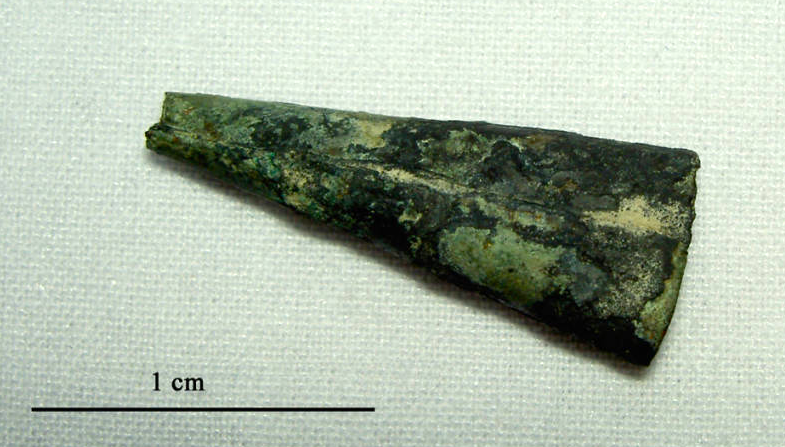
These small, delicate objects don’t look like much from a distance, yet their role in the lives of the Esopus Indians was one of extreme beauty. These tiny pieces of shiny copper, rolled into cones called tinklers, attached to women’s dresses during ceremonial dances, tell as much about these Native American people as they do about their relationship with the settlers who entered the land in the 17th century.

DESCRIPTION
The tinklers, once bright and shiny, are now growing speckled with age; mottled with various mossy greens, ranging in shades of dark forest, to emerald, to sandy beige, they seem as much a part of the earth from which they were uncovered as the grass itself. The copper is astoundingly well preserved, considering it’s around 400 years old, dating between 1609 and 1700 A.D. They are small, ranging between 1.5 and 3 centimeters long. Still, the tinklers have maintained the conical shape that made them jingle and gave them their memorable name. These delicate, decorative cones were part of the Late Woodland Period in the Northeastern United States and belonged to the Esopus Indians who roamed New Paltz and the surrounding region.

PROVENANCE
These tinkle cones were found in New Paltz, Ulster County, New York. They date from the Late Woodland Period and were part of the Esopus Indian culture that dominated the region. They are dated between 1609 and 1700 A.D. and are currently housed in the Historic Huguenot Street Visitor’s Center, located in New Paltz, NY.

NARRATIVE:
We approach the scene: on one side of the clearing, Dutch settlers arrange a wide assortment of brass and copper utilities, iron weapons, silver cutlery, blankets, cotton clothing, liquor, and guns. They seem confident, chatting amongst each other, knowing the sale will go well and they will profit, maybe more than they deserve. For them, these objects are commonplace, imported from Europe where the technology has long existed.

Still, there is a slight sense of fear in the air. Since their arrival in North America, the settlers’ relationship with the Native Americans has been unpredictable, largely because of the difference in cultures and a lack of efficient, or in some cases honest, communication. Quietly but purposefully, their trade partner signals his arrival with the snap of a twig: stepping out of the forest, an Esopus Indian. He is tall, strong, with long dark hair and across his sinewy shoulders stretches a dead deer, a peace offering to the Dutch.

Deals are made, objects exchanged, and a part of history is formed. Each side leaves with something new in their pocket: metal utilities that make survival exponentially easier, or a piece of paper that signs away hundreds of acres of land. One of the most important trade items of all, however, was shiny, malleable copper. This element, never before used by the Esopus Indians, provided a variety of new utensils, weapons, and decorative accessories that could be easily made or altered. While projectile points and pots were essential to the Esopus way of life, one surprising object of a different nature survived 400 years to be found in New Paltz, NY. This object was the tinkle cone.

Tinkle cones, or tinklers, are small pieces of copper rolled into the shape of a cone. When attached to dance and ceremonial clothing, these cones created a melodic jingle, the perfect accompaniment to the drums, rattles, and custom songs of the Esopus. The women, tinklers sewn into their dresses and dangling from their ears, swayed their bodies and reached down towards the ground, thanking the earth that sustained them.

While the Esopus culture was tragically maimed during the increasing settlement of the land, their delicate copper accessories, then a bright metallic orange, survived the test of time to inform later generations of the people that once lived in the area. Now, like the earth that played such a crucial role in the lives of their people, the tinkle cones are a beautiful, natural green.

Sources

Kraft, Herbert C. The Lenape-Delaware Indian Heritage; 10,000 BC to AD 2,000. N/A: Lenape Books, 2001. Print.

Kraft, Herbert C. The Lenape Archeology History and Ethnography. Newark, NJ: New Jersey Historical Society, 1986. Print.

Gertrude Deyo’s Mirror

Image

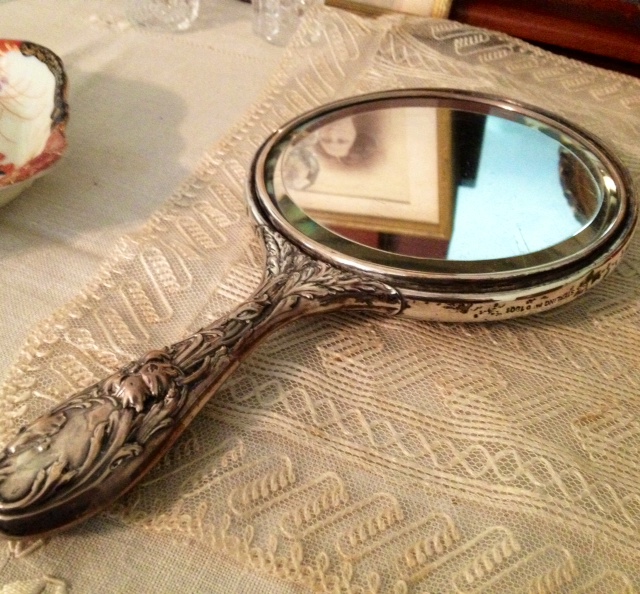
Caption – A tiny and simple representation of high societal living: Gertrude Deyo’s silver mirror played an essential role in preparing herself to venture out in public. There was no question that a modern and sophisticated woman of this time had to look her loveliest at all times. Based off the photos and images of Gertrude, she satisfied these standards quite mesmerizingly. What can be said of the woman whose face appears in the mirror’s reflection?

Description – This sterling silver mirror is surprisingly heavy to the touch yet a humble size of 9 ¼ inches long with the diameter being 4 ¾ inches across. It is over 100 years old and resembles an artifact that could be discovered as one of the remainders from the Titanic ship. Yet the mirror has been exceptionally preserved as the glass on the mirror is vividly clear and reflects a circular frame.  When one turns the mirror around floral designs are seen along with two female looking goddesses in the middle of the surrounding designs. One of which the viewer only sees a side profile and flowing hair and another whose full figure is displayed making her significantly smaller when compared to the woman’s side profile. These depictions most likely represent the importance of a female’s beauty during the time that could be preserved through the mirror. The handle of the mirror is sturdy and one can feel the designs on the mirror implant their characteristics into one’s hands if it’s held tightly enough.

 Provenance – This object was found within the Blake House and was manufactured by F&B Sterling Pat’d 1901. It was donated by the Blake estate which is located on Libertyville Road in New Paltz in 1984 along with 66 other objects that had arrived to Huguenot Street with the collection. The mirror has remained in the Deyo House ever since its arrival. According to the Historic Huguenot website that discusses the Blake’s collections:

This collection was created by William Henry Dill (W.H.D.) Blake (1843-1926), farmer and Civil War officer, and family members after they moved to New Paltz in 1881. In addition to W.H.D. Blake, other family members represented in the collection include his wife, Matilda Booth (d. 1904), two sons Alfred Booth Blake (d. 1950) and William Culbert Booth, a daughter, Matilda Booth (d. 1970), and two cousins Amy L. Hepburn (d. 1966) and Dollie B. Hepburn (1891-1976), both of whom came to live at the house in their retirement beginning in the 1950s. (www.huguenotstreet.org).

Narrative –


Beginning in the 1700s, Pierre Deyo began constructing a humble stone house on the Historic Huguenot Street located in New Paltz, N.Y. Today, viewers quickly recognize that this small stone house is now the famous Deyo House and the same location where Gertrude’s mirror can be found. Pierre’s modest three-room house was transformed dramatically when the descendants of Pierre Deyo: Abraham Deyo Broadhead and Gertrude Bogardus Deyo, married and took it for their home in the late 1890s.  The wealthy newly-wed couple did not hesitate to greatly modernize this farmhouse to have it reflect their status in society. This dramatic transformation introduced to the community of Huguenots the start of the many changes that were taken place in America at the time. These significant changes in appearance and ways of living were strongly recognized by the couple’s society in a negative light and the Historic Huguenot Street websites states: “Newspapers were critical of the destruction of a colonial “relic” and urged residents to organize in order to prevent this fate for any of the other stone houses. This outcry led to the creation of the Huguenot Patriotic, Memorial and Historical Society — the beginning of a preservation movement that continues today.” Clearly, the changes created by this family onto this “relic” had a phenomenal impact on their society and produced preservation movements that have existed for over a century. Similar to these movements the Deyo House and the many modernizations put into it still stands today in New Paltz. The house represents this significant shift in history from the old world to the new world as immigration, technological advances and modernity were pouring over the United States.

 The woman, Gertrude Deyo stood for these changes and her charming physique can be signified in a unique way. Through this silver mirror Gertrude could see the woman she was and the woman she made herself out to be for acceptance into society. The mirror serves to show Gertrude’s reflection of a physical appearance that she took much pride in and viewed with great importance. In Gertrude’s room, viewers not only see the mirror, but several accessories, perfumes and photo frames accompanying her mirror. Objects and accessories were a part of Gertrude’s character as they had the power to make her beautiful and showed a high-status in her community. For example, in an actual letter documented by the Historic Huguenot website, Gertrude writes to her cousin about the material possessions her family purchases on a casual shopping day: “Mama, Papa, and I went to Pougkeepsie yesterday. Papa got a coast, mama a silk waist, and I, a spring coat like this: It is very long but it doesn’t look much like these pictures, I have a new hat too…” Gertrude discusses material items she purchased in this letter to her cousin and even attached photos of these newly acquired items. These possessions played a large role in Gertrude’s character because during the time of the historic Huguenots, a woman’s physical appearance was an integral representation of herself.  Moreover, it is believed that women took at least two hours to prepare themselves for public viewing because they were judged tremendously by the outer layers of their personality. Gertrude’s mirror and other accessories depict the ideal Huguenot woman and, although her house was fairly modernized, it was her obligation to create both an astounding house and astounding woman. She accomplished this by dressing in her best clothes, wearing her finest perfume and styling her hair in the most fashionable way. The mirror, one could say was the judge and the final factor to determine her loveliness. If the reflection was satisfying, Gertrude was content and able to step out of the Deyo house and into society. One could say Gertrude aimed to be exactly what her house represented: wealth, power and originality. She was fortunate enough to establish this through her appearance.

In conclusion what can be said of the description of Gertrude Deyo looking back at herself through her mirror’s reflection? Gertrude Bogardus Deyo appears to be a woman who held herself well and obtained a respected status in Huguenot society. Her objects serve to illustrate her inner-being which appear to be rich, beautiful and even one of a kind. The restructured house along with the objects found within her room display this woman’s urge for modernization and exquisiteness which after a substantial amount of effort and time were completed.

Catch Me if You Can!

Untitled

CAPTION

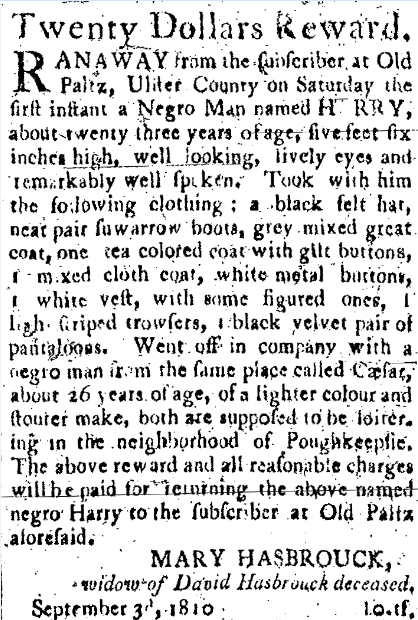
Printed in the weekly Poughkeepsie Journal on September 5th, 1810, this runaway slave notice from one of the most prominent New Paltz families advertises the reward for the return of their slave, Harry. Slavery in the North, though thought to be much less brutal than in the South, was still prominent, and living conditions were detestable enough that slaves were still desperate to run away.

DESCRIPTION

On an off-white page in the Poughkeepsie Journal newspaper lies a rectangular announcement nestled amongst “for sale” and “wanted” advertisements. Atop the eggshell colored paper made from discarded cotton and linen rests crisp, typed words printed in ebony ink announcing a reward for runaway slave Harry from New Paltz, New York. It then describes Harry’s general physical appearance, the items he took with him, and states the company that he ran away with. The inked letters are stamped inconsistently in pressure, with some letters having a bolder, darker presence on the page. Some letters are almost illegibly soft and blurred, maybe due to over two hundred years of survival. Although there is no title, the first four words are printed larger than the rest, begging your eyes to keep reading about the reward and Harry. All 158 words are an unformatted, standard text, except for five words located approximately ¾ inch from the bottom of the advertisement— “widow of David Hasbrouck deceased.” Even after 203 years, the advertisement is still smooth to the touch and legible for all those who desire a snippet of New Paltz slave history.

PROVENANCE

The newspaper containing this slave runaway notice was distributed out into the mid-Hudson Valley region. It is unknown how many prints were made; however, newspapers during this time were better equipped to survive than later newspapers because when papers began to be made out of paper, they were quick to deteriorate. This newspaper was most likely owned by a white resident. This specific ad survives today, and is now located in the New York State Library in Albany, New York.
DATE OF CREATION

Although some slave runaway notices were posted in the paper more than once, this advertisement was only placed in the Poughkeepsie Journal one time, on September 5th, 1810. Because the newspaper was not a daily newspaper until the Civil war, the notice itself was written sometime within the six days before the 5th of September. Because it is dated September 3rd, we can assume that this is the day that it was written.

NARRATIVE

The view of the mountains comforts me in these troubling times. My name is Harry and I formerly lived on Butterville road, with a fantastic view of Paltz point located to the west of my residence. Many would find this home ideal— a medium sized stone house, measuring 40×35 feet, with eleven windows. But life for me on Butterville Road was dreadful. Why? My home wasn’t my home by choice. In fact, it wasn’t even really my home. I was enslaved to Mary Hasbrouck.

 Days have passed since I ran away with my friend Caesar, although we’re still in the New Paltz area. My life has not been the way most people from different parts of the world probably imagined it to be. I heard tell that many people believe that cruel treatment of slaves only happens in the South because the North has abolitionist feelings. However, this is not the case. New Paltz is situated in New York—a Northern state. You might believe that people here hold antislavery views. I can say without hesitation that this is not the case.

Take a look at my runaway slave notice posted in the Poughkeepsie Journal. Although I’m a human being just like anyone else, I’m painted as inferior. I’m referred to as “remarkably well spoken,” as though it is surprising that I would be able to speak civilly and respectably because I am a person of color. I ran away from the Hasbrouck family, a founding family of New Paltz who signed the New Paltz patent. They are very prominent and influential in the community, and are therefore promoting discriminatory views that degrade people of color. Slavery is an acceptable part of New Paltz, a place that I have been forced to call home.

Many people do not realize that life as a slave in New Paltz has not been easy. Every prominent household has at least one slave. Let me tell you about the Hasbrouck family. Although they put out this notice to capture me, the Hasbroucks have more than enough money to hire someone to work for them instead of promoting slavery. March Hasbrouck’s mother-in-law, Wyntje Deyo, is one of the wealthiest residents of the community and David Hasbrouck (Mary’s deceased husband) inherited all of his father’s land in Ulster county.   


So why is Harry’s slave notice significant to the history of New Paltz? “Harry” mentioned that people in that time might think that slavery was only cruel in the South, and this is true of today as well. We are blind to so much of our history. In school, we learn about slavery in America and the abolition movement that took place in the North. Yet, we never stop and think, what about right here? What about this very street I’m walking on? Were people here against slavery? Were blacks filled with terror when walking through the streets of New Paltz? It’s easy to convince ourselves that New Paltz was a community against slavery since it is located in New York, a state in which many abolitionist movements took place. However, this is not entirely true. We learn from slave notices like this one that New Paltz was heavily involved with slavery and believed that blacks were inferior.

The slave runaway notice is significant because we gain insight into the different worlds between slaves and a wealthy family such as the Hasbroucks. The notice shows us how few possessions and clothing the slave owned, making him easily identifiable to others in the area. The detailed focus on the slave’s attire and possessions shows that New Paltz took the capture of slaves seriously. Although we may be naïve and think that New Paltz was a safe place for people of color, New Paltz must have been terrifying to live in if you were black. There was mistreatment and hatred towards blacks.


RESOURCES: ******

Downey, Meg. “From the Bill of Rights to IBM.” http://www.poughkeepsiejournal.com/services/aboutthejournal.pdf


Finding Rebekah

The tombstone of Rebekah McClang, a nineteenth century woman who died on May 3rd, 1862 at  the age of thirty, is a New Paltz community object with a story to tell. Little information has been found on Rebekah’s life, including why she died so young. There is but one detail that enlightens us: she was insane.

Rebekah’s tombstone lies in New Paltz, at the current Ulster County fairgrounds, where the former Ulster County Poorhouse was located. Upon entering the grounds, at the entrance with the red barns, one takes notice of a commemorative sculpture entitled “Rebekah,” by local artist Judy Sigunick. The sculpture is broken at the neck and chin area.

321

As one makes their way towards the back of the fairgrounds, Rebekah’s tombstone will come into view, surrounded by a white fence. It is large and made of heavy material. It is about 3 inches thick, and five feet tall. The surface is rough, cold, and one can feel the grooves of the earthy stone. The inscriptions upon the tombstone are very faint, one can decipher what is said, although it is really hard to do so. The usual date of birth and death is inscribed, as well as Rebekah’s mother’s and father’s names. There is also a poem on the tombstone entitled “Who’ll Weep for Me?” that addresses the age-old question of who will remember a person after they’ve passed. Who wrote the poem, or who decided it was properly suited for the tombstone, is unknown. Inside the white-fenced area, along with the tombstone, is a plaque with the transcribed poem, as follows:

Who’ll weep for me?

Wher’ neath the cold damp earth I lay,

And sleep in quiet day by day,

And have no more on earth to say.

Who’ll weep for me?

When I am sleeping in the tomb,

And o’er my head fair flowers bloom,

Or midnight’s showers in her gloom.

Who’ll weep for me?

Yes others too will weep for me,

As here I sleep beneath this tree,

That waves its branches over me.

They too will weep for me

My mother dear – I know she’ll weep,

And father too while here I sleep,

My brothers and my sisters dear,

Will weep for me while I lay here.

The tombstone belongs to Rebekah, however there is no way of knowing precisely who set up the tombstone in terms of design and content. The person who did do this cared enough to place a poem upon it — most likely Rebekah’s parents. According to the 1849 Admissions Book for the Ulster County Poorhouse, Rebekah was admitted for one, singular cause: “insanity” (Stessin-Cohn 1).

So, what is the dreaded poor house? It is precisely how societies in the past have dealt with the underprivileged. The underprivileged, in nineteenth century Ulster county society, were the poor and the insane. It is a pre-millennial government program (like welfare, food stamps, and the like) that attempted to place the underprivileged into society in ways that would benefit them. However, the Poorhouse has been remembered differently. “Conditions in these institutions were often deliberately harsh, so only the truly desperate would apply,” states Carlton Martz in the 1998 issue of the Bill of Rights in Action (Wasserman 1).

By June 1828, a poorhouse was established in New Paltz, in the same area where the Ulster County Fairgrounds now reside. An 1824 law, stating that a county poor house will be constructed, goes into detail about what sort of individuals were expected in the county poorhouse, listing paupers, begging children, disorderly persons, and other “such persons in such indigent circumstances as to require relief,” as expected residents (“Law Establishing County Poorhouses in New York”). According to an 1852 Ulster County Poorhouse admissions record, individuals were admitted based upon their “dependence.” Reasons for dependency were as diverse as the case of an Irish girl named Mary Holland, aged twenty six, entered on the grounds of “prostitution,” to little Patrick, Mary, and William Molone, ages five, two, and under one, respectively, who are listed as entering the poorhouse because of  “debauched parents” (“Admissions – 1852”).

The County Board of Supervisors and the Judges of the Court of Common Pleas assembled to assign the position of Superintendent of the Poor in 1828. Twenty years later, this position became an elected one. A man in a county was able to hold the position for three years. The election must have been centered around some sort of ethical measuring of each prospective Superintendent. In other words, people in New Paltz had to have looked at this man and wondered: what will he do for the poor? Is he a good man?

In order to address such questions, inspections of the poor house were issued and published in the New Paltz Times throughout the nineteenth and early twentieth centuries. This was a sort of way to address the issue and perhaps calm the spirits of those genuinely concerned about the well-being of those in the poorhouse. A report dating back to December 16th, 1869 analyzes the care of Superintendent Andrew Ketcham, stating,

“The main building was visited first, where everything was in complete order, bed linen clean, and each bedstead furnished with a good straw bed, and comfortable covering … At the colored house, everything was ‘all right,’ according to the language of the inmates. At the insane building, a pitiful site is presented; to look upon the poor maniacs, talking of everything, and yet of nothing, is a sad sight … But one of the attendants says ‘everything is done for their comfort, that can be.’ We would suggest as a comfortable improvement for this building, that it be heated by furnaces.”

Upon reading this review, citizens were expected to arrive at the conclusion that everything was fine and that the unfortunate were being properly taken care of. The very end of the review states,

“After inspecting the premises, the party returned to the residence of the Superintendent, where a sumptuous banquet was prepared, to which they did ample justice, after which cigars and refreshments were partaken of, and the gathering soon dispersed; the Supervisors starting for Kingston and the guests to their respective homes.”

The Ulster County Poorhouse is also, however, known to have been a very pitiful sight, evidenced in the writings of a journalist at the New Paltz Times that states that the poor house is:

“A DISGRACE – We do not believe there is a single county in this state, wherein the insane poor are as miserably cared for as in Ulster. The building in which these unfortunates are confined, is nothing more or less, than a “shanty” half-a-story high … Only a few months ago, a stranger having the small-pox, was taken to a “shanty” in the woods – there being no other place – and left to die.”

Rebekah’s tombstone, within its white fence at the Ulster County Fairgrounds, where the Poorhouse used to stand, is just one tombstone remaining at a burial ground believed to have contained 2,500 bodies of the unfortunate. Hers is the only tombstone left, among thousands lost. When Susan Stessin-Cohn, Director of Education at Historic Huguenot Street and Poorhouse Historian, discovered the tombstone, it was nearly falling through the dirt and would have otherwise disappeared had she not made sure a cement foundation was put into the ground. Exactly why Rebekah’s is the only tombstone still in existence at the site is unknown, yet this stunning artifact of the poor house epitomizes the extreme negligence Ulster County has given to the underprivileged in the past.


WORKS CITED

“1824 Law Establishing County Poorhouses in New York.” Passed 27 November 1824. Print.

“A Disgrace.” Snippet, New Paltz Times 6 December 1862. Print.

“Visit to the County Poorhouse.” New Paltz Times 16 December 1869. Print.

Stessin-Cohn, Susan. “Finding Rebekah.” Ulster County Poorhouse Project. Ulster County Information Services. 2004. Website. 15 March 2013.

—. “Admissions – 1852.” Ulster County Poorhouse Project. Ulster County Information Services, 1852/2004. Web. 17 April 2013.

Wasserman, Gabriel J. “Ulster poorhouse was grim refuge.” The Poughkeepsie Journal 16 November 2004. Print.

New Paltz Composition Book

Gertrude Dubois 03

Caption:
New Paltz Public School Workbook
New Paltz, New York
Between 1896 and 1904
This book features schoolwork by two students that graduated from the New Paltz Normal School, but the contents do not feature New Paltz Normal material. Jane Hayden planned examinations across disciplines for her public school students from October 1896 to April 1897. The later inheritor, Gertrude Dubois, sketched contemporary clothing designs and architectural illustrations alongside her predecessor’s examination questions. She also wrote part of a history essay in January 1904.

Physical Description
???????????????????????????????On face, the thin composition book, approximately 10×7.5 inches, hardly stands out as a historical artifact of New Paltz history. Barely threaded together within brown cardboard covers, the pages yellowed over time, yet the typical blue lines reminiscent of today’s marble notebooks are visible on each piece of paper. Inside the front cover, one clearly wrote “Jane Hayden” in pencil to indicate ownership; a scrawled script in the top right hand corner on the adjacent lined paper can be faintly decoded as “Janie Hayden,” though it looks like someone smudged the pencil marking or attempted to erase the name. Below, “Examinations Oct. 1896” heads the first page, following with “7 Arithmetic” and questions in a fine script. Other pages are headed by the following subjects: literature, grammar, geography, spelling, language, and physiology. Some of the questions are followed by answers, indicated by “Ans.” As the pages progress, thick pencil drawings of elaborately-dressed women and foreign architecture fill the blank spaces alongside examination questions and even some blank pages. On the back, Gertrude Dubois wrote a fifth grade History essay about Cyrus and Croesus in 1904, almost a decade after the previous owner dated her last page at April 9, 1897.

Provenance

Obituary of Jane Hayden in Haviland-Heidgerd collection at Elting Library; reveals family connection.

Obituary of Jane Hayden in Haviland-Heidgerd collection at Elting Library; reveals family connection.

Two names are found within the workbook: Jane Hayden and Gertrude Dubois. Both were daughters of Catherine Emily Deyo from different marriages; John Hayden fathered Jane (July 18, 1873) and her older brother James while Phillip E. Dubois fathered Gertrude (Sept. 21, 1893). (See family tree, below) Jane graduated from the Classical program at New Paltz Normal School in 1894 and her notes from 1896 and 1897 presume educating students in seventh and eighth grades. In 1904, her half-sister Gertrude stumbles upon the book and uses it for her drawings and bits of schoolwork. Gertrude moved to Ft. Lauderdale with husband Watson Eltinge Jr. between her high school graduation (1912) and the birth of her daughter Bernice (1922). There remains no record on how the book ended up in the SUNY New Paltz Special Collection.

Date(s) of Creation
The physical book itself has no indication of where and when it was created. The date of the text within, however, is well-marked. The first writing sample is dated Oct. 1896. A few pages later, the “Final Examinations of the Fall Term” offer the final date of the exam period: December 24th, 1896. The Winter Term kicks off on February 19, 1897. Next, the final examinations of the Winter Term are dated as April 9, 1897. Finally, Gertrude writes her short History response on January 24, 1904.

Narrative
???????????????????????????????First, the object is a unique historical document of the New Paltz Normal School. Between 1986 and 1917, no yearbooks exist for the institution, and while graduation lists and select school events were documented in local magazines, a very thin trace exists of the institution or surrounding academia during this time period. The exam book offers a glimpse into New Paltz academics during these undocumented years. In the same way, the composition book views the effect of the higher education institution rather than the school itself. Jane Hayden, the first author, graduated from the Classical course at New Paltz Normal in 1894 as the secretary for her class; the first date in the exam book is 1896. One could argue that the notes indicated future academic study at New Paltz Normal or elsewhere; after all, a Classical degree does not come with an education certification like the Normal course.

From A History of the New Paltz Normal School.

From A History of the New Paltz Normal School.

However, some of the headings do not match the subject programs offered through the Normal course (i.e. Geography and Spelling), and many of the Normal classes do not exist in the book (such as Zoology and Ethics). Also, no record exists of Jane Hayden, or Jane Minnick (her married name), graduating again from the institution, either in newspaper clippings or the Paltzanga. Plus, the small number notations alongside subjects indicate that she instructed seventh and eighth grade. However, it is also well-known that the New Paltz public school system at the time stopped instruction at sixth grade. Students would attend private institutions in Poughkeepsie and other surrounding areas. As such, no record exists at local collections on Jane Hayden’s teaching career. We only have the book to faintly hint at what instructional material would be offered at the end of the nineteenth century.

???????????????????????????????Second, Gertrude’s notes and sketches offer a glimpse into the educational prowess and social interests of a ten-year-old New Paltz girl. At the back of the book, Gertrude writes her brief essay in a loose, messy script, and a similarly messy grammar and argumentative style follow suit down the page. One could presume the essay was a rough draft, since text follows up along the side, the page appears on the very back cover, she flips over the book to write a few more notes, and no grade is indicated. Such information could excuse her poor word choice and minimal detail, but what else can you expect for a fifth grader learning about Ancient Greeks and Persians? Through her drawings, one could see that Gertrude admired contemporary fashion and architecture more so than her history studies. Her half-sister’s composition notebook became her artistic playground, where she could illustrate eloquent society ladies with curled locks, and adorned in large hair accessories and elaborates dresses. ???????????????????????????????She also sketched various building designs harking from various eras and cultures, demonstrating that young New Paltz girls were exposed to foreign cultures and societies, either through school or travel. Gertrude even learned about igloos, and designed her own with three rooms: a living room in the back, a dog room in the middle, and a sled room in the front. Her love of fashion continues years later; in the Historic Huguenot collection, a letter between Gertrude and her cousin Sarah describes the New Paltz Normal School burning down in 1906 and her trip to Poughkeepsie with her parents. She draws a rough sketch of a coat on the same page as her still-coarse script.

Johnson, Carol A. New Paltz Revisited. Charleston: Arcadia Publishing, 2010. Print.

Johnson, Carol A. New Paltz Revisited. Charleston: Arcadia Publishing, 2010. Print.

Although her writing and drawing in the composition book presumably does not continue far after the stated date, Gertrude Dubois would later make her appearance in the New Paltz Normal School scene. In New Paltz Revisited, a photograph captures her graduating class, including her future husband’s sister, Anna Eltinge. Paltzanga notes her graduation in 1912 from the high school, her marriage to Watson Eltinge, and present status in Ft. Lauderdale, Florida. An Eltinge genealogy records that she died in the same town in August 1981 and that her daughter Bernice survived her.

Finally, the names tied to the book establish the complex family histories in New Paltz. Throughout New Paltz academic records and graduation listings, historical surnames such as DuBois, Deyo, Eltinge, and Lefevre appear again and again. Nearly all of these names could be traced back to the Historic Huguenot founders, and even surnames unrelated to the original founders get pulled into these historic families. Although John Hayden (Jane’s father) hails from Illinois, Catherine’s second marriage to Phillip D. Dubois pulls the non-native family into a complex web of relations. This family web already establishes Gertrude in the Eltinge genealogy before her marriage to Watson Eltinge Jr. Familial webs are inconclusive up to Gertrude and hardly mention John Hayden; below is a rough genealogy sketch from Catherine Emily Deyo down to offer to numerous collections of New Paltz history. Current graphical genealogies found online do not touch upon Catherine Deyo and her descendents; this can be the first step to alleviate the issue.
rough genealogy

References

Dubois, Gertrude. Letter from Gertrude Dubois to her cousin mentioning the burning of the Normal School. Education in a Valley Fair. 2008. Hudson River Valley Heritage. Historic Huguenot Street. 12 March 2013
Documents of the Assembly of the State of New York, Vol. 8. Albany: 1895. Web.
Haviland-Heidgerd Collection. New Paltz: Elting Library.
History of the New Paltz Normal School, A. SUNY New Paltz Special Collections.
Johnson, Carol A. New Paltz Revisited. Charleston: Arcadia Publishing, 2010. Print.
Paltzanga. SUNY New Paltz, 1941. Print.
Rachel Eltinge Family Tree. The School Letters of Rachel Eltinge. 02 Jan 2012. Hudson River Valley Heritage. Historic Huguenot Street. 15 March 2013.
“United States Census, 1910,” index and images, FamilySearch (https://familysearch.org/pal:/MM9.1.1/M57K-HJK : accessed 15 Mar 2013), Watson Elting, New Paltz Ward 2, Ulster, New York; citing sheet 9A, family 26, NARA microfilm publication T624, FHL microfilm 1375097.
“United States Census, 1910,” index and images, FamilySearch (https://familysearch.org/pal:/MM9.1.1/M57K-4CB : accessed 15 Mar 2013), Gertude Dubois in household of Catherine E Dubois, New Paltz Ward 2, Ulster, New York; citing sheet 4B, family 63, NARA microfilm publication T624, FHL microfilm 1375097.

Pocket Chess-Board

Pocket Chess-Board

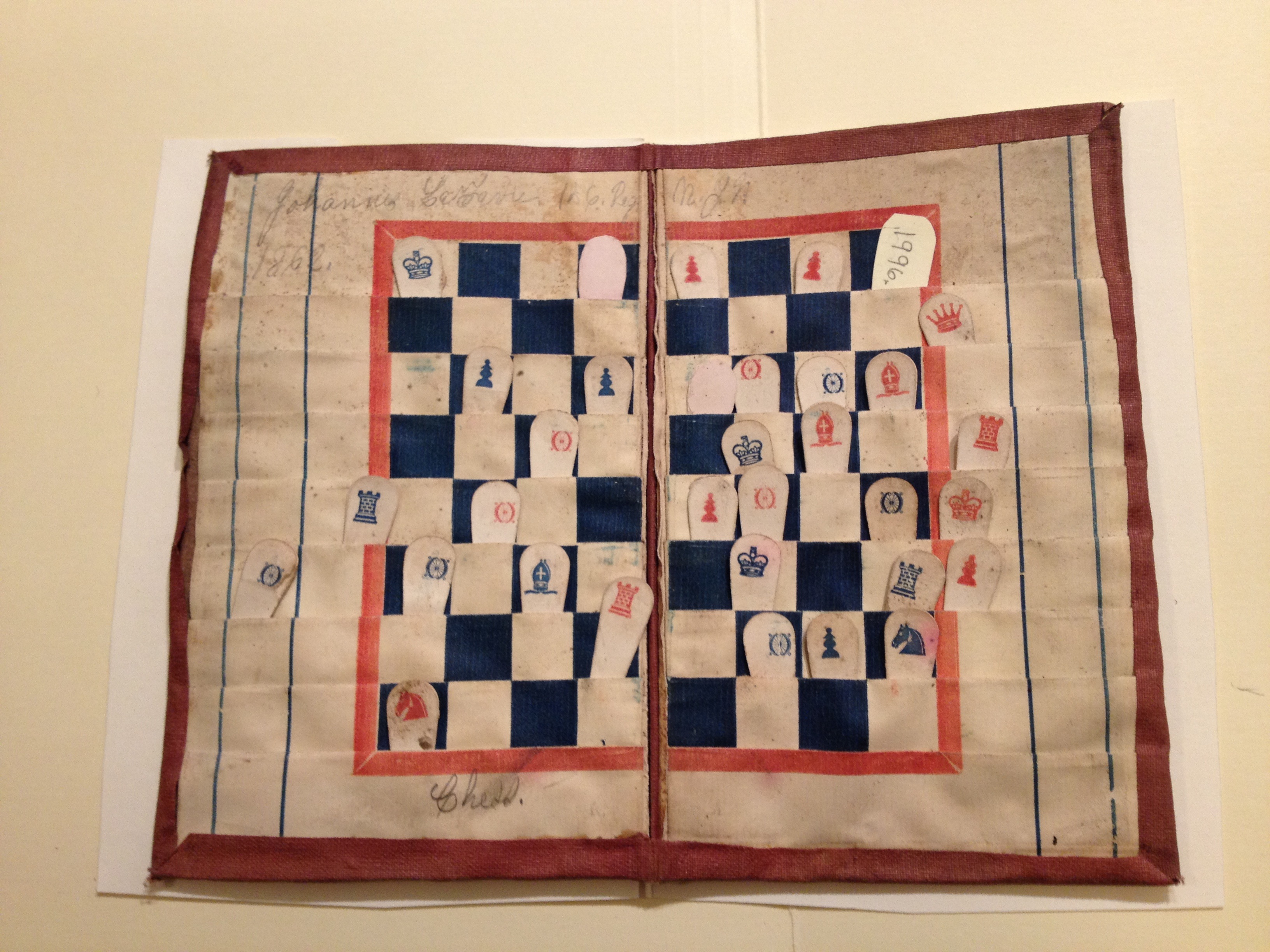
Smaller than your modern chess set, the pocket chess-board was a portable game for travelers to carry from one destination to the next. Because the object was created with a series of slips and paper chess pieces, it was easy to stop at any moment and close the book without disturbing the game.

Description:

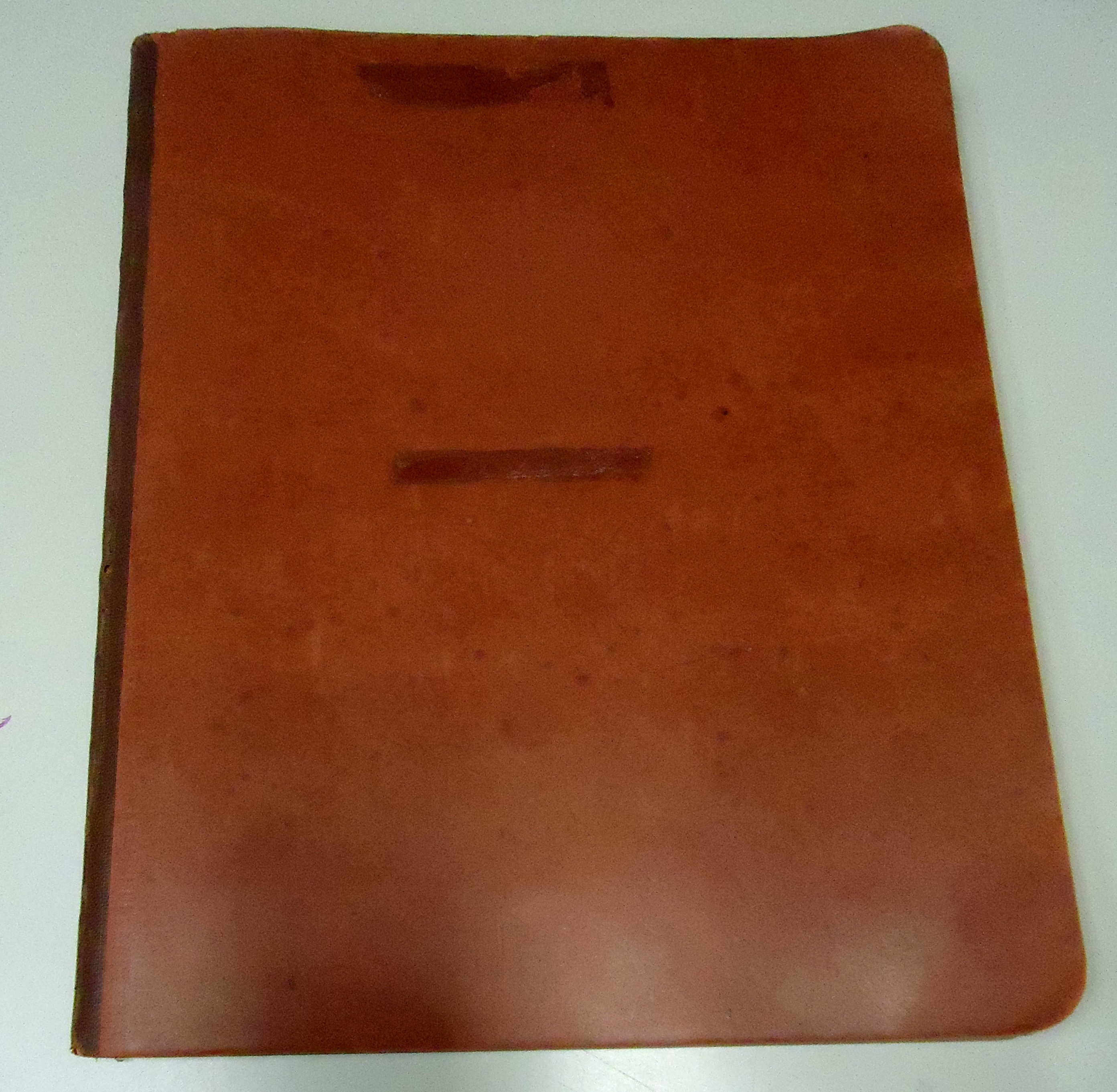
The pocket chess-board, when closed, looks like a small hard cover book made out of cloth material. When closed, you can feel the roughness of the object as if you’re touching the cuff of a fresh pair of jeans. There are small bubbles on the back cover where air trapped itself inside the cloth material over time. On the object’s edges, you can see pieces of the cloth are slowly starting to rip off. The word chess is written in pencil at the top left. The chess board is light brown, but was probably burgundy or red once upon a time. Upon opening the small 4-by-6 book, a mini chess board is located in the middle with blue and white squares surrounded by a red-orange border. Below the border are the words Chess written in script again. Above the border reads: “Johannes Lefevre 126 reg. N.Y.R.” and “1862” on the left corner. The chess board is made out of paper with blue lines on the left and right side, creating little slips for small white tear-drop shaped chess pieces. On the pieces there are printed chess shapes in red and blue ink. Some are in chess slots, others are to the side, waiting to be used.

Provenance:

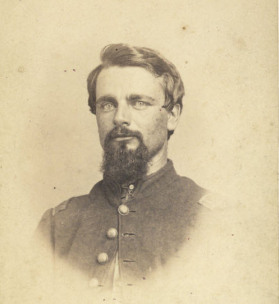
The object was owned by Civil War Soldier Johannes Lefevre of New Paltz. It is believed he carried the object with him during his time in the war. The object was perfect for the life of a solider because of its portability and inability to be disrupted by closing the game at any given moment. Though it is unclear how Lefevre possessed the object, the pocket chess-board was manufactured by D. Appleton & Company in New York City 13 years after its invention by Peter Mark Roget. After Lefevre’s death it was given back to the family and passed down through generations. It presently is located at Historic Huguenot Street.

Johannes Lefevre

Dates of Creation:

The object was manufactured in 1858, but was said to be created 13 years ago by Peter Mark Roget (1779-1869) prior to being sold in general D. Appleton & Company shops.

Narrative (VERY ROUGH DRAFT):

In 1858, D. Appleton & Company began selling its first-ever pocket chess-board for all to own. It became a staple for those who traveled because it was a portable form of entertainment for long journeys. Prior to it being sold at the D. Appleton & Company general store in New York City, it was invented by Peter Mark Roget. During the Civil War, its invention was created for the entertainment of travelers, soldiers and sailors who were always on the go during the Civil War. It was during this time period where Johannes Lefevre took ownership of his own pocket chess-board where he used it for entertainment on long travels and nights throughout the war.

It wasn’t uncommon for a civil war soldier to have such an item. For Lefevre, he probably either had the item before the civil war. He was traveling and looking for jobs upon graduating from Union College, where he obtained a science degree. He most likely used the item as a form of entertainment and played with other travelers. If this wasn’t the case, Lefevre mostly likely obtained the item once he returned to New Paltz upon hearing of his brother Peter’s enlisting in the Union Army. He was visiting his uncle in Michigan at the time. Johannes must have received the item as a gift or bought the item before his departure.

On his journey, Lefevre never wrote about his chess-board to his family and friends, but he was surely in possession of it during his duty as a solider. Throughout his journey in the Union Army, Lefevre picked up a pencil and wrote on the inside of the item: “Johannes Lefevre 126 reg. N.Y.R.”  He also wrote “1862” on the left corner of the chess-board  He wrote “Chess” at the bottom of the page and on the cover of his pocket chess-board too, possibly because of boredom.

Johannes Lefevre had a successful and emotional career in the military, as was depicted in his civil war letters about death, women and family. He soon faced a horrible death when he was fatally wounded during the battle of Cedar Creek. The bullet went into the side of his rear. He was then taken to a Dr. West who was helping him recover. His father, Josiah Lefevre, went south after receiving a letter from Dr. West about his son’s injury. Upon reaching him, Josiah realized his son was recovering and left for New Paltz. However, it wasn’t until his departure that Johannes developed Gangrene disease from the exposed wound. He died in the late fall of 1864.

The chess-board, at that moment, was with all of Lefevre’s things when he died. His brother, Isaac went down to get the body and return it to the family in a coffin, according to Huguenot Street researchers. His belongings, such as the chess-board, were passed down through relatives until finally ending up at Historic Huguenot Street, where it was donated. The chess-board is now part of a larger Johannes Lefevre collection which is split between Historic Huguenot Street and Elting Memorial Library.

Work Cited (More will be added):

Hudson River Valley Heritage, “Civil War Letters of Johannes Lefevre.” Historic Huguenot Street. 1864. Web. 15 Mar. 2013.

Glazer, George D. “The Pocket Chess-Board.” George Glazer Gallery: Antiquarian Globes, Maps and Prints. 1997. Web. 15 Mar 2013.

Sutler Of Fort Scott. “Pocket Chess/Checker Board.” Museum Quality Reproductions. 17 Jan 2013. Web. 15 Mar 2013.

Phillips, Del. “Brewster Viewer By Appleton.” Double Exposure. 2001. Web. 15 Mar 2013.

18th Century Waffle Iron

Image
Image

Photography Source: Shelley Weresnick

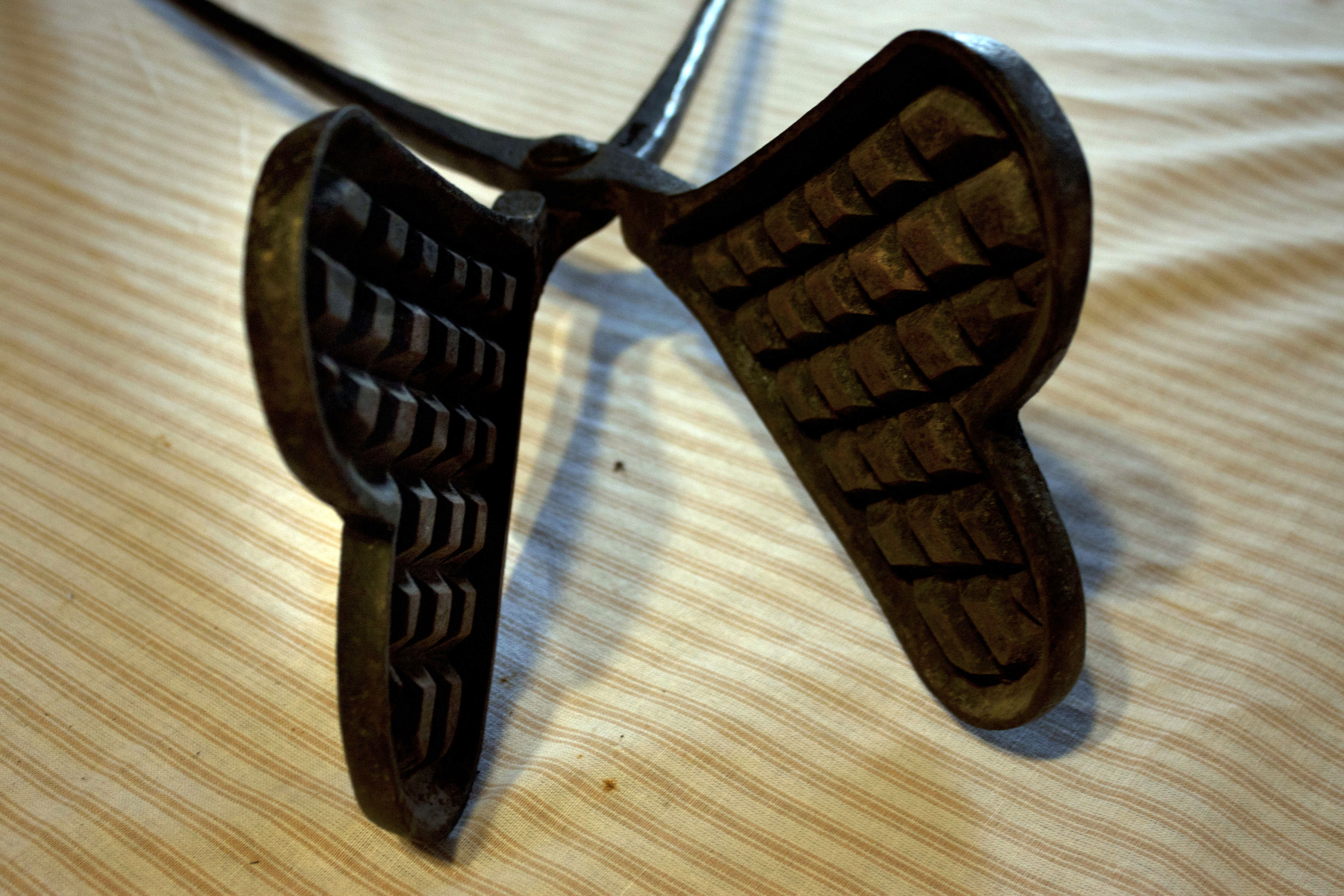
This heart-shaped waffle iron could have been given as a wedding present, and has been passed down throughout generations of the DuBois family. It has felt the heat of an open flame, tasted the batter of home-made waffles, and has provided much insight to the style of cooking in the 18th century and the lifestyle and culture of the Huguenots of New Paltz.

This is a waffle iron. It is adequately named for it is made entirely of cast iron and designed for cooking waffles. It is 34 inches in length, with two long, 28 inch handles to prevent the cook from being burned by an open flame. It has a hinge mechanism where the handles meet the press, allowing the press to open and close. The press itself is heart-shaped, with deep, one-inch square protrusions on both sides of the press. Waffles coming out of this iron would be about two inches thick, with several, one-inch square indentations. This iron is mostly black, but rusty browns can be seen in the inner areas of the press, as they are likely worn with use. This iron is surprisingly heavy, and rough with slight imperfections around the edges. 

The DuBois family was one of the twelve Huguenot families who lived in New Paltz during the 17th and 18th centuries. Benjamin DuBois owned this waffle iron sometime in the 1700’s, and it was likely purchased directly from the blacksmith who forged it. However, it is unknown if Benjamin purchased it himself. Waffle irons were typical wedding gifts in this time period, so it is possible that he and his wife Catherine received it as a gift when they wed. It has since been passed down through generations of the DuBois family, going from child to child. The most recent descendant to own this waffle iron was Edsall DuBois Elliott, who died in the late 1960’s. His wife then donated it to Historic Huguenot Street in 1970, along with many other interesting objects. 

You may wonder what significance a waffle iron has to the history of New Paltz — and I have to say there is far more to this seemingly insignificant object than you might expect. It has seen hundreds of years of history, and through that, holds knowledge about cooking, culture, traditions, and status. 

I’m sure we are all familiar with the smell, taste and texture of a delicious “Belgian” waffle. But this is not actually what a waffle of the 1700’s was like. Think of a wafer- a thin, crispy treat made from a batter. This is closer to what the Huguenots’ waffles were like. The waffles being cooked in this heart-shaped waffle iron were thick, but crispy. These scrumptious treats consisted of flour, butter, milk, eggs, and yeast. They were not served for breakfast, but rather for dessert, and often topped with sugar rather than maple syrup. 

This waffle iron not only tells us what delectable pastries cooked within it, but also explains much about the cooking style of the 18th century. All cooking was done on an open flame, within the home; a more dangerous method than we use today. And so, the cookware needed to fit the needs of the cook. The long, 28 inch handles on this iron allowed the chef to comfortably place and remove the iron from the fire without burning themselves or catching their clothing. 

Considering that waffles first originated in Europe, this waffle iron provides insight into where the people using it might have come from. Waffles were particularly popular in France, Germany, and Belgium – so we can note that the individuals using waffle irons in the 1700’s were possibly from one of these countries. It is also possible that the waffle iron’s popularity quickly spread to America, resulting in its production and use right in our lovely town of New Paltz. 

 In order to go from a lump of iron to the strong, sturdy, and lovely heart-shaped waffle iron it is today, it needed the help of a talented blacksmith. The undefined lump of iron was placed into a very hot fire until it became bright red. It was then placed on an anvil and beat into shape with a hammer. It had to undergo this process many times, each bringing more and more definition and shape until it finally became a lump of iron that could now be recognized as a waffle iron. It was likely painted black for aesthetics before being sold. Today, it has been rusted and worn on the inner areas, but still remains the valiant cooking utensil it was meant to be. 

 Now, 300 years later, this waffle iron is still perfectly functional. It could be filled with batter and placed in a fire to give you a delicious, heart-shaped pastry. Or, it can be placed on display in the village of New Paltz to tell its story. Simple as it may seem, this waffle iron has so much to say, and it will continue to silently observe the world as each day adds a new page to its story.


References:


Bruyn. Family Recipe Book. New Paltz, 1812-1832. 

Heidgerd, William. The American Descendants of Chrétien Du Bois of Wicres, France. New Paltz: Huguenot Historical Society, 1968. Print. 

Keller, C. Ancient Technologies and Archaeological Materials. Eds. S.U. Wisseman, W.S.Williams. Amsterdam: Overseas Publishers Association, 1994. Web.