
The Collier Books 1970 Box Set Edition
During the fall semester of 2013, I was lucky enough to land a spot in the ever popular course on Classic Juvenile Fantasy. A peek at the required reading list revealed that I had already read many of the texts as a kid, a discovery that understandably excited me. Not only would I have a legitimate reason for rereading some childhood favorites during the semester (a luxury I cannot generally afford when faced with the stack of reading for my various English classes), but I also figured I could save a few dollars by borrowing most of the texts from my parents’ house. However, when I called my mom to share my thrifty plan with her, she informed me the several of the books had been donated to the local library. Oh well, thought I, it was worth a shot. My mom took it more seriously, and, on her next visit, she presented me with a used boxed set of C.S. Lewis’s Chronicles of Narnia. Like many children born after 1950 (the year in which the first chronicle, The Lion, The Witch, and The Wardrobe, was published), I read most of Lewis’s adventure in Narnia and was utterly charmed by Aslan the lion. At the time, I held the not so secret hope that if I did not receive an owl that I would at least find a wardrobe into another realm. However, in 2013 when my mom handed me the boxed set, it had been years since I had even thought of Narnia. To be honest, I do not quite remember what my childhood copy of The Lion, The Witch, and The Wardrobe looked like. It was certainly newer than the set I now own. However, what it lacks in youth, the set makes up in character and an interesting, albeit mysterious, background.

Formerly Crowell-Collier, Collier Books was a product of a merger with the Macmillan Co. in 1960.
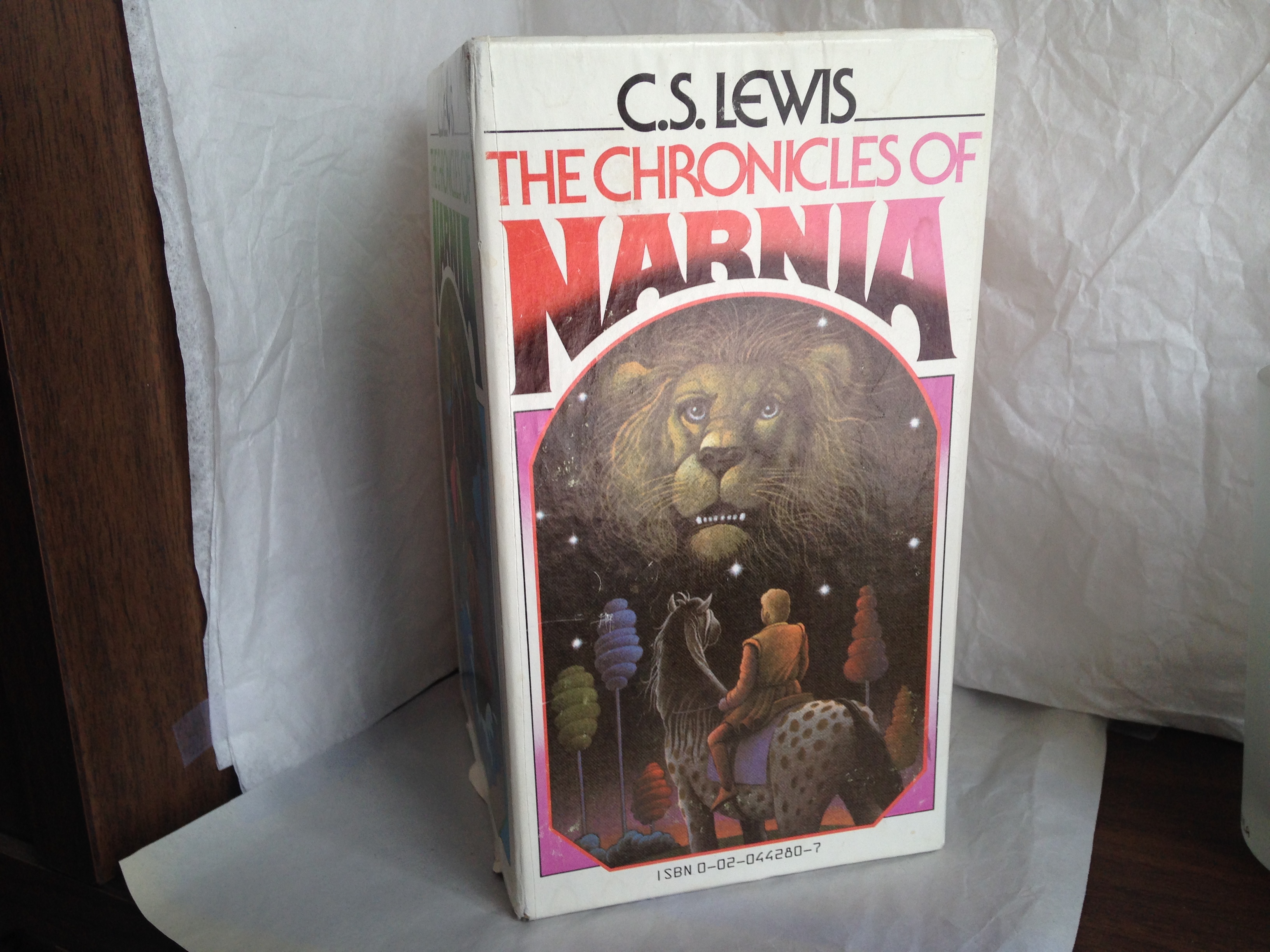
Released in 1970 by Collier Books, a subsidiary of the Macmillan Publishing Company, the box set is technically the fourth edition of the series to be released in America since Macmillan premiered the series between 1950 and 1956. The need for more editions indicates the ongoing popularity of the series, but it also offers an interesting reflection of the publishing business at the time. This is the only edition of TCON to be released under the Collier Books imprint, as eight years later the subsidiary would be sold to Harper & Row, concluding a relatively short business relationship between the Collier group and the Macmillan company. With the advances of printing technology, including the addition of computers in 1970, the publishing world seems to have been in a state of flux with new companies gathering steam and older companies choosing to merge to keep themselves afloat. There is an extreme ambiguity about this period that stands in sharp contrast to the material objects it produced. For instance, try as I might, I could not track down the actual printing company that assembled the box set. It is as if some distributer at Macmillan/Collier Books waved his or her arms and the set just magically appeared on book shelves everywhere.

Left side
Right side
Yet, the set is clearly the product of a material process, be it an automated procession line or human hands. After all, something had to assemble the box, arrange and print the pages, etc. The box measures roughly four by four by seven inches, about the size and shape of a lunchbox. In order to fit in the space allotted, the seven chronicles have been condensed into slim paperback form, each being no more than half an inch thick and a little less than seven inches tall. In most places, the eleven-point font crowds the page to ensure that none of the action is lost. Both the box and the books feature key scenes from the novels, rendered with dynamic colors and shapes. Exposed to the sun, the colors on the box have faded. However, the book covers stored safely inside suggest how bright they must have been.
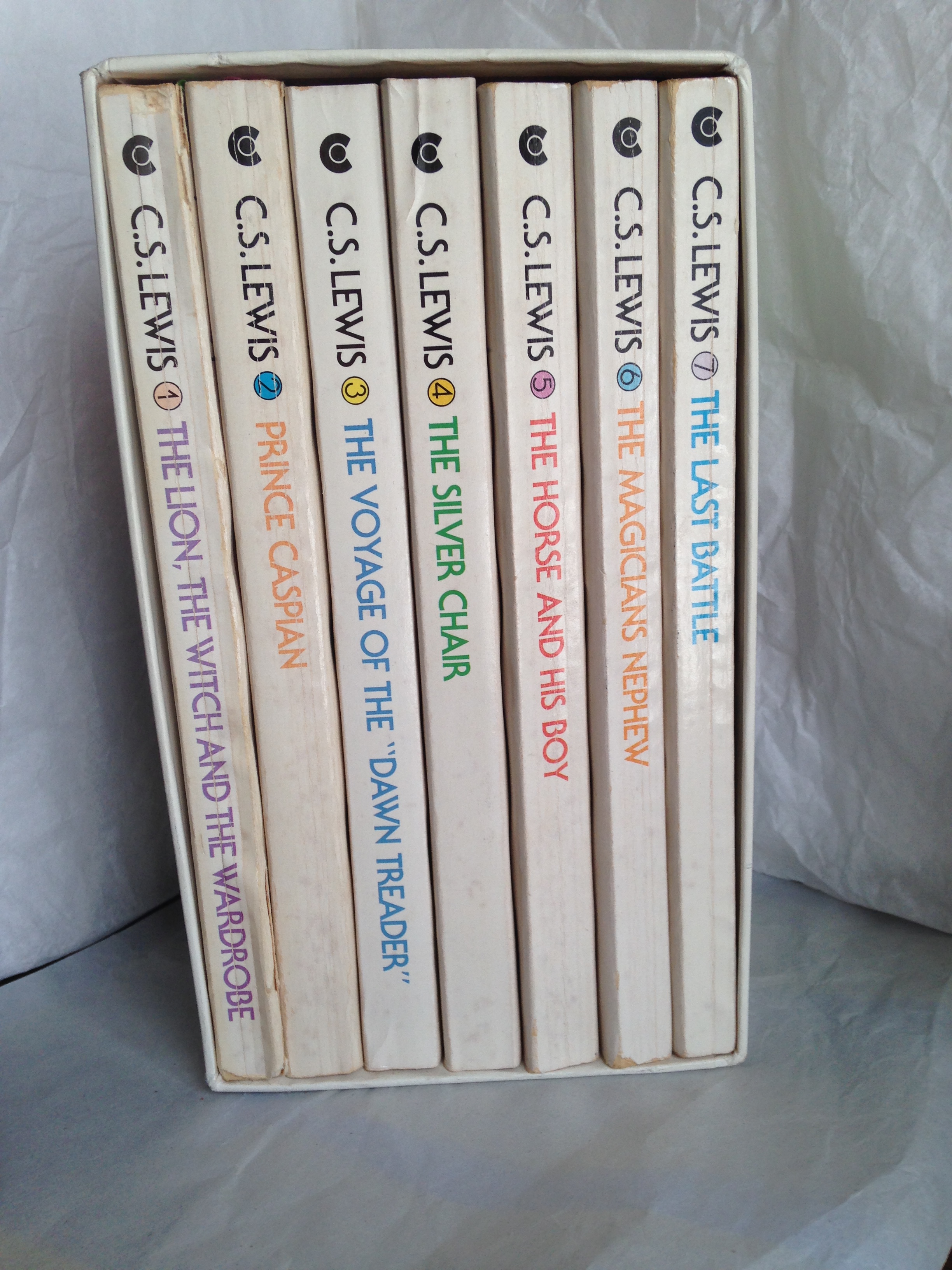
All seven chronicles. Note that the books are numbered in order of publication rather than chronologically as they are often numbered today.
The set has certainly seen better days. The box is light shelf wear, particularly noticeable on the corners. One can see from the crinkling of the spines of the books that the glue that holds the paperboard binding together is beginning to degrade. At some point during its time in my backpack during the fall semester, the front cover of The Lion, the Witch, and the Wardrobe began to fall off. I have yet to take my sticky notes back out. In spite of some patches of wear and tear, the collection as a whole is still pretty hardy. In addition, the books themselves are compact and lightweight enough that they can easily be transported to be read on a trip. One of the previous owners seems to have done exactly that, leaving a Massachusetts Bay Transportation ticket tucked in between the pages of The Horse and His Boy. It is a round trip ticket for a day trip to Boston stamped June 23. Thrilled to find another ticket, I tried to track down the exact route this anonymous reader had taken, but I honestly believe that the MBTA is even more oblique than my own murky family history.
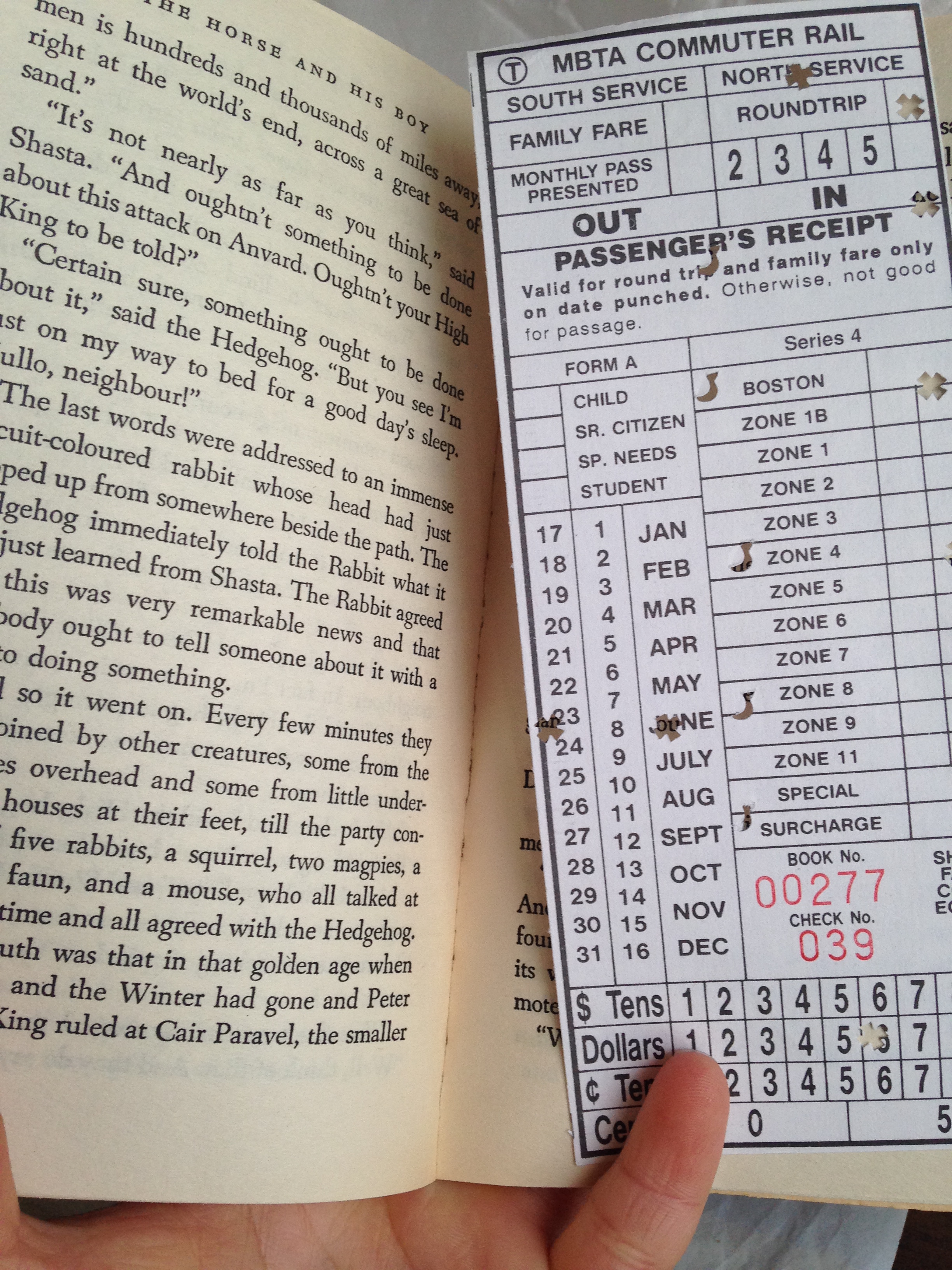
Another ticket!
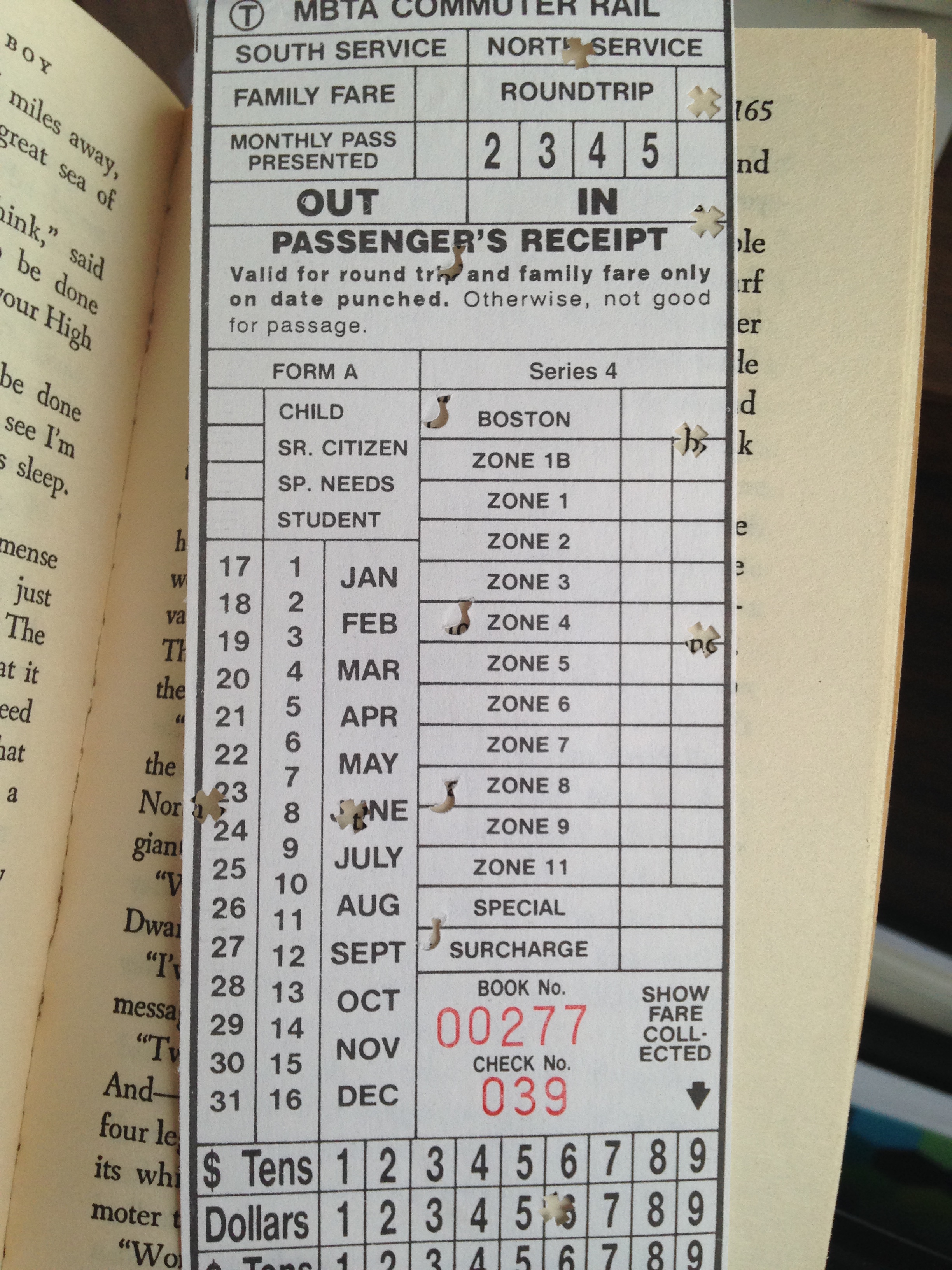
Where exactly are zones 4 and 8?
Still, discovering the ticket cast the box set in a whole new light. Although I knew the set was used, I had not previously stopped to consider what the previous owners had done with it. Now on top of wondering where they came from, I am also wondering how many trips these slim little volumes have been on and what they have seen. Where did the previous owner buy them? Were they new at the time? What did they look like on his or her shelf? The only things I can be sure of is that someone else held them in their hands and carefully turned the pages.
Works Consulted
For A Brief Overview of the Printing Process through the Ages:
http://www.hrc.utexas.edu/educator/modules/gutenberg/books/printing/
For More Information about Collier Books:
For More Information about Macmillan Publishing Co.:
http://archives.nypl.org/mss/1830#access_use
For Helpful Information Regarding the Various Editions of The Chronicles of Narnia:
 The Materials of History, Thought, and Art
What a coincidence that we both chose the same series! Did you find that you appreciated the books–both the stories and the collectors’ copies–the same way you did as a child the second time around?
Your post also brings up something interesting about publishing itself. As companies go out of business, the physical copies of the books they publish become something akin to historical documents–records of a time when a slightly different edition was being produced and purchased. They become physical symbols of societal advancement and the passage of time in a way, which, combined with the stories they tell, adds a new dimension to reading.
Hi there.I’ve been searching online for some time trying to figure out if my memory is incorrect or if this is an instance of the Mandela Effect (it isn’t, of course). I had this box set as a kid in the late 80s, purchased by my dad at a yard sale. I don’t know what happened to them but I must have lost them in a move when I was around 10 years old. However, I distinctly remember the book covers being very stiff, like paperboard as you said, of similar stiffness as the box. But after searching online for hours, all I have been able to find are the thin, bendy covers of your typical paperback. I find it hard to believe that is what I had because I read and reread each book dozens of times and I cannot imagine them having survived so long. Is there any more you can tell me about these editions? Many thanks!
Hi, Justin, I unfortunately don’t know much more about the boxed set other than what I wrote here, but it does still occupy a proud place on my bookshelf. Coincidentally, I believe my mom might have picked our set up in a yard sale as well. Your comment about the book covers made me curious so I pulled one out for reexamination. Although they are certainly a little thicker than some of my other paperbacks, they aren’t quite as thick as the paperboard box. The only other thing I can think to note is that the back flap states that the books were printed in the USA. I’m not sure if the same can be said of later editions (i.e. any that might have been printed after Collier was sold). I hope this helps a little!