 I brought my copy of The Phantom Tollbooth into class on the first day, but I don’t think I adequately expressed my love for this book so I decided to dedicate a blog post on it. Even as I look at it now my heart melts. I first read it as a kid in elementary, picking up a copy in my classroom library. Though I have this odd knack for retaining a detailed memory of stories I read as a kid, I never forgot about this one, and wanted a copy of it ever since. Years go by, I would think about the study often, dying to reread it, and then just this past year I ended up at a “history of children’s books” exhibition at the New York Public Library. The Phantom Tollbooth had a spot in the show and they had copies in the bookstore at the end of the exhibit. By the time we got there the store was closing, so I ran inside and bought one.
It’s a little more than 5 inches wide and 7 and a half inches tall. It’s a paperback, with it’s iconic blue cover and illustration of Milo (the protagonist) and his companion Tock (a watchdog). It’s printed on what feels and smells like newsprint, with a thin but rough feeling to contrast it’s glossy but thicker cover. It’s a “Yearling Classic” but is published by Random House.
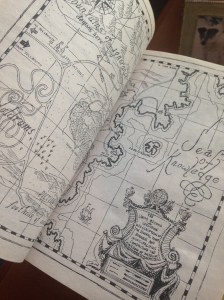 The author Norton Juster and illustrator Jules Feiffer are still alive and well. Though I haven’t met many people who have read the book they say it has a cult following. This may be true considering a small documentary just came out called Beyond Expectations which, “delves into the history of the novel and the enormous influence it has had on generations of children through today.” – The A.V. Club. I know it had an enormous influence on me, but on generations I’m not so sure. Anyhow what I have found about the history of the novel and Juster’s process as a writer is fascinating. As the trailer to this documentary points out, Juster and Feiffer were roommates, and thought he was not the original illustrator, Feiffer was involved with the novel from the very beginning; uncommon for most book illustrations. Juster would read the novel out loud to him, and at some point Feiffer started sketching, developing characters in his scratchy style which Juster must have enjoyed, for the two ended up collaborating. They remain good friends even to this day. This was one of the things that stuck out to me in the evolution of this novel because I think that illustrations and novels as independent of each other, as if the artwork is nonessential and can be deleted or replaced. However, especially in the case of this book and many other children’s books, some texts are made to be read with illustrations. This made me wonder what Shakespeare would say about his plays and the visuals; would he demand that seeing the play acted out was essential?
At the time, Juster had received a grant to write a children’s book about urban aesthetics. He did not want to write this book. Instead, he started writing The Phantom Tollbooth. To this, Juster said, “I find the best things I do, I do when I’m trying to avoid doing something else I’m supposed to be doing.” However parts of his original task seeped into his work, “One was the Cities Of Illusion and Reality — the cities disappear but people don’t notice it. There were several things that came directly from things that I was either thinking about, or had done research about for the book on cities.” Juster cited many influences, more of which I will talk about soon enough, but hearing author’s comments like these gives me, relief, I guess that is the best way to put it, because – like it was said in the Shakespeare reading – for a long time I feel like it was implied that all great works were made by one man, in one room, on the stroke of genius, and it was easy, breezy perfection from start to finish. For Juster at least this is total crap:
I write in a very laborious kind of a way. I write and rewrite. And rewrite. And rewrite. Well, the thing of course is if you’re doing it well, when you finish your 30th rewrite, or something, it should sound like you’ve just written it completely, freshly once. Because sometimes what happens when you write and rewrite and rewrite, is you suck the life out of something. It’s difficult.
I find that writing is a very bleak, and lonely, and stressful, and often unhappy occupation. And I find this is not only with me when I talk to other writers. First of all you eat it. You sleep it. You can’t get it out of your head. You wake up in the morning constantly with this idea of staring at this blank page — you’ve lost it — you’re never going to get what you know you feel. What’s most interesting is that, say that goes on for several months while you’re working. That several months’ period of time can be an absolute misery. At the same time, when you finish and you look back on that time it’s somehow a very satisfactory — if you can use the word happy, time.
 Juster also mentions that he did not have a mission when he started writing the book, and it was much more for his personal enjoyment. He didn’t even know what demographic it was for. He would write it in pieces, sections of dialogue and scenarios; he felt as if he was eavesdropping more than constructing the story himself. At some point, he needed to tie all the pieces together, so Feiffer’s wife, Judy, told him to write a two page synopsis. The story he wrote down had nothing to do with the detailed pieces he spent so much time on. Some of the earliest ideas he had developed didn’t fit into the story until very late. Though all authors have a different process, I found some similarities between Juster’s process and the commonplace books that were present in Shakespeare’s time. I think these sort of things disprove the romanticized “instant creation theory,” showing that a lot about genius is synthesis, it’s not just a have or have not quality, like any other great achievement it is very much earned.
And then there’s the editor. Juster said that, “I worked with a single marvelous editor at Random House. He had a million suggestions and we talked them all over. None of them really addressed the issue of simplifying or “dumbing down” the book.” Though it’s been over fifty years since the book was published, I looked at some interviews from Random House editors, in addition to trying to find information about the company’s manufacturing. The editors seemed just as kind and enthusiastic as Juster’s from fifty years ago. In a video these editors said that their mission is to make the author’s vision as clear as possible, and to do that they try to make an editing system that works for both parties; it could be edit as they go or a whole book at a time. Andy Ward the VP Executive Editor said, “…I find the relationships that I have are intense, they’re really intense, and they’re really close. A lot of the writers that I work with become some of your best friends because it’s very intimate work, and I think you develop a sort of dependency on one another.”
As far as manufacturing goes I didn’t find much. Random House is a huge force, with two warehouses, one in Illinois and one in Maryland. The total square footage of these two warehouses is about forty football fields, and ship over a million books per day between these two facilities. Though getting a book from an industrialized manufacturer is not as personal as getting a hand bound, personalized book like the table books in “Shakespeare’s Tables,” it is these kinds of manufacturers that have made the written word so widely available and affordable. It was also specifically the grant for a book about urban aesthetics that provided Juster with the money to support himself while he wrote the novel. The book is still deeply personal to me, and I am grateful that I am able to have my own copy


I can tell that you love this book so much, and I have never even heard of it until you brought it to class! I like how you included a video in your blog post – maybe one day I will read The Phantom Tollbooth for myself and see what it’s all about!
I recently had to write a paper and make a presentation about The Phantom Tollbooth and I also had never heard of it until you presented it to our class on the first day. When my professor was assigning books to us, I was secretly hoping to get this book because your description and its apparent popularity that was unknown to me made me want to read it. Through my research and presentation, I grew to appreciate the book as well. My assignment made the conclusion that this book really deserves to be a part of classic juvenile literature and I truly believe it. In my research, the book was constantly referred to the closest thing American literature has to Alice’s Adventures in Wonderland. Since Alice has been relevant for over a century, I consider this to be high praise even if I had never heard of it before. I also found it interesting how originally it was thought the book would not be successful because it was too challenging for children with its puns and word play. I like to think children everywhere proved these critics wrong.