From Muncee Folklore to Practicality: Speculations Surrounding The Pestle

_MG_5305

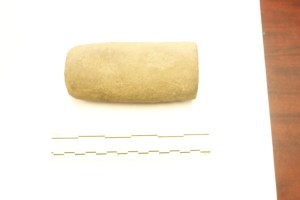
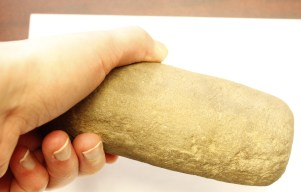
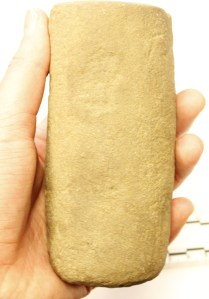
Pestle found in August, 2012 on Historic Huguenot street between the Deyo and Bevier houses; this tools have been used for cooking, medicinal purposes, and spirituality dating as far back as 2500 B.C. Photo Credit: Julia Ponder

Bee-Balm

Bee Balm, a red flower with medicinal properties that grows in the Hudson Valley. Photo Credit: herbsguide.org

The Sandstone Pestle found on Historic Huguenot in August of 2012 is an object that dates back as far as 2500 B.C, and shows us how valuable sturdy tools were in a time that lacked modern amenities. Pestles are representative of cultures that relied heavily on plant matter as a source of food, and its second life as a nutcracker indicates a people who had a strong relationship to their objects, even after they were broken.

There is an old folklore told among the Muncee people of the story of the maiden Lanawee and her lover, “The Arrow.” Before the night of their wedding, the two lovers’ families met and were getting ready for the following day when The Arrow was taken sick by small pox, which had been plaguing the local people. Within the night the Oswego bridegroom died of his ailment. Lanawee was so stricken by grief that she in turn killed her self in the very spot that her betrothed had met his end, meaning to sacrifice herself to the Great Spirit in exchange for the good health of her people. Lanawee held a knife to her chest and shouted to the sky, “Lay me with The Arrow, I am but a blighted flower!” before taking her own life. The next morning when their families returned both bodies had disappeared, and in the place where their bodies had been grew bright red flowers, which are today widely called by the name Bee Balm. After finding the bodies,  the relatives of Lanawee and The Arrow decided to hold a celebration in honor of the departed and used the Bee Balm to decorate their clothing and hair. Later on, tea was made out of the plant, and was named after The Arrow’s place of origin, Oswego, and therefore become Oswego tea which was said to cure smallpox (Pritchard 298).
_MG_5304

Photo Credit: Julia Ponder

_MG_5301

Photo Credit: Julia Ponder

A mortar and pestle would have been used to crush and grind the flower that made Oswego tea, this pestle would have been very similar to the one found on Historic Huguenot street in 2012 by SUNY New Paltz Professor, Joe Diamond and his crew.The pestle is made of sandstone and has a cylindrical shape with a flat bottom, which is slightly rough, and has edges that have been worn dull with age. It is heavy in the hand, a completely solid item that is not easily broken; its smooth and rounded top fits nicely in the palm, while the bottom flat part of the pestle indicates its original form was different, and that we are actually only holding part of an original piece. Most likely at some point in its history this tool was broken in half, but was kept still after it was broken and used. The pestle is hypothesized to have been at least twice as large when it was first made, currently its size is about five inches in length and three in width.  There is indication that the pestle served another purpose in its second life as nut cracker, due to the indent on its upper left side where it was most likely used to crush acorns. Although it is impossible to tell the story of a single individual who might have owned this tool, we can let our imaginations make inferences as to where and when it belonged, and what significance it had to a culture which lacked all modern amenities.

Today, Pestles are usually seen with a mortar, but the one found by Professor Diamond’s crew was alone. Archaeological digs on the North East coast have many times discovered pestles that have attached effigies, most commonly a bear’s head, but also that of phallic symbols. Bears were sacred spiritual animals to the Algonquin people (Diamond). Pestles with bear effigies most likely did not serve the purpose of grinding, but were “fetishes or the guardian spirit of women” (Lenik 141).
pestle 2

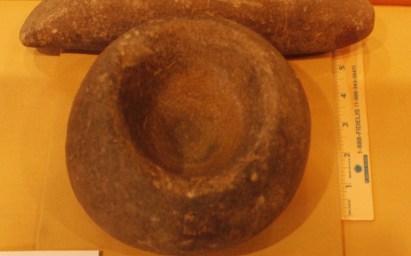
Complete Pestle and Mortar on display at Historic Huguenot. It was found in Hurley, NY and donated by Reuban B. Crispall, October 1965. Photo Credit: Julia Ponder

The tribes of the Munsee were predominant in the New Paltz area, conducting trade and having confrontation with the setters (Grumet 48-49). Is it possible that this pestle could of traded hands between the Huguenot’s and the Muncee, and that an effigy could have been broken off in order to use this tool for other purposes? This question is quite possibly unanswerable, and expert Joe Diamond believes that this was just your ordinary everyday pestle; an object of simplicity, yet at the heart of traditions like cooking, medicine making, and spirituality. These objects are used still today for the same exact purposes as they were centuries ago.

A complete pestle and mortar can be seen on display on Historic Huguenot street. In proportion to the number of pestles found in the Hudson Valley, mortars are more scarce. This is due to the difficulty it took to hollow out the stone to create the mortar (Parker 60). Other’s speculate that the mortar was more easily used over again and again, therefore they were less likely to be discarded and harder for archaeologists to find. When they are found, pestles and mortars indicate that the culture that once used them was relent on plant foods, where a lack of such objects indicates a more hunting oriented culture. Not only does the pestle serve for crushing herbs for medicinal purposes, like the families of Lenawee and The Arrow, the pestle offered a way to eat plant foods, and smash grain that would have otherwise been inedible proving to be an essential tool in the lives of ancient peoples across the globe. In a world where common cooking objects are considered disposable, the Huguenot Street pestle reminds us that every day objects can still be reused and have value even after they are broken.

Works Cited:

Diamond, Joe. Personal Interview. 13 April 2015.

Lenik, Edward J. Picture Rocks: American Indian Rock Art in the Northeast Woodlands. Lebanon: University Press of       New England, 2002. Print

Grumet, Robert S. Manhattan to Minisink: American Indian Place Names in Greater New York and Vicinity. Norman:       University of Oklahoma Press, 2013. Print

Parker, Arthur C. The Archaeological History of New York. New York: The University of the State of New York, 1920. Print.

Pritchard, Evan T. Native New Yorkers: The Legacy of the Algonquin People of New York. San Francisco:                   Council Oak Books, LLC, 2002. Print.

The History Behind the Stone Walls

Description

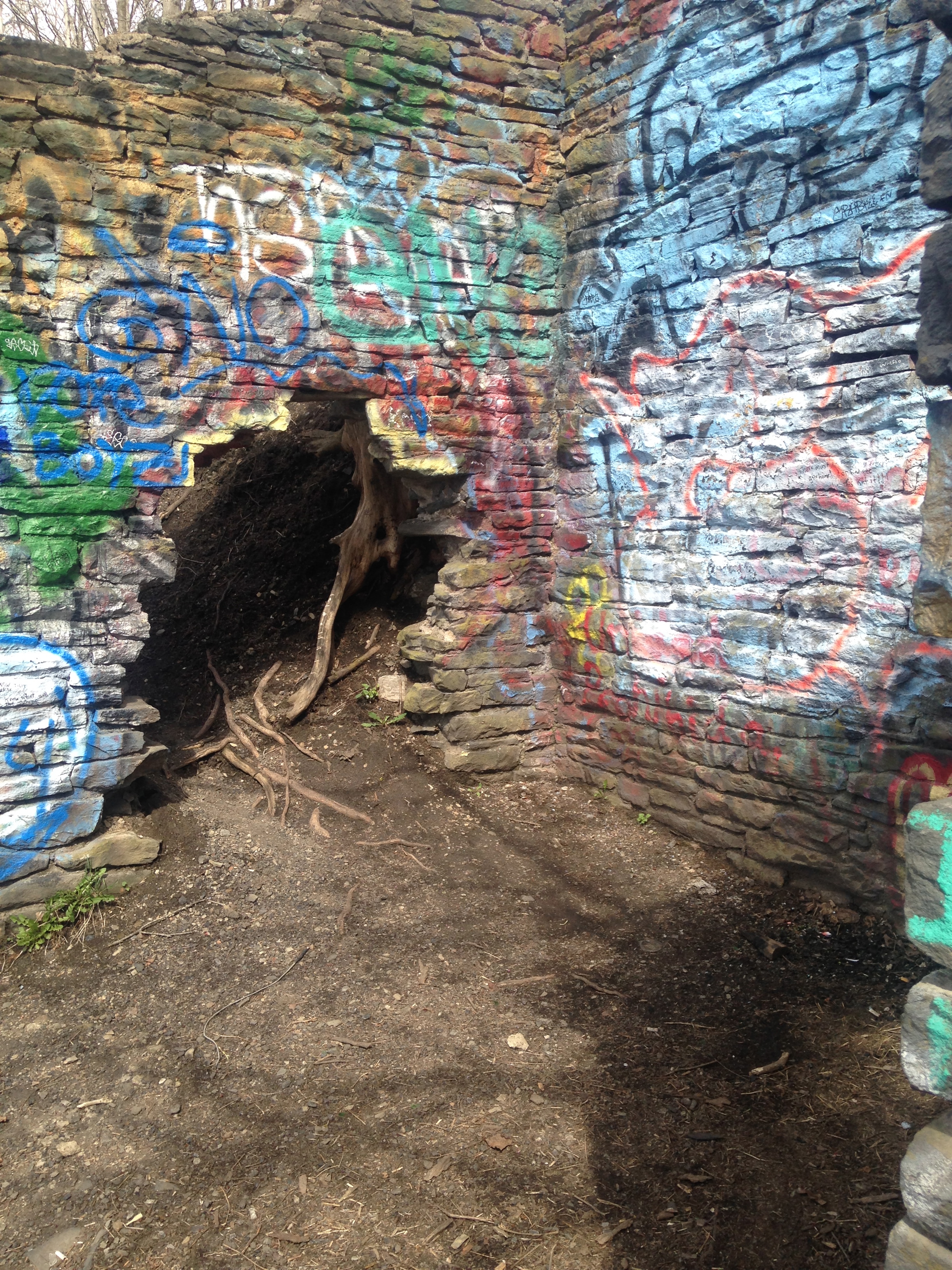
You’ve all seen it. That dilapidated stonewall that lies along the banks of the Wallkill River. Freshman and tourists walk by and wonder: “What the heck is that?” While seasoned SUNY New Paltz students avoid it for fear of harassment or assault or use it for their smoke circles and hangouts. Upon entering the New Paltz section of the Wallkill Valley Railtrail, walkers, runners and bikers pass this crumbling stone structure without any thought of what it might have been. The once closed structure now consists of only three walls. Any foundation that might have been there centuries ago when it was constructed is now dirt and leaves. The wall that once faced the Wallkill River is now nonexistent. What’s left of the structure is now covered in graffiti from the various decades of rebellious hippies and risky students wanting to leave their mark on the town. What they didn’t know was that the neglected stone that they were defacing was actually centuries old and built by two of the founding families of the town of New Paltz.

Provenance

The Elting family and the Lefevre family initially purchased the property together in an agreement for 3,000 acres of land along varying parts of the Wallkill River (Village of New Paltz). On this specific plot of land the Elting family built a steam mill equipped with various warehouses and shed, including the tool shed. For the first century or so after the purchase, the Elting family successfully ran their factory. However, when the business failed in 1894, A.P. Lefevre bought the steam mill property at an Elting Real Estate Sale (Village of New Paltz). The Lefevre’s retained ownership of the property until 1986 when most of the buildings were sold and demolished.

Narrative

Studying the old maps of the Village of New Paltz shows us that the structure was once a tool house, however it neglects to detail whose tools it held. One possibility is that it could have been used for both the Elting factory and the later Lefevre family business that stood on the opposite side of the train tracks. In 1748 Noah Elting, in conjunction with Nathaniel Lefevre, gained ownership of 3,000 acres of land “lying on both sides of the Wallkill” (Lefevre 485). On this land the Elting family built “Elting & Son”, a steam mill consisting of an icehouse, two lumber sheds, the flourmill and a coal shed that was shared between the factory and the neighboring trains that ran along the Wallkill Valley Railroad.IMG_4628

The family ran the steam mill and New Paltz’ one and only canning company until the business failed in 1894 (Village of New Paltz). Upon the failure of their business, the Elting family delegated ownership of the factory to the assignee A.K. Hays of Walden (Lefevre 485). For the next two years, Hays ran his barrel crafting company out of the factory and continued to utilize the far off tool shed on the other side of the tracks. Then, in 1896, the Elting family was forced to sell their properties in an estate sale, including the steam mill. At this sale, A.P. Lefevre purchased the property as the second location for his established lumberyard and hardware company (Village of New Paltz).

IMG_4629The 1905 map of the village shows that upon taking over the farm A.P. Lefevre and Sons Lumber and Hardware Company cleared out some of the buildings from the original Elting factory and added new spaces for their different business. However, the tool shed remains standing on the other side of the train tracks. In 1907, Lefevre rented out part of the coal shed to D.C. Storr’s Concrete Block Company, which allowed him to then build the residential areas of New Paltz (Village of New Paltz). Storr built almost all of the cottages that still remain standing on Oakwood Terrace and Manheim Boulevard. As if this was not enough, Storr also donated land for St. Andrew’s Episcopal Church, built a windmill to supply the residents of the village with fresh water and erected entire new streets and walkways. Working out of the Lefevre’s coal shed with tools from the tool shed on the other side of the tracks, D.C. Storr modernized the village of New Paltz and turned it into a living destination for both students and families alike. For more than 70 years after initially acquiring the property, the Lefevre’s lumber business continued to thrive at their location alongside the Wallkill Valley train tracks. The tool shed also remained as a part of the property throughout the changing businesses and was continually shared with both the Wallkill Valley Railroad and the Consolidated Rail Corporation who continued to make stops to the lumberyard even after the closure of the New Paltz Train Station in 1959 (Mabee and Jacobs). This dilapidated structure that continues to stand along the banks of the Wallkill River has watched many businesses come and go. The stones in those three remaining walls watched over the course of centuries as the Eltings ran New Paltz’ one and only canning company until it failed, the railroad companies stopped coming through town, the Lefevre family ran a successful lumber yard and D.C. Storr built half of New Paltz with concrete.

IMG_4681IMG_4678IMG_4682

Today, students, residents and tourists alike pass it by while walking along the Wallkill Valley Rail Trail. After sitting abandoned for years, plans were launched to turn the rail road tracks into a “linear park” in 1983 (Wallkill Valley Rail Trail Association). Volunteers worked together to clear the brush, smooth out paths for hiking and biking and repair the various bridges between New Paltz and Gardiner. After over a decade of hard work, the trail informally opened in 1991. When it first opened, it stretched along the river from the Village of New Paltz to the neighboring towns of Gardiner, Rosendale and Kingston (Mabee). In recent years, the Wallkill Valley Rail Trail Association has been rumored to be working to connect with the Dutchess County Rail Trail, which would connect New Paltz to the other side of the river. All the while, the volunteers have been passing by this abandoned structure that stood beside the trail and the Wallkill River. That graffiti covered and forgotten tool shed watches as the current residents of New Paltz pass it by and completely overlook the centuries of history hidden behind its neglected stones.

IMG_2098

Photo Credit: Shelby Seipp, Charlie Seipp

Works Cited

Lefevre, Ralph. History of New Paltz, New York and Its Old Families

(from 1678 to 1820): Including the Huguenot Pioneers and Others Who Settled in New Paltz Previous to the Revolution. Albany, N.Y.: Fort Orange, 1903. Print.

Mabee, Carleton, and John K. Jacobs. Listen to the Whistle: An Anecdotal History of the

Wallkill Valley Railroad in Ulster and Orange Counties, New York. Fleischmanns, N.Y.: Purple Mountain, 1995. Print.
The Village of New Paltz: 100 Years of Community Life. New Paltz,

N.Y.: Centennial Committee, Village of New Paltz, 1988. Print.
“Villageofnewpaltz.org.” Villageofnewpaltz.org. Web. 15 Apr. 2015.

<http://dosingpdf.com/v/villageofnewpaltz.org1.html&gt;.

Wallkill Valley Rail Trail Association. “History-The Wallkill Valley Rail Trail.”

Wallkill Valley Rail Trail. Web. 24 April 2015.

Discovering the Colonial Pipe

IMG_1490

CAPTION: This 17th century pipe fragment was found in Historic Huguenot Street in New Paltz, in late 2012. This particular fragment was part of a clay pipe fashioned by Hendrik Gerdes, a Dutch pipe maker, as his initials can be found on the heel of the pipe. Although a seemingly mundane object, this pipe gives us particular insight on colonial life in the Hudson Valley.

Physical Description:

Called a “little ladle” by the Elizabethans, the tobacco pipe was almost an essential piece of colonial living and there are clues that these pieces give us into the diverse community of Historic New Paltz. The particular piece(s), was discovered by Professor Diamond and his team at Historic Huguenot Street on September 18, 2012. The location of this pipe piece was North of the Freer House in unit 215. The pipe is in four separate pieces, and appears to have been white at one point or another. But, of course with the passage of time, the outside has become jaded. While there are scratches and points of discoloration that appear almost brown along the stem of the pipe. Being that the pipe is broken, one is able to see inside, again there is the same brown discoloration along the smooth interior of this piece. The whole in the mouthpiece is notably very small, and if memory serves me correct, Professor Diamond said that you could not actually smoke out of this pipe. On one of the pieces there is an impression of the initials “HG” on the heel, which signifies the Dutch pipe maker, Hendrik Gerdes.

Provenance:

Hendrik Gerdes was in commission during the 17th century, approximately circa 1668-1685. At the same time another prominent English  pipe maker named Edward Bird. Although he hailed from England, Bird Amsterdam to “fight for the Dutch” and subsequently met and married a woman named Anna Maria van der Heide. After the death of her first husband Anna married the then confectioner, Hendrik Gerdes.  A little odd how the two lives of two different pipe makers so intimately collided. Gerdes may have been a confectioner/sugar refiner or possibly worked one of the “large industrial potteries” that made  ceramic molds for sugar loaves.

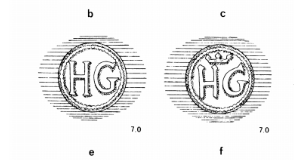
 The heel appears to be a type 2 style heel, which includes a simple border around the initials. While this insignia is relatively simple, Gerdes did have another one that had a three pronged crown above his initials. Besides New Paltz, his pipes have been found everywhere from Caughnawaga Mohawk in Canada to my birthplace of Staten Island.

Although little, but the initials can be determined from merely looking at the pipe, upon further exploration we get the bigger picture. The look of the pipe itself gives insight as to the time period it was manufactured in, as well as where it originated. “…Dutch pipe bowls were often cone-shaped rest backwards on their stems, and were often more highly polished.  English pipes from that time period sat more upright, with a duller finish.” In a more general view, these clay pipes were extremely delicate. And although this particular make was made from clay, others were made from silver, brass or pewter. These typical 17th century, 11-inch clay pipes, if dropped would immediately fragments into six or seven pieces. A fact we see clearly, in the remnants of this piece.

Screen Shot 2015-04-14 at 5.38.10 PM

Pictograph depicting the hell marks on traditional clay pipes. Photo Credit: EUROPEAN CLAY PIPE MARKS FROM 17TH CENTURY ONONDAGA IROQUOIS SITES

Screen Shot 2015-04-14 at 5.37.45 PM

Two versions of Hendrik Gerdes makers mark, that would be found on the heel. Figure B is what is used on the pipe from Huguenot Street. Photo Credit: EUROPEAN CLAY PIPE MARKS FROM 17TH CENTURY ONONDAGA IROQUOIS SITES.

Narrative:

These tobacco pipes were used as a form of trade in colonial times and tobacco itself was a huge source of economic income for the colonies. Often times these pipes were used as a from of trade, in many instances between the colonizers and the Native Americans for furs and such.  And, although the pipes themselves were fashioned in Europe, tobacco was a product from the Americas, being introduced into Europe in the mid-1500’s. Another interesting facet of this practice, was that by the 17th century tobacco spread amongst every race, class and gender. Upon doing further research I also found that women were very much a part of the pipe making process. “Women have always been active in the pipe-making industry…as decorators and finishers, as pipe firers and proprietaries and as independent craft persons”. Although they were invisible to the public eye, women were very much apart of the process. For instance Edward Bird pipes were signed with his initials “EB”, although that did not necessarily mean he crafted the pipe, it could have very well been his son or his widow. Particularly considering that the pipes were still being made after his death. It’s really something to see women being such an instrumental part in creating objects that were so widely used, especially considering the time period. In addition to the pipe showcasing cultural assimilation, it is also representative of an early inclusion of women in economy. This holds true today, as women are central pillars of societies across the globe. For many communities they are the ones who start up their own businesses and support their families. Even in the small village of New Paltz, there is a strong presence of women in the community, as many own their own businesses along and around the bustling Main Street.

Although, I could not find anything specific on the specific owner of this pipe, I think the general idea of such an object is to see how a multi-faceted group produced such things. It was odd at the time to have both men and women making and using the same product. And what’s more, to have a multitude of cultures using each others products also seems a bit revolutionary. For New Paltz, it can signify the early culmination of all different types of people. What’s more it showed the melting pot that places like New Paltz had become. As we are aware, the French, Germans and English had settlements in New Paltz and most notably in Historic Huguenot Street. What is even more interesting is that despite the English conquests, Dutch pipes were still being imported and used. It’s interesting then, that we see a melding of cultures among the inhabitants of New Paltz at this time.

Although this pipe is seemingly just a vessel for tobacco, it represents a community on a much larger scale. It not only gives us context to see what life was like for the people before us, but also allows us to see how objects as mundane as a pipe could help weave the fabric of a community. It’s also quite striking to see, that many of the facets that this “little ladle”has proved to be so unique about it, are still relevant in our community today.

Cleric smoking a pipe with a shorter stem, which was used for easier handling.  Photo Credit: CW Journal

Cleric smoking a pipe with a shorter stem, which was used for easier handling.
Photo Credit: CW Journal

IMG_1486 IMG_1489

Works Cited:

Bradley, James W., and Gordon DeAngelo. EUROPEAN CLAY PIPE MARKS FROM 17TH CENTURY ONONDAGA IROQUOIS SITES. Vol. 9. N.p.: Eastern States Archeological Federation, 1981. Archaeology of Eastern North America. JSTOR.

Web.Mann, Rob. “Smoking and Culture: The Archaeology of Tobacco in Eastern North America.” Academia.edu. N.p., 2015. Web.

Tate, Bob. “Archeologists in New York Uncover Tobacco Pipes Dating Back to the 17th Century.” Pipemagazine.com. N.p., 18 Mar. 2010. Web.

Hume, Ivor Noël. “Hunting For a Little Ladle: Tobacco Pipes.” Colonial Williamsburg. CW Journal, 2002-2003. Web.

Searching for Truth in a Legend: The Case of the Huguenot Ring

IMG_8477

Rooney, Megan. “Huguenot Refugee Ring.” 2015. jpg.

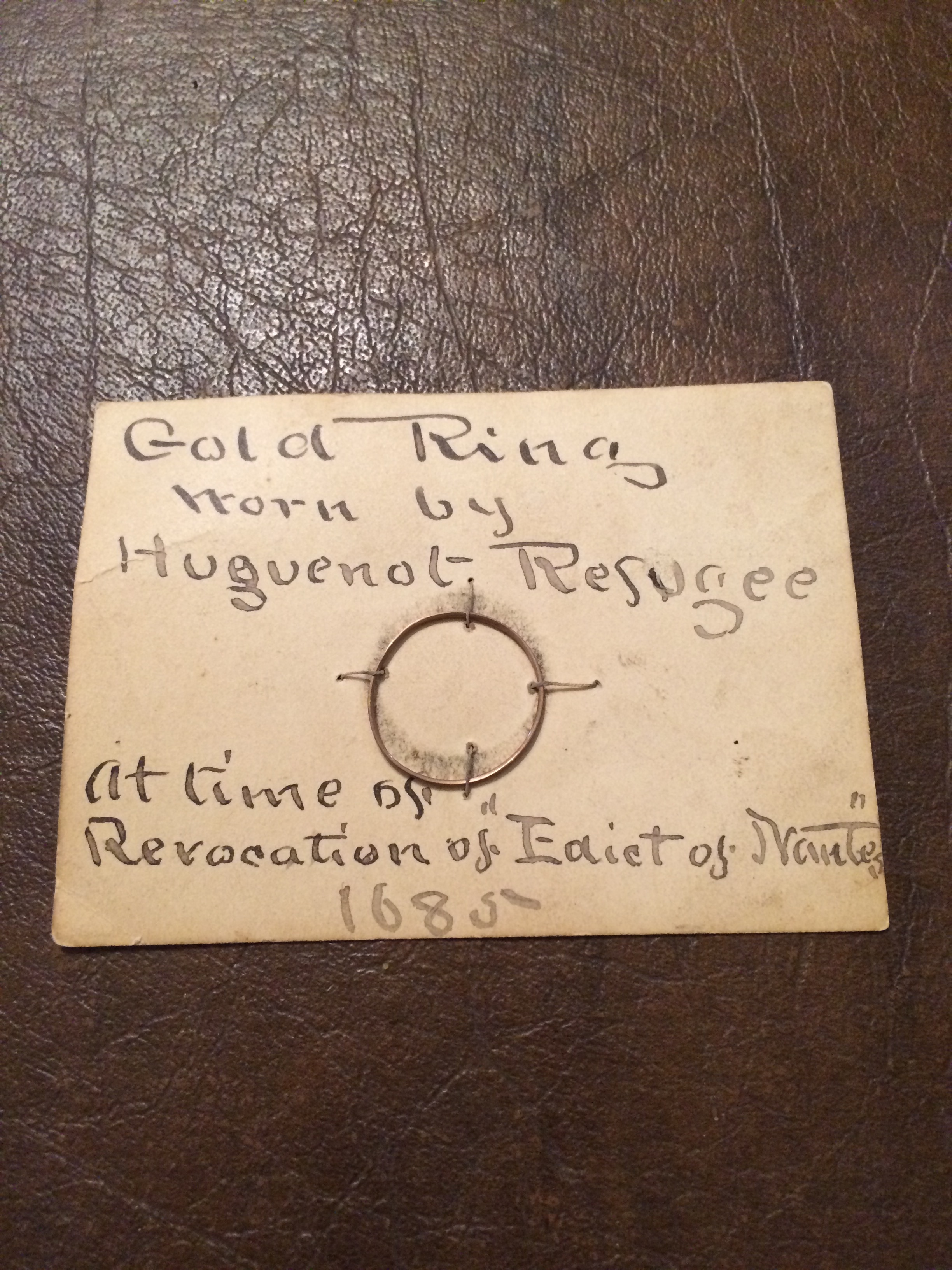
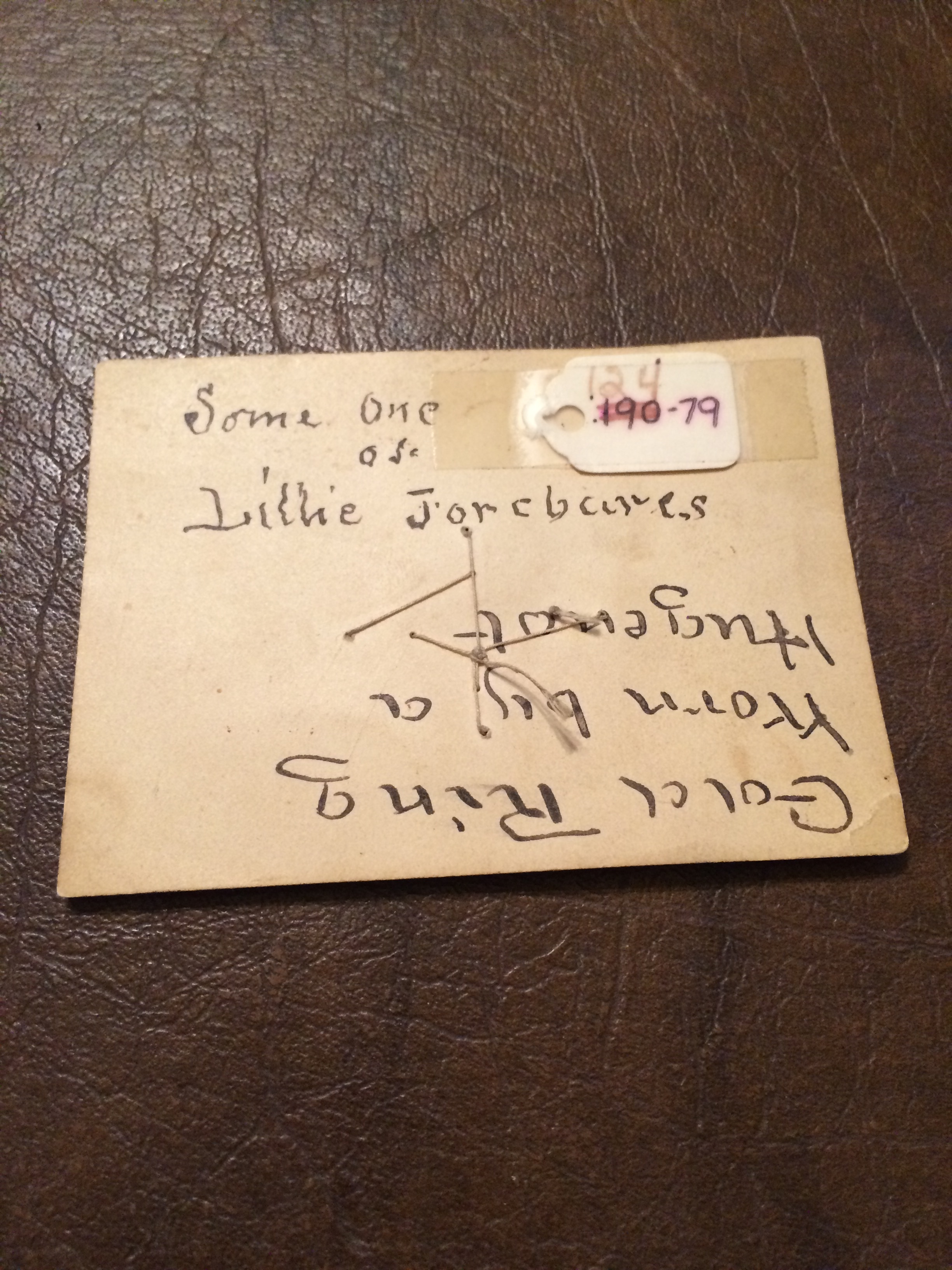
Caption: Tucked away, inconspicuously in the corner of a collection box under a thin cloth laid a piece of paper with a ring fastened onto the rectangular sheet. For the Historic Huguenot Street historians however, it is an item that could possibly be one of the oldest and most interesting to their collection if legend can be proven as fact.

IMG_8478

Rooney, Megan. “Huguenot Refugee Ring Reverse.” 2015. jpg.

Physical Description: The ring is fastened to a piece of somewhat thick paper, thicker than typical writing paper of today. It is fastened to the middle of the paper by four pieces of string, punctured through the paper and tied together on the backside. The ring has left a grey circle on the paper where perhaps the material of the ring has rubbed off onto the paper like tarnish from years of being attached. Information has been written onto the paper on which the ring is secured that suggests a great history for such an unassuming object. “Gold Ring worn by Huguenot Refugee // at time of Revocation of “Edict of Nantes” 1685” is written in ink onto the front of the paper above and below the placement of the ring. The script certainly looks like it was written from a different time where words were written on paper by quill and ink with a more expressive style. The back of the paper possibly reads: “Some one of Lillie Forebares” though the handwriting is somewhat illegible as compared to the other writing on the paper. Additionally, written upside-down and opposite the aforementioned description is a repeat of the front detail, this time stating: “Gold Ring worn by a Huguenot”.

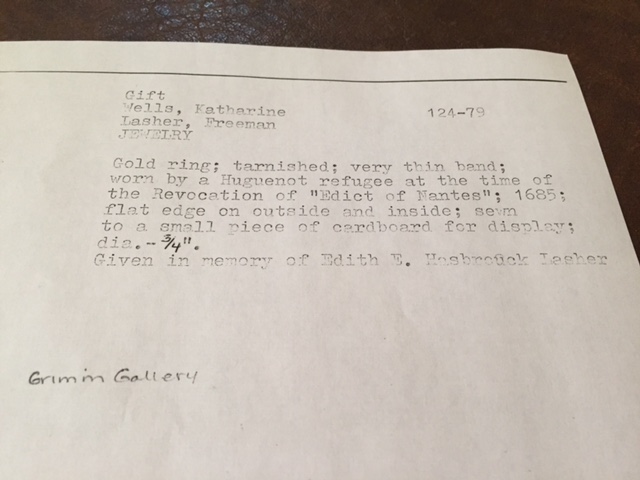
Provenance: The object was donated to Historic Huguenot Street from a Ms. Katherine Wells and Mr. Freeman Lasher in memory of Edith E. Hasbrouck. A ring of such simplicity could have been a wedding band worn by one of the Huguenots who sought refuge in this area of New York or possibly in one of the European countries the Huguenots fled to such as Ireland, England, the Netherlands or Germany. The secondary object, the piece of paper the ring is attached to, comments on “some one of the Lillie forebears” which is a potential link to the rings ownership.

Narrative: Little can be determined about the ring’s history by just simply observing the ring itself. It is a humble piece of jewelry that would call little attention whether on a finger or off for it is thin and without markings, as plain as a ring can get. On the sheet of paper it is fastened to, it is referred to as a gold ring though that is an assumption thus far. It bares no markings or decorative details that would signify a maker, time period, or owner. The ring is simply a circle of metal. The claim on the piece of paper that a Huguenot refugee wore this ring during the Edict of Nantes is of both huge significance as well as speculation. It is simply a claim after all; hearsay, a myth. We cannot directly ask the object questions or will it to provide us with all the answers.

IMG_8389

Rooney, Megan. “New Paltz Placard.” 2015. jpg.

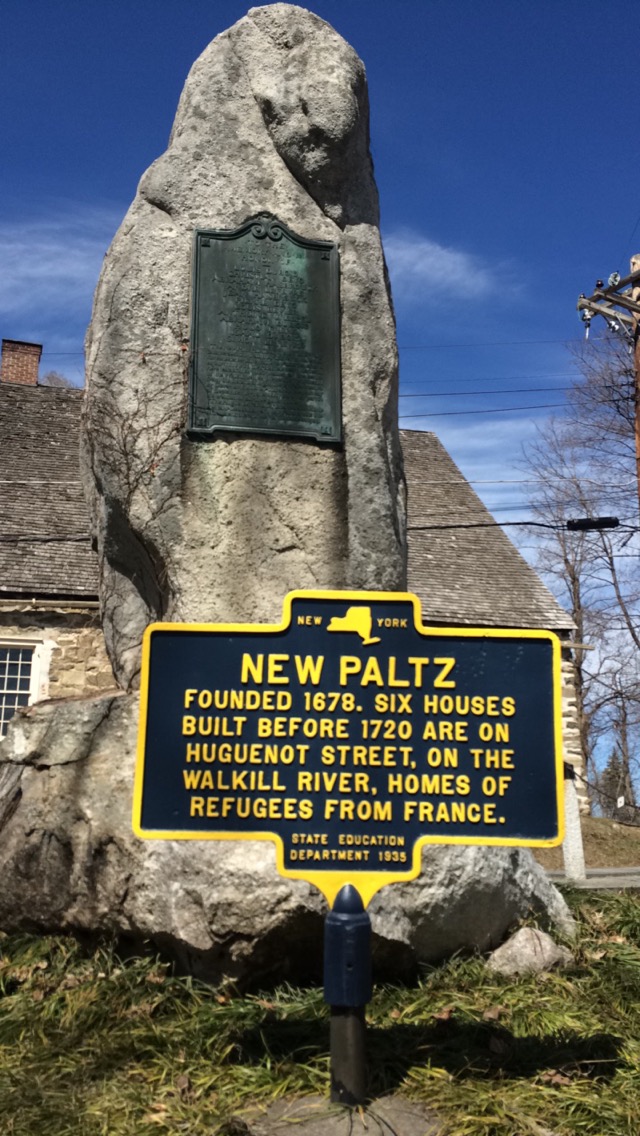
The object combines fascination and frustration—it could potentially be an object of great importance for it could be a material link to the very event that caused the great emigration of Huguenots to various places around the world, in this particular case, our home of New Paltz. However, it could unfortunately be of no consequence at all—a story of make believe thought up by perhaps a history fanatic with a grand imagination or a distant relative related to someone in the New Paltz genealogy that could have sworn that’s how the story went about the ring in the retelling of a tale.

This object has been a source of enchantment. Regardless if its history is true or false, when one thinks about this ring, it is likely that nostalgia will take over as it has the potential to be a miniature piece of a dramatic history that is so dear to the town’s past.

The Edict of Nantes was a French law passed by King Louis IV allowing French Protestants a degree of religious freedom to publically worship their religion with full civil rights. The Protestants of France are referred to as the Huguenots and it was they who found freedom of persecution following the Revocation of the Edict of Nantes decades later by King Louis XIV in the New World. The overturning of the edict in 1685 spurred the emigration of the Huguenots to what would become New Paltz. If the description on the paper were indeed true, that would mean this ring was worn by a Huguenot seeking refuge in response to the revocation of the Edict of Nantes and furthermore, this person could belong to that of a Lillie ancestry but there is still much to explore. In contrast, if this is false, then who crafted this story and why? Who are the Lillie’s, if anyone at all? Who may have worn this ring and from where did it come?

In initial searching, little has been found about a Lillie family connected with the Ulster County settlement by the Huguenots. However, some information was found about the Lillie Family of Lisburn in Northern Ireland. These Huguenots are descendants of de Lilles from the town of Lilles in France who left the country for Ireland in the 1570s following the Massacre of St. Bartholomew’s Eve in 1572. Is it possible that one of the Huguenots who came to the Hudson Valley is connected to this family line and wore this ring? If no Lillie family is connected to New Paltz or elsewhere in New York then it would be important to determine any connection the donors may have had with this ring and why they chose to donate it in memory of Edith E. Hasbrouck.

Trainor, Ashley. “Donor Card.” 2015. jpg.

The ring is so painfully simple that upon inspection, nothing can be derived from the materiality of it. However, the object does show us that we can emotionally connect to even the most basic of items. If this was in fact a wedding band from the 1600s, then the society has in its hands an item that bound two people through the placement of this item on their finger. Those people’s histories are a part of the ring as well in addition to anyone after them that wore this ring and carried it with them through their life. Now the ring has a new layer added onto it as it resides at Huguenot Street, its new home. We perpetuate the utter fascination with this object with the legends we imbue in it since its origins ultimately remain a mystery.

Bibliography

Best, E. Joyce. “The Huguenots Come to Lisburn.” Lisburn. Web. 13 Apr. 2015.

Cavendish, Richard. “The Edict of Nantes.” The Edict of Nantes. History Today, 4 Apr. 1998. Web. 13 Apr. 2015.

Trainor, Ashley. “Donor Card.” 9 April 2015. Digital Image

Taking Up the Hatchet

DESCRIPTION: In modern English lexicon, we’re all aware of the phrase “burying the hatchet”, literally meaning to end a feud or dispute by putting a dead stop to whatever we’re bickering about. But just several hundred years ago, that phrase had an entirely different meaning. According to The History of the Indian Tribes of Hudson’s River, the process of going to war was a simple yet elegant one; if a hatchet was stuck into the head of a murdered victim not from the same tribe as a murderer, anyone could literally “take up the hatchet” and declare war (Ruttenber 31). According to author William R. Gerard in his article “The Term Tomahawk”, the etymology of the word is seemingly derived from a Lenape word “tamahak”, which is essentially a root meaning “used for cutting” (Gerard 277). The first use of a term similar to this in English is from Captain John Smith’s account in his work Map of Virginia, in which he describes a tool called a tomahack, likely an erroneous spelling, which is “a long stone sharpened at both ends”. Gerard also explains that despite its obvious applications as a weapon, that a tomahawk’s cutting ability was somewhat weak. Rather than hacking downward into wood or meat, a “succession of blows would occur in a slanting direction, a sort of chipping operation” (Gerard 278).

Hatchet and axe heads aren’t particularly unique, as according to author Herbert C. Kraft in his book The Lenape-Delaware Indian Heritage, “finding arrowheads, spear points, and axes is exciting and enjoyable but often go undocumented” (25).  While I could find no specific examples of an axe head in the local area, more often than not, axes among Native American tribes did not differ very much. For example, axe heads were usually employed as “celts”, which is essentially an archaic tool with both digging and chopping abilities thanks in large part to its distinct edges. The second picture in this post, courtesy of Ice Age Artifacts, is typical of this style, as its distinctive edges and wide shape indicate possible implications like digging. PROVENANCE: According to archival work According to archival work NYS Arrowheads, it is very likely that “a Lenape warrior would have used a bow and arrow along with either a ball-headed war club or a ‘tomahawk’ hatchet”, likely acting as a short and long range compliment to one another (251). When a Lenape warrior would take up their arms, they would chant; “Let us go and devour them! Do not sit inactive! Follow the impulse of your hereditary valor! Anoint your hair! Paint your faces! Fill your quivers! Make the woods echo with your voices! Comfort the spirits of the deceased and avenge their blood!” (Ruttenber 31). A chant like this would often accompany a charge issued by a warchief or captain, as the Europeans would call them and more often than not, these were counter-attacks against the land encroaching Europeans, most often the Dutch settlers in the region (Ruttenber 30). For this reason, it seems likely that the Lenape would attempt to settle disputes peacefully before taking action, and likely the act of the Europeans forcing them off of their land or killing tribe members was a good enough impetus to fight back. However, war wasn’t always initiated by taking up the hatchet, and instead reparations could be made through gifts or simply giving the murderer up (Ruttenber 31). Clearly this wouldn’t be the case between tribes like the Lenape and the Dutch or any number of the other European settlers in the region but in addition to its uses as a weapon, an arrowhead such as the one depicted had many other roles to fulfil. Kraft explains that because the climate in the region around when the Dutch, the French Huguenots, and the English were settling roughly four hundred years ago was temperate, activities such as hunting and fishing were likely enacted alongside gardening and agriculture (34). For that reason, a Lenape axe head may have seen use chopping wood or breaking small stones in addition to hunting turkeys and turtles for meat as well as trapping and skinning wolves for their pelts (6).

DATE OF CREATION NARRATIVE: Very simply put, an axe had such as the ones in the pictures would have no unique history beyond what could be assumed. As most adzes, axes, and celts were made for functionality and not form, no distinct markings are typically found on them and as such, their own personal narratives are often lost to time. However, in this way of thinking, a practical history could be imagined rather easily. Likely created for both its utility as a tool and a weapon, a Lenape tribesman would have probably chosen stones that were of an appropriate but manageable size and weight, as a stone too big would be weighted improperly and cause swinging mishaps. After choosing the correct stone, the tribesman would likely attempt to chip the stone down to points to sharpen it at either one or both ends. This was probably done in the off chance that one end would break or simply dull over time, and as most mounted axe heads were done so on simple sticks, the “handles” likely wouldn’t have been meant for either hand nor had a definite head or tail. Most wrappings for axe heads were similar if not the same sinews used to bind arrowheads to shafts, and these sinews were likely from animal carcasses killed on previous hunts. The axes could then be employed as simple cutting implements, likely making woodchips if the cutting motion required it or for felling small trees. In terms of warfare usage, they were likely thrown rather than used in hand to hand combat because of their delicate constructions, leaving that duty to weaponry like warclubs and the like (Gerard 280). However, you might be asking what makes axe heads like the images shown unique to New Paltz?  Again, simply put, nothing really makes any axe head unique to the Lenape or New Paltz itself, however the cultural significance behind any objects like these is what matters most. As axe heads and celts were replaced with the traded iron cutting and digging implements used by the Europeans, the cultural practice of making personal implements became more or less lost to time. For that matter, each Native American tool that’s found is significant in some way, as even though the direct history behind it is lost, it signifies a history that is far older than the more widely known European narrative we are all accustomed to.

Works Cited:

William R. Gerard. “The Term Tomahawk”. American Anthropologist. New Series, Vol. 10, No. 2 (Apr. – Jun., 1908). pp. 277-280. Print.
Kraft, Herbert C. The Lenape-Delaware Indian Heritage: 10,000 B.C.- A.D. 2000. Lenape, 2001. Print.

NYS Arrowheads. Author unknown.

Ruttenber, Edward Manning. History of the Indian Tribes of Hudson’s River. Port Washington, NY: I.J. Friedman Division, Kennikat, 1971. Print.

Image Sources:

http://www.warpaths2peacepipes.com/images/stone-tomahawk

http://www.iceageartifacts.com/images/Gray%20Axe%20-%20KH%20(338%20x%20300)

http://www.penn.museum/sites/expedition/files/1999/03/grooved_stone_axe

Colonial Revivalism in the Deyo House: The Purpose of a Print

IMG_1716

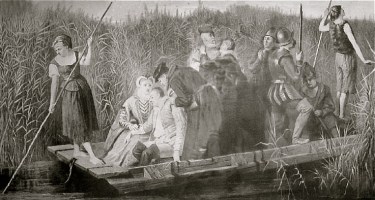
This late 19th century print depicts a romanticized scene of the Huguenots as they fled religious persecution in France. It is one of three such images in Abraham Brodhead’s office that act as a visual reminder of his cultural participation in the Colonial Revival movement that once swept through the Hudson Valley.

“Escape of a Huguenot Family after the Massacre of St. Bartholomew”

London published June 1st 1880 by Henry Graves & C° the proprietors publishers to HM the Queen and TRH the Prince & Princess of Wales, 6. Pall Mall – copyright registered. Entered according to Act of Congress in the year 1880 at the Library of Congress in Washington.

Engraved by J. Scott

Printed by Holdgate Brs.

boatpicture

“Escape of a Huguenot Family after the Massacre of St. Bartholomew”

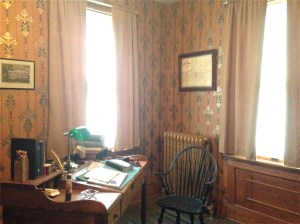
Hanging on the north wall of Abraham Brodhead’s small second story office is a 25.5 in. x 34 in. print, set within glass and against a 3 in. linen mat. The frame is ornately carved wood, about 2 in. thick and decorated with gold colored paint. The prints’ somewhat ostentatious frame very much reflects the propagandistic nature of the scene, and both serve to catch the visitors attention almost immediately. As the eye moves across the composition from left to right, the viewer is confronted by an assortment of figures crowded together on a small wooden raft. Firstly, a young woman dressed in typical 16th century peasant-clothing stands at the back of the raft, steering it through tall reeds. Sitting beside her, an elderly woman in a fine dress and headpiece looks worried as she consoles the disheveled elderly man leaning against her shoulder. Behind the couple are two bearded gentlemen, one with a purse around his waist who leans down to aid the couple, and another who stands proudly turned towards the front of the raft, as the other finely dressed woman wraps her hand around his neck and gazes desperately at his profile. Just in front of them are the two men wearing armor, one holds a tall spear and faces frontally while the other looks back towards the party sympathetically. Lastly, two young boys wearing peasant attire crowd the front of the boat, one attending to his weapon, and the other standing with his head up, looking eagerly towards whatever might lie ahead.

IMG_4297

The northwest corner of Abraham Brodhead’s office. Half of the print is visible on the right side of the picture. It is the first decoration that a visitor encounters upon entering the room, and is situated directly opposite the door.

The printed inscription that lies just below the image is a key factor in discovering the origin of the print. James Scott (ca. 1809-1889), whose name is found on the lower right hand corner, was one of the finest English engravers of the mid to late 19th century. Not much is known about his art education, but he became equally talented in the genres of portraiture, history paintings, and sporting subjects. Scott earned notoriety when his portrait of the Duke of Wellington was published in 1837, and over the next fifty years he engraved a large number of designs after the works of contemporary painters. Henry Graves & Co. was a publishing house in Pall Mall, London that was active between 1844 and 1899, and it ended up publishing over one hundred of Scott’s prints within that time period. The National Portrait Gallery in London now houses over two hundred prints published by Henry Graves & Co., twenty-two of which are attributed to the artist James Scott. The inscription informs us that this print was published on June 1st, 1880, and dedicates the work to Her Majesty the Queen of England, and Their Royal Highnesses the Prince & Princess of Wales. This formality may seem odd in modern practice, but it was customary to honor the head of state in all matters of fine and high art especially for those who distributed prints & literature. Although it is not known how this particular print came to be in the Deyo-Brodhead family collection, we are able to infer that it was some point after 1880 when, as the inscription tells us, it travelled to Washington and passed through the Library of Congress.

IMG_4295

The northeast corner of Abraham’s second floor office.

You may wonder how this unique foreign print became a part of the modern day Historic Huguenot Street collection. It’s a dramatic image of a purely fictional event; the raft that all ten Huguenots seem to be floating on could have never held the weight, and the socioeconomic diversity of their fleeing party (as is evident in the clothes they’re wearing) appears democratic, but highly improbable. It is true that over 5,000 French citizens were killed during St. Bartholomew’s massacre on August 23, 1572 in Paris alone, and thousands more fled the country permanently, but this particular rendering of the escape is inaccurate. What, then, is the point? Why would a respectable descendent such as Abraham Brodhead want a romanticized print that remembers this traumatic moment in French Huguenot history hanging in his primary office? Understanding the owners’ personal history and examining the broader cultural context of the Hudson Valley during the late 19th century yields quite a fruitful explanation.

In 1894, Abraham and Gertrude Brodhead received notice that they had inherited what they believed to be a large sum of money from a “rich banker uncle”. Pierre Deyo was one of the original Patentees of New Paltz and had built his stone house along the main thoroughfare of the settlement in 1720. Slowly over the years, Deyo’s grandchildren added other stone additions to the rustic house, but none as dramatic as what Abraham and Gertrude decided to build nearly two centuries later.

IMG_1720

A detail of the printed inscription. Only the title is visible without a magnifying glass.

At the ages of 37 and 32, Abraham and Gertrude regarded their inheritance as an opportunity to join a new, upper-echelon of society. The period of Colonial Revivalism that emerged in 1876 was a national expression of Early North American culture; although its underlying goal was to create a particular historical consciousness pertaining primarily to the original East coast colonies, the movement manifested itself as a style of architecture, decorative art, and landscape design. In keeping with the trend, the couple took out several bank loans (all of which they believed they would be able to pay off after the family money came through) and began reconstructing their small ancestral stone house into a three-storied mini-mansion. The stone foundation was retained as an important reminder of the family history, and once construction was complete, the original one room stone house became the couples’ main entertaining space. Abraham and Gertrude were able to welcome their guests into their lavish, contemporary home and point to the exposed wooden beams of their sitting room as a visual reminder of their ancestors’ hard work (and more importantly, of the Brodhead’s inherent privilege to that status).

getrude broadhead

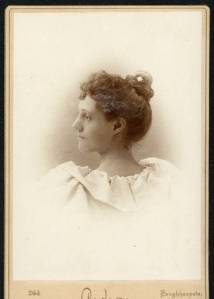
Studio portrait of Gertrude Deyo (b. 1868-1926), daughter of Matthew Deyo & Julia Etta Dubois Deyo. She married Abraham Deyo Brodhead in 1890. Photo ca. 1890

abrham brodhead

Studio portrait of Abraham Deyo Brodhead (b. 1863-1926). Photo ca. 1880-90

At this point in history, the Brodhead’s were “competing”, for lack of a better term, with families like the Vanderbilts, the Roosevelts, and the Rockefellers who had established their own family estates across the river in Hyde Park and beyond. Although those particular families were also the embodiment of the struggle between “old” and “new money,” they represented the top tier of opulence and grandeur in American society. Even on their side of the Hudson, the Brodheads were up against the then-growing number of Gilded Age homes that were lining the streets of nearby Kingston. They never would reach the same social sphere that the aforementioned families occupied (primarily due to their habit of spending money they didn’t have), but this did not stop Abraham and Gertrude from trying. The Hudson Valley had turned into a hot spot for Colonial Revivalism and the Brodhead’s knew that in order to stand out, their best bet was to advertise their heritage.

DSC_0535

A modern view of the Deyo House. Evidence of the original stone stucture built by Pierre Deyo in the 18th century can be seen on the exterior of the first floor.

Besides their newly impressive home and manicured gardens, what better way to display that particular connection than through decoration? This is where the interior of the Deyo-Brodhead house becomes important to the underlying Colonial Revivalism theme; family heirlooms and antique furniture inhabit every room, and dozens of prints & portraits dot the walls. In 1894, the Brodhead’s family home had become a stage, and these objects, their props. The image that James Scott created in 1880 is obviously sympathetic to the Huguenots, but more importantly, it portrays them as a resilient and brave people. The proud man comforting the emotionally distraught woman on his chest as he looks towards the future is an overt symbol of the Huguenots’ heroism. They were persecuted as French Protestants and run out of their own country, but instead of dying out and accepting defeat, the Huguenots became pioneers of a new land. When Pierre Deyo and the eleven other founders of New Paltz came to settle the area, they faced deadly inclement weather, starvation, and hostility from the Esopus Indians who were ready to fight for their land. These are the types of stories that would have been told as esteemed friends and colleagues visited with Abraham in his office, and these are the pieces of history that served to glorify the Brodhead name.

gertrude 2

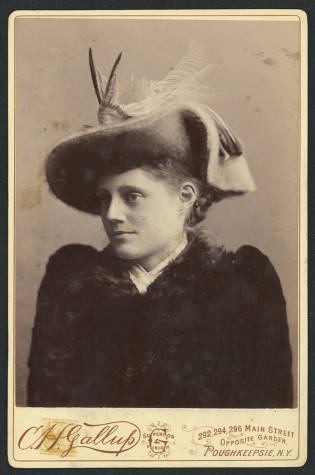
Studio Portrait of Gertrude Deyo in Hat. Photo ca. late 1890’s.

It seems somewhat strange that the true value of this print is indeed the lie that its able to tell. Its ornate frame indicates that the print was most definitely displayed and appreciated as a piece of fine art, but its true function was that of an ancestral advertisement. Although a modern perspective could perceive the Brodhead’s as power-hungry, it is crucial to remember that they were one family among a large scope of the American population who participated in this cultural obsession. In many ways, the Deyo House and the 19th century art and artifacts that are now kept protected inside are able to add to the rich history of the original settlers. By examining the Brodheads and the way in which they attempted to re-establish a family legacy, we are able to better understand the complexity of this noteworthy print, and the role it had in reviving an idealized memory of the Huguenot settlers.

BIBLIOGRAPHY

“August 24: This Day in History, St. Bartholomew’s Day Massacre.” History. A&E Networks Digital, n.d. Web. 12 Apr. 2015. <http://www.history.com/this-day-in-history/saint-bartholomews-day-massacre&gt;.

“Henry Graves & Co. (active 1844-1899), Publishers.” The National Portrait Gallery. NPG, n.d. Web. 12 Apr. 2015. <http://www.npg.org.uk/collections/search/person/mp12751/henry-graves–co?search=sas&sText=Henry+Graves+%26+Co&OConly=true&gt;.

“James Scott (ca. 1809-1889), Engraver.” The National Portrait Gallery. NPG, n.d. Web. 12 Apr. 2015. <http://www.npg.org.uk/collections/search/person/mp15031/james-scott?role=art&gt;.

“The Katherine Deyo Cookingham Downer Collection.” Hudson River Valley Heritage. N.p., 19 Mar. 2007. Web. 14 Apr. 2015. <http://www.hrvh.org/cdm/search/collection/hhs/searchterm/Katherine%20Deyo%20Cookingham%20Downer&gt;.

Trainor, Ashley. “Professor Mulready’s Class.” Message to the author. 2 Apr. 2015. E-mail.

Weikel, Thomas. “Professor Mulready’s Class.” Message to the author. 3 Apr. 2015. E-mail.

The Paradox of a Narnian Box

The Collier Books 1970 Box Set Edition

The Collier Books 1970 Box Set Edition

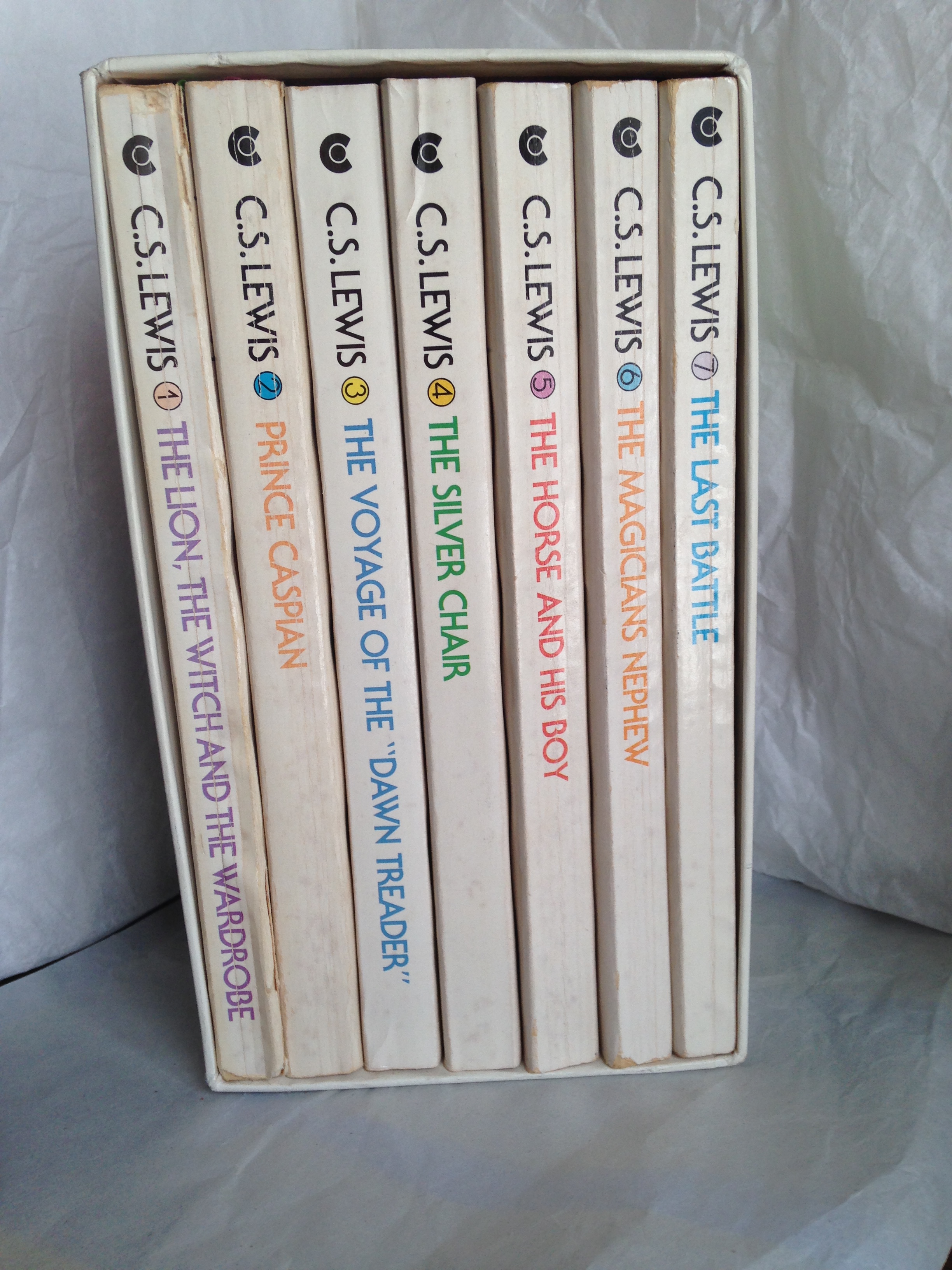
During the fall semester of 2013, I was lucky enough to land a spot in the ever popular course on Classic Juvenile Fantasy. A peek at the required reading list revealed that I had already read many of the texts as a kid, a discovery that understandably excited me.  Not only would I have a legitimate reason for rereading some childhood favorites during the semester (a luxury I cannot generally afford when faced with the stack of reading for my various English classes), but I also figured I could save a few dollars by borrowing most of the texts from my parents’ house. However, when I called my mom to share my thrifty plan with her, she informed me the several of the books had been donated to the local library. Oh well, thought I, it was worth a shot. My mom took it more seriously, and, on her next visit, she presented me with a used boxed set of C.S. Lewis’s Chronicles of Narnia. Like many children born after 1950 (the year in which the first chronicle, The Lion, The Witch, and The Wardrobe, was published), I read most of Lewis’s adventure in Narnia and was utterly charmed by Aslan the lion. At the time, I held the not so secret hope that if I did not receive an owl that I would at least find a wardrobe into another realm. However, in 2013 when my mom handed me the boxed set, it had been years since I had even thought of Narnia. To be honest, I do not quite remember what my childhood copy of The Lion, The Witch, and The Wardrobe looked like. It was certainly newer than the set I now own. However, what it lacks in youth, the set makes up in character and an interesting, albeit mysterious, background.

IMG_0654.JPGpub

Formerly Crowell-Collier, Collier Books was a product of a merger with the Macmillan Co. in 1960.

Released in 1970 by Collier Books, a subsidiary of the Macmillan Publishing Company, the box set is technically the fourth edition of the series to be released in America since Macmillan premiered the series between 1950 and 1956. The need for more editions indicates the ongoing popularity of the series, but it also offers an interesting reflection of the publishing business at the time. This is the only edition of TCON to be released under the Collier Books imprint, as eight years later the subsidiary would be sold to Harper & Row, concluding a relatively short business relationship between the Collier group and the Macmillan company. With the advances of printing technology, including the addition of computers in 1970, the publishing world seems to have been in a state of flux with new companies gathering steam and older companies choosing to merge to keep themselves afloat. There is an extreme ambiguity about this period that stands in sharp contrast to the material objects it produced. For instance, try as I might, I could not track down the actual printing company that assembled the box set. It is as if some distributer at Macmillan/Collier Books waved his or her arms and the set just magically appeared on book shelves everywhere.

Left side

Left side

Right side

Right side

Yet, the set is clearly the product of a material process, be it an automated procession line or human hands. After all, something had to assemble the box, arrange and print the pages, etc. The box measures roughly four by four by seven inches, about the size and shape of a lunchbox. In order to fit in the space allotted, the seven chronicles have been condensed into slim paperback form, each being no more than half an inch thick and a little less than seven inches tall. In most places, the eleven-point font crowds the page to ensure that none of the action is lost. Both the box and the books feature key scenes from the novels, rendered with dynamic colors and shapes. Exposed to the sun, the colors on the box have faded. However, the book covers stored safely inside suggest how bright they must have been.

All seven chronicles. Note that the books are numbered in order of publication rather than chronologically as they are often numbered today.

All seven chronicles. Note that the books are numbered in order of publication rather than chronologically as they are often numbered today.

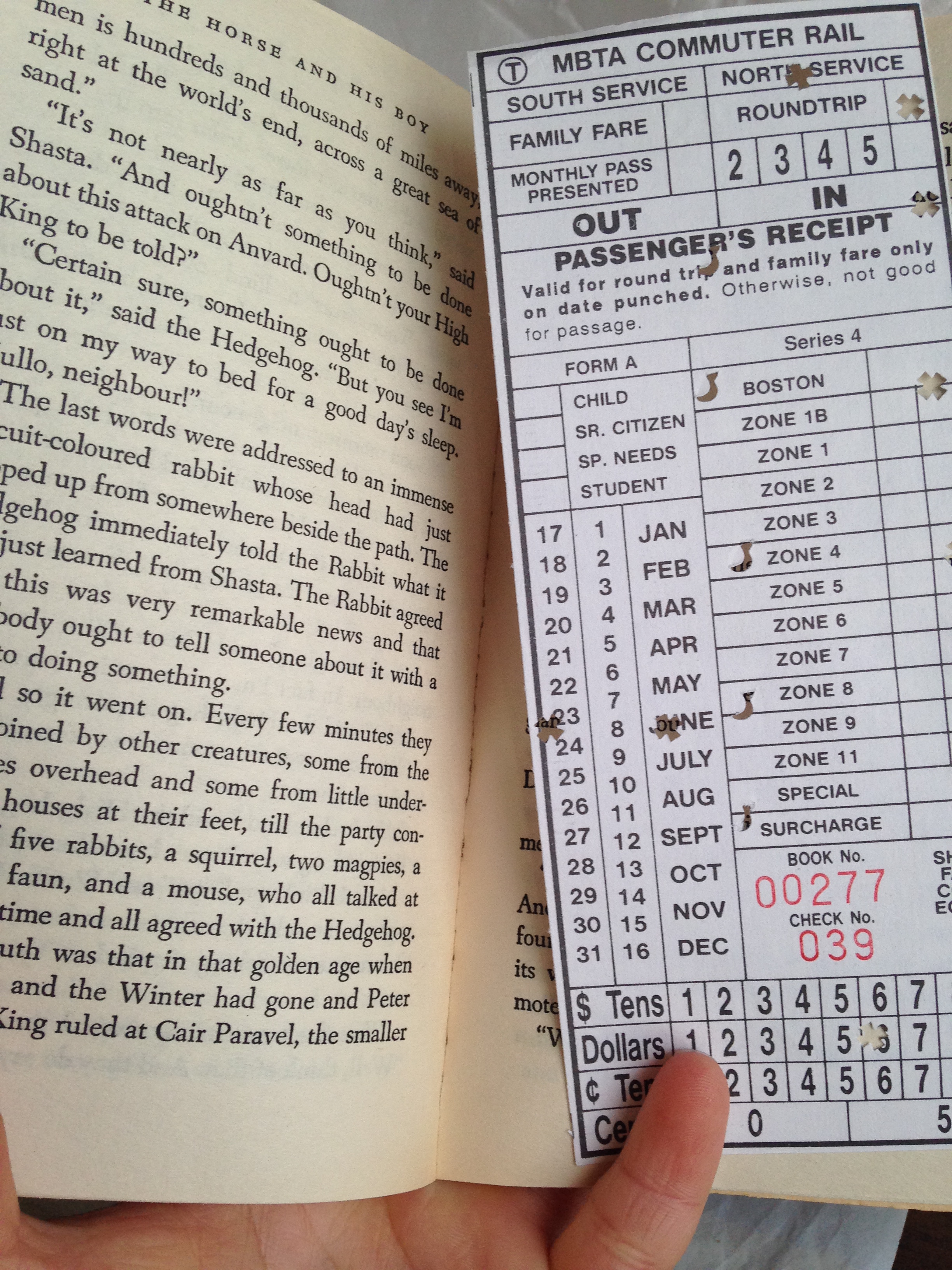
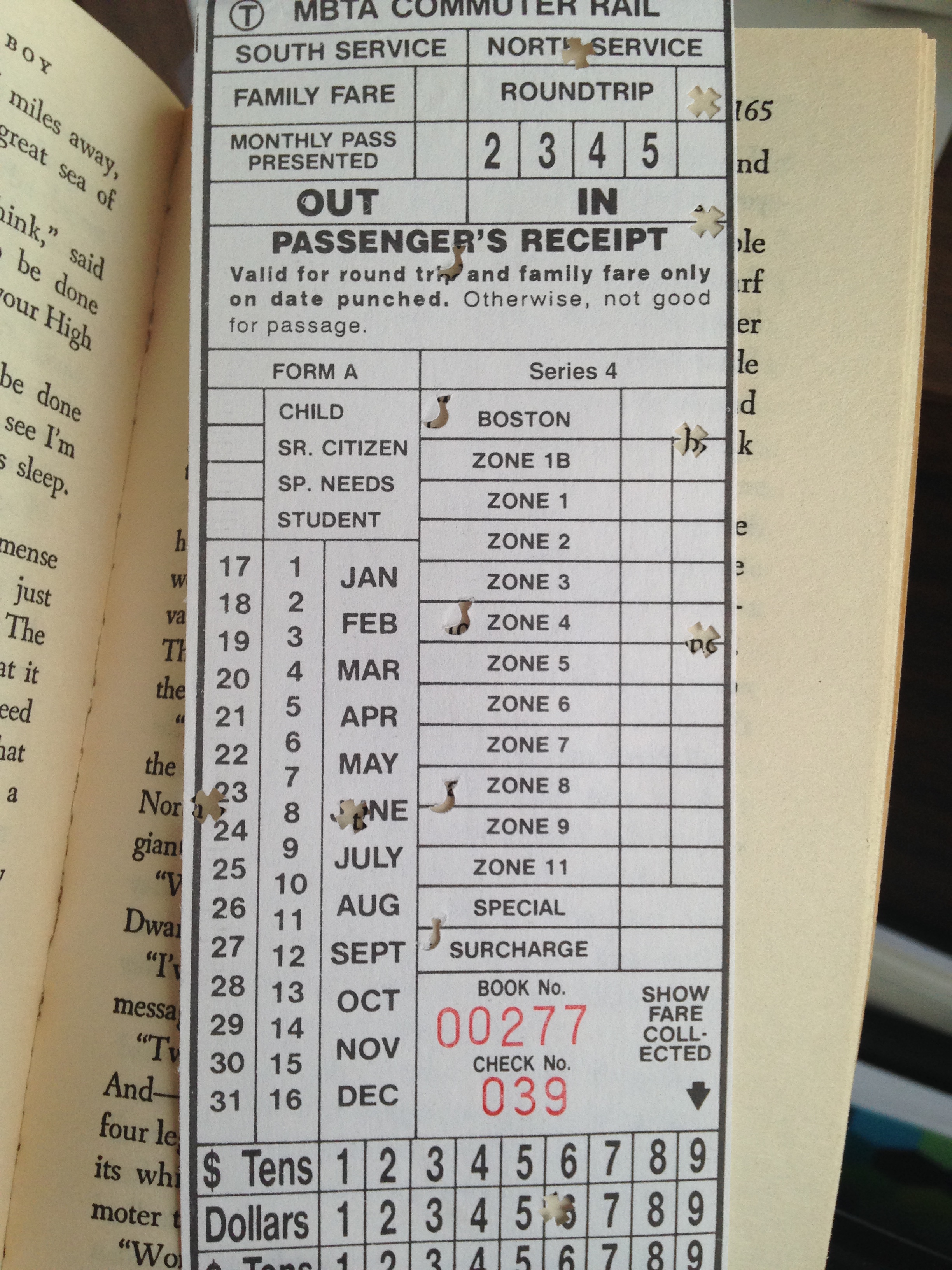
The set has certainly seen better days. The box is light shelf wear, particularly noticeable on the corners. One can see from the crinkling of the spines of the books that the glue that holds the paperboard binding together is beginning to degrade. At some point during its time in my backpack during the fall semester, the front cover of The Lion, the Witch, and the Wardrobe began to fall off. I have yet to take my sticky notes back out. In spite of some patches of wear and tear, the collection as a whole is still pretty hardy. In addition, the books themselves are compact and lightweight enough that they can easily be transported to be read on a trip. One of the previous owners seems to have done exactly that, leaving a Massachusetts Bay Transportation ticket tucked in between the pages of The Horse and His Boy. It is a round trip ticket for a day trip to Boston stamped June 23. Thrilled to find another ticket, I tried to track down the exact route this anonymous reader had taken, but I honestly believe that the MBTA is even more oblique than my own murky family history.

Another ticket!

Another ticket!

Where exactly are zones 4 and 8?

Where exactly are zones 4 and 8?

Still, discovering the ticket cast the box set in a whole new light. Although I knew the set was used, I had not previously stopped to consider what the previous owners had done with it. Now on top of wondering where they came from, I am also wondering how many trips these slim little volumes have been on and what they have seen. Where did the previous owner buy them? Were they new at the time? What did they look like on his or her shelf? The only things I can be sure of is that someone else held them in their hands and carefully turned the pages.

Works Consulted

For A Brief Overview of the Printing Process through the Ages:

http://www.hrc.utexas.edu/educator/modules/gutenberg/books/printing/

For More Information about Collier Books:

http://ketupa.net/crowell.htm

For More Information about Macmillan Publishing Co.:

http://archives.nypl.org/mss/1830#access_use

For Helpful Information Regarding the Various Editions of The Chronicles of Narnia:

http://inklingsfocus.com/en_US/amer_1950-1956.html

Totally Worth the Toll

IMG_2549I brought my copy of The Phantom Tollbooth into class on the first day, but I don’t think I adequately expressed my love for this book so I decided to dedicate a blog post on it. Even as I look at it now my heart melts. I first read it as a kid in elementary, picking up a copy in my classroom library. Though I have this odd knack for retaining a detailed memory of stories I read as a kid, I never forgot about this one, and wanted a copy of it ever since. Years go by, I would think about the study often, dying to reread it, and then just this past year I ended up at a “history of children’s books” exhibition at the New York Public Library. The Phantom Tollbooth had a spot in the show and they had copies in the bookstore at the end of the exhibit. By the time we got there the store was closing, so I ran inside and bought one.
It’s a little more than 5 inches wide and 7 and a half inches tall. It’s a paperback, with it’s iconic blue cover and illustration of Milo (the protagonist) and his companion Tock (a watchdog). It’s printed on what feels and smells like newsprint, with a thin but rough feeling to contrast it’s glossy but thicker cover. It’s a “Yearling Classic” but is published by Random House.

IMG_2552The author Norton Juster and illustrator Jules Feiffer are still alive and well. Though I haven’t met many people who have read the book they say it has a cult following. This may be true considering a small documentary just came out called Beyond Expectations which, “delves into the history of the novel and the enormous influence it has had on generations of children through today.” – The A.V. Club. I know it had an enormous influence on me, but on generations I’m not so sure. Anyhow what I have found about the history of the novel and Juster’s process as a writer is fascinating. As the trailer to this documentary points out, Juster and Feiffer were roommates, and thought he was not the original illustrator, Feiffer was involved with the novel from the very beginning; uncommon for most book illustrations. Juster would read the novel out loud to him, and at some point Feiffer started sketching, developing characters in his scratchy style which Juster must have enjoyed, for the two ended up collaborating. They remain good friends even to this day. This was one of the things that stuck out to me in the evolution of this novel because I think that illustrations and novels as independent of each other, as if the artwork is nonessential and can be deleted or replaced. However, especially in the case of this book and many other children’s books, some texts are made to be read with illustrations. This made me wonder what Shakespeare would say about his plays and the visuals; would he demand that seeing the play acted out was essential?

At the time, Juster had received a grant to write a children’s book about urban aesthetics. He did not want to write this book. Instead, he started writing The Phantom Tollbooth. To this, Juster said,I find the best things I do, I do when I’m trying to avoid doing something else I’m supposed to be doing.” However parts of his original task seeped into his work, “One was the Cities Of Illusion and Reality — the cities disappear but people don’t notice it. There were several things that came directly from things that I was either thinking about, or had done research about for the book on cities.” Juster cited many influences, more of which I will talk about soon enough, but hearing author’s comments like these gives me, relief, I guess that is the best way to put it, because – like it was said in the Shakespeare reading – for a long time I feel like it was implied that all great works were made by one man, in one room, on the stroke of genius, and it was easy, breezy perfection from start to finish. For Juster at least this is total crap:

I write in a very laborious kind of a way. I write and rewrite. And rewrite. And rewrite. Well, the thing of course is if you’re doing it well, when you finish your 30th rewrite, or something, it should sound like you’ve just written it completely, freshly once. Because sometimes what happens when you write and rewrite and rewrite, is you suck the life out of something. It’s difficult.

I find that writing is a very bleak, and lonely, and stressful, and often unhappy occupation. And I find this is not only with me when I talk to other writers. First of all you eat it. You sleep it. You can’t get it out of your head. You wake up in the morning constantly with this idea of staring at this blank page — you’ve lost it — you’re never going to get what you know you feel. What’s most interesting is that, say that goes on for several months while you’re working. That several months’ period of time can be an absolute misery. At the same time, when you finish and you look back on that time it’s somehow a very satisfactory — if you can use the word happy, time.

IMG_2553Juster also mentions that he did not have a mission when he started writing the book, and it was much more for his personal enjoyment. He didn’t even know what demographic it was for. He would write it in pieces, sections of dialogue and scenarios; he felt as if he was eavesdropping more than constructing the story himself. At some point, he needed to tie all the pieces together, so Feiffer’s wife, Judy, told him to write a two page synopsis. The story he wrote down had nothing to do with the detailed pieces he spent so much time on. Some of the earliest ideas he had developed didn’t fit into the story until very late. Though all authors have a different process, I found some similarities between Juster’s process and the commonplace books that were present in Shakespeare’s time. I think these sort of things disprove the romanticized “instant creation theory,” showing that a lot about genius is synthesis, it’s not just a have or have not quality, like any other great achievement it is very much earned.

And then there’s the editor. Juster said that, “I worked with a single marvelous editor at Random House. He had a million suggestions and we talked them all over. None of them really addressed the issue of simplifying or “dumbing down” the book.” Though it’s been over fifty years since the book was published, I looked at some interviews from Random House editors, in addition to trying to find information about the company’s manufacturing. The editors seemed just as kind and enthusiastic as Juster’s from fifty years ago. In a video these editors said that their mission is to make the author’s vision as clear as possible, and to do that they try to make an editing system that works for both parties; it could be edit as they go or a whole book at a time. Andy Ward the VP Executive Editor said, “…I find the relationships that I have are intense, they’re really intense, and they’re really close. A lot of the writers that I work with become some of your best friends because it’s very intimate work, and I think you develop a sort of dependency on one another.”

As far as manufacturing goes I didn’t find much. Random House is a huge force, with two warehouses, one in Illinois and one in Maryland. The total square footage of these two warehouses is about forty football fields, and ship over a million books per day between these two facilities. Though getting a book from an industrialized manufacturer is not as personal as  getting a hand bound, personalized book like the table books in “Shakespeare’s Tables,” it is these kinds of manufacturers that have made the written word so widely available and affordable. It was also specifically the grant for a book about urban aesthetics that provided Juster with the money to support himself while he wrote the novel. The book is still deeply personal to me, and I am grateful that I am able to have my own copy

Even Cowgirls Get the Blues

Most books I buy now are usually used. I’ve found that it isn’t too difficult to find used books in great condition – Barner Books, right in town, has a huge selection – as well as even ordering used from Amazon and Barnes and Noble. I rarely buy new books now, especially if we’re talking those pesky, pricey textbooks. I love buying used because it’s nice to hold a book that could have been once cherished and is now once again up for grabs, looking for a new owner to make happy.

IMG_3224

This particular book was purchased at Barner. It sits on my bookshelf beside my collection of other used books, and I think the last time I took it off the shelf was when it was sunny and I could lay in the grass by the pond on campus reading it. Even Cowgirls Get the Blues by Tom Robbins is one of my favorite books, which might be weird to say about a book I haven’t quite yet finished. There is a dog-eared page on page 261 and I think that’s where I left off. Creases on the corners of pages can be seen throughout the novel, indicating that I definitely took my time while reading Robbin’s writing. The book is in fairly good condition for a used book, and penciled in on the front page is the price whoever working at Barner set, a scribbled 8, which barely looks like a number and could easily fade away or be written over or erased. The novel must have been bought used by somebody before it was sold to Barner because it had a used barcode sticker on the back cover. The initial price of the book was $11.95, so I guess I didn’t save as much money as I probably could have on this used book. The binding is extremely creased and a little bit torn on the bottom. The front cover is actually missing it’s bottom right corner, almost like it was folded and then ripped off. Other than the slight tearing and creased pages, the pages aren’t too yellowed and I would still call this book “in good condition”. I will just be more careful when I decide to finish the story in hopes that the front cover doesn’t fall off.

IMG_3225

The title page says it’s a “Bantam Trade Paperback”, and when I researched this publishing house I found out it’s entirely owned by Random House, a subsidiary of  Penguin Random House. Basically, this book was printed by an American company that is owned by a larger American company. This book also includes a “Printing History” section on it’s copyright page.  It’s printing history says that a portion of this book has appeared in the literary journal American Review in 1976, however the edition I have is from 1990. I think that from the printing history and title of the novel, as well as the tears, one can infer that this is an American tale that takes some time to read, but it’s definitely loved.   IMG_3226