The Sun Also Rises

For this blog post, I have chosen to write about my copy of Ernest Hemingway’s The Sun Also Rises. I read this book last semester for my Intro to American Literature class with Professor Stoneback. For me, it was definitely a challenging and enlightening class. Looking at the book is like looking at a reminder of an accomplishment I made by completing the class. I bought it used off of Amazon in pretty good condition with barely any marks on it. However, I was not shy in marking this book during class. Within it I have highlighted important sections such as the value scene with Brett, Jake and the count and famed lines such as “Isn’t it pretty to think so.” All over the book I have scribbled questions to myself and made notes of Stoneback’s remarks like how important the value scene is.

Hemingwaysun1The size of the back is about 5 x 7 inches. It is a paperback edition published in New York by Scribner an imprint of Simon & Schuster in 2003. Scribner originally published the book on 22 October 1926. The book has remained in print since it’s original publication. Hemingway used his own experiences in Spain to inspire the novel. The photo to the left is a first edition cover of the book.

The book is based off of Hemingway’s manuscript of the story. According to an article I read online from The New Yorker, it seems that the manuscript went through an intensive editorial process. Ian Crouch’s article “Hemingway’s Hidden Metafictions” details several alternatives titles and lines that had been rewritten. The final line “Isn’t it pretty to think so” was originally written, as “It’s nice as hell to think so.” There has been a new edition of the novel published that reveals alternatives from Hemingway’s early manuscripts.

Maxwell Perkins was the Scribner editor on Hemingway’s work. Perkins also worked with F. Scott Fitzgerald who played a role in Hemingway’s editorial process in their correspondence as well. Fitzgerald reminded Hemingway that less is more and that the book didn’t really start until “Robert Cohn wasunnamed once middle weight boxing champion of Princeton.” Hemingway deleted the several pages of material he had written before this official opening line.

The book now sits amongst a stack of novels I am currently reading this semester and ones I read last semester. But, this book always brings me back to Stoneback’s class which was unlike any other. The front cover has Ernest Hemingway in big letters on the top and The Sun Also Rises on the bottom and in between is a blurry picture of a bull and a matador. When I look at the book, I see a text that bares the evidence of being carried from class to class. Ultimately, it looks like a student’s book to me. A student that was deeply motivated and interested in learning about the subject. However, I suppose my opinion could be a little biased on this matter.

From Dr. Sullivan’s Bookshelf: Cicero on Oratory and Orators

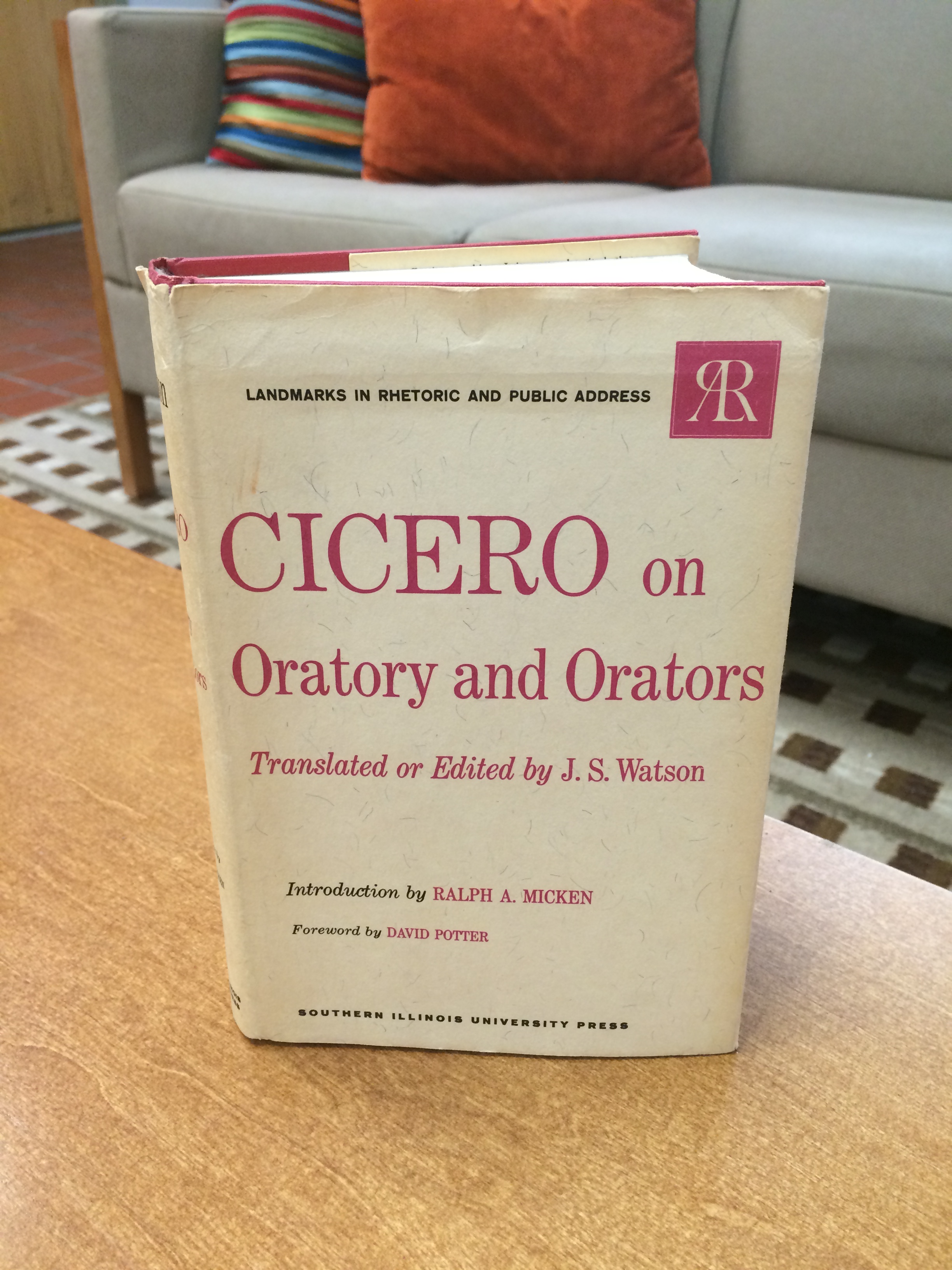
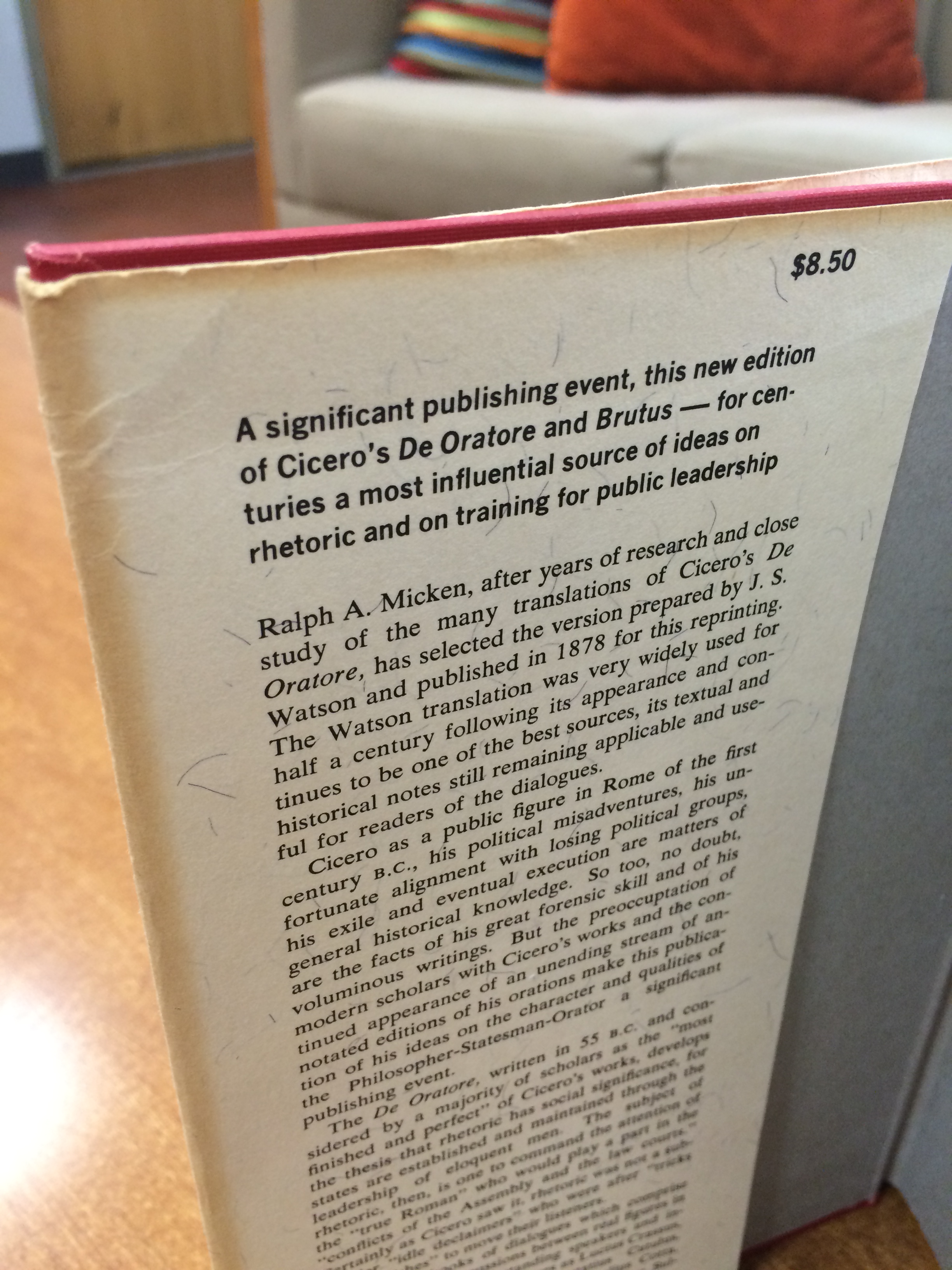
For this week’s blog post I decided to look at a text that lives on Dr. Pat Sullivan’s bookshelf. I thought it was be intriguing to observe one of the books she owns and keeps in her office. Dr. Sullivan is a scholar of rhetoric and focuses on gender, race and class in political rhetoric. The book she suggested to analyze is Cicero on Oratory and Orators, translated and edited by J.S. Watson and was a new edition of Cicero’s De Oratore and Brutus which was written way back when in 55 B.C.! The inside flap IMG_7766of the paper cover introduces the text as “a significant publishing event”. Ralph A. Micken, was a professor of Speech and Chairman of the Department of the Southern Illinois University,  wrote the introduction for this particular text. The back flap of the cover informed me that Micken lectured on Cicero for over 30 years and completed extensive research at the British Museum and British Universities, reviewing manuscripts of Cicero’s De Oratore. I learned that J.S. Watson prepared and published this edition of the text in 1878 and it was Micken who selected this edition for reprinting as it is considered one of the best translated versions with its textual and historical notes made by Watson. The preface to the text is by J.S. Watson from his original publication where he credits the work of George Barnes, a Barrister of the Inner Temple, whose translation of De Oratore in 1762 provided the ground for Watson’s further translation. IMG_7762

This version of the text was published in 1970 and is a part of a series called “Landmarks in Rhetoric and Public Address”. It is a hardcover book that could have been purchased for $8.50, according to the price printed on the inside flap of the jacket. It was printed using the process of “offset lithography” in the United States of America. Offset lithography is a process that uses printing plates to transfer images and text to paper and was created in 1796. It requires a chemical treatment on the plate to allow for the transferring of the specifically inked areas that utilizes the repulsion of oil and water.. I looked into the IMG_7763process online and it was rather confusing to me even though it was one of the most common ways to print materials. Looking into this facet of the book as object research was eye-opening–I had no idea how many different processes have been invented and innovated for printing materials and that a book printed in 1970 would use a process first created nearly 200 years earlier!

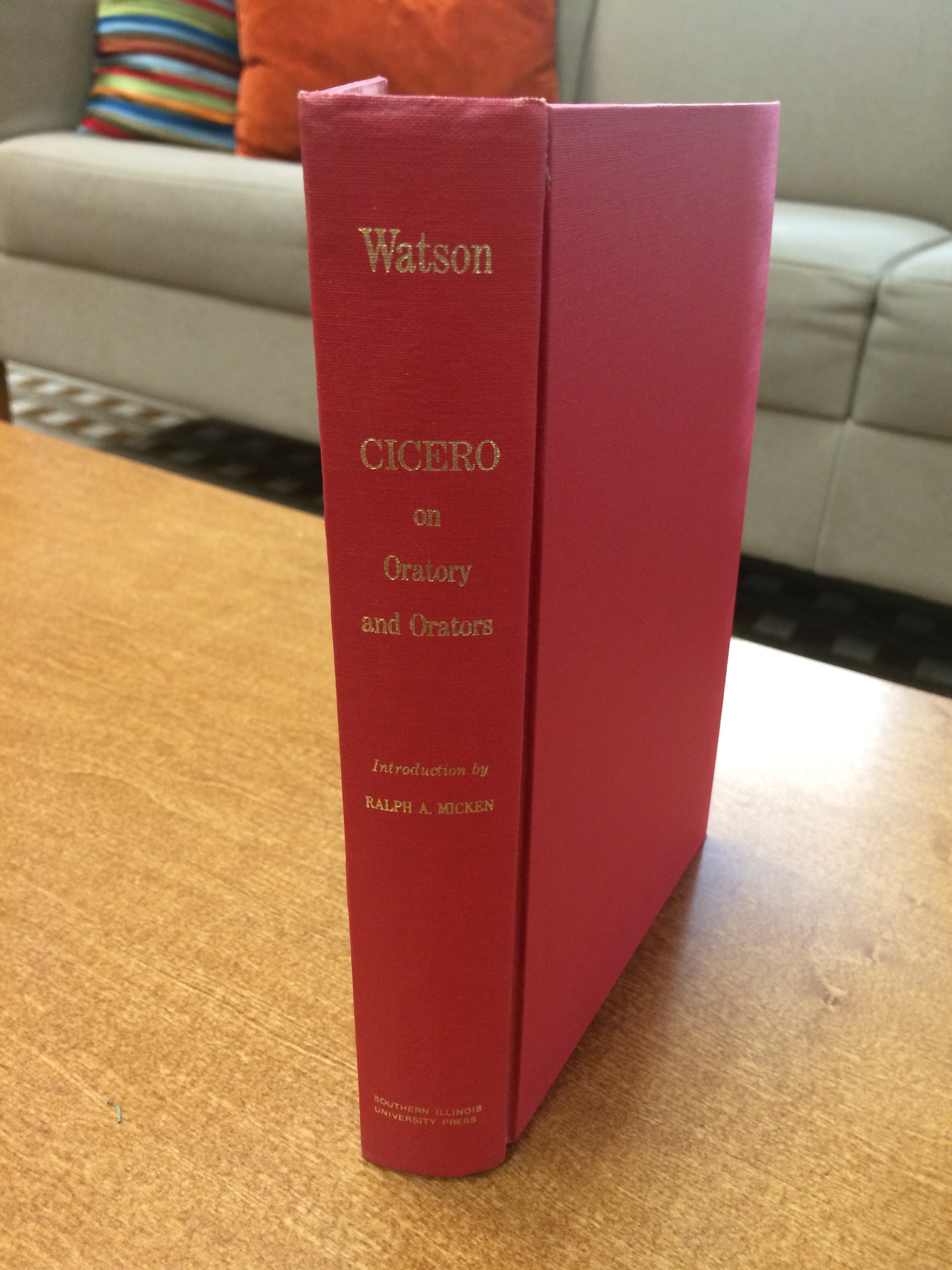
Most hardcover books that I own or have come across have a paper cover that has been printed with a glossy finish. The jacket of this text however looks a lot like manila paper to me! The inside flap reveals a color that would have been much closer to its original color which appears to be buff in color though the outside back, front and IMG_7764spine have certainly yellowed with age. It has this interesting design to it with that looks like fine blue marks that may have been a choice by the designer of the paper product. The book itself is a bright red color and the spine has the editors last name, Watson, the title of the text, Mickens name as well as Southern Illinois University Press all printed in gold. The book is about eight by five inches and contains over 400 pages of text. Within the pages of the text are notations written by Dr. Sullivan. She marked IMG_7761passages with a blue pen, preferring to underline sections of interest and writing key words from the text that struck her such as the phrase, “memory exercised through practice” in her familiar handwriting.

I enjoyed using the little clues within the text to determine its origin story even though I really only scratched the surface with this post! It was interesting to me to select one text off Dr. Sullivan’s bookshelf because it allowed me to take a small peak inside her academic journey, having acquired the text in 198o while she was at graduate school for a course on classical rhetoric that Pat attests to being “really intense”! A text such as Cicero’s shows that it continues to transcend time thanks to the effort of translators and the influx of interest and continued relevance in consuming such works of one of the great orators.

What’s in a name? Would the “Bad” Quarto by any other name still be so “Bad?”

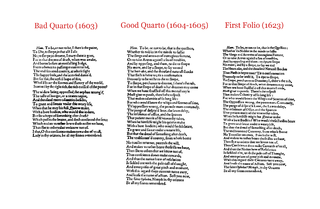
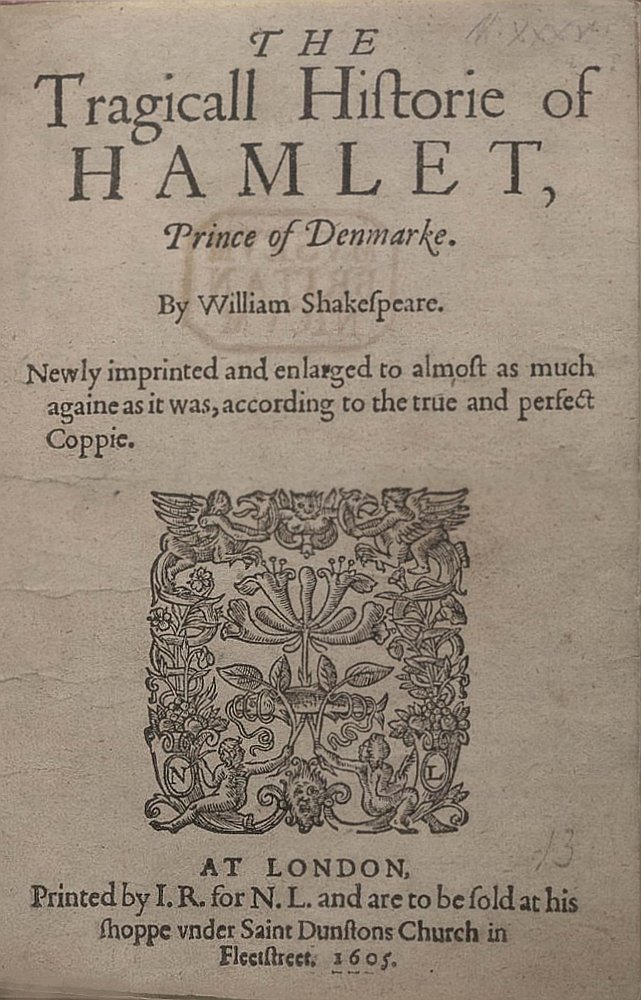
I had some fun this week with my Norton Anthology of Shakespeare’s works. Inside this 3,417 page book, each play has a preface, and every preface holds some juicy treasures. The introduction to Hamlet explains how there are such differences between the First Quarto (Q1) the Second Quarto (Q2) and the First Folio (F).

globe-2

Deciphering the differences and similarities between the First Quarto and the First Folio is one of the most exciting things you can ask me to do. I love how we still have access to some of the different versions of Shakespeare’s work. Studying these variations can give us more clues to make a hypothesis of why some changes exist from play to play within different editions — or they can add to the mystery! But I absolutely love jumping into the growing unknown.

The First Quarto is also known as the “Bad” Quarto. Q1 has 2,200 lines while Q2 (printed just a year later) has 3,800 lines. What’s in a name… would this Quarto by any other name still be so “Bad?” The first thing we know is that lines are being added, which means that some sort of purposeful addition is going on.

320px-Bad_quarto,_good_quarto,_first_folio

So what exactly is going on? What is being added and why? What is being added from memory of an actor or from the writings contained in someone’s commonplace book? What is possibly more accurate in the first recording of Hamlet (Q1)? With the knowledge of the Common Place books I start to realize the “Bad” Quarto could possibly (a very quirky “possibly”) have some poignant accuracy. Q1 contains the true and raw way plays were recorded and to that there is beauty!

Scholars have proposed that Q1 is constructed from memory. Actors recited their lines to a scribe and the scribe recorded them. This method seems vulnerable to the many different interpretation a memory can have. I was under the impression that the “Bad” Quarto had some distinctiveness because Q1 was the first published and closer to the ways these plays were really recorded. Q1 may be unique; however, the First Folio is thought to more closely capture the way the play was actually performed. The First Folio is hypothesized to be constructed from promptbooks. A promptbook is a scribal transcript. The promptbook itself was probably constructed from foul papers — a soft of rough draft from the author — which editors then annotated.

Who truly knows if the foul papers of Shakespeare were annotated by editors. Who knows if the memories of his actors were picked by a scribe and recorded in the First Quarto. Who knows if Shakespeare himself had everything, nothing, or some to do with the changes between Q1, Q2, and the First Folio.

Scholars say the mystery is so complicated because Q1 and Q2 hold true to Shakespeare’s style — they both are equally authentic to truly being of Shakespeare’s own writing.

Then we get to the eighteenth century and the oxford edition breaks tradition. They hypothesized that Shakespeare did indeed hold responsibility for the changes in the foul papers in which the promptbook were composed from. That if the foul papers were different it was because they were deliberately revised by Shakespeare.

Whether from the memories of actors or from editors decisions or from Shakespeare’s own revisions, the source is not completely secure.

I chose to compare and contrast act 3 scene 2 from Hamlet in Q1 and the First Folio. It was pretty phenomenal to me because the only differences were of spelling, punctuation, and stage direction. Only a couple of revisions were made — very few words were added or deleted.

Since the message of both versions is predominantly the exact same; this shows just how important act 3 scene 2 is.

The biggest difference was the clear editing done to the clarity of stage direction. The entrances of certain characters were in slightly different places in Q1 as compared to the First Folio. In Q1 the Prologue enters after Hamlet and Ophelia are done exchanging increasingly inappropriate lines about shows and meaning. In the First Folio the Prologue enters between Hamlet and Ophelia’s lines and then delves into his plea for the audience to patiently watch the play. Q1 has Polonius enter after Hamlet is done with his monologue directed towards Rosencrantz and Guildenstern to understand he will not be played. In the First Folio Polonius enters and then Hamlet finishes his speech with “God bless you sir.” The stage direction of character action is more explicit in the First Folio. For example, the First Folio includes very specific direction for Hamlet to take Rosencrantz and Guildenstern aside when they come to tell him the Queen wants to see him, while Q1 does not contain this information. In Q1 all of the characters on stage say “Lights, lights, lights” while just the Courtiers say “Lights, lights, lights!” in the First Folio. The editing is focused on creating more specificity between the choreography of the characters in the sense of lines being interspersed with movement.

Other than the spelling revisions, the editing of the sentences were very subtle. One example of change is Hamlet’s line to Ophelia about husbands. In Q1 he says “so you mistake husbands” and in the First Folio he says “so you mistake your husbands.” I think the addition of the word “your” makes the line more direct and gives it more attitude. At the end of the scene Hamlet has a brilliant monologue directed towards Guildenstern. Hamlet lets Rosencrantz and Guildenstern know how acutely aware he is that they are playing him. The message is so fully the same in Q1 and the First Folio, but there are some small changes to word choice. In Q1 Hamlet says “… there is much music, excellent voice, in this little organ, yet cannot you make it.” In the First Folio Hamlet says “… there is much music, excellent voice, in this little organ, yet cannot you make it speak.” I think that this again is a change for the purpose of clarity. The addition of the word “speak” helps the audience understand Hamlet is comparing himself to a musical instrument. This particular section has one more word change — in Q1 Hamlet questions Rosencrantz and Guildenstern directly and says “Why do you think that I am easier to be played on than a pipe?” and in the First Folio Hamlet says “ ‘Sblood, do you think I am easier to be played on than a pipe?” So what is the meaning of the difference? Is there a meaning? Is it to use the vernacular of the people? I think there is a slight transition from being less overtly obvious to more clearly clever.

I believe punctuation to be very important because punctuation conveys voice. Punctuation helps the actors know the tone and in turn helps the audience get the message. Question marks and exclamation points were added to sentences in the First Folio. Examples include two of Hamlet’s lines; one being “If she should break now!” and the other “Why, look you now, how unworthy a thing you make of me!” This addition makes the ability to understand the meaning a lot easier.

It was a bit humorous to read that Q1 was so much shorter, yet the scene I picked had almost no difference to the First Folio. I am thankful for the changes to spelling and punctuation in the First Folio as compared to Q1. I understand why the characters enter when they do in the First Folio rather than Q1. The timing is more natural. In Q1 it seemed too staged to have one person done talking and the next person enter. Instead the flow from people talking to people entering mesh as one organic movement.

The differences were minimal, but with minimal change comes a greater meaning. The tempering of Q1 to Q2 to the First Folio was for greater clarity. The spelling, punctuation, slight syntax revision, and the stage direction changes were all for the purpose of making the scene more of a masterpiece. More — because it already was.

Shakespeare Quartos Project
The comparison of act 3 scene 2 in Q1 and the First Folio was so impressive to me because with the chance to revise this scene, very little was actually changed. To me this shows how incredible this scene already was. It shows how much work went into this piece at the beginning of its creation.

The Chronicles of Narnia collection

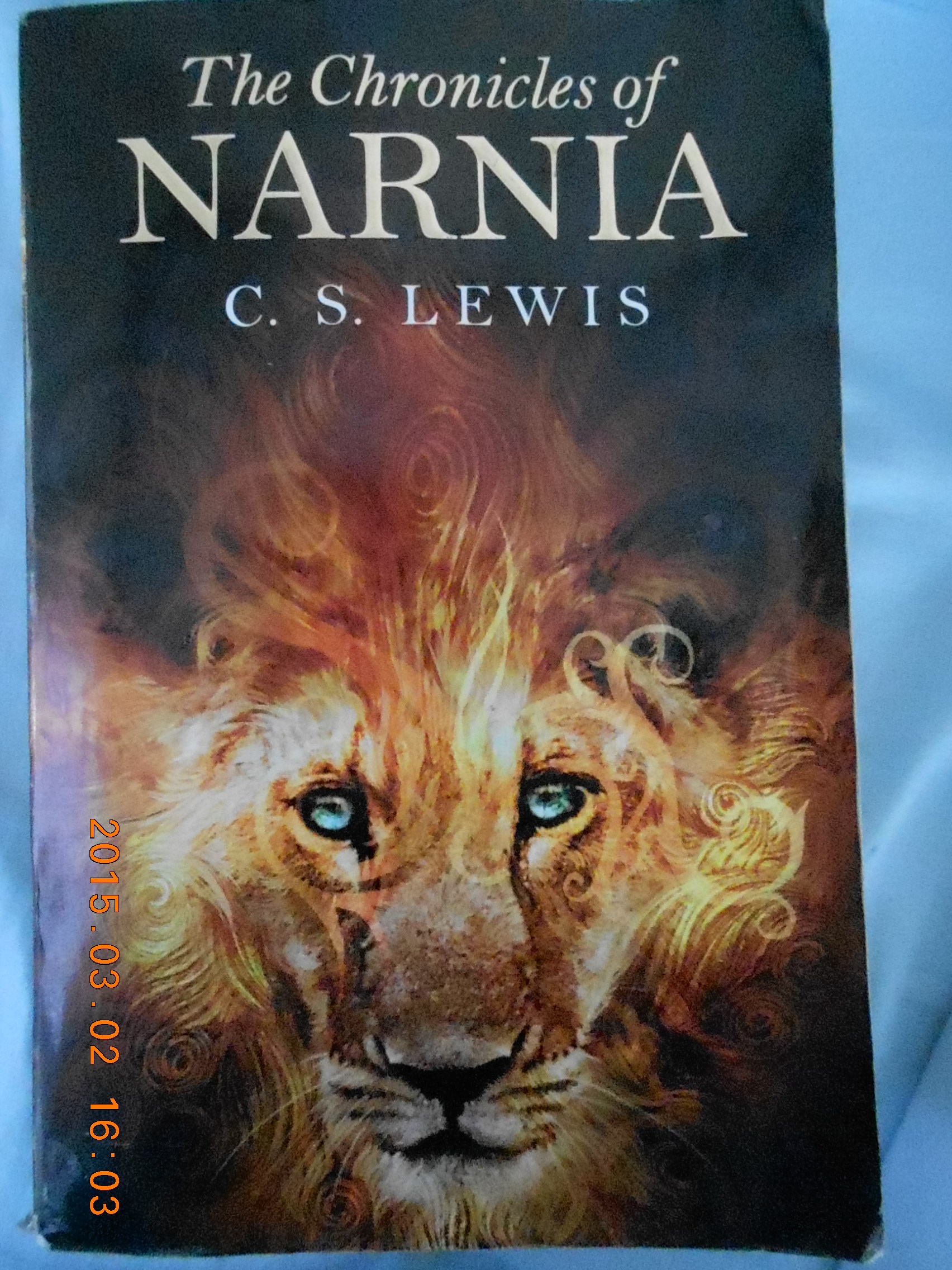
For this week, I chose to write about my copy of C.S. Lewis’s The Chronicles of Narnia.

DSCN0292

Additional proof of its age can be found on the back cover, which sports a price tag of $19.99. Mom had the good sense to buy this back when books were fairly cheap.

My copy is a paperback anthology of all seven books. I don’t remember when I received it–I seem to have always had it with me–but I know for certain that my mother (a devout Christian and a fan of Lewis’s works) was the one who purchased it, probably for her own reading pleasure before it was given to me. I also know that I must have taken it to school at some point, because on the title page is written my name, scrawled in her practiced busy-mom handwriting.DSCN0293

This copy of the text, if you couldn’t already tell, is quite old. Despite having been treated carefully, it shows signs of age and wear that signify its having been owned by loving readers. The pages are slightly worn at the edges. The plastic film on the cover is beginning to peel away, and (as you can see from the photograph) there are little stains on the pages from the dust, fingerprints, errant (unwelcome) insects, and yellowing from age that mar the clean, white surfaces. Although I never dog-eared a page in that book (a lesson driven into me by my elementary-school librarian), the bottom corners of some of the pages have folded and crumpled slightly from being inserted and taken out of bookshelves and other convenient spaces–carefully by my mother, less so by the then-seven-year-old me.

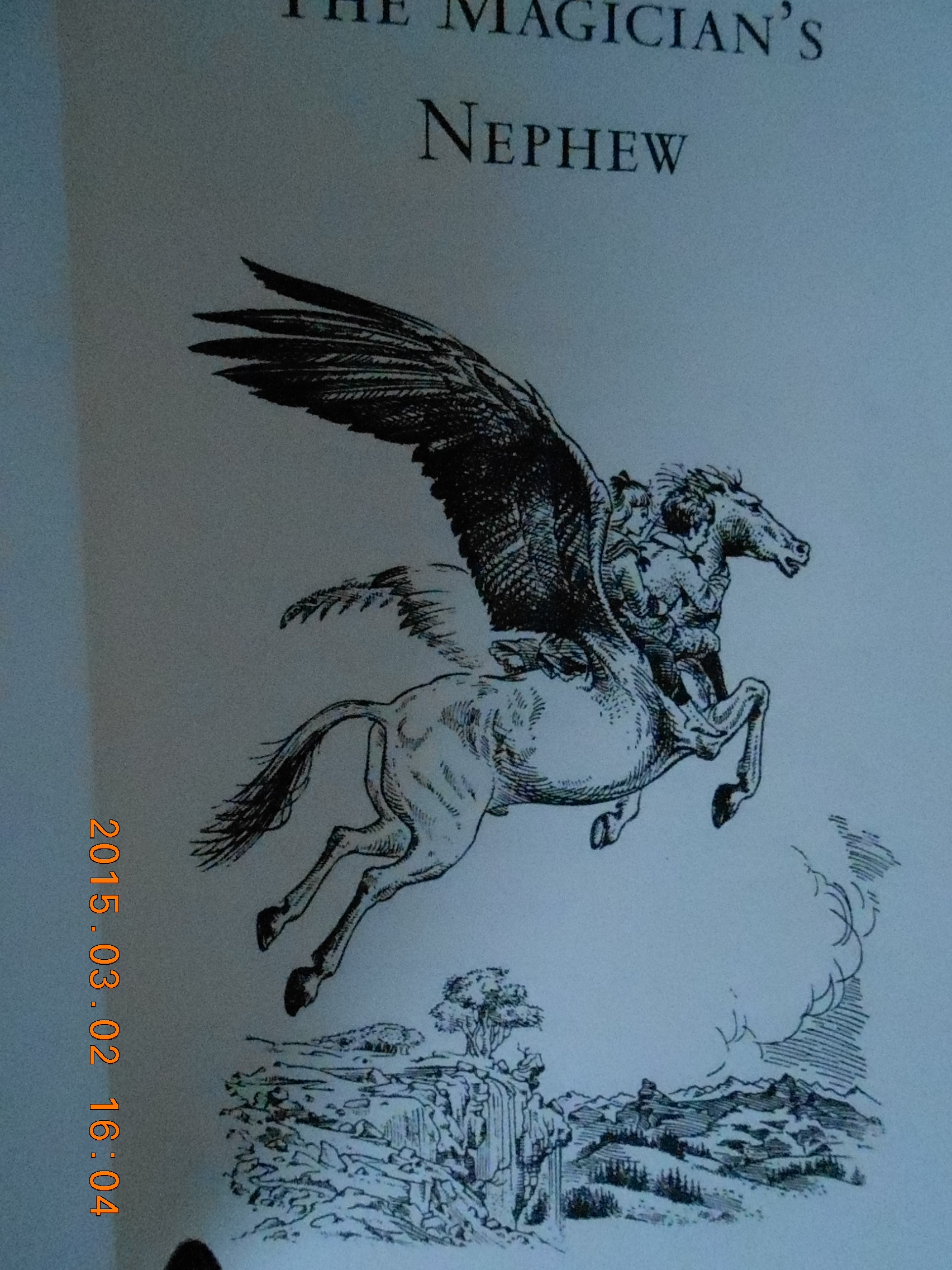
This collection of The Chronicles of Narnia is a special edition, published in 2001. The opening page of each book, as well as the title page for each chapter, has been paired with an original illustration by Pauline Baynes.

DSCN0294

Lovingly detailed and quite intricate, not uncommon for a collector’s edition

Interestingly, the books are not arranged in publication order in this volume. Rather, Lewis himself arranged them in his “preferred order”–presumably chronological order. Although this book was published years before the fandom culture really took off, I would still assume that this arrangement, illustrations included, would have meant little to the novice or casual reader (who would likely not notice the difference between the original and anthology editions), but would have elicited strong feelings–both good and bad–among the community of avid Narnia readers, and perhaps also been an incentive for them to purchase this copy even if they had read or owned previous editions. This, in fact is the first and only time I’ve ever heard of this kind of rearrangement being done to a book series. Clearly, this is an edition meant to be collected and read by serious lovers of the series or, at the very least, by collectors of famous literary works.

As a child, I only ever read The Lion, the Witch, and the Wardrobe. I remember that the coexistence of fantasy and religious symbolism fascinated me, but also that I unfortunately lost interest in it after discovering that the order of the books in the anthology wasn’t the “correct” (that is, publication) order. I didn’t have access to a computer at that time, and wasn’t going to be bothered looking up and arranging copyright dates; alas, the book remained untouched in my room until recently, when I decided to read the series as a whole. As a fan of fantasy literature, and as someone who appreciates Lewis’ works, I’m certain that I’ll get the most out of this special edition copy (or, at the very least, be able to enjoy it in the way that it was meant to be).

In the Palm of Your Hand: Thoughts on a 1907 Prayer Book

After reading Darnton’s The History of Books, I was inspired to further investigate prayer books and the role of the publisher.  After my research on my great-grandmother’s French prayer book from 1937, my interest for these books grew intensely. The book I chose to focus on this week is a prayer book from my great-grandmother Mary Egan Ward. Mary Ward was the mother of my grandfather John J. Ward, Jr. who was married to Marguerite Ward. My earlier blog posts focused on the prayer book on my grandmother’s side, Marguerite. This prayer book belonged to my great grandmother Mary Egan Ward, on my grandfather’s side.

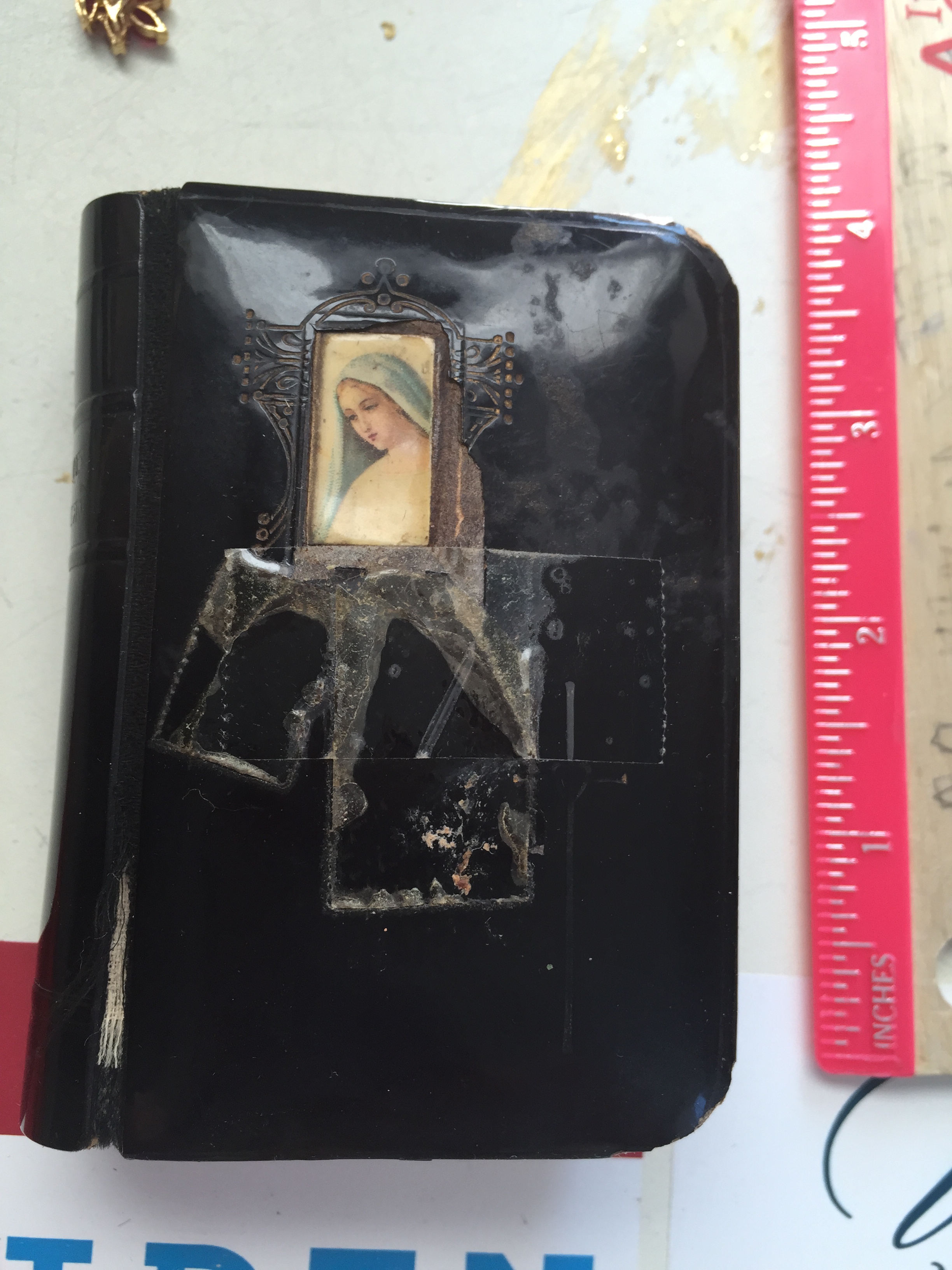
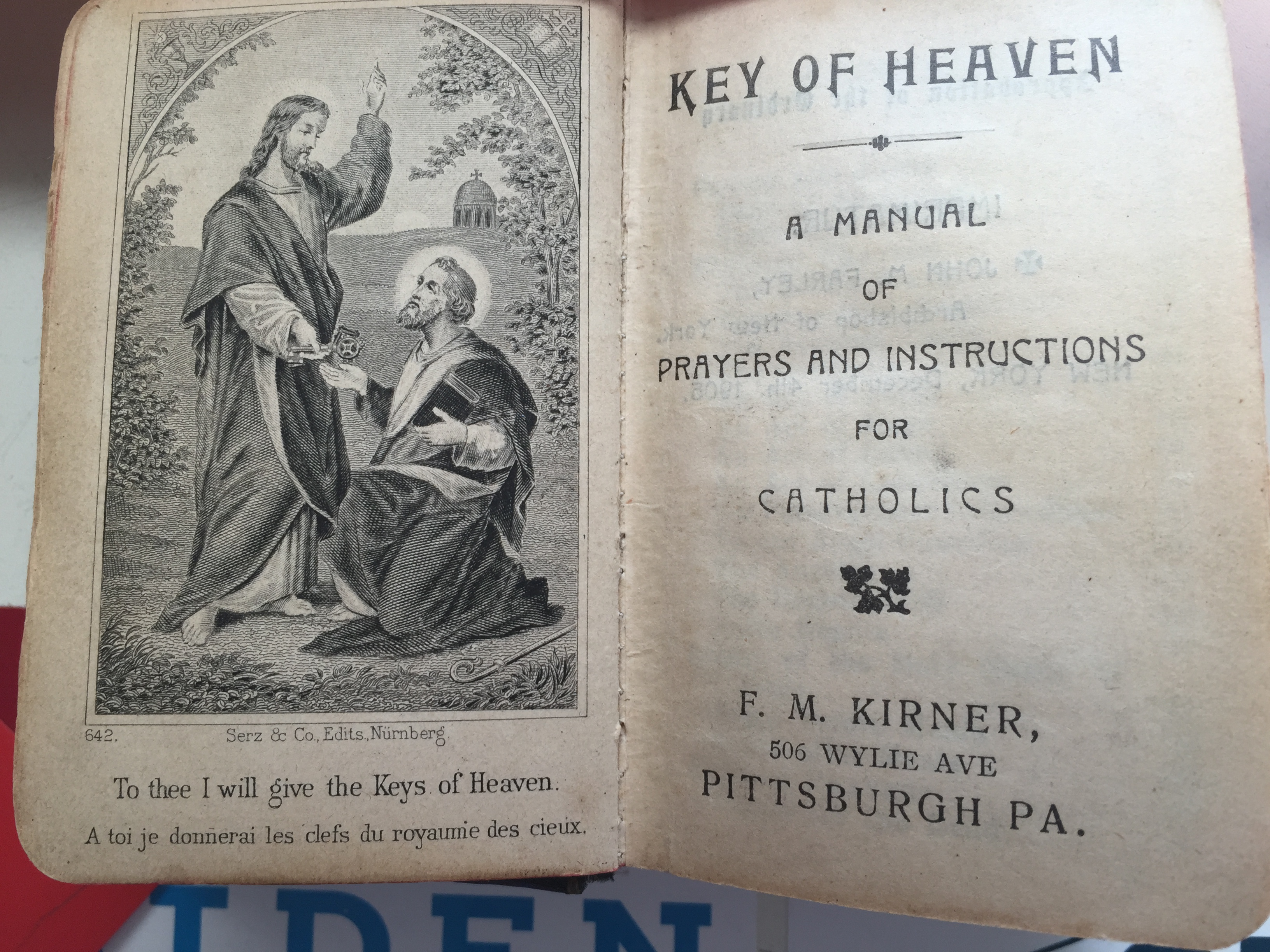
IMG_6193The prayer book is titled “Key of Heaven: A Manual of Prayers and Instructions for Catholics.” The book is so small it’s hard to believe. The book measures roughly four inches long, and fits perfectly into the palm of the hand. The book shows extreme wear. The black cover has scotch tape on it, to hold together a rip. Yet in the extremely small book, there is an engraving on the front of Mary in full color. When the book is opened, the first page is extremely ornate. The front  cover has stitching around a cross and crucifix, with the adjacent page revealing beautiful script in gold lettering. I found the book in my grandfather’s apartment in White Plains, NY. My grandfather passed away this past December at the age of 101. My research into the 1937 French prayer book on his wife’s mother, remained in the back of my head as a I went through his belongings. Lo and behold, in my grandfather’s bedroom I found this small prayer book. I couldn’t believe its small size and the how old it was. The book contains a plethora of prayers and poems to be utilized both in the Church and at home.

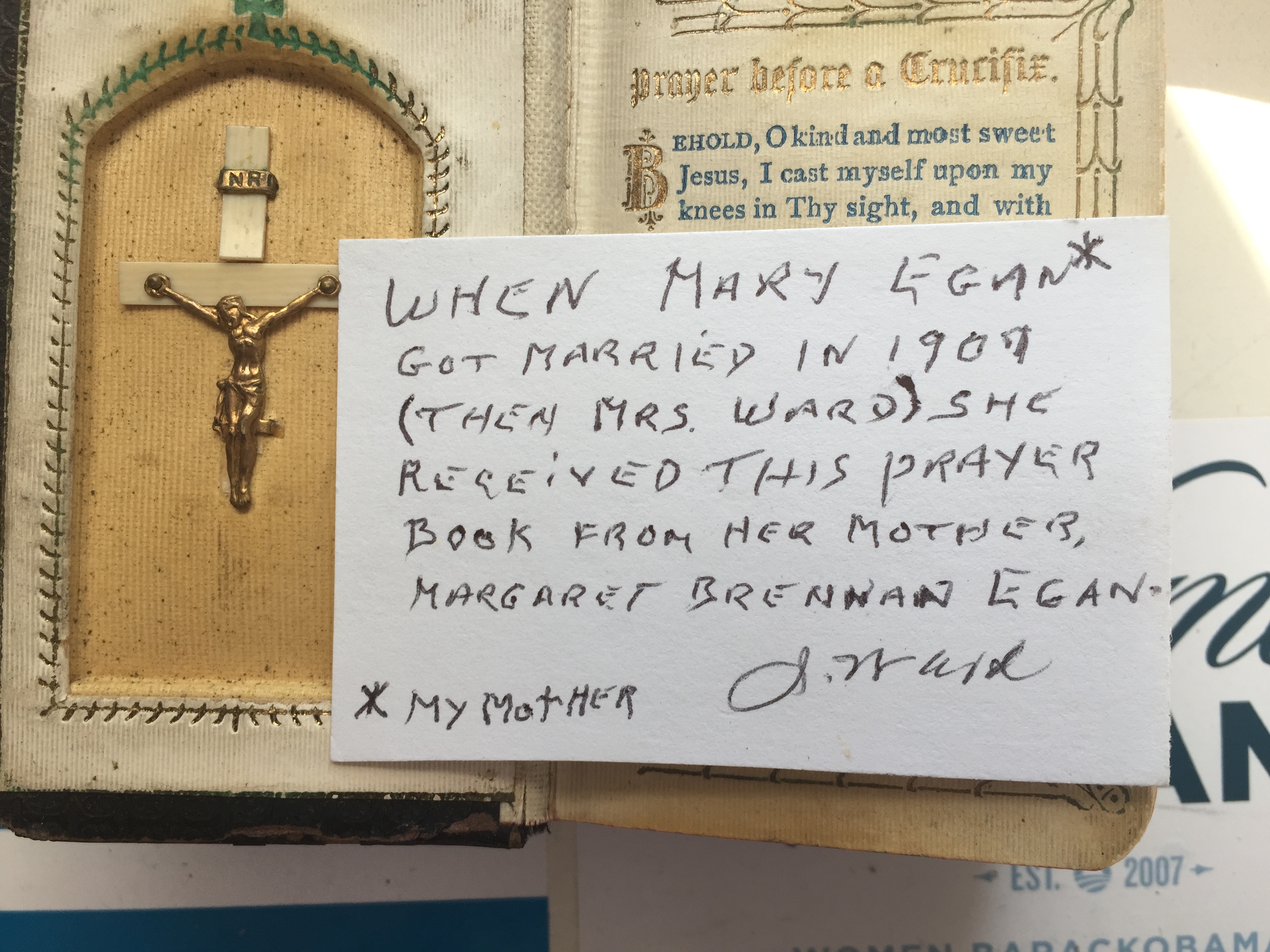
IMG_6428yes Inside the book there is a note, written in my late grandfather’s handwriting, that says “When Mary Egan got married in 1907 (then Mrs. Ward) she received this prayer book from her mother, Margaret Brennan Egan.” The small prayer book was a wedding gift to my great-grandmother, by my great-great grandmother. In 1907, Mary married John James Ward in Pittsburgh, PA.  They had five children, including my grandfather, John. In the early 1920s, my grandfather contracted pneumonia and was hospitalized for several weeks. Shortly after the ambulance took my grandfather to the hospital, the ambulance came for his mother. I recall my grandfather telling me the story of how he had given his mother pneumonia and how he felt incredible guilty for that.  She died in the hospital and my grandfather survived.

IMG_9366meThe history of my great-grandmother is important to understanding the sentiment of the prayer book. My grandfather kept the little prayer book with him up until his death in 2014. I wish I knew when my grandfather acquired the prayer book. Maybe he obtained the book at a young age to remember his mother when she passed in Pittsburgh. Or maybe he found the book as he was cleaning out his father’s apartment after his father’s death in 1970. I cannot know that history but what I do know, is this small prayer book survived one hundred and five years. It is not a stretch to infer the importance of the book to my grandfather. He revered his mother greatly and after losing her at such a young age, I can only imagine the pain and suffering he himself felt. What tangible evidence I do have of the book, is the history of the publisher and printing.  My research in to this 1907 prayer book proved to be much more successful than my history into the publisher of the 1937 French prayer book. I’m sure the language barrier has something to do with that.

Industries and Wealth of Pittsburgh, 1890

Industries and Wealth of Pittsburgh, 1890

The publisher listed on the prayer book is F.M. Kirnerfrom  Pittsburgh PA. Online, I found a PDF of an illustrated book published in 1890 titled “Industries and Wealth of Pittsburgh and Environs.” The introduction states the book’s purpose as  “….portraying the efforts of those who have so ably assisted nature in the process of making Western Pennsylvania the most remarkable portion of the American continent.” The illustrated text provides mini histories on several industries and merchants in Pittsburgh. It is in this book where I find information on the prayer book’s publisher, F.M. Kirner. The history is written in an extremely close and humanistic touch. FM Kirner is listed as “Dealer in Church and School Supplies, Corner Thirty-seventh and Butler Streets.”  The description of F.M. Kirner from this history text is so fascinating. The text continues to describe the goods in the store,

” These goods have been imported direct from Europe by Mr. Kirner, and selected with great care and excellent judgment.The array of goods presented here Is a most interesting and attractive one, and the house Is the headquarters in its line in Pittsburgh for church and school furnishings of every description, and tbe trade, which is both wholesale and retail. Is spread over the whole of western Pennsylvania, eastern Ohio, Western Virgina, etc. Mr. Kirner is a native of the city and a gentleman of fine business tact and of the highest repute.” 

IMG_5388The popularity of the F.M. Kirner’s prayer collections and books is evident from the array of editions I found online. My great-great grandmother, also a native of Pittsburgh must have visited Kirner’s shop and picked up the book for her daughter, my great- grandmother Mary. When the book is opened, in script at the top of the book reads “Holy Ghost.” Honestly, I have no idea who wrote that in the book. It could have been the book’s owner, my great-grandmother, or it could also have been my grandfather. The fact that the book was given to my great-grandmother  by her mother on her wedding day in 1907 is very important . The gift of mother to daughter on her wedding day, is an important one. The fact that a prayer book was given reveals the values and faith of my  great-grandmother.I’m sure my great-grandmother used this prayer book at church and in the home. And the intimacy of the small object shows how personal this text was intended to be to its owner. The prayer book, in its small form, was fashioned to be for the individual. This is not a text that would be passed around or shared between many individuals. “Key of Heaven” was meant to be a key to the individual.

I am extremely warmed by the fact that I could further research into this book and in the process, find out more about my great-grandmother. The exploration into this 1907 prayer book is, my own small way of honoring my grandfather’s legacy whom was an extremely important figure in my life.

Hitchcock

The book I chose to write about this week, is a collection of short stories compiled by Alfred Hitchcock, “Portraits of Murder”. As I thoroughly enjoy anything to do with Hitchcock, when I saw this book on Amazon for three dollars I jumped at the chance to add it to my collection. Along with this edition I also have “Tales of Terror”, another compilation of stories chosen by Hitchcock himself. “Tales of Terror” was a gift given to me by my brother, as he knew of my love for Hitchcock. I’ve never shuddered so much, while reading a work of fiction as when reading “Tales of Terror”. Each story is wickedly crafted, as the authors spin tales of mysterious people, who at first glance could be the person next door. And, as most of these stories were written in the 60’s, you get a glimpse into the everyday life during that time period. Another cool aspect to these collections. Needless to say, my expectations for this book were high. And, it most definitely did not disappoint.

This particular edition I have of “Portraits of Murder” has a copyright date of 1988 under the publishing company, Galahad Books in New York. I couldn’t find much on Galahad books, besides that it’s based in New York. However I would guess it was probably named for Sir Galahad, a Knight of King Arthur’s round table. Although the book was published in the 80’s the stories were written between the mid-50’s ad the late 70’s. The stories are from various authors, who gave Hitchcock permission to publish their stories once again. Originally these stories were featured in Alfred Hitchcock’s Mystery Magazine, which through research, I discovered is still being published. The magazine was founded in 1956 and is based in New York, although the magazine has changed hands over the years. The premise of the magazine is to share original short stories that discuss crime or mystery fiction. The stories that Hitchcock chose for each of these collections, were some of his favorites from the magazine over the years. The magazine itself has won many awards for mystery, including the “Edgar Award” for best short story.

The book contains 47 short stories spanning over 503 pages. As given away in the title, all the stories are enveloped in murder. When I purchased this book, and took it out of the amazon box, there was a black sleeve. Although at present it seems I’ve misplaced it. At the center of the sleeve is the classic silhouette of Hitchcock he used on his show. The title is printed in white lettering on the top, although the word “murder” is capitalized in green lettering. Without the sleeve, the book has block coloring of black while the spine is a light gray. On the front cover, there are dents in the book. I can’t tell if they’re a fault of my own or whether it came like that. If I had to guess, it was probably me. On the spine in shiny green letters, it reads Alfred Hitchcock, “Portraits of Murder”, with Galahad books written on the very bottom.  The bottom edges of the cover are a little tattered. Probably due to the fact that when reading large books, the bottom is usually resting on my stomach or a table. Inside the book, the off-white pages look very new. There are no tatters or folds. I can’t remember if I bought this book used or not, but from the looks of it I’m the first owner. Although it seems like an odd observation, the pages seem thicker than some of the other books I own. Perhaps it speaks to the quality of the materials used to make them. As is my way, I tend not to alter the books I own. I rarely fold over the tops of the page or write along the margins. Although as I’m always drinking coffee, more often than not, there are brown stains covering most ever paper in my possession. This book has evaded by clumsy coffee drinking habits, and is in fairly good condition.

index

There isn’t much to the book as far as alterations go. Just the occasional tattered edge and the dents on the front cover. But the contents of these pages are haunting and a rather exciting read. It’s also cool for me, to read these stories that Hitchcock hand picked. I may be a little biased, based off of my love for his work, but if the Master of Suspense deems these as worthy, I’ll take his word for it.

index16692

T.S. Eliot Collected Poems 1909-1935

t.s eliot collected

My copy T.S. Eliot Collected Poems 1909-1935 was reprinted by Harcourt, Brace and Company, Inc. in  New York, 1936. The original publication was by Faber in London of the same year. In this copy the title page has a stamp from Milton Academy library in blue ink. After some research, I found that Milton is a k-12 private school in Massachusetts that’s been around for over a hundred years. The book must have belonged to that library before it was either donated, or bought by the used bookstore I purchased it from. This collection contains all of Eliot’s work between the years 1909-1935. It is an old hard cover, but I’m unsure of its exact age. The pages are yellowed, the binding is worn, and unlike newer editions of Eliot’s collected poems, it lacks footnotes. However, someone has gone through and lightly marked up with pencil the more studied works, like The Waste Land, “The Hollowmen”, and “The Love song of J. Alfred Prufrock”. The annotations are in meticulously small and written a quite beautiful and delicate handwriting that leads me to believe that whoever wrote in this book was once a female student or professor at Milton Academy.

the hollow menMy first encounter with Eliot was through The Waste Land. I had the Norton critical edition, which provides all of Eliot’s original footnotes and then some. I can only imagine the time and effort that this person went through to understand all the obscure references and to translate passages that were in a different language. Her notes are extensive, but there are a lot of stanzas that are made clearer by the Norton edition.

Although I write in almost every book I own – underlining, circling words I don’t understand, and making comments – I would never dream of touching my pen to these pages. I have come to the minor epiphany that I don’t write in any books that I purchase used; there is something sacred about these annotations, and any marks made by me would be disfiguring the true heritage of the book. The most annotated poem in this collection “The Hollow Men” suggesting to me that whoever the book belonged to at Milton might have had to write a paper on it. I wonder how it made its way to my favorite book store?

I picked if off the shelf on a rainy cold day sometime in mid-November of last year in the Bruised Apple book store in Bruised-AppleInside10Peekskill. The clerk who is usually there is an older gentleman with a kind smile and a receding hairline reminiscent of Prufrock. I once heard him read poetry at an open mic several years back. He had brought in his poem to the open mic reading in a paper bag and while he read dramatically dropped the pages to the ground as he flew through his verses. He started off saying, “No one wants to be a poet – it’s like being an aristocrat during the revolution.” I still don’t know if I agree with him, but I’ll never forget the surprise I felt in finding that the little old man behind the counter of my favorite bookstore had so much to say. It was a lot like finding this book. Forgive the cliché, but I had discovered something much more in its pages than the cover could ever reveal

.Bruised-AppleOutside13

Just Another Used Book

Instead of returning to the four Shakespearean plays for this week’s blog, I am going to focus on another used book, also found in the “Used” section of the Barnes and Noble in Paramus. I originally purchased this book, The Portrait of the Artist as a Young Man by James Joyce during this past winter break, purely for the reason that it was included on my book list. Once I got home, I set in the box with the rest of my booklist and didn’t return to it until about two weeks ago when we began reading it for class.

It appeared to be the Penguin edition, just as my professor suggested, and the page numbers correspond to the correct edition. It wasn’t until a bookmark fell out that I noticed I had not bought the same edition. The bookmark is a boarding pass, assigned to one Morris Lang, flying from Dublin to Shannon, Ireland. So I looked at the cover of the book again, noticing a sticker on the back cover that had the bookseller’s name on it: Hughes & Hughes Booksellers, and a price: ϵ 8.25. There was also another sequence of numbers: 27 05 02 but I was originally struck by the Euro symbol. Euro – not dollars. I had purchased a book from a country I’ve never visited. So I emailed the company after finding them on Facebook, and am awaiting a response.

Setting aside my interest in the person who purchased the book and why (perhaps he needed a good read for his flight), the origins of the book are quite international, too. The booksellers are Irish – there are six locations, one which happens to be in Stephen’s Square, Dublin (I presume that this is the location from which the book was published, although I am not sure). The copyright page of the book gives the name of the printer and a blurb describing the copyright rules, which interestingly enough don’t apply to the U.S. The printers, Clays Ltd., are actually English – and are a part of St. Ives plc which is the canopy for a dozen or so marketing and publishing companies for books. Clays and St. Ives are both located in London.

Below the printers, the book notes that it was printed with monophoto photosetting which is the second generation of the mechanical photosetting machine. The first generation had an output of about 8000 characters an hour.  The book was printed in Sabon typeface – which was created in the 1960s. This particular font became very popular because it was designed for monotype and linotype printing, specifically for the purpose of making the italic and bold variations of the font the same size as the roman form. This font is also a bit narrower, saving space and money for the printer. Thus, it became an economical option which fits considering my copy of the book is a mass-produced Penguin edition.

Physically, the book is about eight by five inches, the average size, and just under an inch thick. The cover is worn, with what looks like some water damage to make the last couple of pages wavy. It was either a well loved book, or since it’s travelled through three different countries (that I know of), a well abused book. The mediocrity of the physical appearance turns out to be a good inference as to the mediocrity of the edition itself. Despite the European origin, it contains the same exact text, notes, introduction, etc as the American version.

The editor of this edition works for Penguin, and was born and educated in Ireland. Again, another fitting element since Joyce is an Irish writer (I would hope the person is well versed in the culture in which the book was written – and he seems to be).  He is also the General Editor of all of Joyce’s works for Penguin. The book was obviously based on Joyce’s original work, but this edition has notes for each chapter, explaining terms and often times referring to things by their locations in Ireland. This doesn’t help me much because I don’t know Ireland’s geography, nor am I familiar with the characteristics of a city that is mentioned as a qualifier for one of the events. But with the availability of Google Maps, this shouldn’t stand as a problem.

The edition I have is based on the original publication of Portrait in 1914-1915 in The Egoist, but since has been edited by Chester G. Anderson (New York: Viking and London: Cape) in the 1960s, which became the edition that was revised with notes and an introduction by the General Editor in 1992. It was then republished in 2000 by Penguin Classics. The three publication variations (or reprints) that are noted in the book lead me to believe that the original text was used as a basis in 1992, by the General Editor.

Nonetheless, it turns out through a comparison to the American version of the same Penguin Classics’ Portrait that the ONLY difference was where the book was printed. The American version was printed in America (appropriately so although it does not say by which company) and even uses the same phototype and font. Whatever the similarities, I still think it’s cool that an Irish book has made it into my hands.

Good Ol’ Frankenstein

For this assignment, I was a bit sad to find that I didn’t actually bring the one book I really wanted to talk about, which was a little known novel titled We by Russian writer Yevegeny Zamyatin. Somehow, in my cloudy, collegiate brain I didn’t think to bring this one little book, a book that I fell in love with and read nearly from cover to cover despite my particularly bad habit of so rarely reading, just because I had filed it away under, “finished” and therefore unimportant. So for this particular assignment, I took a look at my sadly underpopulated bookcase and scanned for another book I could claim that I read in its entirety and lo and behold after some deliberation, I found it; my copy of the Oxford World’s Classics edition of the 1818 original text version of Mary Shelley’s Frankenstein or the Modern Prometheus.

Now, from what I know, the book is roughly eight inches in height, about an inch in thickness, and about five inches in width. Like all Oxford World’s Classics books, this particular version of Frankenstein sports a smooth, almost stone-like cover that seemingly has a layer of “new” dust to it, the kind of dust that comes with completely new books like a preservative to keep the pages semi-white. Along the front cover, the book sports the OWC’s usual conventions for their brand of books; a picture designed the represent the core theme of the novel along with a white strip near the bottom of the cover that sits against the picture that contains the title, author, edition and finally the OWC’s brand name. The picture on the front cover is an oddly grotesque painting of the Creature from the novel and what’s so immediately striking about it is the somehow cartoonishly large eyes that the Creature sports which give him a somewhat sassy look to him.

Like most books in my possession, I tend to try and keep all the pages straight and unblemished, the cover and corners unbent, and the spine straight. For this particular copy I own, all of those requirements have been met despite the fact that I brought this book to two separate classes nearly four days a week. I bought this book new and for the most part, it still looks new, which I take an odd amount of pride and satisfaction in.

The actual blood and bones of the book are fairly simple; OWC’s usually scoops up the rights to a pretty wide swath of novels ranging from antiquity to the early twentieth century and they typically include an index of important references, footnotes and other bibliographical information as well as a history section documenting a particular book’s publication process and relevant history about the author’s life and colleagues. In any case, this version of Frankenstein is, like I mentioned previously, the 1818 unrevised text version of the novel. Mary Shelley, who authored two versions of the novel, the initial and widely regarded to be “superior” version of the text and a later revised version published in 1831 at the behest of her publishers Richard Bentley and Henry Colburn to be a tad more conservative and truncated. While I have but little knowledge of the 1831 version of the novel, as I’ve only read and owned the 1818 version, I can understand why the novel was toned down. When Mary Shelley was in the process of writing the story on her famed vacation at the Villa Diodati with her husband Percy, step-sister Claire, their friend Lord Byron, and his physician John Polidori, the impetus for which was both a terribly cold climate affecting much of the populated world, (known as the “Year Without a Summer”) as well as a challenge by Byron to write a “ghost” story, Mary fashioned what was ostensibly conceived to be a horror story from the very beginning and as a result, the book contained themes of sublime isolation, terrible, murderous weather and of course, a monster so closely resembling man that much of the novel is spent uncovering what it is to be human. Though it’s a bit difficult to understand why a book like this would be scary, the subject matter of the book is somewhat grotesque and unsettling and therefore it’s easy to understand why someone would want the content to be toned down.

In any case, I just have a weird connection this book. I read it in highschool and liked it but didn’t “get” it, and I knew that I’d have to read it some time in college, which luckily I did. And you know what? I actually took the time to sit and read its relatively brief 191 pages and came to find that I really enjoyed it.

Ophelia’s Flowers

When looking at the objects that present themselves in Hamlet, it is often hard to extract them from the implicit symbolism that embodies their description. An example of this are the flowers that Ophelia describes in Act IV, Scene V (pg. 388). Here, Ophelia in all of her psychological anguish, hands out flowers to those around her and in doing so ascribes meaning to them;

Ophelia: There’s rosemary; that’s for remembrance. Pray you, love, remember. And there is pansies; that’s for thoughts.

Laertes: A document in madness – thoughts and remembrance fitted!

Ophelia: There’s fennel for you, and columbines. There’s rue for you, and here’s some for me. We may call it herb of grace o’ Sundays. You may wear your rue with a difference. There’s a daisy. I would give you some violets, but they withered all when my father died. They say ‘a made a good end.

rosemary

rosemary

“A document of madness…” Laertes claims, but surely, as we know from Shakespeare’s tendency to call upon objects with a rich cultural history, there is no folly in what Ophelia is suggesting by presenting these flowers. As a reader, we are under the impression that the flowers must be embedded in some deeper context that allows Ophelia to look at them as symbols of larger ideas (such as remembrance, and thoughts). And indeed they are; in order to understand why Ophelia is looking at these specific objects as vehicles for a more significant message, it is necessary to look at each plant and its historical uses.

pansies

pansies

Rosemary – Was first used by the Greeks and Romans as an aid of protection against evil spirits. Students in ancient Greece wore garlands of rosemary around their necks, or braided it into their hair to improve their memory during exams.  Others would place it in their pillow the night before to enhance memory during sleep. When it was brought to Europe it was regarded as a purifying and healing herb, but it’s usefulness for retaining memory was also reiterated in the English court. Sir Thomas More (1478-1535) wrote, “As for rosmarine, I lette it runne all over my garden walls, not onlie because my bees love it, but because it is the herb sacred to remembrance, and, therefore to friendship . . .” In addition to Hamlet, Shakespeare also makes the use of rosemary as an allegorical symbol in Romeo & Juliet (Friar Lawrence requests that mourners bestow Juliet with rosemary at her burial, as dedication to her memory).

Pansies– The flower’s name is derivative of the French pensee, meaning thought, reflecting the flower’s reputation for bringing thoughts of loved ones. Shakespeare also cited the meaning of the flower when, in A Midsummer Night’s Dream, he wrote that the sleeping Titania will fall in love with the first creature she will see when she will awake, thanks to the pansy juice on her eyes; “the juice of it, on sleeping eyelids laid, will make a man or woman madly dote upon the next live creature that it sees.”.

The fennel flower looks very different from the wild fennel plant and the fennel root (both of which can be eaten and used in home remedies).

fennel flower – The fennel flower looks very different from the wild fennel plant and the fennel root (both of which can be eaten and used in home remedies).

Fennel – Fennel is one of nine Anglo-Saxon herbs known for secret powers; a bunch of fennel hung over a cottage door was said to prevent the effects of witchcraft. Greek and Roman women nibbled on fennel seeds because they believed the herb suppressed the appetite. Ancient Egyptians believed eating the fennel herb and seeds imparted courage, strength, and conveyed longevity.

The columbine flower comes in a large variety of colors with differing petal shapes...it's hard to believe they're all the same species!

The columbine flower comes in a large variety of colors with differing petal shapes…it’s hard to believe they’re all the same species!

Columbines – The symbolism of the columbine flower is varied, and often quite confusing. It was once believed that this flower was a symbol for foolishness, at the same time, however, it was considered a symbol of fidelity and holiness. Today, though, these flowers are given as gifts to represent its more modern meanings of seduction and anxious excitement. These flowers make very uncommon but beautiful and meaningful gifts, and are sometimes given as potted plants or simple, single-cut flowers.

The rue flower differs from the rue plant; at one time the holy water was sprinkled from bushes made of rue at the ceremony usually preceding the Sunday celebration of High Mass, for which reason it is supposed it was named the "Herb of Repentance" and the "Herb of Grace".

rue flower – The rue flower differs from the rue plant; at one time the holy water was sprinkled from bushes made of rue at the ceremony usually preceding the Sunday celebration of High Mass, for which reason it is supposed it was named the “Herb of Repentance” and the “Herb of Grace”.

Rue –In the Middle Ages and later, it was considered – in many parts of Europe – a powerful defense against witches, and was used in many spells. At one time the holy water was sprinkled from bushes made of rue at the ceremony usually preceding the Sunday celebration of High Mass, for which reason it is supposed it was named the “Herb of Repentance” and the “Herb of Grace”.

white daisies

white daisies

wild violets

wild violets

Daisy – The Celtics connected daisies with innocence. They believed that daisies came from the spirits of babies who had died during the birthing process. The daisy flowers grew in order to lighten their parents’ grief. Daisies have their place in Christianity. One legend has it that the daisy grew from the Virgin Mary’s tears. In fact, daisies are sometimes used to symbolize Christ and the Virgin Mary. You will also see the daisy as a motif in artwork from the medieval period as a symbol of Christ’s innocence when Christ was a child. Another Christian legend describes how the wise men were looking for a sign of where the newborn Christ was located. When they saw groups of daisies near a stable, the wise men knew they had found Jesus as the daisies looked like the star that had led them to Bethlehem.

Violet – In Christian symbolism, the violet stood for the virtue of humility, and several legends tell of violets springing up on the graves of virgins and saints. European folktales associate violets with death and mourning. In the language of flowers, it has had various symbolic meanings. Its color may indicate the love of truth or, conversely, the truth of love. In keeping with the latter, it is said that unknown persons who had secretly admired or loved him decorated the tomb of the Roman tyrant Nero in the spring with violets.

As I began to do research about each of these specific plants, I started thinking about the phenomenon of the flower as an object. Firstly, it is important to recognize that flowers are meant to die. In many ways they are similar to human beings; they are given life by preexisting organisms (germination and seeding), their growth depends on the environment they are brought up in, and their life span is generally short. Looking at those facts alone, it is interesting that Ophelia in her “madness” chooses to draw similarities between the life of these flowers and the lives of the people around her.    

Stepping outside of Hamlet and looking into the historical/mythological associations of these plants has helped me understand the important influence that religion had on Shakespeare’s work (and most other artistic creations of that time). When Shakespeare began writing plays for the group called Lord Chamberlain’s Men in 1594, Queen Elizabeth I had already dealt with England’s fierce schism over Protestantism and Catholicism. As Queen, she wanted to appease a large majority of the English population who had converted to Protestantism when her father, Henry VIII, had implemented the Protestant Reformation in 1532; however Elizabeth herself still clung to symbols of the Catholic faith such as the crucifix. Although most of the religious upheaval had been settled by the time Elizabeth died in 1603, Shakespeare lived another 13 years under the rule (and patronage) of King James VI, who is remembered primarily for his campaign against witchcraft. James became obsessed with stopping the threat posed by witches, and in 1597 wrote the piece Daemonologie, which is suspected to be the main source of background context for Shakespeare’s Tragedy of Macbeth.

In looking at all of this research simultaneously, it is fascinating to see how close Shakespeare was to the religious figureheads of his time, and in retrospect, notice the religious influence on the implicit meaning of the objects presented in Hamlet. One small example that I found absolutely fascinating is to look at the way Ophelia describes the daisy in comparison to the rest of the flowers; “There’s a daisy.” When I first read it, I wondered why the daisy was undeserving of any more explanation. But upon doing research on the mythological associations of the flower, and learning that in the Christian faith, some believed daisies marked the path that the wise men followed to find Christ in Bethlehem, it made sense that Ophelia simply stated “there it is”. It’s as if the daisy, in this context, could be representative of that traditional story, or it could be an indication from Ophelia that the daisy is representative of guidance.
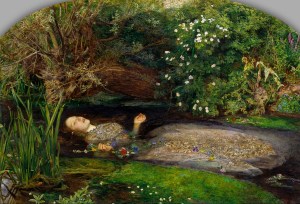
This painting is held in the Tate Britain Gallery in London. It depicts Ophelia singing before she drowns in the river in Denmark. The work was not widely regarded when first exhibited at the Royal Academy, but has since come to be admired for its beauty and its accurate depiction of a natural landscape.

“Ophelia”, Sir John Everett Millais, 1851-52. This painting is held in the Tate Britain Gallery in London. It depicts Ophelia singing before she drowns in the river in Denmark. The work was not widely regarded when first exhibited at the Royal Academy, but has since come to be admired for its beauty and its accurate depiction of a natural landscape.

Many more connections could be made when looking at the deeper symbolism of the objects in Hamlet, but this specific section painted a full circle connection in my own head, so I thought I’d share!