The History of the World through 100 Objects

As I began to read the introduction to this book, I admit to being quite skeptical. Historically, scholars from the Western world have analyzed other cultures incorrectly by making assumptions based on Western understanding. To project meaning onto objects from a foreign society and create a historical narrative based on our own interpretation is dangerous, which the author admits.

Reading on, I found several concepts discussed which helped bolster the author’s authority in studying objects from other cultures. First, a quantity of items lends credence to an analysis. The discovery of numerous pottery shards on the east coast of Africa as a group was evidence of trade throughout the Indian Ocean; it would have been impossible to reach this conclusion with only one item, or with several shards from different time periods.

The use of new technology in reinterpretting an object is also significant. DNA evidence is being analyzed to identify mummified bodies by scientists today to glean historical information about the ancient world. The identification of the exact boulder in Italy from which an axe found in England was made is a fascinating example of how an object can convey information about early trade routes among diverse societies.

Most important, in my opinion, is the author’s idea of interpreting past cultures through the eyes of people living in the same places today, such as the feather helmet found in Hawaii by British Captain Cook. Asking native islanders about the object’s meaning and significance can shed more light on the truth than any Western interpretation.

Reading the introduction makes me want to read the rest of the book, and since I found it in my local library system, I’ll be able to do so. I think that knowing how these 100 objects were analyzed will help with the remaining work in this class.

The Thread between SUNY and the Village: a New Paltz Observation

Since I am less informed about the Village of New Paltz than my (soon to be) alma mater (which I did not know either; I doubt people know their alma mater until they graduate), I observed the New Paltz Wikipedia page in its similarities to the campus. Since New Paltz is a college town, formed by not just its history but the vigorous youth attracting business to shops and art and culture, I yearned to find connections between the two pages, especially since I know there are plenty of people who stay in the area after school, or students who make up a huge portion of the off-campus population.

Looking at the demographics sections on each page, there is a notable correlation between school and village racial populations (roughly 80% to 73% for White; 5% to 8% African American; 11% to 11% for Hispanic or Latino; 3% to 7% for Asian/Pacific Islander). While one could argue that New York State populations do not change dramatically, unless one lives in a highly urban or rural area, the similarities are striking when most of the SUNY New Paltz students hail from lower New York areas, such as the five boroughs, Long Island, and the lower Hudson Valley. From my perspective, I view SUNY New Paltz as racially diverse; my roommate, who attended a performance high school in the city, was initially shocked by the amount of white students on campus. Statistics could offer a fairly pale-skinned melting pot, but racial diversity remains a slightly biased subject, as a northern Westchester student will be exposed to different cultures than a city-dweller. Statistics strip cultural expression.

The demographics section (on the Village page) also reveals the heavy effects of college students living off campus, as I implied earlier. “The per capita income for the village was $11,644. About 11.8% of families and 36.9% of the population were below the poverty line, including 18.6% of those under age 18 and 12.2% of those age 65 or over. While this is one of the lowest median household incomes in the area, it includes large number of college students who attend SUNY New Paltz, many of whom have incomes that would place them below the poverty line.”

To which I say “obviously.” Nothing screams college town more than an incredibly low per capita income and 58.7% of a population consisting of 18-to-24-year-olds. Most students can hardly afford tuition, let alone pay for their monthly rent, let alone live on their own. Students drastically affect the village environment, perhaps largely on this economic level. There was no information on tax rates in the village (which is troubling on another level, since plenty of locals complain about high tax rates in the area), but one would assume lower cost-of-living to balance out low incomes. The other way likely exists since less of the population can provide taxes, many exempt as students and receiving wages well below the poverty line, and yet the village and town must keep up maintenance not just for its townspeople, but for the prospective students of SUNY New Paltz. The village apparently thrives on the large student population, as it makes such a large majority of residents, and the town must always keep up with the unstable population. None of that exists on either Wikipedia page. Most of the speculation depends on a single bit of information I mentioned earlier was not provided. Yet did that not explain the very complex dynamic of a college town?
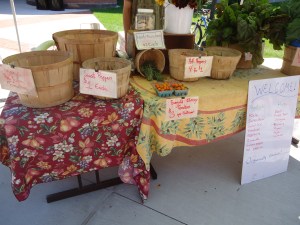
Another missing piece: the Farmer's Market, held every Thursday in warm weather. Not only a strong connection between campus and village, but a hint to the environmentally-friendly atmosphere on - and off-campus.

Another missing piece: the Farmer’s Market, held every Thursday in warm weather on the Academic Concourse. The event not only reveals a strong connection between campus and village, but hints at the environmentally-friendly atmosphere on – and off-campus.

While the village Wikipedia page includes several notations of its dependence on the student population, it hardly goes far enough. Similarly, the SUNY New Paltz page hardly interacts with the village environment, making no mention of the effect its students and activities have on the community. Since the college is such an asset to the village, albeit sometimes a burden, at least give credit to the town offering such academic hospitality. Then again, these are Wikipedia pages, not official reports. Still, it is incredibly apparent the two environments intertwine, and should offer such on the SUNY New Paltz page. SUNY Binghamton discusses transportation options on their Wikipedia page; why not discuss taxi services, escort services, and the Loop on the SUNY New Paltz page?

Photo0232There are other small points of mention on the SUNY New Paltz page in particular. First, the “Campus theaters” subsection does not include the newly-renovated Julian J. Studley Theatre, connected to Old Main building. The page includes the completion of Old Main in the section above entitled “Campus,” but perhaps the authors could not detail the theater, which hosts on-campus theater performances (such as Into the Woods by Miami Theater Players in Spring 2012), choirs, lectures, and even the President’s Inauguration in Spring 2012. Second, “Clubs and traditions” includes Student Association and Residence Hall Student Association, but not the United Greek Association, which is the presiding body over the Greek life, even if it does mention fraternities and sororities. Third, not once did any part of the page mention the awesome outdoors environment during the beginning and end of the academic year. Such little facts about students lying down outside on nice days, playing instruments, or throwing a frisbee–it’s a whole new environment when the snow melts and the skies clear–would add a distinct personal touch to the page and resonate the name with the school many students adore.

Indians and Hippies

Image

The very first thing I found interesting about the New Paltz Wikipedia page is the early development of the town. I always thought the dorm buildings at SUNY New Paltz had funny names, but I also always knew they had to mean something, particularly to the history of New Paltz. Upon reading the New Paltz Wikipedia pages,  I realized, once again in my life, that things are not just named to be named; names are almost always carefully selected to suit a thing in sometimes unexpected ways. When I moved on campus as a freshman, I saw the new dorm buildings called Lenape and Esopus as an option in which to love. They were freshly constructed and beautiful on the inside, but I ultimately decided against them because they were “way too far” – which was a hugely common opinion among my peers. Understandable: they are on the far surrounding areas of the campus rather than in the center. Thus, many students, including myself, chose to live in buildings closer to classes and ignored the brand-new dorm buildings built on the perimeter of the campus, despite all of their niceties. Since then, Lenape and Esopus have dropped out of my mental consciousness completely, until I read the history of New Paltz on Wikipedia and fully realized where the names for these dorm buildings came from. New Paltz was formed in 1678, and while Hugenot settlers were trying to expand the town perimeters, they “purchased a patent for the land surrounding present day New Paltz from a Lenape tribe known as the Esopus” – how funny! It all makes sense now. While someone was trying to figure out what to name the new dorms being built outside the center of the actual campus, they directly paralleled the experience to when, over a hundred years ago, the actual town of New Paltz was looking for surrounding areas to expand their boundaries. In the campus situation, the campus is the town, and the buildings of Lenape and Esopus are the surrounding lands acquired. I thought this correlation was funny and thoughtful, on whoever named the building’s part. It reveals a part of the history of New Paltz I never even thought existed nor even thought about at all. All I could say was, “how… funny.” It really inspired me to look into things more and not just brush off everything as something that is not intimate or carefully named.

Image


The New Paltz history pages are pretty informative and interesting, however I was really looking forward to how the town garnered its whole “hippie culture” and rock n’ roll façade that is still used so effectively in marketing the town (i.e. The Groovy Blueberry, Rock da Pasta, etc). I was disappointed to see that this was left out of the history of the town, besides the various protests that went on in the history of the campus. Yet, this omission revealed something else to me. It reminded me of the changes I’ve seen in the New Paltz campus since I’ve been here four years ago. The school logo has been changed from an old historical portrait of Old Main to a sciencey, geometric (and ugly) abstraction. The newest school building besides the renovated Old Main is that grotesque pyramid, and I’ve also heard that the school has been trying desperately to promote its engineering, science, and business departments. Combined with the realization that cops have also always ruthlessly focused upon reducing drug use within New Paltz, this all makes me feel as if New Paltz is trying to banish its reputation as a “hippie school” – High Times magazine actually dubbed the school as the #7 “Counterculture College” in the United States. I have been suspecting this for years, and a look at the New Paltz history pages on Wikipedia has finally verified my idea! How fascinating.

http://hightimes.com/entertainment/ht_admin/3027


More Than An Object (History of the World)

I have to confess my love for this introduction. Although I am not an anthropology scholar, I did find some sentences which spoke to anthropological studies. “The Caribbean Taino, the Australian Aboriginals, the African people of Benin and the Incas, all of whom appear in this book, can speak to us now of their achievements most powerfully through the objects they made: a history told through things gives them back a voice.” I found this quote to be extremely powerful and comforting because in a sense our work and history doesn’t die with us. We have all this material from early settlers and tribes so we can fully analyze their lives. We can turn away from the empirical analysis and realize that these were actual people who used these items for a purpose or treasured them.

I also liked how the author describes written history vs object history. I like that the author introduced the problem of no textual or written history from early ancestors. Some more of my insights include literate vs. illiterate history. We did have written works from the enlightenment, but groups of indigenous tribes didn’t write or they wrote in a different language. Through objects we can analyze that tool and use it to our advantage in finding the history of these individuals. I completely agree with the notion that we must view history through objects and not through written material, because objects give us a deeper history than what appears on a page. Although not mentioned in the text, textual form is one-sided, but an object can mean different things to a different person—just another thought.

Objects create a significance to the story their told. As I said in the previous paragraph, they create multiple meanings and histories for different people. Textual information is a little tough to analyze since it’s one-sided. Objects also go into deeper meaning. A diamond which was passed down by the royal family was probably found or created by slaves or servants. This creates more of an understanding of the time and I find that absolutely interesting, am I wrong?

I think we can use this knowledge to our advantage. When we encounter an object and analyze its surfaces, descriptions and history we can find out not only what they were used for, but also how they were created. Why use this item as opposed to another? Why create it this way? Was this object passed down? How was this item used and by whom? How can we fully grasp the use of this object? I think that when we do our own research we need to consider all aspects of an object and not just its use by one person. There’s a history behind the person or manufacturer who created the object. We must listen to their voices as well. Were they mistreated? Were they slaves? How did the object get to the person or place who has it now? It may seem like a lot of questions, but you’d have to act like a journalist when researching and finding out all details.

Essentially, go out there and question everything about the object. Ask yourself what do you want to know about the object.

Wiki Pages

For a brief introduction to the town of New Paltz, I thought the Wikipedia page did an okay job. It did have a decent amount of categories to look through, although I feel like many of them could be expanded. One thing I felt was missing was the general “feel” of the town. New Paltz definitely has a “feel” and this is part of its appeal. I especially get this when walking down Main Street. I almost feel like there needs to be a description of Main Street because it is such a main part of the town and in my opinion it is very cute with all of the local businesses and small stores.

I need to comment on the fact that the village area of New Paltz is only 1.8 square miles. That’s tiny! I was curious so I looked at my town’s Wikipedia page… my town is 49.6 square miles! Also, just from looking at my town’s page, I’m seeing many things that I think could be included into ours. On my town’s page, it includes local landmarks in a bullet pointed list and traces back each building’s/landmark’s personal history. I’m sure that there are several historic landmarks in New Paltz that have a fascinating story, so it would be interesting to include this on the page.

The culture section of the New Paltz village page does not do the town justice at all. It mentions “big” events such as “Memorial Day Parade” and the “Halloween Parade” and these are such standard events that most towns have. The culture definitely needs to be described and expanded more. The culture section focuses on events, and there is so much more to culture than just “events”.

Also, I think it’s very strange that we have a sister city in Japan. According to Wikipedia, a sister city is “cooperative agreements between towns, cities, and even counties in geographically and politically distinct areas to promote cultural and commercial ties.” I’d like to know how we came to get a sister city in Japan, and what exactly goes on between the two cities to promote cultural and commercial ties. It would also be interesting to see if any of the old newspapers mentioned in this wiki page are still around somewhere. Maybe they’re in a museum or an archive? It would be fun to try and track them down!

SUNY New Paltz would have some crazy stories on its wiki page (such as the events from November 1997). Although this page was more interesting than the New Paltz village page, I still think that the cultural feel of the school is missing. I want to know more about the bell tower. Maggie brought it up one day and I’ve never stopped thinking about it since then. There must be some sort of history to the bell tower!

Every Object Tells a Story

From the introduction, this actually seems like a very interesting book. The basic premise is that discovering History requires both historical texts as well as historical objects.

Objects are particularly important to history because they can tell us so much. They can tell us who used them, what they were used for, where they were made, when they were made, and so on. By knowing these bits of information, we can extrapolate further to discover a very large quantity of information about a culture or group of people. Although written texts can do some of this, they cannot help us with the deeper histories of civilizations. Written documentation is relatively recent, and so objects enable us to learn about those civilizations that did not have a written language. So long as we have an imagination, we can always continue to learn more about history through objects.

In the past few weeks, this course has really taught me to appreciate objects, and I certainly look at them in a very different light. After reading this Introduction from a historian’s point of view, I can really understand just how much you can learn from an object. The examples given in the text really illuminate the abundance of information hidden within a singular object. Each individual object is not only a piece of history, but also a clue towards understanding so much more.

Reading this made me very eager to start the project of the history of New Paltz. If every object has a story to tell, then we can discover so much about our community as well as the history it has to share with us. As a class, we can all learn the value of an object; discover the individual stories each object has to tell us, and work together to create a detailed history of our lovely community of New Paltz.

Jessi Putnam- New Paltz History

I was immediately shocked at how brief of the Wikipedia page is devoted to our fair New Paltz! And more disheartening still is that a good quarter of the page lists our various modes of transportation! New Paltz is home to one the oldest street in America, surely we have a little more history then that to tell.

There is a good amount of information given about the founding of New Paltz and historic Huguenot, but the story seems to fast forward quite suddenly after that. It jumps to modern demographics, politics, media appearances, etc. Although these are useful facts, I feel that the spirit and culture of New Paltz is terribly cut short. There is a short section on some of the cultural events that we host here in town, but there seems to be so much missing! How can this page not include everything that happened her in the 60’s for example, I mean we were almost the eternal home of Woodstock for heavens sake (although I’m sure it wouldn’t have been called Woodstock if it had taken place here). But that just goes to show and impact a seemingly small town like New Paltz can have on history. There needs to be more mention of the rich culture we have here. Some of New Paltz’s historical goings on may not have been the most upstanding or PC events but that is what makes New Paltz  unique. And it informs who we are a students here,

I did learn a few new things from the wikipedia page. Did you know New Paltz has a sister city,cause I didn’t; Its Niimi, Okayama, Japan. I also thought the section about New Paltz’s first Newspaper was interesting. But other then that, a lot of this was old news. 

As far as the Wikipedia page about the college, this was a little more juicy with history! I loves reading about all of the demonstrations and protests that took place on campus. There seems to have been some sort of political, student run action happening on this campus during every decade! New Paltz clearly was and still is full to the brim with free and independent thinkers who are not afraid to speak their minds. I also liked reading about all of the prominent people that have taught here or attended the school (minus Vinny from Jersey Shore of course). The page gets a little dull after that however, providing statistics and information on a few key buildings on campus. The Tripping fields don’t even get a mention!

P.S. I am ashamed of this…but I have never read our Alma Mater before this moment

Two-Dollar Bill

Image

Image

Much like Ricky, I had a really difficult time picking an object for this week’s assignment. The past week I have been assembling things that I could maybe write about, but none of them seemed to have a history worth delving into. It was not until I read Ricky’s post that I realized to look to my wallet. But not the one I’ve been using, (a see-through plastic coin purse circa 1990s… although that might be interesting to look into one day), but the wristlet I used to use all the time which has become more of a paper-collecting receptacle at this point. In there I found a two-dollar bill that has been there for roughly three years now. 

I received the bill when I sold my old books to a textbook buyer at the end of my freshman year. I made exactly $102 from that transaction (as you can imagine, there were about 12 books sold.) And although, as a college student, the 100 dollar bill was fun to look at, I knew (read: hoped) there would be more of those in my future. I did not know how lucky I would be to find a two-dollar bill again. There would be times where I would have absolutely no money left in the wallet besides the two-dollar bill, yet I could never bring myself to spend it. I felt like it was too rare of a find to just go and spend. What could be worth the exchange of this oddity? A pack of gum? Half of a latte? 

It is this sentiment that makes the two-dollar bill seem so valuable. In fact, it is not worth more than, you guessed it, two dollars. According to an article in Eagle News, one percent of bills produced annually are two-dollar bills. Furthermore, they make up $1.2 billion of printed currency in the US. There is even a website, usethetwo.com, devoted to cracking the myth of the two-dollar bill. Their mission is to get these bills back into circulation and stimulate our economy. 

Exploring the website further I was able to track my particular bill. Mine is from the most recent printing, the 2003A series, which occurred between July and September 2006. There were 230,420,000 bills printed in this series. According to usapapermoney.info, this bill was printed in Fort Worth, Texas in September of 2006 (as evident by the serial number beginning with a “D”.)

However, the two-dollar bill first came to be in 1976 to honor the 200th anniversary of the Declaration of Independence. The front of the bill has a portrait of Thomas Jefferson, author of the Declaration of Independence. The back of the bill features an illustration of the painting, Declaration of Independence, originally by John Trumbull.

Nowadays, you can even track your two-dollar bill. The website, wheresgeorge.com, which is most notably used to track one-dollar bills also features options for bills with denominations up to 100. Here is the list of the top 20 two-dollar bills reported.

After learning all of this and debunking the myth of the “valuable” two-dollar bill, I am still not sure I can part with mine. It has become a sort of keepsake for me. It has been a great conversation piece and something I find myself studying whenever I come across it. I always joke that I will spend it when it is literally the last bill I have left in my name. But who knows, it might just get me out of a tight spot one day.

An American Fortune

Fortune1

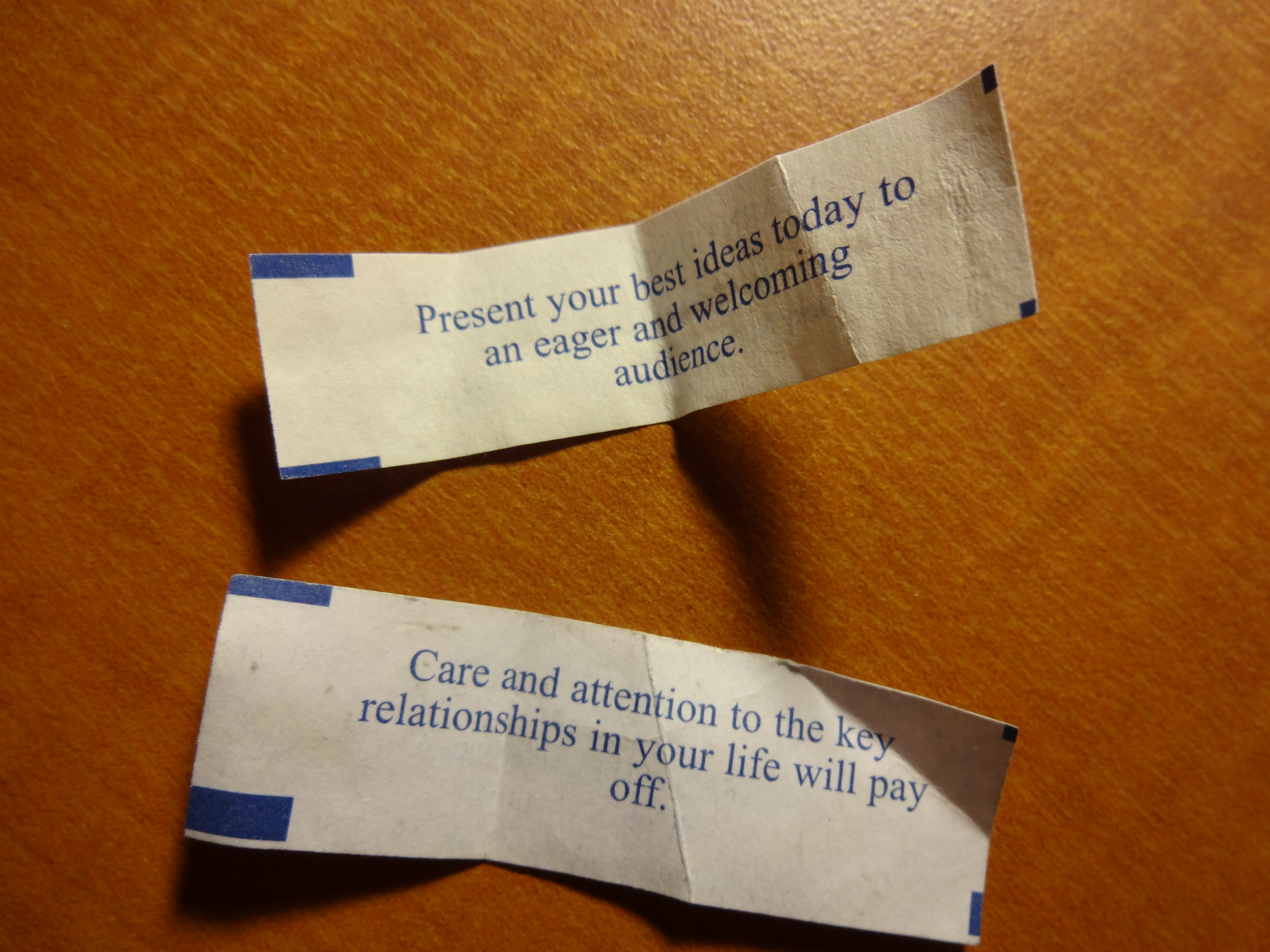
Picking an object wasn’t easy this week. The Hare with Amber Eyes had made me realize that I really don’t collect anything. That was until my friend was going through my wallet last night and found about 12 fortunes from fortune cookies. Some from this past weekend, others from years ago. Let’s just say, I have a fortune problem.

“Fortunes” are pieces of paper with words of inspiration, wisdom and vague prophesies or phrases. About an inch and a fourth long, the fortune also holds a chinese word or phrase on the back with lucky numbers attached to them. Mine currently says family and my lucky numbers are four, 25, 27, 52, 11 and 24.

According to Wikipedia (not exactly the best source for information) fortune cookies were “introduced by the Japanese, popularized by the Chinese but ultimately consumed by Americans.” According to ABC News, fortune cookies originated in Japan, and then were brought over to California. It wasn’t until the Japanese-American internment period that the Chinese took over the booming fortune cookie market and began spreading their fortune cookie wealth. The Japanese never achieved their fortune cookie status again.

The white piece of paper with red or blue writing was an essential part of Japanese culture. The fortune cookie in Japan, both larger and darker than the modern object, contained fortunes from Japanese temples. These cookies were seen as a dessert delicacy and were sold in some regions of Japan. Wikipedia reports that the most notable neighborhood was Fushimi Inari-taisha.

Erik Sumiharu Hagiwara-Nagata is the relative of the original Japanese-American introducer of the fortune cookie, Makoto Hagiwara. They reveal that the Japanese fortune cookie was also eaten at New Year’s festivities at Shinto shrines. They were called “folkcraft” or the Japanese name, tsuji ura sembei. These treats also weren’t owned or manufactured by one individual. They were a Japanese tradition, much like how apple pie or pizza have been called an “American” tradition today, according to ABC News and Hagiwara-Nagata.

DSC00154

However, today the object is much different compared to its original form in Japan. They still do have the same function as a treat, but they’re smaller, shaped differently and contain fortunes written by retired history professors and freelance writers in Brooklyn, N.Y. (Wonton Foods) The largest fortune cookie manufactures today, Wonton Foods, contains a databank of 10,000 fortunes which are rotated frequently. This is much different compared to the original fortunes, created in temples.

The only form of ownership was in America where Makoto Hagiwara served the first American fortune cookie at his restaurant, Japanese Tea Garden in San Francisco during the early 1900s. Since then the fortune cookie trend expanded throughout the United States by the Chinese due to the Japanese American internment period.

Although the original fortune cookie is from Japan, both Japanese and Chinese citizens say that the fortune cookie is an American food and is only expected to be served in American Chinese restaurants. Today, the fortune cookies are sold in China and Japan as American imported treats. So, remember: Next time you receive a fortune cookie at a restaurant, the words are actually written by a writer and not some wise man or woman in a temple.

The Thinking Chair Replica

photo

When I was little, apparently I really liked Blue’s Clues.  I have a replica of the thinking chair sitting in my basement to prove it.  It is approximately 4×4 feet and the back of the chair and the arms are leaning outward, stretched and slumped from years of use.  The chair has a soft velvet feel to it, with light curlicues against its rich burgundy.  It is outlined all around the edges with black that swirls and gets thicker at the front of the arms.  The sides are mummified with tape—an attempt to cover the rips in the material, revealing its rough inside skeleton, an unpolished wooden frame held together by many nails with their sharp ends exposed.  Who would think that such a lovely children’s prop with soft arms meant for a little prince would be a torture chamber on the inside? Those bits are covered though with duct tape and an affectionate resistance against getting rid of it.

My mom bought the thing from Sears, probably making a scene carrying that ostentatious chair through the lines of people and to the parking lot.  It is very small in comparison with other furniture, but I don’t know any mom other than my own who would bring it home.

stevechair-758231

In Blue’s Clues, this red chair was designated to doing some serious contemplation on piecing together clues to solve the weekly mystery with Blue.  The main character Steve would sit on it, cross his legs, and bring his hand up to his chin: Rodin’s the Thinker with funny hair and a green striped long sleeve shirt.

Its counterpart was brought to my house, perhaps not to think, but to play.  As I got older my family and I used it as a normal chair, and friends would sit on it when the couches were filled up.  Bright and red and clashing with the other colors in the family room as it was, it became rather inconspicuous, an accepted part of our space.  My two cats eventually claimed it as theirs and it is now decked with little blankets and toys.

As we redecorated the house, we were going to get rid of it, but between our own sentimental value attached to it, and how fond of it my cats are, it is now the designated cat bed in my basement.

This chair has had so many different purposes in its lifetime, from being a space to think, to a space to play, to a space to sleep.  Depending on the owner of the thinking chair, it was used in different ways.  Much like the Netsuke in the Hare with Amber eyes was used differently depending on their owner.

As objects go through all of their different lives with different owners, they serve different purposes.  Depending on the use, the role the owner gives it, the object becomes something new, embedded in it all of its past lives.