mug – part II

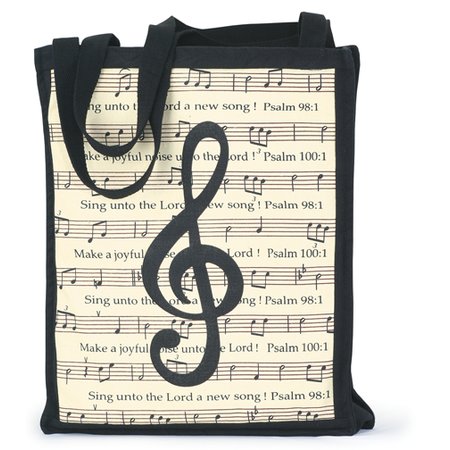
tote bag with details resembling the music notes on mug
tote bag with details resembling the music notes on mug

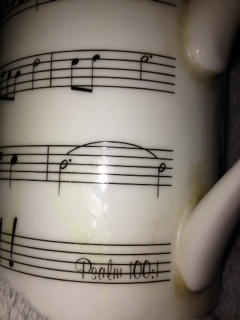
Psalm number
Psalm number

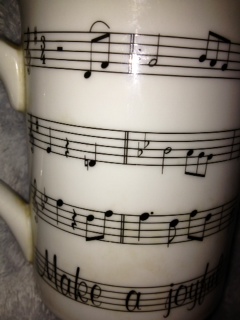
close up of the notes

close up of the notes

As I reflect on my mug for a second time I will be paying more attention to the musical significance behind it; particularly, the psalm imprinted on the object and why out of all the Bible verses, this psalm was placed on this mug. Psalms serve tremendously within a Catholic mass; they are typically done as solos by a cantor (one who leads the music of the mass) and are done between the first and the second readings which occur early on in the mass. They consist of one refrain and several verses. They are sung very reverently and holy and make the mass all the more spiritually serene and lovely. The psalm written on my mug resembles a verse of the psalm with the refrain: Sing to the Lord a New Song for He has Done Marvelous Deeds (Psalm 98:1). As I researched where my mother bought the mug I came to realize that another object she bought for me (a psalm tote bag) has the same musical notes imprinted on it with the same psalm verse (along with the refrain that I just quoted from chapter 98). I cannot take a picture of the tote bag as it’s at home with my family but I will attach the picture of it from the website so you can get an idea of what it looks like. As I researched the origin of the psalm’s other verses I found the full piece as written according to the King James Bible Version:

 Psalm 100:1-5

100 Make a joyful noise unto the Lord, all ye lands.

Serve the Lord with gladness: come before his presence with singing.

Know ye that the Lord he is God: it is he that hath made us, and not we ourselves; we are his people, and the sheep of his pasture.

Enter into his gates with thanksgiving, and into his courts with praise: be thankful unto him, and bless his name.

For the Lord is good; his mercy is everlasting; and his truth endureth to all generations.


These are the words of the entire psalm and now I moved to look at the musical notes on the mug. The music notes have a large range and its G-clef detail represents that is written for a female singer. However I could not mange to find a familiar tune to match up the notes with and so I searched the website in which the item was purchased (christianbook.com). Unfortunately, I could find no trace of the mug so I searched for the tote bag because it also has a musical staff on it and perhaps the description would have some information on the notes. Unfortunately the product description was not very informative and simply states that the bag’s detail has a G clef “against a musical score background”. Therefore I do not believe the music on the mug represents a particular song but rather music in general. This makes sense because psalms are written and sung in multiple ways in Catholic masses; traditionally they are sung slowly with organ accompaniment but others are sung with guitar or different types of musical accompaniment at a faster pace. Therefore, the significance of the musical background is simply to stress that one should sing praise to God through music. After reflecting on the words of the psalm one can sense the urge for people to be joyful because God is our creator and everything about Him is good. On a personal level this psalm is comforting to me because it pushes me to be happy even in my greatest struggle because I can be assured the Lord will not betray me – his mercy is everlasting. I believe my mother chose this object with these words for several reasons. First, and perhaps the most obvious reason is because I am a singer and it serves as a reminder to never stop praising or in my case, never stop singing. I have been singing for over ten years and music has made me particularly involved with my faith and so my mother uses this verse as a message to never lose this involvement and never stem away from your faith. I believe my mother also chose this object to serve as a representation for those memories of rehearsals, church concerts and first solos that I underwent throughout my time of church singing in my home parish. She wants me to have a reminder of all the happiness I have endured through my music ministry and to never forget that God gave me that talent. Psalms are the most holy part of the mass and they are the time in which the cantor truly can give thanks in her own personal way. When a psalm is sung it should be sung for God since it typically is coming from one voice, the relationship between God and the singer becomes that much more intimate. These words and the music on the mug represent a form of praise and thanksgiving and serve the psalm justice in a beautiful way.


Unexpected Irrelevancies

Image

While searching for an object to date and chronicle the history of, I found this crumpled up play program of Lear’s Daughters. The front of the program lists the play’s title, director, dates, and a picture drawn by a New Paltz art student to fit the play. Many people who saw this program thought that the girl in the center of this picture was supposed to represent me. I did not know nor never met Jes Mackenzie, and I’m guessing she had never seen me either. The resemblance is just one funny coincidence that falls along the timeline of the assemblage of this object. There are a few other peculiarities that can be found through further describing the object.

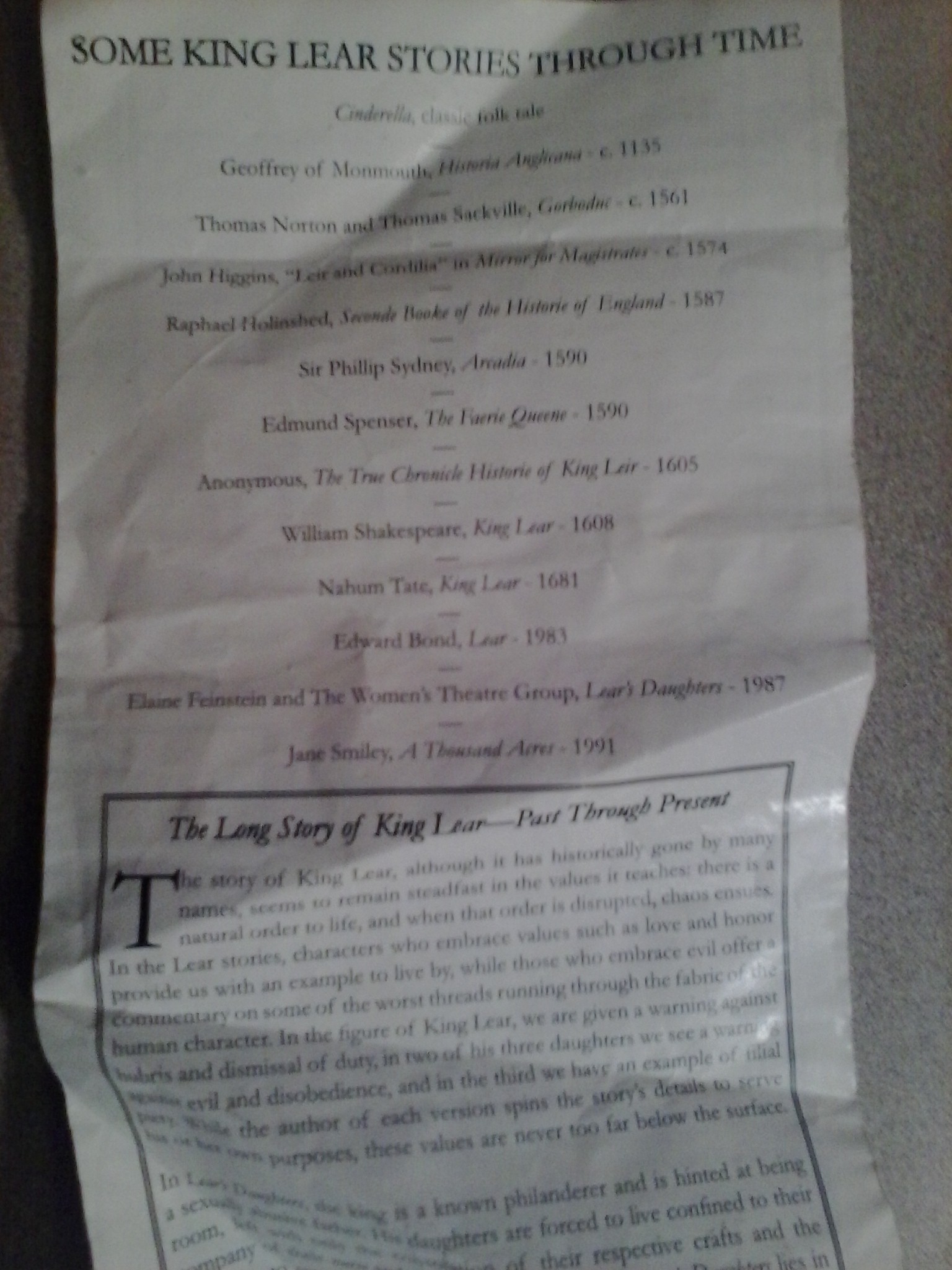
It is fascinating that in describing this found object, I am also able to learn about its history:  its production, as well as the names of the people who helped produce it. The same cannot be said for many objects in this world, and I find this object not only fiercely existing as a memory in my life, but also a detailed chronicle of the amount of minds and efforts it took to bring the play, and even this program, into inception. Upon opening the program, one can see not only the cast and production crew, but also a list of six dramaturges that each contributed to this very detailed program. Lear’s Daughters was a collaborative production between New Paltz’s theatre and English departments. Needless to say, then, in-depth analyzation of the play was applied throughout its production, and is even inserted within the program itself. Upon opening the program all the way, one beholds seven mini-essays with a meticulous analysis of each character. These essays were provided by the hard work of the dramaturgy. Back to the front of the program, one can see the dates of the play on the 9th and 10th of April 2010. If anyone else had found this program, however, they would not have known it was printed two years ago; there is no year listed in the play’s production dates at the front of the program. I am so confident in my dating of this object because I was part of its production. I played the role of Cordelia in the play.

Image

I find it very interesting how the year-to-date of the program was irrelevant in this pamphlet’s production, as if the year would not matter to audiences. Admittedly, it is a little redundant during a then-current event. Yet I find it interesting how so much hard work went into this object, and yet no one thought to date it. It is as if it was constructed and thought to function only on the dates of the play, frozen in that moment and then soon tossed away at the end of the entertainment. Even more stunningly, on the back of the program is a list of King Lear stories throughout time, with exact dates, and yet the Lear’s Daughters production dates at the front of the program are left incomplete.

Image

I remember taking very many of these programs, so that I may remember being in my first play. Since then, ironically, I have completely forgotten about the folios and have no idea where they lie, except for this one crumpled escapee. I found it on the bottom of one of my suitcases. I guess at one point I felt it was essential to bring to a destination to which I also no longer remember traveling.

My Mother’s Shirt

Image

My mother’s shirt is made of a flow-y, cheetah print. The tag reads “100% Rayon”. There are five brown plastic buttons down the middle of the shirt. The collar is one of my favorite parts: it is long and pointed with black trim. Inside the shirt there are two semicircular shoulder pads, also in the cheetah print, and lightly stuffed with fabric.

My mother told me that she bought this shirt when she first heard she was pregnant with me. She is a high school teacher and thought it was appropriate to hide her “baby bump” for as long as possible. So in a way, I suppose I have worn this shirt before, but as a fetus, so I’m not sure that counts.

Every time I’m home for a break, my mother will have a pile of old clothes waiting for me to try on and possibly add to my own wardrobe. Sometimes I’ll take the garments to school with me, other times I leave them at my parents’ house and revisit the clothing later. The latter is the story of this particular shirt. This winter break, having worn other hand-me-down shirts to death, my favorite being the painted denim ones, I decided to give a second-string shirt a try. This one was in the back of my closet but the unique collar drew me in. It wasn’t until I tried it on did I realize how enormous the shoulder pads were!

Interested in the history of fashion and even more intrigued by the concept of shoulder pads, I started looking into its conception into the fashion world. When they first were introduced in the 1930s, shoulder pads were often triangular and stuffed with cotton or even sawdust. The style did not really take off until post World War II when women, coming off of doing men’s jobs during the war, adopted a more militarized fashion. However, the shoulder pad craze is most commonly associated with the 80s and even into the early 90s (this shirt being circa 1990 exactly.)

Now I think it is socially acceptable to wear these dated clothes (and maybe that is just my opinion.) I am grateful for this semi-recently-discovered source of clothing (my mother) and I enjoy finding ways to integrate her clothes into my wardrobe. I’d like to think I bring new life into the garments by the way I style them. People will sometimes ask me where I get these interesting pieces from and it makes me proud to say “I got it from my mama.”

Long, Carola, and Harriet Walker. “Shoulder pads: A history.” The Independent, 14 Oct. 2009. Web. 7 Feb 2013.

Victory Medal


get-attachment    get-attachment (1)

The item I decided to write about today is this medal/pendant I have that I wear often on a black string.  The reason I picked this object to detail is because I had absolutely no idea what it’s history is, perhaps I enjoyed the mystery of it, but perhaps it is also time to delve into it!

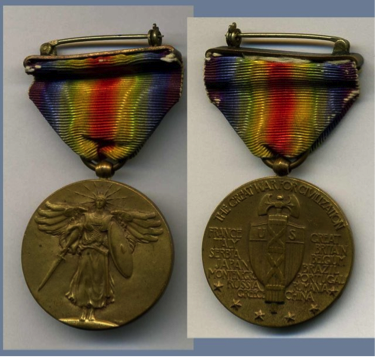
This medal is around the size of a half dollar coin.  It is a light bronze color and has a semi-heavy weight.  One side of the medal has the image of an angel on it.  The angel’s head resembles that of the Statue of Liberty.  It’s wings are spread apart and it is clad in armor.  In one hand it holds a sword pointing downward and it’s other arm is hidden behind the big shield it bares.  It stands face-forward on a small platform.  The other side has a logo that appears to be a code of arms with “U.S” inscribed on it.  The top of the coin states “The Great War For Civilization”, with the 13 countries France, Italy, Serbia, Japan, Montenegro, Russia, Greece, Great Britain, Belgium, Brazil, Portugal, Rumania, and China inscribed on the sides.  There are 6 stars on the bottom and a loop for attachments on the top.

I picked this coin up late 2nd semester of last year at the antique shop in town on Main Street.  I went into the shop with my friends one day because we were looking for objects to use in a rather odd art project we needed to do for Design Form.  I saw it through glass casing sitting under a shelf and was immediately intrigued by it, but I didn’t buy it or inquire further.

I found myself continually thinking of it shortly after, and decided to go back to buy it.  I went into town alone this time and inquired to the shopkeeper about the item.  I lied and said it was a present for someone so I could ask more questions about it.  Perhaps I thought it was silly to go into an antique shop alone and buy something so random for myself.  The friendly, albeit strange, lady handed it to me but did not know much about it.  We concluded that it must have something to do with World War I and left it at that.  I thought it was curious how the coin has an angel on one side, a symbol of peace and protection, and an inscription about war on the other.  I bought it for around twenty dollars and attached it to a black string.

I didn’t know why the coin was so compelling to me, or why I became so attached to it.  I hadn’t the slightest clue.  One of the more absurd thoughts that when through my head when I was trying to decide why this medal meant so much to me was that maybe this coin belonged to me in a past life (preposterous! I don’t even believe in reincarnation!)  I thought of the religious symbolism of the angel and that perhaps it speaks to my faith.  I am Jewish and believe in basic Judaic traditions and morals, however my personal beliefs are much more complicated than that and are grounded more in philosophy than religion.  It was while I was pondering about this that I came to the (semi-existentialist) realization that this medal is meaningful to me because I decided it is. I imbued it with meaning.  It represents the sometimes irrational or subconscious inclinations we have to find meaning or faith or mystery in life.  It has meaning to me because I decided thus, and that doesn’t make it any less meaningful.  Along with the representation of the side of me that is open to faith or meaning without reason, the coin came to symbolize my own inner strength.  I brought it with me to Europe and wore it on all of our travel days (there were a lot of them! Plains, underwater trains, boats).

Untitled


Sometimes I feel silly about giving this medal so much meaning in my life when it has no “real” significance for me.  It was not handed down to me from my ancestors nor a part of my history.  Yet I continue to hold it in my possession nonetheless.

I was reading this assignment and my eyes began to search for something in my room interesting to write about.  They immediately fell on this coin hanging with all of my other necklaces on my dorm wall.   I began to search for the coin online and found many like it, some clad with ribbons.

Untitled1

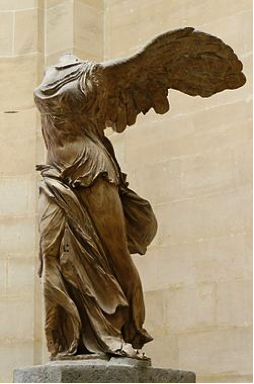
I discovered that this medal is a WWI Victory Medal.  The sculptor of the medal is James Earle Fraser (1876-1953), and it is said to be his most important medallic commission.  The design is based on the Winged Victory of Samothrace.

Untitledw

I have studied this statue before and have seen it in person and definitely see the resemblance to it, and the medals ancient Greek influences.  The goddess in the medal is pointing the sword downward as a sign of peace, the cessation of hostilities brought about by the Peace of Versailles.  The 13 nations on the sides of the coin are the allied nations, and what I thought was a code of arms is a double-headed battle ax surmounting a U.S shield with a bundle of sticks tied together with a ribbon, representing the unity of the Allied military.  The nob at the top allowed for attachment of a double-rainbow ribbon, representing renewed beginning.

The 36 millimeter bronze medal is composed of 90% copper and 10% tin. In addition to the U.S. Mint, A miniature version was also issued for wear on formal military attire.  Upon the end of the Great War, the victorious Allies decided to honor each other by making this medal a joint award.  Each nation created a similar medal with compatible designs.

It was commened on Feb. 3, 1920, at the U.S. Mint. The first medal was forwarded to President Woodrow Wilson by the Secretary of War on Feb. 11. General distribution to soldiers began on June 21.  It was the most widely circulated medal of its time.  The award was available to all officers and enlisted personnel for honorable service in the Armed Forces between April 6, 1917 (the declaration of war against Germany) and Nov. 11, 1918 (date of the Armistice).

It was fascinating to learn about the history of my coin, and I don’t feel that the mystery of it is taken away, as I still am not sure how it arrived at the antique shop or why I decided to buy it.  However, one aspect of it that possibly charmed me is its Greco-Roman influence.  I had not known that at the time, but I love studying art history and learning about ancient mythology and perhaps felt its cross-cultural/historical design when I noticed it. I still wonder how it acquired all of its scratches and nicks.

This class is making me realize how rich so many objects are with history, and how layered these histories are.  Just like geology and the earth, each time period an object endures is captured into the essence of the object, and we are adding to that very history by having them in our possession.


http://www.pcgs.com/News/Victory-Medal-Celebrates-Victory-Honors-Victors

Filofax 1999 Personal Planner

IMG_2416 IMG_2418 IMG_2419 IMG_2420 IMG_2422 IMG_2423


The object I decided to post today is a Filofax 1999 Personal Planner.

The planner measures a little less than 7 ½ inches in height (~19cm), about 5 inches wide (~13cm), and 1inch thick (~2.5cm). The color of the planner is a dark navy color, and it is made out of leather, giving it a smooth but textured feel. The inside of the front cover has eight slots for cards, credit cards, IDs, etc., and beneath the slots, there is a long pouch that can be used to store paper money. The inside of the front cover has the words “FILOFAX PERSONAL PICCADILLY REAL LEATHER” engraved in it. In the back cover of the planner, there is another pouch with a zipper attachment that can be used to store coins. The planner contains two rulers (one clear and the other black) and six sections/ dividers. These sections include: diary, notes, projects, information, financial, and an address section. The paper for every section except the ‘project’ section is labeled “Personal Filofax c 1999” (however, each section has a different reference number labeled to it). The ‘project’ section is labeled “BAROG BE- 1102.” The planner also contains a map of all the countries and capital cities and a map of the standard time zones for each country. Finally, the planner has a plastic pouch that hold six cards. The first few pages of the planner as well as the map attached to the back looks aged and a bit worn, but none of the paper inside shows wear

Before this post, I had no idea where this planner came from, when it was made, where it was made, and what the name of the brand even was. I came across it one day when I was bored and I was searching through a drawer of old items that my mom had kept throughout the years. The drawer contained old ID cards, credit cards, some jewelry, a nice handkerchief, and among other items, it contained this planner. Never used, never written in, the only signs of age came from some dust accumulated in the covers of the planner, as well as the worn look of the first page.

I love notebooks, planners, sketchbooks, paper, journals, diaries, and anything else that offers a clean slate for ideas, thoughts, doodles, and drawings. At home I have 26 journals/ diaries/ notebooks in all shapes and forms. The first one dates back to 1996 and the journals follow me through till present. I finish anywhere from one to three journals per year. The penmanship in that first journal is horrible and the content is actually really funny. I think I write that my brother is being a “pane in the but”?  I keep all my journals in a special shelf made out of cardboard that has doodles all over it, deep in my closet at home.

Paper just draws me in, and there is something about fresh notebooks or journals that just make me want to grab a pen and fill it with words or pictures. So when I saw that this really nice leather sophisticated planner was unused, I asked my mom why it wasn’t touched. She told me she just never had any need for it and that I could keep it if I wanted to. Over break my mom saw how well I was using it and told me she was glad; she hadn’t wanted to see it go to waste.

In order to find more information about the product, I tried a Google search on the brand name. There were a lot of similar planners on the website, but there were none from 1999, which is when this one seems to have been made.  The brand name of the planner is called FILOFAX and they make organizers, planners, diary refills, paper/ essentials, pens, bags/ briefcases, leather accessories, folders/ folios, and more. The merchandise is available worldwide from the United Kingdom, to Taiwan, to the United Arab Emirates. It seems the website was created in the year 2001 and the registered office is the Royal London House in England. The products seem to be made in Britain, Scotland, and Asia. The products are mostly made of leather and the price range for these products includes $29.99 to $2,300+ (the most expensive planner is made out of alligator skin).

According to the English Dictionary (http://www.collinsdictionary.com/dictionary/english/filofax), the term Filofax means “a type of loose-leaf ring binder with sets of different-coloured paper, used as a portable personal filing system, including appointments, addresses, etc.”

I actually finally did find the same exact planner that I have. I found it on ebay and I found pictures of the same planner on flickr. The title for the ebay website is “Filofax Personal Organiser: Piccadilly, black leather.” The pictures on ebay match my planner exactly and the price in US dollars is about $103.13. And here I thought the planner was worth only twenty bucks.

I love my planner very much. It contains all my different cards, IDs, and it is full of written schedules, lists, post-its, and drawings. I just know that if I ever lose it… 😦

Victorian Needle Case – Part 2: its Provenance

The first assignment has led me on a fascinating quest for information in two directions: my own family history, as well as the history of needlework and its significance. This post will focus on the people involved with my Victorian needle case. Prof. Mulready raised an interesting possibility that perhaps the needle case was made as a gift for Ruth Broadwell, rather than made by her; in modern times, it’s common to have a gift engraved with the recipient’s name. However, in my experience collecting antique needlework items, the most common inscription is the maker’s name and a date, frequently found on a quilt or embroidered sampler. In “1898” Ruth would have been 78 years old, and “Vern’s oldest daughter” (my grandmother Nellie) was about nine years old. According to rootsweb.com, Ruth died in 1910, and so wrote the bequeathal note when Nellie was between the ages of 9 and 21. My grandmother was proficient in sewing, knitting, crochet, embroidery and tatting. It makes sense that her great-aunt would leave her this precious item. I just wish I knew where it was that Ruth was going — a trip? a hospital stay? “If I don’t come back…” That may remain a mystery forever.

Amanda1

The photo above includes my great-great-grandmother Amanda Lee Howe, seated on the right, with her sister Ruth Lee Broadwell seated on the left and her brother Spencer Lee, standing with his wife Mary. The photograph was taken in Iowa where Spencer lived. It was common to have photographs taken during rare family visits. Amanda lived in Potter County, PA — remember, no automobiles! A long-distance visit was a special occasion. I found a note from my third cousin Karen, with whom I corresponded via email during our joint family history search in 2003. She speculates that the visit may have taken place after the death of my great-great-grandfather Simeon Powers Buck Howe in 1873, which is backed-up by other photographs I have of Amanda. If so, this photo precedes the making of the needle case by Ruth, but is the only picture I have of her.

Howe Kids Nellie age 4

howes

Having deduced that Nellie received the needle case between age 9 and 21, I include two photos of her, above. The first was taken in late 1893, when she was around age 4. Nellie is in the center, with older brother Clinton and younger sisters Louise and Mabel. My assumption as to Nellie’s age is based on the apparent age of her baby sister Mabel who was born in May 1893, and the absense of younger siblings not yet born. The second photo shows the whole family: Lavern Buck Howe (son of Amanda Lee), his second wife Mary Daniels Howe (sister of his first wife, my own great-grandmother Ella Estelle Daniels Howe who died from complications of childbirth) and five children. Nellie is standing in the center; her older brother Clinton is missing, having been married in 1904. Based on the apparent age of little brother Lavern (b. 1900), Nellie would be about 18 years old in this photo. Did she have the needle case yet?

Howe Farm

Finally, this is a photograph of the Howe family farm. According to a published history of Potter County, PA, in 1832 Isaac Howe relocated his family from Lansing, Tompkins County, NY, to Bingham Township where the farm is located. Isaac’s son Simeon, would have been age 14. Family tradition holds that the farm in the photo was built by Simeon, and would have been occupied by him and wife Amanda Lee. (I hope to verify this someday by doing a deed search.) After Simeon’s death in 1873, Amanda married a neighbor Ebenezer Ryan. The farm was passed to her son Lavern Buck Howe, and later to his son Lavern Burdette Howe, the little boy in the family photo. It was in this farm house that the embroidered needle case resided after it came to Nellie.

My mother inherited a box of old family photos from her mother Nellie, including those posted here, and the velvet needle case. It now belongs to me, but next? I have two daughters and one granddaughter so far…

5 Centimes

Image

5 Centimes

Helly everyone! So for whatever reason, when I try to upload this photo to a text blog, it won’t work, therefore I have to write it as a photo caption. Hopefully this won’t cause any problems.

My object for today’s class is a French 5 centimes coin that I wear as a necklace. The coin is approximately a quarter of an inch wide and high, and looks silver. It smells metallic, a smell which instantly gives your mouth a funny and unpleasant taste. Despite its age, the coin is still very detailed, suggesting it didn’t have much circulation.

The front of the coin has the letters RF surrounded by what seems to be some sort of bough. The R and the F are combined with a flourish on their serifs and stand for la République Française. Above the RF is a war helmet, which I happen to know is of the French style thanks to my class in French civilization. Around the outer edge of the front side of this coin, there is a small detail that looks like a chain made of arrows, like this: <<<<. In the center of the coin, there is a hole.

The back side of the coin features more detail than the front. The same chain details runs around the outer rim and there seems to be another plant which surrounds the central hole. The top of the coin reads “Liberté, Egalité, Fraternité,” Liberty, Equality, Fraternity, the French national motto that was formed after the Revolution. On the left side of the hole, one finds the number 5; on the right, the abbreviation “Cmes.” This informs us that this coin is worth 5 centimes, or 5 cents. On the very bottom of the coin, we find its date of mint, 1918.

I bought this coin perhaps 2 years ago at a street vendor in New York City. She made a variety of necklaces with old coins and I was drawn to this particular coin for many reasons, most notably that it is French and I am a francophile, that I was leaving for France within the year, and that the script and decoration on this coin is beautiful.

Long before I found it on the streets of New York, however, this coin was traveling the world. According to my research, this coin must have been minted between 1917 and 1920 after World War One, and because materials were running low after the war, this coin is made of copper and nickel. The hole in the center served to set it apart from other coins of the same size but of greater value. Approximately 33 million of these coins were minted and therefore they are not of great value. One tidbit of information that I found very interesting is that during World War 2, when the Germans occupied France, all francs were printed without the letters for the République Française, RF, because the Germans thought it would be too nationalistic and cause rebellion against their soldiers.

While I have no idea who carried this coin, I like to imagine its life: who owned it? What did they purchase with it? How long did it spend in each owner’s pocket before being passed on to another? Did anyone stop to look at the beauty of its creation when it was just another 5 centimes?

Unfortunately, I will never know this information and this coin stopped being useful in 1999 when France adopted the Euro. It still makes me happy, however, knowing that something I wear around my neck has such a rich, secret history tied so closely to a country I love.

The Visual Makeup, Illustrations and All, of Harry Potter

Early February 04When deciding whether to continue exploring my previously mentioned item, a tattered copy of Harry Potter and the Sorcerer’s Stone, the object’s lack of inheritance or personal cultural significance stopped my initial drive short. After one post about a very well-known, non-antique item, I could no longer see what should be described. I focused in on how my copy reflected my memories with the prized item, rather than vivid details of the book itself. Even though I provided pictures of the novel, you could not inherently know that cracked embossed metallic silver-gold lettering for the author, series title, a “THE EXTRAORDINARY NEW YORK TIMES BESTSELLER,” and the writing on the spine still stood out from the smooth, semi-sheen outer book layer. You would not conceptualize the size of the novel: 7.5×6.5x.75 inches, which is small compared to the hardcover and later books in the series, but large for its time as a juvenile novel. You could not visualize the semi-coarse pages glued to the spine, as opposed to a much sturdier woven fashion, marking the paperback as a massed-produced, short-lived item rather than an object worthy of artifact-status centuries from now; I will prove those bookmakers wrong. You could not identify the typeface, even by looking through the pages. Despite several online ask.com users stating the back cover of each Harry Potter novel identified its typeface, a 12-point Adobe Garamond, such could not be found in my edition. I love its fallacy. The other font, used across the novel for chapter numbers on the table of contents, the dedications, numerous “HARRY POTTER AND THE SORCERER’S STONE”’s before the story unfolds, chapter titles, the two-line drop-caps, page numbers, and headings, reveals the sheer magic of the novel, conjuring new font styles for visual delight. Mugglenet, a well-established fan-based Harry Potter website, provides a nearly-identical font called Lumos for all the obsessed Harry Potter fans. The same font exists on the cover page and spine’s metallic words, except “Harry Potter”: mimicking-font “Harry P” on Mugglenet almost matches the unique typeface except for more stubbly jagged lines for the electric-style stem of the “P.”

DSC02660I also did not describe the illustrations within the pages. At the beginning of each chapter, true to its identity as a children’s literature book, a black-and-white picture faintly hints at what is to come in the following pages. As if US illustrator Mary GrandPre set fine charcoal to the pages, the thick grayscale illustrations match her front-page style of skillful shading and blending, masking grand portions of the pictures in darkness. Unlike the much more realistic illustration on the front cover, the smaller chapter pictures feature thicker outlines, oftentimes identifying Harry by little more than their body outlines, a few clothing details, and hair, such as the illustration for Chapter Twelve, the Mirror of Erised.

Back cover of Harry Potter and the Sorcerer's Stone (1998)

Back cover of Harry Potter and the Sorcerer’s Stone (1998)

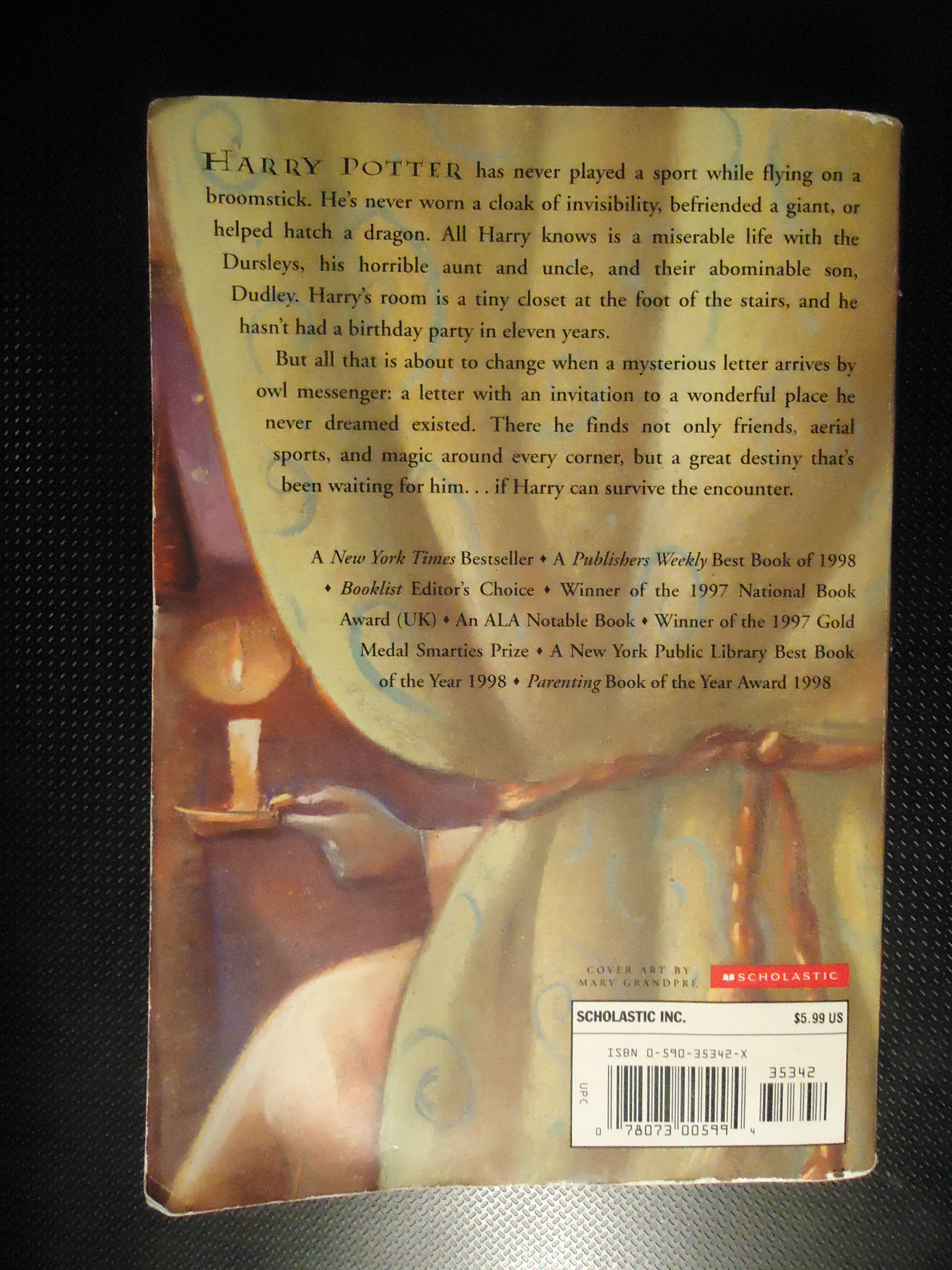
While my pictures provided a familiar view of the book to many in our age group, sometimes referred to by columnists and fans as the Harry Potter Generation, there are several distinctions between the American paperback versus hardcover illustration. Behind the embossed metallic font, the American front cover features a young black-haired boy in a yellow and red striped shirt, blue jeans, and a red cloak hanging from his neck, flying on a thin, wooden broom through two stone pillars, decorated by an intricate swirling design. His arm extends to catch a tiny gold ball with white wings, the gold hue and yellow blur of movement nearly blending into the brown stone. Behind the boy, a unicorn dashes from the middle out towards the woods on the left side of the cover; three beastly dog faces growl from the shadows of a castle on the right; small purple shadows of people on brooms stand against the pink-purple sky. While a golden “Harry Potter” stands out from the illustration, the rest of the title disguises itself in the middle archway. At the bottom, behind the embossed “J.K. Rowling,” a slightly opaque blue-and-red diamond strip covers the bottom pillar rungs and the thin grass landscape; the spine repeats the design. The front cover image prevails across most American copies, paperback or hardcover, although newer editions are significantly lighter, as if a graphic designer turned up the brightness and contrast in Photoshop. The back cover, differing from its hardcover counterpart, gives way to the light-hearted summary written upon the green drape (pictured to the right). Behind the drape, a dark hand decorated by peach cloth holds a similar-color candle on a brass candle-holder; the bright candlelight hardly illuminates the purple-brown blur behind. I do not believe anyone knows who this mysterious man might be, especially since this back cover only exists on paperback editions. As many more people turn to hardcover editions for material examination—perhaps because of promised longevity of the artifact—everyone recognizes Hedwig and Dumbledore on the back of the version’s book sleeve. Although the peach-clocked man behind the green drape exists on the front-inner flap of the hardcover sleeve, HP1_CoverGoogle Images reveals the figure’s arched bare foot, as if tiptoeing to his next destination. The figure, although still mysterious, could be linked up to the actions within the book, as several characters snoop around the castle at night to find the Sorcerer’s Stone.

Front cover of UK Bloomsbury publication of Harry Potter and the Philosopher's Stone (1997)

Front cover of UK Bloomsbury publication of Harry Potter and the Philosopher’s Stone (1997)

In contrast, the UK Bloomsbury edition of the first Harry Potter book features a much more simplistic illustrative and type style. The front page, with title, illustration, and front-page praise divided by thin green lines, distinctly separate images from words. “HARRY POTTER,” written in a gold Times New Roman, and “and the Philosopher’s Stone,” written in a small, white italic script, sit upon a solid crimson background. Underneath, an orange oval encapsulates a “J.K. Rowling” in a black Times New Roman-esque font style. The illustration of Harry Potter in front of the Hogwarts Express on Platform 9 and 3/4, evokes a distinct cartoon style with thick lines, bright colors, and unrealistic indications of time, place and environment. The Hogwarts Express, written in gold against a large green plate
Original back cover of Harry Potter and the Philosopher's Stone (1997)

Original back cover of Harry Potter and the Philosopher’s Stone (1997)

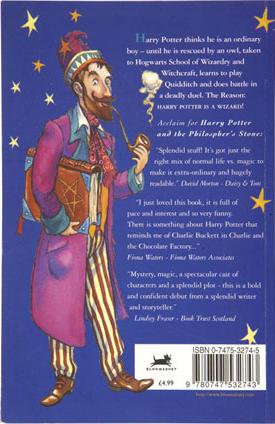
on the front of the red train, overtly proclaims its presence; the “9 3/4” sign towards the top looks like a piece of parchment floating in the sky; and stars within the smoke evoke magic rather than a realistic portrayal of stars with bright colors and skewed angles. The first back cover featured a wizard named Wizzy, created by illustrator Thomas Taylor and completely unrelated to the book content, donning a very odd wardrobe of purple and brown, carrying a large brown book, and smoking a pipe. The book description is just as silly: “Harry Potter thinks he’s an ordinary boy — until he is rescued by an owl, taken to Hogwarts School of Witchcraft and Wizardry, learns to play Quidditch, and does battle in a deadly duel. The Reason: HARRY POTTER IS A WIZARD.” After a few editions, Wizzy is replaced by Albus Dumbledore holding a Puter-Outer, and the summary receives slight renovation, though nothing compared to the eloquent, enticing summary on the US editions. Of course, by the time the novel reached the US, Americans were already ecstatic about the story, buying UK editions. The US cover reflects achieved fame, while the UK cover expresses a small hope in a long, complex children’s story nearly unprecedented across the globe.
Back cover of UK edition of  Harry Potter and the Philosopher's Stone

Revised back cover of UK edition of Harry Potter and the Philosopher’s Stone (1997)

Many differences between the UK and US editions amassed plenty of critical examination and pages of online content. As the most apparent change between the versions, Scholastic altered the title from “Philosopher’s to “Sorcerer’s” when buying US copy rights because the publishing company believed no child would read about a “philosopher.” America is also not as familiar with the legend of the “philosopher’s stone,” a legendary alchemist substance capable of turning base metals to gold or silver and as an elixir of life (just as described in the novel). Otherwise, one of many sources for each word change between the books can be found here at the Harry Potter Lexicon, another fan-made website for Harry Potter needs.

Fraying Red Threads

Jessi Putnam

100_4455

“Fraying Red Threads”

Once I had a Winnie the Pooh Bear sweatshirt. It belonged to my Gramma. She gave it to me one summer as I was about to leave for my first overnight at camp. It was a navy blue crew neck with a rectangular picture on Pooh on the front. The picture was enormous, and on my small scrawny body it seemed to consume my entire chest. Pooh Bear was that particularly annoying type of photo appliqué that feels kind of rubbery, you know, the kind thats just a bit sticky all the time and you cant leave it in the dryer too long or it will melt. It was the kind of sweatshirt people would make fun of you for wearing at that age. It was the kind of sweatshirt that most kids would stuff in their overnight bag, leave it there, and then lie the next day and say that they wore it. But that night as I lay in my sleeping bag scared and homesick with sleep a distant possibility, that sweatshirt got me through. The cabin smelled terrible and I couldn’t seem to block out the noise or the lights or my fears. So I covered my face with Winnie the Pooh and buried myself deep into its folds. The sweatshirt smelled like lavender and mountain breeze laundry detergent…the sweatshirt smelled like my Gramma.

I kept Winnie for a while after that, but eventually a big hole grew at the elbow, and I grew too big as well. I went without a Gramma scented protection shield for some time. But my senior year of high school, the imminent threat of leaving for college was upon me, and I wanted a new Winnie for my older self. My Gramma took me to huge wooden chest in one of the spare bedrooms at her house. She opened the lid and the smell came wafting out. The lavender and mountain breeze detergent that always reminds me of her but because of allergies I could never wash my own clothes in. I peered into the chest at all the possibilities and she told me to pick one.

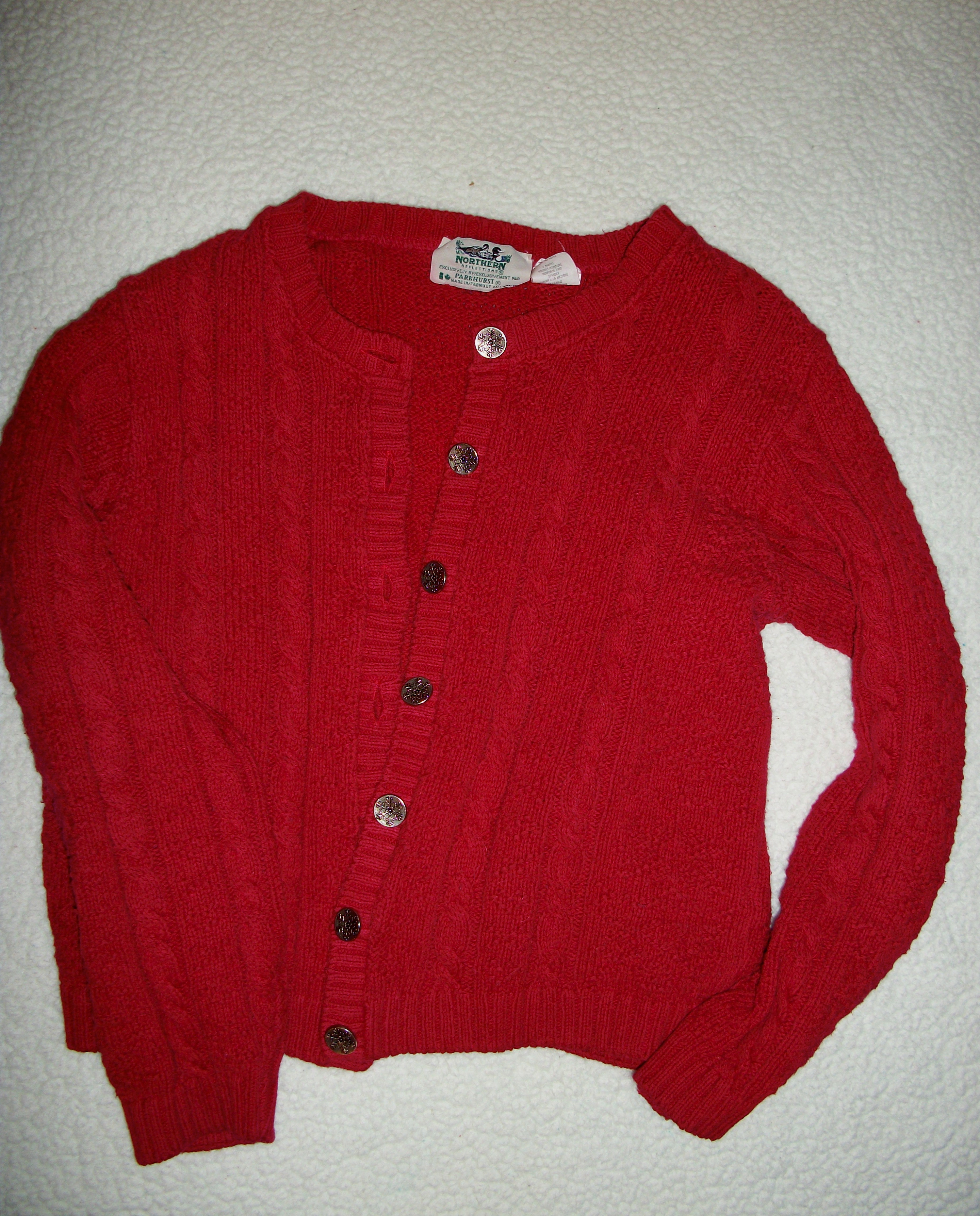
And there is was. I picked up the neatly folded bright red sweater and fell in love. It was a perfect fit, which is odd because I am over a foot taller then my Gramma. It was thick and baggy, falling loosely around my arms and torso. And it was soft with years of washing and wear and warm with more then fabric but also with memories. It has big metal buttons printed with snowflakes, and when you take the sweater out of the dryer you run the risk of searing your hand a bit on them. But the buttons are getting a little loose with age. They are holding on to their fraying red threads for dear life. I live in constant fear of the day I put on my sweater and a button has gone missing. But for some reason, despite the how long this sweater has been around, the extra button is still sewn to a seam along the bottom, so my fears are alleviated for the time being. According to the tag that is only hanging on by a few threads, the sweater is from a store called Northern Reflections. There are two loons embroidered on the top of the tag and the print is mostly in french. It reads “Farbique au Canada” with a small Canadian flag along side the text. Another tag lists out my sweaters washing instructions…”machine wash cool do not bleach tumble dry.” And below that is my sweaters contents…”70% cotton 25% acrylic 5% other fibre.

But none of that really matter to me, my sweater is made up of so much more. woven into its cable knits is my Gramma; the memories, love, and of course the smell. Sometimes I will just  hide my face in the sweater, absorbing its smell, its softness on my skin, and the nostalgia that rushes upon me every time I wear it. Like Pooh bear the first time I wore my red sweater did not go over very well with other kids. “Nice Gramma sweater” was the sarcastic remark of admittedly not one of my most favorite people in school. But it didn’t matter, I love that sweater. I love its sagging red fabric and fraying threads, its worn spots where years of elbows have leaned and its dangerously loose buttons. I love the smell of lavender and mountain breeze and I love wrapping it around me and feeling safe and at home. Now I fondly call it my “Gramma Sweater” and I plan on letting it keep me safe for a very long time.

Shark Tooth Necklace

Shark Shark

So, I decided to change it up this time and give my rosary beads a break. For this week’s blog I decided to showcase my shark tooth necklace. The necklace was given to me by a friend. She gave me the necklace on my 20th birthday before she transferred to another school in the middle of my second year at SUNY New Paltz. I consider it a symbol of our friendship. I wear it a lot now that she’s studying abroad in Italy. Maybe she’ll bring me back something else, who knows?

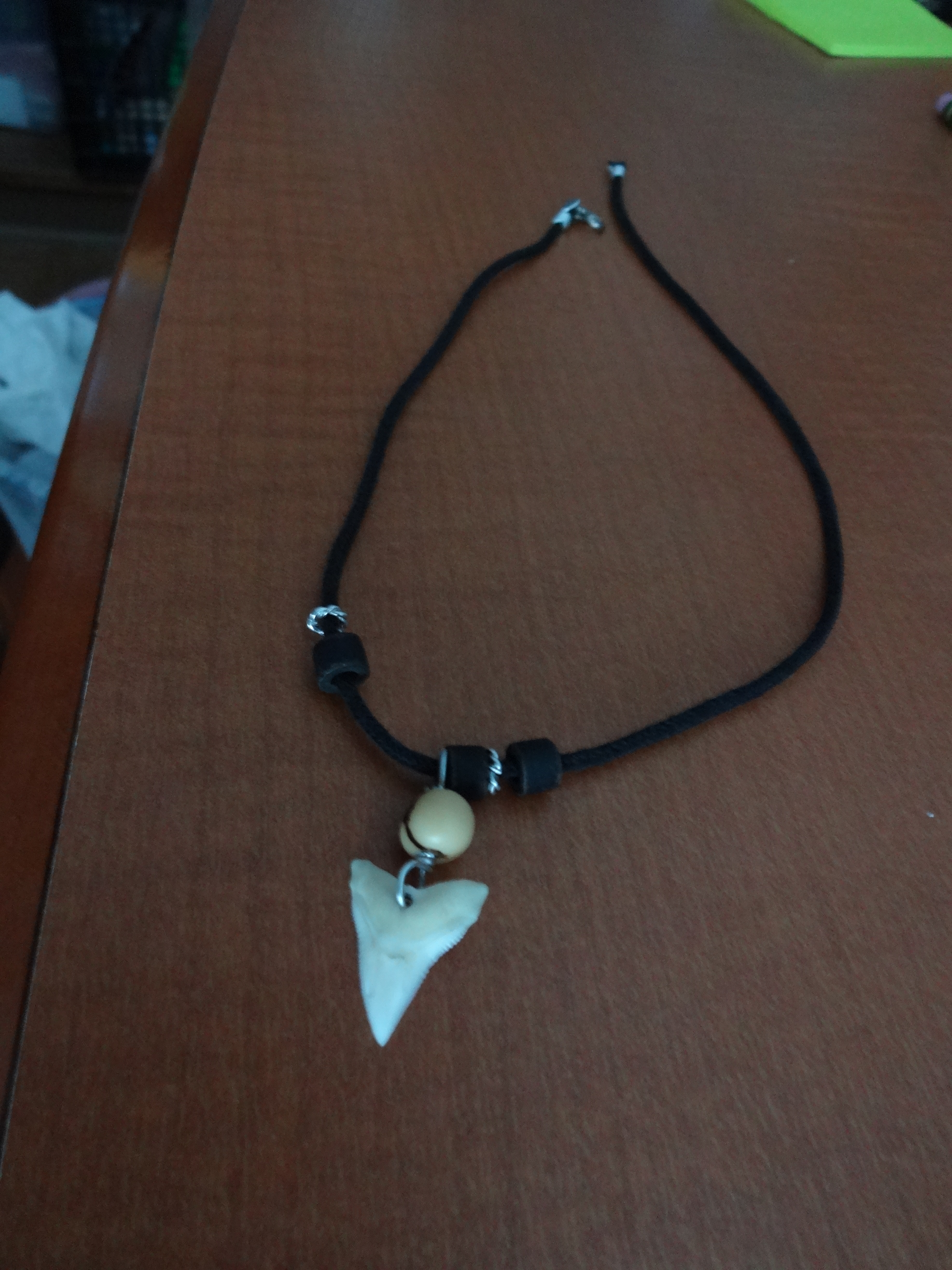
If you hold the shark tooth necklace at its sides you can feel the metal pieces which connect to each other. The metal pieces spiral into a thick black material, which almost feels like the strings of sweatshirts and hoodies. The string is rough as denim material. The necklace is about 7 to 8 inches long, revealing pieces of metal and wood around the string. The wood is dark, almost black even. The wood and pieces of metal, wrapped around the string, are uneven in quantity. When you hold up the necklace, there are two pieces of wood and one piece of metal on one side of the shark tooth, but then there is one piece of wood and one piece of metal on the left side.

Finally at the end of the necklace a piece of metal material holds the shark tooth necklace. Between the shark tooth necklace and metal is a plastic ball which feels smooth at the touch as if you’re rubbing a marble. Below, the shark tooth necklace is about a half an inch long. The white shark tooth is sharp around the edges. If you place your finger against the end, you’ll feel the sharpness against your skin. I wouldn’t push too hard though, you might create a cut.

So, I thought I would share my image’s description before I delve into what I’ve learned about it so far. Although they’re considered a fashion choice today, the tool was used very differently in the past. Shark teeth were used as weapons, and tools for food preparation. These tools were originally used by Native Hawaiians, who called them leiomano. Native Hawaiians would pass down some types of shark teeth to royalty. As the 20th century came along, the use of shark teeth became less a tool of survival and more of a fashion accessory.

It turns out a shark tooth necklace was a symbol of “male strength, potency and a proud display of masculinity,” as described by a few websites. The fashion choice was unsuccessful in the 1970s where they were worn to make up for some masculine shortcomings. Given their masculine and strength meaning, these necklaces offer a natural charm of “man of the wild.” They’re known to lure women and create “irresistible attraction for women near and far.” I don’t necessarily agree, but I do happen to love the quality of my necklace.

Unfortunately, the necklace broke this week, but maybe I’ll find a new latch soon. Any suggestions?